- The paper introduces structure-preserving CBO algorithms tailored for computing the entanglement of formation in bipartite quantum states.
- It employs Hermitian and unitary manifold constraints, ensuring robustness and convergence in high-dimensional, nonconvex optimization problems.
- Extensive numerical experiments demonstrate that the multi-species CBO framework outperforms projection-based methods in accuracy and efficiency.
Consensus-Based Optimization for Quantum Entanglement Computation
Introduction
Quantum entanglement, as a foundational resource for quantum information science, presents significant computational challenges—especially in quantifying entanglement measures such as Entanglement of Formation (EoF) for general bipartite mixed states. The EoF optimization problem is high-dimensional, nonconvex, and involves nonlinear matrix manifold constraints. The paper "Computation of entanglement for quantum states by a Consensus-Based Optimization method" (2605.03773) introduces structure-preserving adaptations of the Consensus-Based Optimization (CBO) paradigm to these problems, offering new tailored algorithms that embed the required Hermitian and unitary manifold constraints to maintain computational fidelity.
The paper develops two principal structure-preserving CBO frameworks—one based on Hermitian matrix evolution and one directly on the unitary Stiefel manifold—and further proposes a novel multi-species CBO strategy to leverage information exchange across different manifold dimensions. Comprehensive numerical experiments on quantum state families (Horodecki, Werner, Isotropic) demonstrate the efficacy, robustness, and scalability of the proposed methods.
For a bipartite system ρAB of local dimensions NA, NB, the task is to minimize the average entropy over all pure-state decompositions, resulting in the EoF definition:
EoF(ρAB)=U†U=IrminEAB(U)
where U∈CM×r with r the rank of ρAB and M≥r, and EAB(U) involves successive nonlinear transformations including partial traces and von Neumann entropy calculations. The feasible set is thus a complex Stiefel manifold Vr(CM).
Consensus-Based Optimization: Adaptation and Manifold Extension
The original CBO approach employs a collection of stochastic particles moving in NA0, balancing deterministic attraction toward the consensus with noise-driven exploration. To address the EoF problem's manifold constraints, the paper devises three variants:
- Hermitian-Preserving CBO: CBO is implemented over the space of Hermitian matrices, with particles evolving as Hermitian operators under bespoke stochastic dynamics and consensus projection; unitary matrices are then derived via matrix exponentiation.
- Unitary-Preserving CBO: Particle dynamics proceed directly on the Stiefel manifold using an intrinsic Stratonovich SDE formulation and exponential integrator, ensuring orthogonality is preserved at every iteration.
- Multi-Species CBO: Allows simultaneous optimization across multiple matrix dimensions, with flexible inter-manifold communication enabled via dimension-embedding and truncation operations—enhancing information exchange and convergence efficacy.
Structure-Preserving CBO Algorithms
Hermitian-Preserving CBO
Here, each particle represents a Hermitian matrix NA1, and evolution proceeds by:
- Drift toward the consensus Hermitian matrix, computed via weighted averages incorporating the objective NA2.
- Anisotropic noise (Hadamard multiplication with Hermitian Brownian motion), guaranteeing Hermitian property is preserved.
- Consensus and stochastic steps are constructed so the evolved NA3 always generates a valid unitary matrix (via exponentiation), and thus a candidate NA4 on the Stiefel manifold.
Unitary-Preserving CBO
This approach directly evolves NA5:
- Updates are framed as Stratonovich SDEs maintaining orthonormality constraints intrinsically.
- Drift term aligns NA6 toward the current consensus (objective minimizer).
- Stochastic term employs skew-Hermitian increments, ensuring every iterative update remains on the manifold through the exponential map.
Multi-Species CBO for Cross-Dimensional Communication
Recognizing that optimal decompositions may involve different NA7, the multi-species approach executes several CBO instances in parallel, one for each relevant NA8, but computes the consensus at each dimension by incorporating particles from all sizes via embedding (zero-padding) or truncation (column norm thresholding). This design enhances diversity and global exploration, as empirically demonstrated by consistent consensus convergence across dimensions.
Numerical Results and Analysis
Low-Dimensional Benchmarks: Validation with Analytic Solutions
For NA9 Horodecki and Werner states, the computed EoF closely matches the analytical values. The dependence of accuracy on the number of CBO particles NB0 confirms convergence to the mean-field limit. Structure-preserving CBO methods consistently achieve lower mean errors than naive projection-based alternatives.
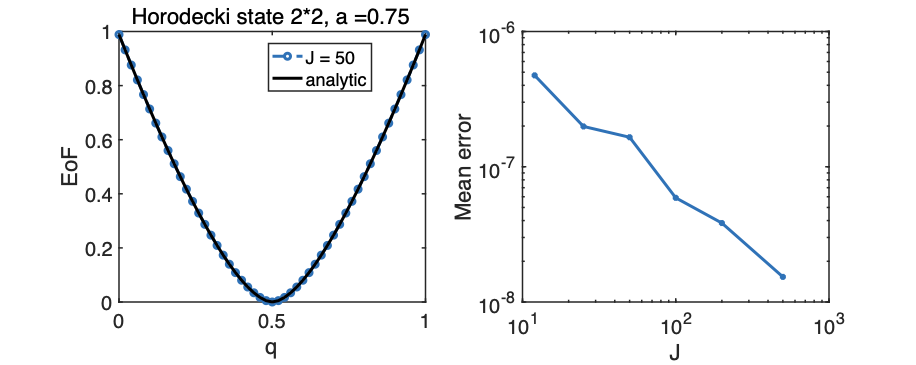
Figure 1: Left: Computed EoF for Horodecki states with NB1 compared to analytical solution; Right: Mean error decreases with more particles.
Plotting the evolution of consensus entanglement during iterations demonstrates rapid and stable convergence for all NB2, with the entanglement trajectory flattening as the consensus is established.
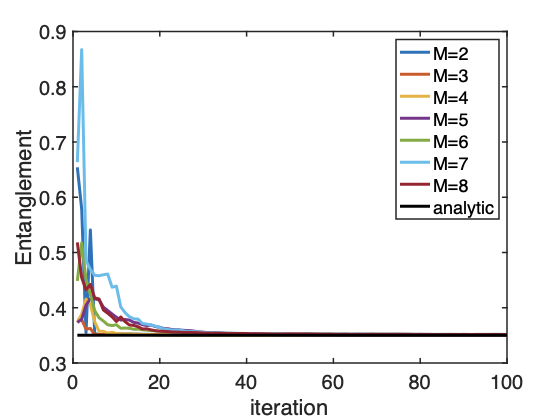
Figure 2: Example of entanglement evolution at consensus for various NB3 showing convergence over iterations (Horodecki state, NB4).
Structure-Preserving vs. Projection Methods
Comparative studies consistently indicate that both Hermitian- and unitary-preserving CBO methods outperform projection-based approaches in final error and stability, especially as problem dimensionality increases. Discontinuities and larger deviations manifest in projection approaches due to inconsistent manifold enforcement after unconstrained updates.
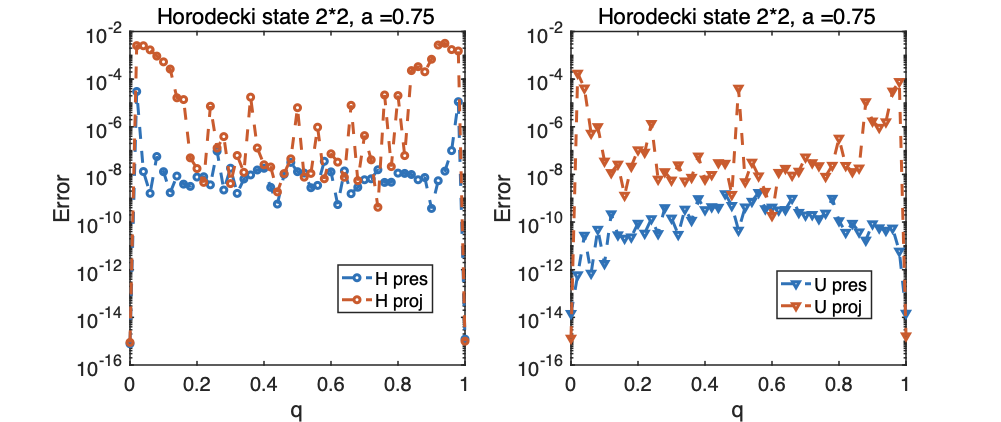
Figure 3: Structure-preserving CBO variants show reduced errors over projection methods for Horodecki states, both in Hermitian and Unitary settings.
High-Dimensional Cases: Robustness under Dimensional Scaling
For challenging cases such as isotropic NB5 states or NB6 Horodecki states (with no analytical solutions), structure-preserving algorithms remain effective and significantly more reliable than projections, even at high NB7. When compared against simulated annealing references, the CBO algorithms (especially with structure preservation) achieve competitive or superior results.
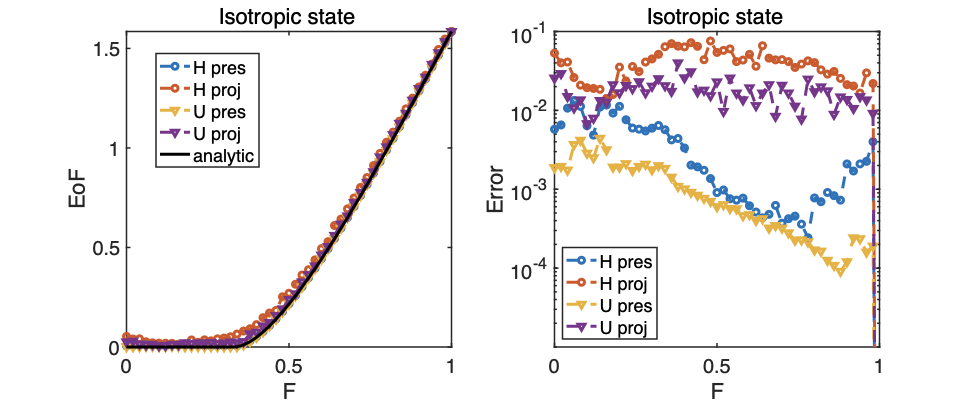
Figure 4: CBO methods provide accurate EoF computations for high-dimensional Isotropic states; errors for structure-preserving methods are consistently lower than projection-based ones.
Multi-Species CBO: Effectiveness of Cross-Dimensional Consensus
Allowing information exchange between CBO systems at different dimensions both accelerates consensus and reduces EoF error for all considered quantum states. This effect is especially pronounced for nontrivial instances such as Werner states at intermediate fidelity and isotropic states in larger Hilbert spaces.
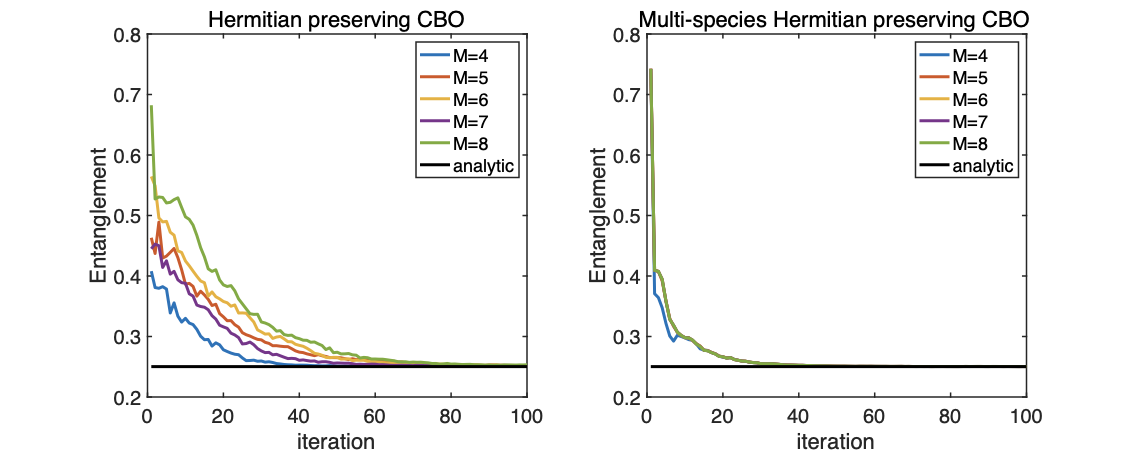
Figure 5: Entanglement trajectories in multi-species CBO for Werner states (NB8) show synchronized consensus across different NB9 values.
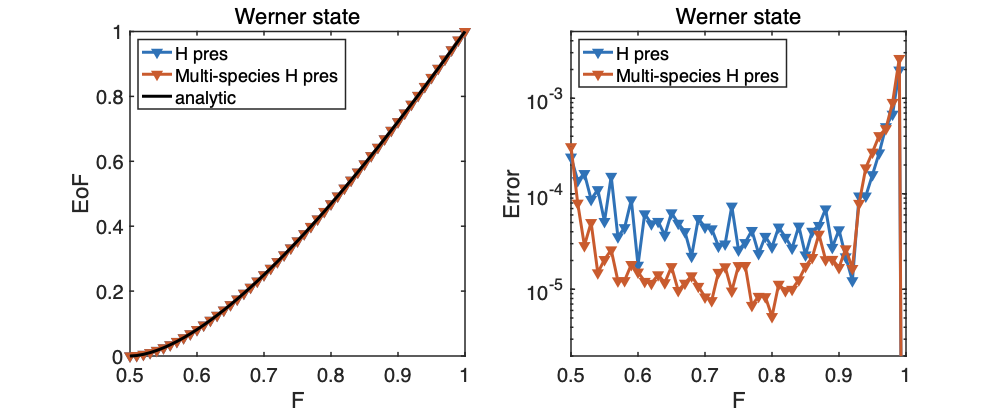
Figure 6: Multi-species CBO reduces the EoF error for Werner states, demonstrating effective synergy from inter-dimensional communication.
Discussion and Implications
The presented structure-preserving CBO algorithms significantly advance the computational toolkit for quantifying entanglement in mixed quantum states. By adapting the particle-based consensus paradigm to nonlinear, manifold-constrained, and dimension-flexible settings, the methodology enables robust, scalable, and parallelizable optimization for EoF and potentially other entanglement measures. Empirical evidence supports superior numerical stability, consistency, and solution accuracy over previous projection-based or unconstrained CBO approaches.
The multi-species extension, introducing cross-dimensional coupling, offers a promising route for ensemble-based exploration in high-dimensional, nonconvex, and contextually ambiguous optimization landscapes common to quantum state analysis. The clear empirical improvements suggest broader applicability to other quantum information optimization challenges.
On the theoretical side, these results bridge stochastic optimization, geometric numerical integration, and quantum information theory. The algorithms operate with parameter constraints insensitive to ambient dimension, facilitating their application to large Hilbert spaces—an aspect critical for current and future quantum technologies.
Conclusion
This paper constructs a structured and scalable approach for the computation of quantum entanglement measures, specifically the EoF, by leveraging and extending the CBO framework to respect Hermitian/unitary constraints and to incorporate multi-dimensional information exchange. The proposed methods deliver strong performance across a range of challenging quantum states, outperforming prior projection-based schemes in both accuracy and convergence stability. The developments open prospects for efficiently quantifying entanglement in increasingly complex quantum systems and support further methodological advances in stochastic manifold-based optimization for quantum information science.

