- The paper refines the rank threshold for LoRA fine-tuning by replacing symmetric counting with a non-symmetric condition, showing rank-one suffices under NTK for binary tasks.
- It demonstrates that for cross-entropy loss, the Polyak–Łojasiewicz inequality holds empirically, ensuring global convergence at any rank in binary classification.
- For multi-class settings, empirical results reveal that higher ranks help balance the bias–variance tradeoff, confirming the need for task-specific tuning.
Sharpened Rank Thresholds for LoRA Fine-Tuning in the NTK Regime
Background and Motivation
Low-Rank Adaptation (LoRA) is widely adopted for parameter-efficient fine-tuning of transformer models. The LoRA protocol enforces weight updates of the form ΔW=uv⊤, with matrices u∈Rm×r and v∈Rn×r, reducing the number of tunable parameters from mn to r(m+n). The prescribed choice of rank r has practical implications for both expressivity and computational efficiency. Existing theoretical analyses, notably in the neural tangent kernel (NTK) regime, set a conservative sufficient condition on r to guarantee spurious-free optimization: for output dimension K and N training samples, r(r+1)/2>KN is required under squared-error loss, translating to u∈Rm×r0 in canonical RoBERTa-base binary fine-tuning (u∈Rm×r1, u∈Rm×r2) [jang2024lora]. However, the necessity and optimality of this threshold, especially under the cross-entropy loss commonly used in practice, remained unresolved.
Theoretical Advances: Loss-Dependent Rank Thresholds
This paper provides a rigorous refinement of the rank threshold for LoRA fine-tuning in the NTK regime, challenging the conservative u∈Rm×r3 prescription and aligning theoretical guarantees with practical loss functions.
Non-Symmetric Sard Counting
The first theoretical contribution replaces the symmetric dimension count used previously with the correct non-symmetric dimension of the LoRA parameter manifold, yielding u∈Rm×r4, where u∈Rm×r5 under Gaussian-iid features. For typical transformer settings (e.g., RoBERTa-base, u∈Rm×r6), this condition is already satisfied at u∈Rm×r7.
No Rank Threshold for Cross-Entropy
For practical cross-entropy loss, the Polyak–Łojasiewicz (PL) inequality holds empirically and, when satisfied, removes the rank threshold entirely: any rank u∈Rm×r8 suffices to guarantee global convergence in binary classification. This reveals a strong loss-dependence in the behavior of LoRA fine-tuning.
Rank–Generalization Tradeoff and Multi-Class Case
A Rademacher complexity analysis makes explicit the bias–variance tradeoff. For binary classification, the bias for u∈Rm×r9 saturates, and the variance term increases with v∈Rn×r0, making rank-one adaptation variance-optimal. For multi-class tasks (v∈Rn×r1), the bias gap grows, and the optimal rank shifts above one, as confirmed empirically.
Extensive empirical evaluations were conducted across GLUE-style binary tasks (SST-2, QNLI, MR, QQP), encoder architectures (BERT-base, DistilBERT, RoBERTa-base, RoBERTa-large), and at various scales. Results demonstrate that:
- On binary tasks, rank-one (v∈Rn×r2) matches or outperforms the existing recommended v∈Rn×r3, with negligible differences in test accuracy and generalization.
- Higher ranks do not provide generalization advantages and often induce mild overfitting signatures.
- Robustness sweeps over training size, LoRA layer index, and encoder architecture confirm the persistence of rank-one sufficiency.
- In multi-class settings (MNLI, v∈Rn×r4), rank-one adaptation underperforms higher ranks by 3-5 percentage points, consistent with the theoretical prediction that bias dominates for larger v∈Rn×r5.
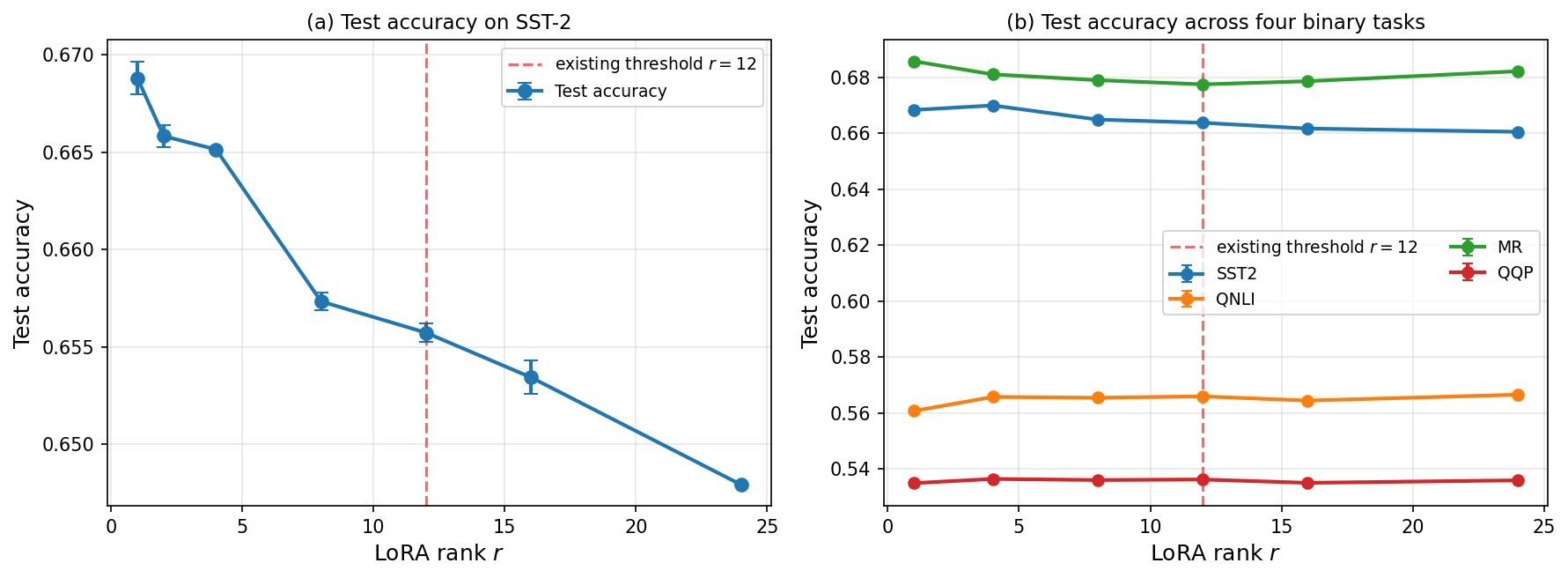
Figure 1: Test accuracy as a function of LoRA rank for RoBERTa-base on SST-2 and other GLUE-style binary tasks, showing rank-one is competitive with the existing threshold.
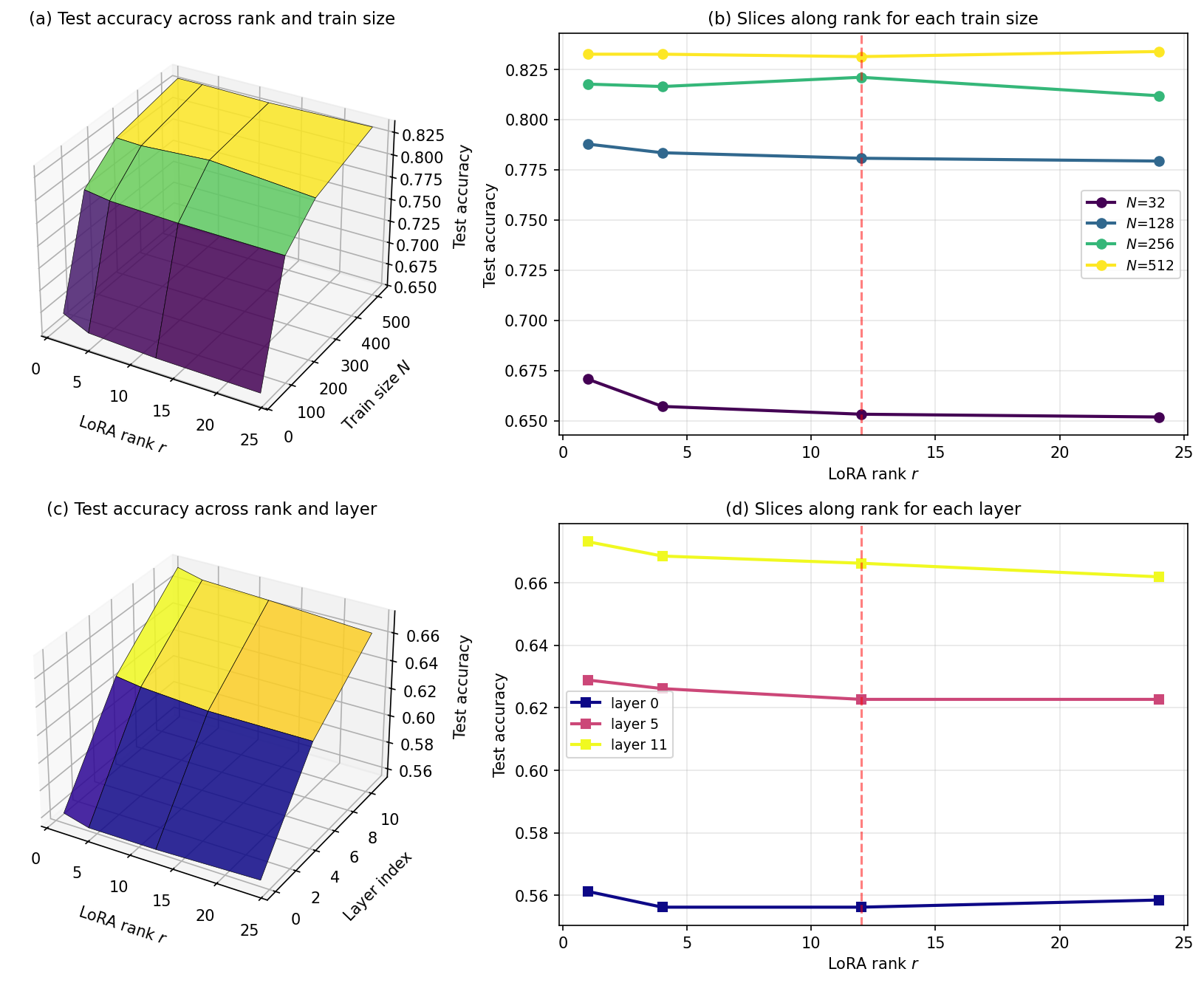
Figure 2: Robustness of test accuracy across train sizes and LoRA layer indices, demonstrating the preservation of the rank-one sufficiency across task and architectural axes.
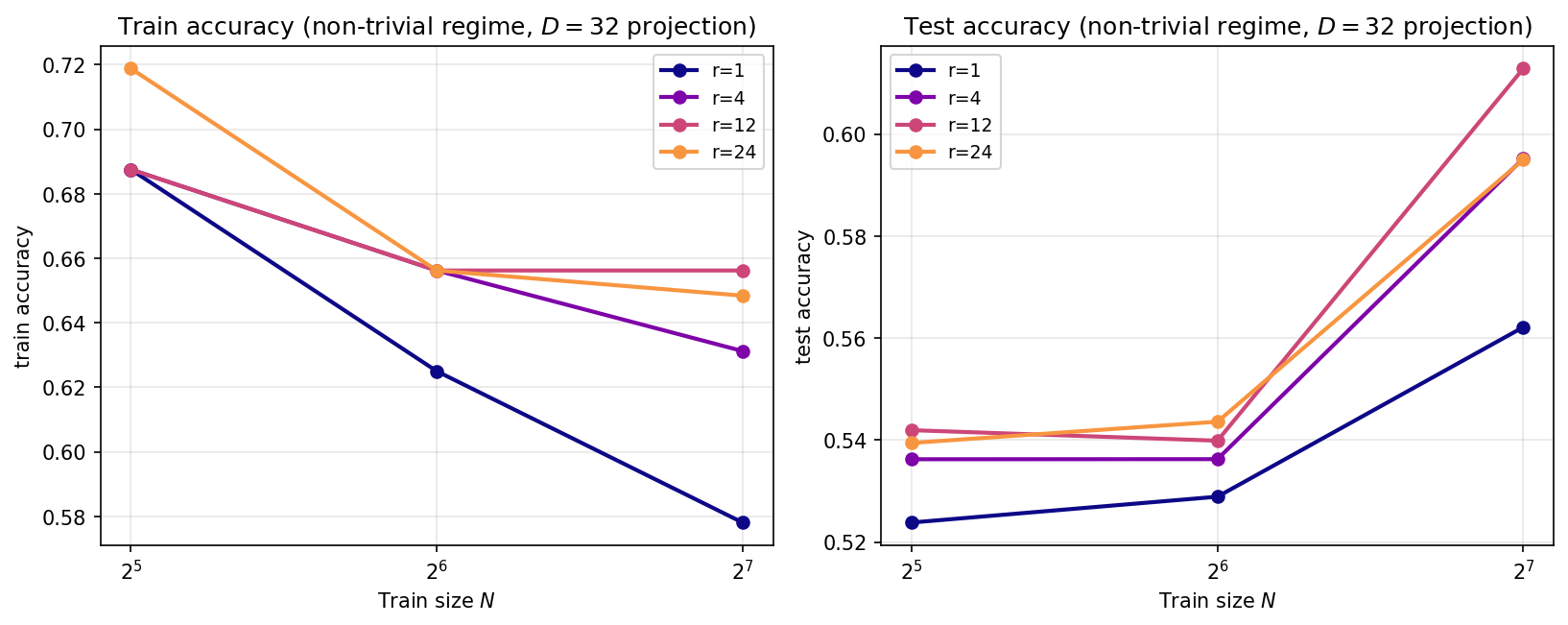
Figure 3: SST-2 training and test accuracy in a constrained NTK regime; higher ranks clearly improve both fit and generalization in low-capacity settings.
Practical and Theoretical Implications
Practical
- Fine-tuning transformer models for binary classification tasks can achieve optimal or near-optimal performance with rank-one LoRA adaptation, with substantial memory and compute savings vs. recommended defaults.
- In multi-class regimes, the optimal rank is task-dependent and can be empirically tuned above one.
Theoretical
- The refinement from v∈Rn×r6 to v∈Rn×r7 (with v∈Rn×r8) makes the sufficient condition for spurious-free LoRA optimization both tighter and more relevant.
- The PL property in cross-entropy loss under NTK dynamics implies global convergence at all ranks, conditional on network-wide overparameterization.
Future Directions
- Formal PL proofs for LoRA in the NTK regime and theoretical treatment for real (non-Gaussian) NTK Jacobian distributions are required for complete generality.
- Sharpening the rank threshold for multi-class tasks as a function of v∈Rn×r9 remains open.
- Extending the analysis to settings with intrinsic low-rank structure in data and to other parameter-efficient adaptation regimes could further minimize required ranks.
Conclusion
The paper establishes a loss-dependent, tightly quantified rank threshold for LoRA fine-tuning in the NTK regime, demonstrating that past conservative prescriptions significantly overestimate necessary rank in canonical transformer setups. For binary classification, rank-one adaptation suffices, freeing practitioners to prioritize parameter efficiency. For multi-class classification, the bias–variance tradeoff shifts optimal rank higher. The results both revise theoretical understanding and offer direct practical guidance for the design of parameter-efficient fine-tuning routines in LLMs.
References: See arXiv paper "Rethinking the Rank Threshold for LoRA Fine-Tuning" (2605.03724) for full bibliographic details.