- The paper establishes a unified spectral framework by using complex scaling to extract both quasinormal mode poles and the continuum level density in de Sitter black holes.
- It applies the method to scalar, electromagnetic, and gravitational perturbations, demonstrating that QNM frequencies shift and narrow as the cosmological constant increases.
- The study extends the approach to coupled-channel and higher-dimensional systems, linking spectral response to scattering theory and providing insights into greybody factors.
Spectral Structure of de Sitter Black Holes via Complex Scaling
Complex Scaling Framework for Black Hole Perturbations
The paper "Quasinormal modes and continuum response of de Sitter black holes via complex scaling method" (2605.03277) develops a non-Hermitian spectral framework for black hole perturbations, applying the complex scaling method (CSM) to Schwarzschild–de Sitter (dS) geometries. The central technical advance is the systematic extraction of both quasinormal mode (QNM) poles and the continuum level density (CLD) in a unified approach, extending resonance-theoretic structures from asymptotically flat to dS backgrounds, and exploring extension to higher dimensions and string-motivated coupled-channel systems.
The CSM is implemented by analytically continuing the tortoise coordinate r∗ in the Schrödinger-type master equation for black hole perturbations as r∗→r∗eiθ, turning the outgoing-wave boundary value problem into a non-Hermitian eigenvalue problem. Resonant QNM poles become isolated discrete eigenvalues—independent of the complex scaling angle θ—while the branch cut continuum is rotated in the complex energy plane, enabling simultaneous access to resonant and continuum response.
Identification of QNMs and Continuum Structure
The authors compute complex-scaled spectra for scalar (s=0), electromagnetic (s=1), and gravitational (s=2) perturbations in Schwarzschild–dS spacetime for several angular momenta and cosmological constant values.
In the complex ω-plane, the QNMs manifest as stable, isolated eigenvalues, distinguished from the rotated continuum by their independence under moderate changes in the complex scaling angle and the basis. The numerical results explicitly reproduce and validate the expected shift and narrowing of low-lying QNM frequencies as the cosmological constant Λ increases—both Reω and ∣Imω∣ decrease smoothly, consistent with the approach to the Nariai limit as r∗→r∗eiθ0.
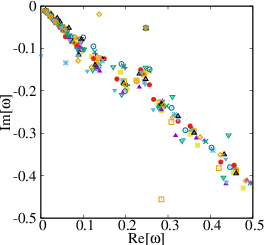
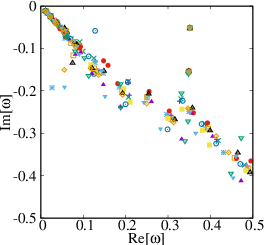
Figure 1: The complex-scaled Hamiltonian eigenvalues for r∗→r∗eiθ1 in Schwarzschild–dS, with QNM candidates marked as isolated eigenvalues separated from the rotated continuum (r∗→r∗eiθ2, r∗→r∗eiθ3).
Similar spectral isolation is demonstrated for r∗→r∗eiθ4 and r∗→r∗eiθ5 (Figures 2, 3), confirming the robust extraction of QNM poles.
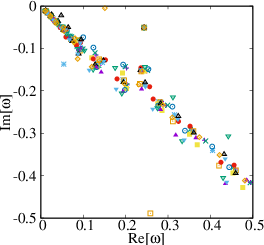
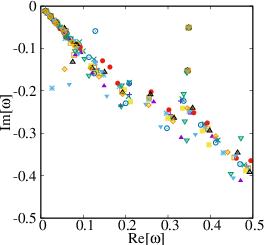
Figure 2: Eigenvalue spectrum for Schwarzschild–dS with r∗→r∗eiθ6, showing QNM candidates for r∗→r∗eiθ7 at r∗→r∗eiθ8.
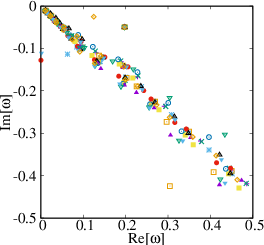
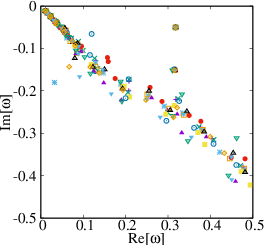
Figure 3: Eigenvalue spectrum for Schwarzschild–dS with r∗→r∗eiθ9, showing QNM candidates for θ0 at θ1.
Continuum Level Density and Spectral Response
The CLD is evaluated as the difference in spectral density between the full Hamiltonian and a suitable reference (asymptotic) problem, as a function of θ2. After complex scaling, the CLD is constructed from the complex eigenvalues of the non-Hermitian operator. This provides a frequency-resolved view of the continuum response, highlighting the redistribution of the density of states due to the black hole potential.
The results for θ3, θ4 (and analogously for θ5, θ6) show that the dominant structure in the CLD is governed by the lowest QNM pole, whose contribution captures the main peak and width. As θ7 increases, the CLD peak sharpens and shifts toward lower θ8, tracking the QNM spectral flow.
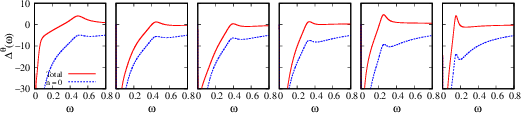
Figure 4: CLD for θ9, s=00 across s=01, showing dominance of the s=02 QNM pole in determining the main CLD structure.
Higher-s=03, higher-s=04 modes (e.g., s=05, s=06) also contribute but primarily refine the subleading continuum and secondary features (Figures 5, 6, 7, 8, 9).
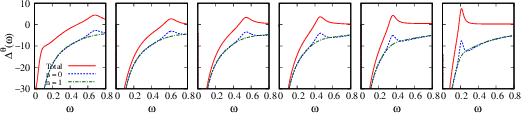
Figure 5: CLD for s=07, s=08, with contributions from s=09 and s=10 QNMs.
Generalization to Coupled-Channel and Higher-Dimensional Black Holes
The framework extends to coupled-channel problems, as exemplified by the Mandal–Sengupta–Wadia (MSW) 2D stringy black hole, which leads to matrix-valued Schrödinger-type equations. Here, the spectrum features multiple rotated continuum branches, reflecting several thresholds. Isolated resonances are more difficult to extract due to basis limitations—in the investigated parameter regime, QNMs are too broad to be isolated below the numerical complex scaling angle threshold.
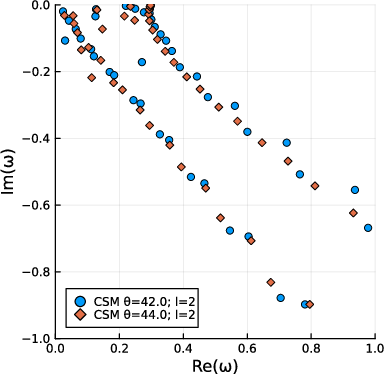
Figure 6: Complex-scaled spectrum for the coupled-channel MSW black-hole problem with two rotated continuum lines at fixed s=11.
Similarly, direct extension to higher-dimensional Schwarzschild–dS spacetimes is shown for s=12 tensor- and vector-type perturbations. The complex scaling method yields stable resonance candidates and the expected rotated continuum, confirming the generalizability of the spectral method.
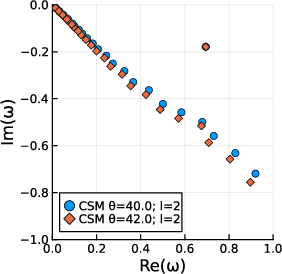
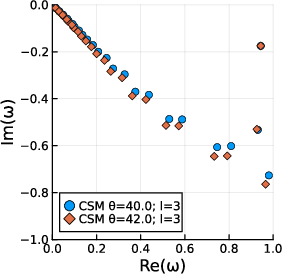
Figure 7: Complex-scaled spectrum for Schwarzschild–dSs=13 tensor-type perturbations (s=14; s=15).
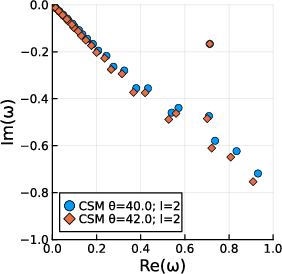
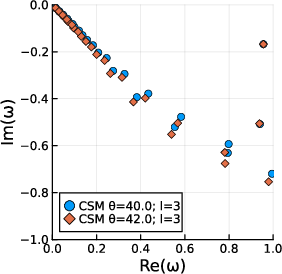
Figure 8: Complex-scaled spectrum for Schwarzschild–dSs=16 vector-type perturbations.
Connection to Scattering Theory and Greybody Factors
While the CLD is not itself a greybody factor, it is directly related in 1D scattering theory to the derivative of the phase of the transmission amplitude. The CSM framework thus allows a decomposition of the scattering phase into resonant and nonresonant (continuum) contributions. The modulus (greybody factor) requires direct calculation of transmission probability, but the CLD adds orthogonal information about spectral reorganization and provides a rigorous tool to analyze the relative resonance/nonresonance content in the black-hole response.
Conclusion
This work establishes the complex scaling method as a robust, generalizable spectral framework for analyzing both QNM poles and continuum response in de Sitter black holes. Numerical results demonstrate that the dominant features of the continuum response (as probed via the CLD) are controlled by the lowest QNM poles, a fact that extends across perturbing spin and angular momentum, and persists under moderate cosmological constant. The extension to coupled-channel and higher-dimensional backgrounds is operational, though further algorithmic developments are required for cases with highly damped QNMs. The CSM-based CLD provides a precise complement to canonical QNM tables, with future prospects for rigorous treatments of continuum observables, scattering phases, and possible connections to greybody factors. The framework paves the way for unified treatment of black hole perturbation spectra in both astrophysical and string-theory-inspired contexts.

