- The paper demonstrates that both DA and LPDE methods can accurately recover inertial-range energy transfer rates in anisotropic MHD turbulence under proper measurement constraints.
- The study employs high-resolution incompressible MHD simulations with virtual spacecraft setups to evaluate directional biases and tetrahedral geometry effects.
- The results reveal that isotropy-based estimators misestimate energy dissipation by up to ±20%, highlighting the importance of anisotropy-aware methodologies in space plasma research.
Inertial-Range Energy Transfer in Turbulent Space Plasma without Isotropic Assumptions
Introduction and Motivation
Astrophysical plasmas, especially in the solar wind and heliosphere, typically exist under conditions far from isotropy. The assumption of isotropy, though mathematically convenient, fails to represent the intrinsically anisotropic nature of such systems, primarily governed by the presence of a mean magnetic field. Historically, the estimation of inertial-range energy transfer and dissipation rates in turbulent space plasma has relied on theoretical constructs derived under isotropic or axisymmetric assumptions. However, direct multi-point measurement capabilities introduced by missions like MMS, Cluster, and future large-spacecraft constellations (e.g., HelioSwarm) motivate the need for methodologies agnostic to isotropy.
The paper "Inertial-Range Energy Transfer Free from Isotropic Assumption in Turbulent Space Plasma" (2605.03271) conducts a systematic comparison between two anisotropy-aware techniques for estimating the energy transfer rate: the Direction-Averaging (DA) method and the Lag Polyhedral Derivative Ensemble (LPDE) method. Both approaches are implemented on high-resolution incompressible MHD simulations, where virtual spacecraft provide controlled testbeds for practical deployment constraints—such as limited lag-vector configurations and tetrahedral baseline effects.
Theoretical Framework and Estimation Methods
MHD Turbulence and the Third-Order Law
The theoretical backdrop is the von Kármán–Howarth equation generalized for incompressible MHD turbulence. The exact third-order law relates the divergence of the Yaglom flux vector in lag space to the mean energy dissipation rate, circumventing assumptions of isotropy. Under isotropy, this reduces to a familiar scaling law for longitudinal increments, but the full anisotropic form remains rigorous without rotational symmetry.
Direction-Averaging (DA) Method
The DA method employs integration of the longitudinal component of the Yaglom flux over a spherical surface in lag space, using solid-angle averages to approximate the net energy transfer. Practically, this requires measurements along multiple directions, which places demands on either time-resolved single-satellite swaths (under Taylor's hypothesis) or multi-point simultaneity.
Lag Polyhedral Derivative Ensemble (LPDE) Method
LPDE is a fully differential, geometry-aware estimation technique, leveraging tetrahedral lag arrangements enabled by four or more simultaneous spacecraft. It computes the divergence of the Yaglom flux from field increments along the edges of a lag-space tetrahedron, using the reciprocal vector formalism for divergence approximation. The quality of tetrahedral conditioning (planarity, elongation) is actively filtered to ensure numerical robustness.
Simulation Setup and Data Acquisition
A 3D driven incompressible MHD simulation (10243 grid points) with an imposed mean magnetic field serves as the numerical laboratory. Kinetic and magnetic energy injection and inertial-range development are validated via spectral analysis.
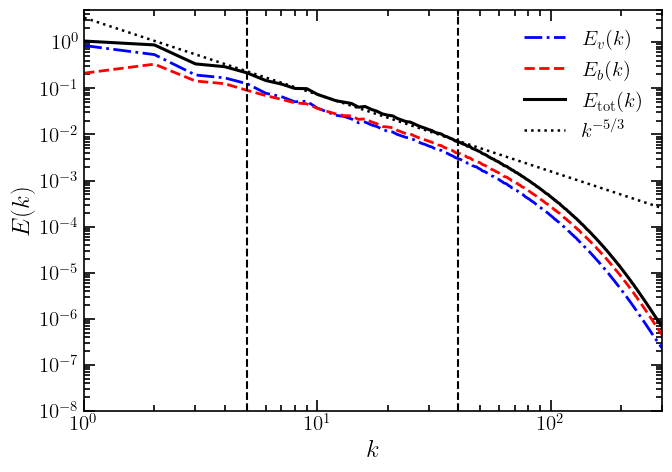
Figure 1: Energy spectrum of the simulation. The blue dash-dotted and red dashed curves show the kinetic and magnetic energy spectra, respectively. The black dashed line denotes the −5/3 inertial-range power law, and vertical dashed lines mark the inertial range.
Virtual four-spacecraft constellations are constructed to sample field increments along prescribed sets of directions and baseline geometries, emulating the data environment of real multi-point missions.
Characterizing Direction-Averaged Estimators
The DA method quantifies the energy cascade as a function of both polar and azimuthal angles relative to the mean magnetic field. Empirical analysis demonstrates pronounced angular dependence in the inertial-range energy transfer rates, invalidating isotropic simplifications and verifying the necessity for solid-angle averaging.
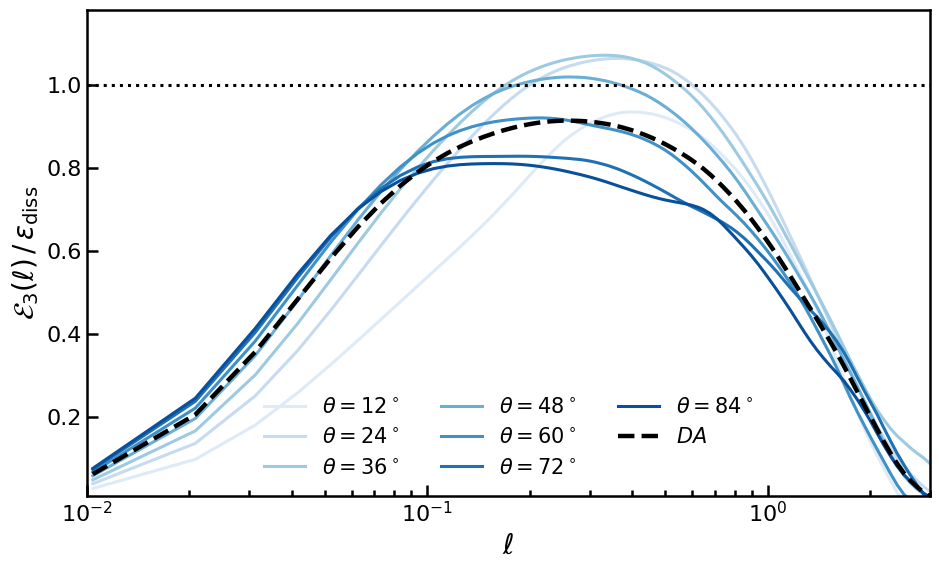
Figure 2: Scale-dependent third-order estimates E3(ℓ) reveal substantial dependence on polar and azimuthal sampling direction, underscoring the anisotropic character of the cascade.
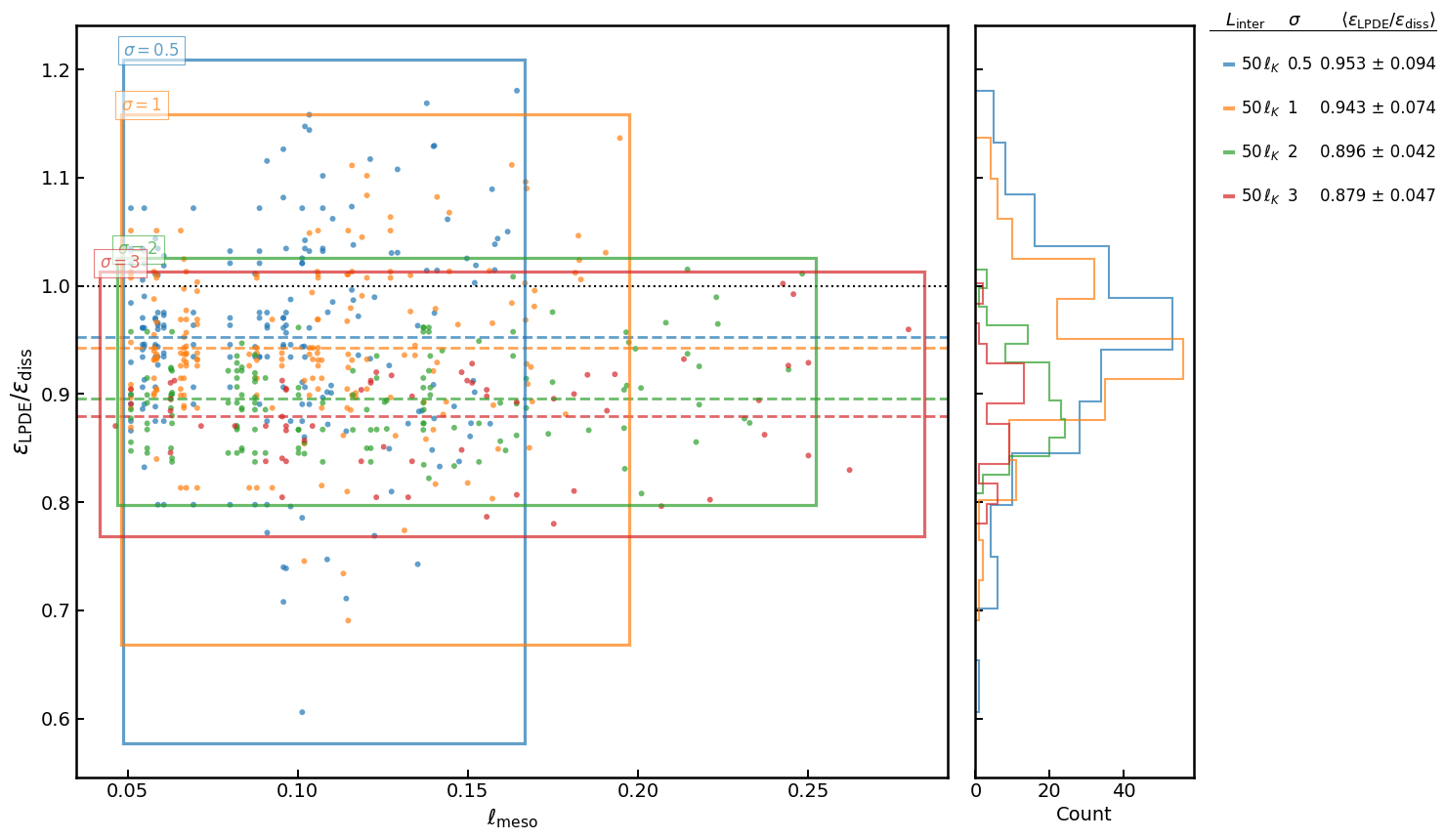
When only a subset of directions is accessible, the DA estimator is biased, with errors up to ±20%. However, high-fidelity solid-angle coverage via multiple spacecraft or repeated temporal sweeps can mitigate this bias, yielding energy transfer estimates accurate to within roughly 8% of the true volumetric dissipation value for the simulation.
The LPDE approach is evaluated comprehensively for its sensitivity to baseline scale (i.e., inter-spacecraft separation), tetrahedral irregularity, selection threshold, and sampling trajectory. Only lag-tetrahedra of sufficient geometric quality and inertial-range location are retained.
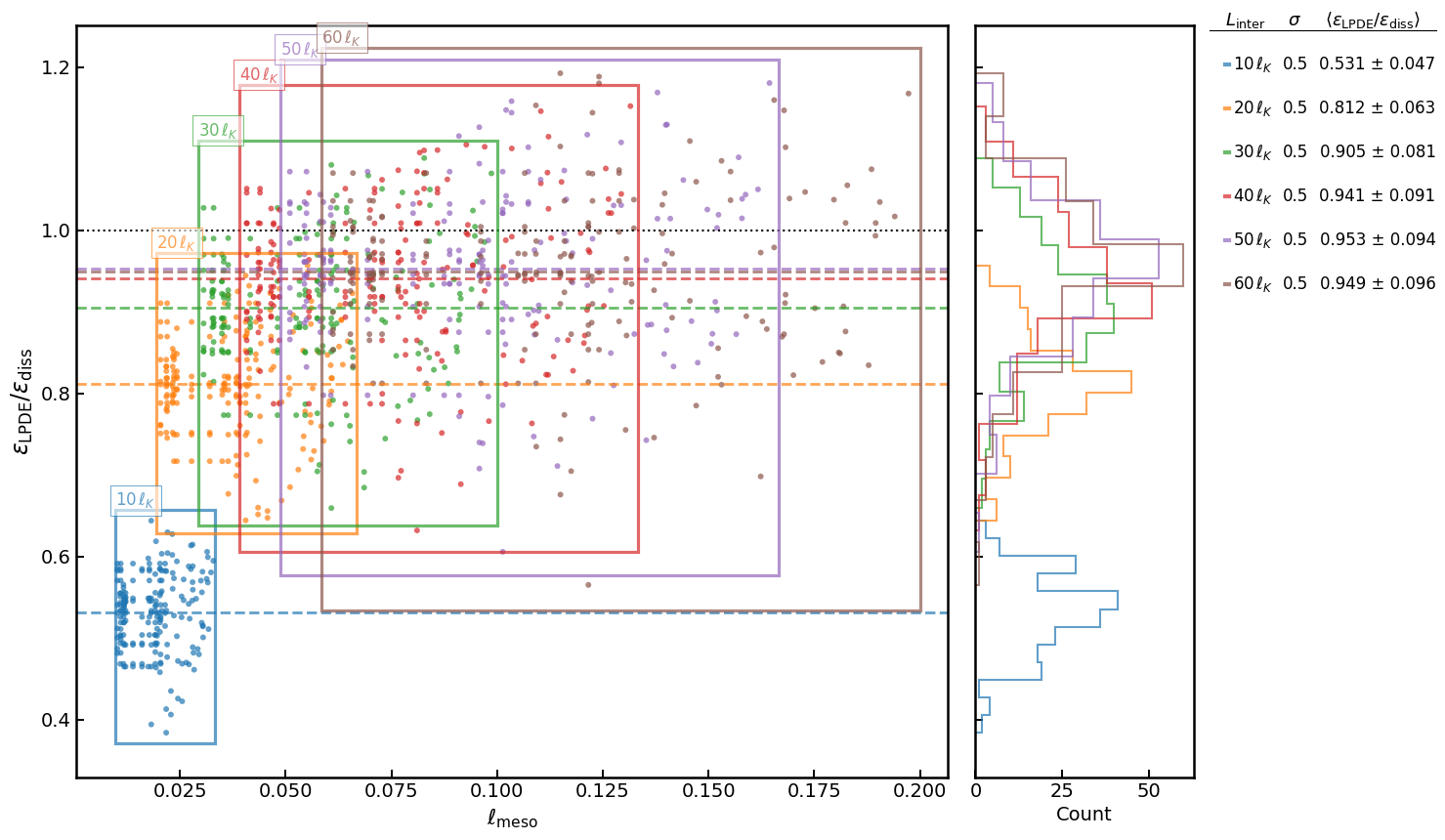
Figure 3: LPDE cascade rate estimates versus lag-tetrahedron mesocenter length, colored by baseline family; larger baselines aligned with the inertial range yield estimates congruent with true dissipation rates.
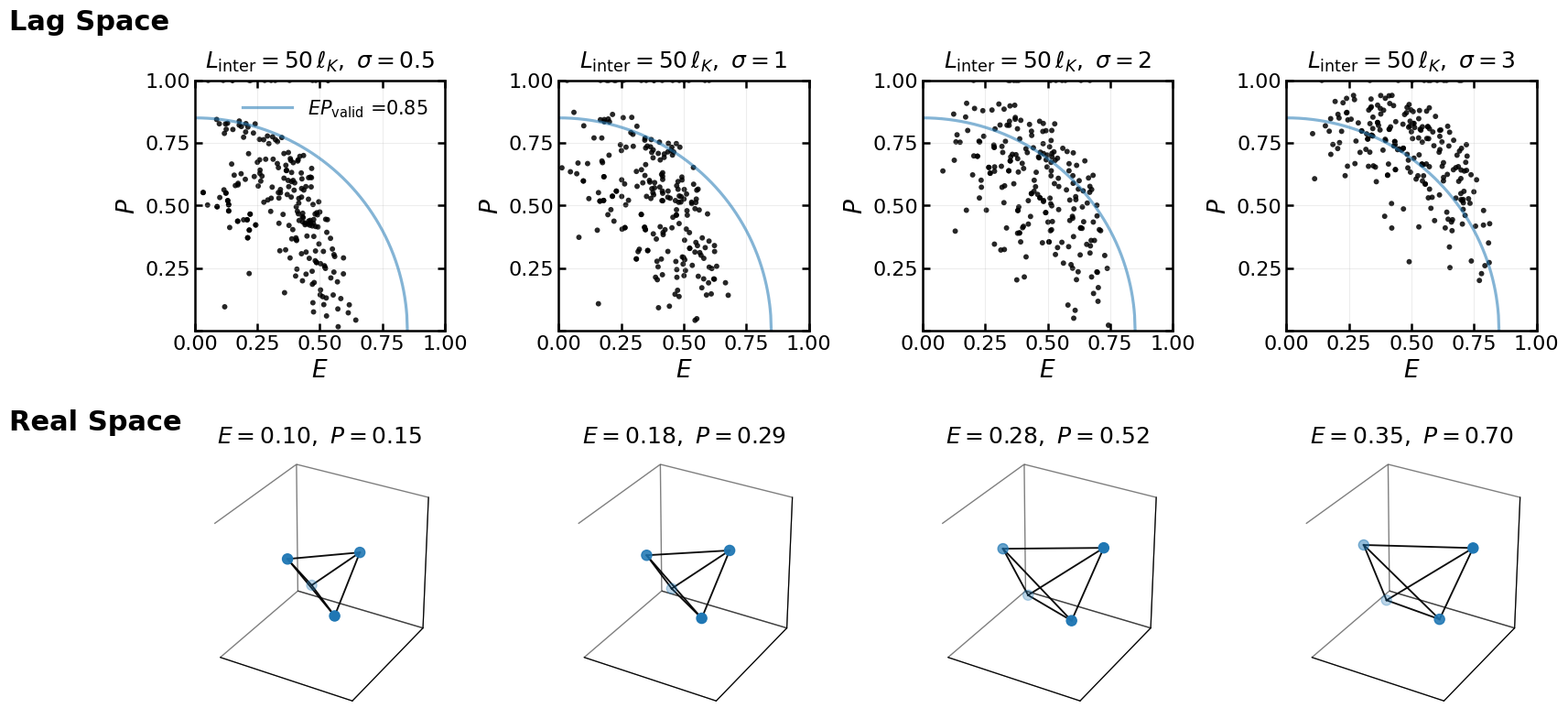
Figure 4: Distribution of lag-tetrahedron geometries in elongation-planarity (E,P) space for varying non-regularity σ; only configurations within the marked threshold are deemed well-conditioned for divergence estimation.
Notable findings:
Comparative Synthesis and Implications
A direct comparison against grid-resolved ground-truth computations (using full simulation data) demonstrates convergence of DA, LPDE, and theoretical estimates within the inertial range.
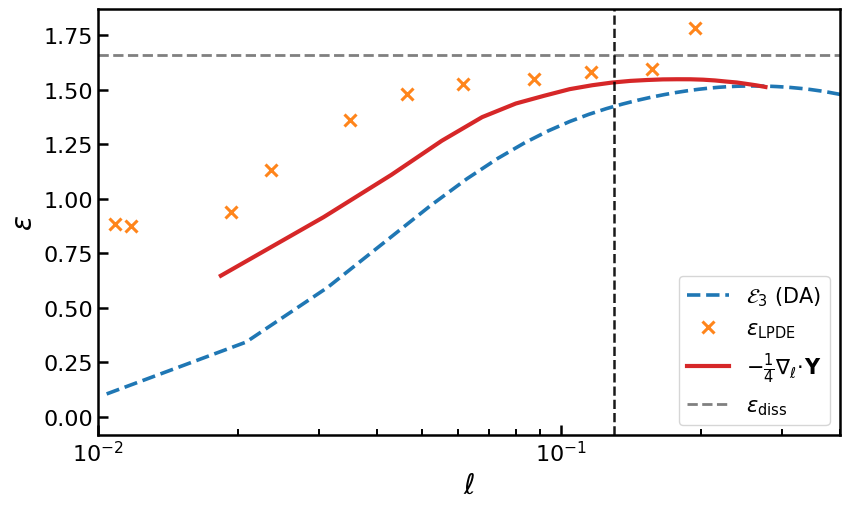
Figure 6: Scale-dependent energy cascade rates from simulation grid, LPDE, and DA methods, all converging in the inertial range to the true dissipation rate.
Key technical claims:
- Both DA and LPDE reliably recover the inertial-range cascade rate in anisotropic MHD turbulence if their respective measurement constraints (solid-angle coverage for DA, geometric conditioning and inertial-scale baselines for LPDE) are satisfied.
- For limited coverage or suboptimal tetrahedral geometry, both methods can exhibit systematic bias, but the direction of bias is predictable from the respective methodological sensitivities.
Contradictory to prior practice, the results demonstrate that isotropy-based single-direction estimators are generally insufficient and commonly misestimate the true dissipation by significant margins in anisotropic systems.
Practically, these results clarify mission design priorities:
- LPDE is better suited to missions whereby a large-enough constellation enables sustained inertial-range separation and high-quality tetrahedral formation.
- DA is advantageous when repeated, time-resolved, or distributed directional sweeps can be accumulated, but remains sensitive to angular sampling bias.
Conclusion
This work rigorously establishes the comparative accuracy and practical constraints of DA and LPDE methods for inertial-range energy transfer estimation in anisotropic MHD turbulence, relevant for modern and planned multi-spacecraft missions. The clear demonstration that isotropic-assumption-based estimators are systematically biased in the anisotropic plasma regime will inform future data analysis, observational strategies, and constellation mission designs. As multi-point missions become more ambitious, the methodologies detailed here will underpin precise quantification of turbulent energy transfer, vital for understanding energy dissipation and heating in astrophysical plasmas.
Future directions include methodologically optimized weighting schemes for both DA and LPDE (incorporating physical relevance and geometric quality), further adaptation for compressible and kinetic-scale regimes, and direct application to in-situ data from forthcoming spacecraft constellations.