- The paper introduces a structural reparameterization using disjoint SVD-slice expert bases to guarantee cross-expert orthogonality and resolve cold-start deadlock in DiT LoRA.
- It employs Cayley orthogonalization and layer-local RMS pooling to secure effective gradient differentiation and immediate specialist adaptation from initialization.
- Empirical results demonstrate rapid routing entropy decrease without stochastic heuristics, confirming robust and efficient multi-style fine-tuning.
Ortho-Hydra: Orthogonalized Experts for DiT LoRA
Motivation and Problem Statement
HydraLoRA introduced a Mixture-of-Experts (MoE) extension to Low-Rank Adaptation (LoRA) for fine-tuning large diffusion Transformers (DiTs) in multi-style domains. The fundamental issue addressed is "style bleed": a single low-rank adapter cannot simultaneously encode multiple, orthogonal artistic styles; optimization in LoRA collapses distinct style fingerprints into a blended average. While mixture-of-experts LoRA compartments (HydraLoRA) allow for specialized expert heads, these methods exhibit a "cold-start deadlock" when all expert projections and the router begin with identical parameters—typically zeros. The router receives no differentiating gradient at initialization, resulting in permutation-symmetric expert evolution and a degenerate solution where the MoE acts as a single LoRA adapter, incurring E× computational cost.
Ortho-Hydra: Methodological Innovations
Ortho-Hydra resolves the cold-start deadlock with a structural re-parameterization. For each linear projection in the DiT, the core ideas are:
- Disjoint SVD-Slice Expert Bases: The E expert up-projections are each allocated a disjoint, orthonormal slice of the top-(Er) left singular vectors (U) from the SVD of the pretrained weight W0. Each expert projects only within its own subspace, guaranteeing cross-expert orthogonality at every training step.
- Cayley Orthogonalization: Each expert's up-projection operates within its slice via a per-expert, Cayley-parameterized rotation. The shared down-projection is also Cayley-rotated. The Cayley transform ensures exact orthogonality throughout optimization.
- Layer-Local Routing via RMS Pool over the Rank-r Bottleneck: The router does not operate on raw activations or text conditioning, but on the RMS-pooled, rank-r bottleneck representations, which provides a non-degenerate source of expert-specializing signal early in training, particularly on long sequences where other poolers degenerate.
These design decisions are illustrated in the following architecture comparison:
(Figure 1)
Figure 1: High-level architectural comparison of plain LoRA, HydraLoRA, and Ortho-Hydra, focusing on basis structure and expert specialization.
Analysis of the Cold-Start Deadlock
The primary phenomenon of interest is the inability of the HydraLoRA router to specialize experts at initialization when all experts are zero-initialized and share the same basis:
- Shared-Basis HydraLoRA: All expert up-projections Be are aligned within the same subspace. The router’s per-expert scores, being based on inner-products with identical representations, are always equal. This symmetry is never broken by the gradients, yielding no specialization signal.
- Sigma-Jitter Mitigation: Gaussian noise added to expert weights (Be∼N(0,σ2)) only modestly perturbs this symmetry and is highly sensitive to hyperparameters.
- Disjoint Slices: In Ortho-Hydra, because expert subspaces are mutually orthogonal, the router’s weights receive meaningful, differentiated gradients from the first training step, and specialization emerges without external symmetry-breakers or scheduling heuristics.
Empirical Results
Extensive diagnostics validate the theoretical analysis. Adapters were tested in a DiT fine-tuning pipeline (anima-preview3-base, E=12 experts, E0), with all other variables (dataset, optimizer) controlled.
Router entropy—the average normalized entropy of per-layer expert softmax gates—was used to measure specialization (E1 means uniform routing, E2 indicates one-hot routing).
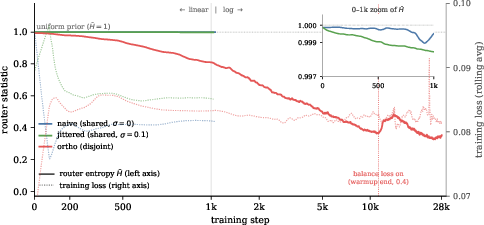
Figure 2: Cold-start router dynamics for three HydraLoRA variants: naive (shared basis, zero-init), jittered (E3 Gaussian), and Ortho-Hydra (disjoint SVD-slices), showing only Ortho-Hydra escapes the uniform routing deadlock within a few hundred steps.
- Both baseline variants (naive, jittered) remain pinned at the uniform prior (E4) for 1k steps; only Ortho-Hydra exhibits rapid entropy decrease, with the router de-uniformizing within 200 steps and converging to E5 by the end of training.
- Training loss curves are indistinguishable across variants, indicating optimization and capacity are unaffected; only expert utilization/routing differs.
This supports the claim that the HydraLoRA deadlock is structural, not a slow-to-train or initialization artifact.
Implications and Future Directions
Ortho-Hydra's structural disjointness guarantees immediate and persistent cross-expert orthogonality, making the router’s gradient informative from initialization and eliminating dependence on fragile schedule or noise-based symmetry-breakers. This approach is runtime-free compared to loss-based regularizers for expert diversity and decouples symmetry-breaking from optimization schedules.
Practical implications include:
- Immediate, robust, and efficient specialization of expert adapters in DiT LoRA under multi-style regimes
- No tuning of stochastic initialization or scheduling heuristics
- Compatibility with additional regularizers (e.g., output orthogonality or gate variance penalties) in later training stages
Theoretical implications include decoupling the specialization problem from loss-local regularization, as the symmetry-breaking is architecturally guaranteed rather than an emergent property.
Limitations:
- The Ortho-Hydra architecture restricts E6 to the top principal subspace of E7, which may not always contain all variation needed for highly creative fine-tuning.
- The method is constrained by E8; on narrow projections, it falls back to the degenerate shared-basis regime.
- End-task generation quality and ablations (effect of E9) remain to be systematically evaluated.
Future research directions include:
- Extending empirical validation to direct multi-style downstream metrics (FID, style classification, etc.)
- Investigating alternative orthogonal or structured random expert subspaces for optimal specialization-diversity tradeoff
- Integrating banded or content-aware expert assignment beyond denoising timestep bucketing
Conclusion
Ortho-Hydra introduces a structurally differentiable, orthogonalized expert partition for DiT LoRA, rigorously resolving the MoE cold-start deadlock and enabling robust specialization in diffusion model adapters. While downstream quality metrics and expressiveness constraints are open questions, the method fundamentally reframes expert specialization as a geometric property of the adapter basis, distinct from loss-side or scheduling interventions. The design principles are broadly applicable to other MoE settings facing initialization symmetry barriers.