Dynamic Vine Copulas: Detecting and Quantifying Time-Varying Higher-Order Interactions
Published 4 May 2026 in stat.ML, cs.LG, q-bio.QM, and stat.ME | (2605.03061v1)
Abstract: Time varying dependence is often modeled through dynamic correlations or Gaussian graphical models, yet many multivariate systems change through tail behavior, asymmetry, or conditional structure while correlations change little. We introduce Dynamic Vine Copulas (DVC), a temporal vine copula framework for estimating and diagnosing sequence wide non-Gaussian dependence. DVC keeps a chosen vine factorization fixed for comparability, can use C-, D-, or R-vines, and couples pair copula states across time through smooth parameter trajectories or temporally regularized family switching paths. Its central diagnostic contrasts held-out scores from a full vine and its matched 1-truncated counterpart, separating flexible first-tree pairwise evidence from higher-tree conditional evidence. At the population level, under a correct fixed vine and simplifying assumption, this contrast is the higher-tree term of a vine total correlation decomposition; in finite samples, it is a predictive diagnostic. Across controlled benchmarks, DVC detects Student-t tail degree changes, Clayton-to-Gumbel switches, and recurrent conditional interaction episodes that Gaussian dynamic baselines miss or conflate. The higher-tree score stays near zero in pairwise only regimes but rises selectively during conditional interaction regimes. On Allen Visual Behavior Neuropixels data, DVC identifies a reproducible time indexed higher-tree signal that is positive across held-out splits and disappears under a decorrelated null, indicating simultaneous cross-area dependence. Together, these results show that DVC is both a flexible temporal copula model and an interpretable diagnostic for whether time varying dependence changes are pairwise or conditional.
The paper presents a dynamic vine copula framework that distinguishes pairwise from higher-order, non-Gaussian dependencies in time series.
It employs fixed vine factorizations with smooth and switching models to capture both gradual and abrupt changes in dependency structures.
The approach yields interpretable diagnostics validated on controlled experiments and neural data, demonstrating practical scalability and theoretical rigor.
Dynamic Vine Copulas: Temporal Detection and Quantification of Higher-Order Interactions
Introduction and Motivation
Time-varying multivariate dependence in complex systems frequently involves mechanisms beyond evolving Gaussian correlations, such as changes in tail dependence, asymmetric co-fluctuation, or conditional higher-order interaction structures. Traditional methods—dynamic conditional correlation (DCC) and temporally regularized Gaussian graphical models—remain fundamentally limited to capturing second-order, Gaussian-style dependence, missing substantial non-Gaussian and higher-order phenomena. The paper "Dynamic Vine Copulas: Detecting and Quantifying Time-Varying Higher-Order Interactions" (2605.03061) introduces Dynamic Vine Copulas (DVC), a temporal vine copula framework that provides a principled approach for sequence-wide modeling and order-sensitive diagnostics of non-Gaussian, time-varying dependence.
Methodological Framework
Temporal Modeling with Fixed Vine Factorization
DVC operates by choosing a fixed vine factorization (C-, D-, or R-vines) across all time windows, allowing sequence-wide comparability. Temporal evolution is encoded either through:
DVC-smooth: Assigns smooth parameter trajectories to each edge, enabling gradual changes in dependence (e.g., correlation and tail parameters), where parameter paths are modeled by basis functions with shared coefficients.
DVC-switch: Allows abrupt or episodic state changes through temporally regularized family/parameter paths, optimized with dynamic programming and regularization for family switches and parameter drift.
Unlike windowed approaches that refit local models independently, DVC constructs a coherent temporal dependence model, compressing the temporal parameterization and enabling robust order-sensitive diagnostics.
Diagnostic Metrics
Central to DVC is the matched held-out contrast between the full vine model and its 1-truncated counterpart:
Full Vine: Captures both first-tree pairwise and higher-tree conditional dependence.
1-Truncated Vine: Retains only first-tree pairwise copulas.
Higher-Tree Score: The copula NLL gap (ΔHO) between full and 1-truncated vine diagnoses the predictive contribution of conditional structure.
At population-level truth, and under the simplifying assumption, this diagnostic matches the higher-tree term in the vine total-correlation decomposition, connecting predictive performance with information-theoretic structure.
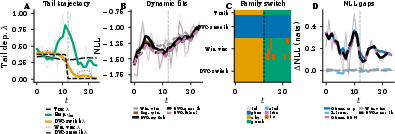
Figure 1: DVC detects tail degree and copula family switches; held-out NLL shows that pairwise-only models suffice in tail mechanisms, but full-vine is required for true higher-tree structure.
Experimental Results
Pairwise Non-Gaussian Dynamics and Limitations
DVC effectively detects non-Gaussian pairwise changes unidentifiable by Gaussian baselines. In tests with piecewise Student-t tail degree shifts (fixed correlation) and abrupt Clayton→Gumbel family switches (fixed Kendall'sτ), DVC-smooth and DVC-switch outperform windowed and regularized Gaussian baselines, with held-out NLL improvements (+0.153, +0.194 nats, respectively). However, matched 1-truncated vine models remain competitive, confirming that such mechanisms are primarily pairwise.
The XOR stress test exemplifies a limitation: with construction yielding unchanged pairwise summaries but hidden triplet structure, DVC's C-vine estimator returns null higher-tree evidence, underscoring that the diagnostic is tuned to vine-representable conditional structure, not arbitrary higher-order interactions.
Episodic and Higher-Order Interaction Detection
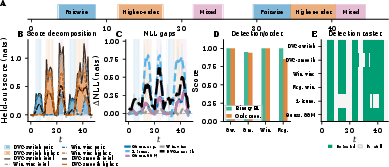
In benchmarks involving agent episodes with alternating pairwise and higher-order/mixed interaction phases, DVC-switch discriminates interaction order, with the higher-tree NLL gap sharply separating pairwise-only (−0.018 nats), higher-tree (+0.683 nats), and mixed (+0.744 nats) episodes. The diagnostic is not merely binary but is temporally selective and order-sensitive.
Figure 2: DVC-switch separates interaction order across agent episodes, with higher-tree scores rising only in conditional interaction epochs.
Showcase: Combined Regimes and Oracle Validation
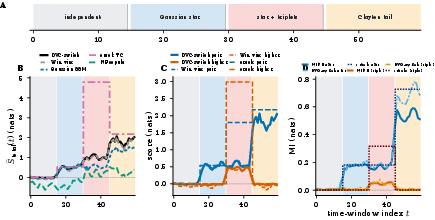
A four-phase benchmark (independence, Gaussian pairwise, multiplicative triplet, lower-tail) further demonstrates DVC's temporal selectivity: the higher-tree diagnostic activates exclusively during the triplet phase (+0.458 nats), remains null in Gaussian and tail phases, and matches the oracle mutual information decomposition.
Figure 3: DVC-switch distinguishes Gaussian, pairwise, and higher-tree regimes, localizing the higher-tree signal to multiplicative-triplet phases.
Real Neural Data: Allen Visual Behavior Neuropixels
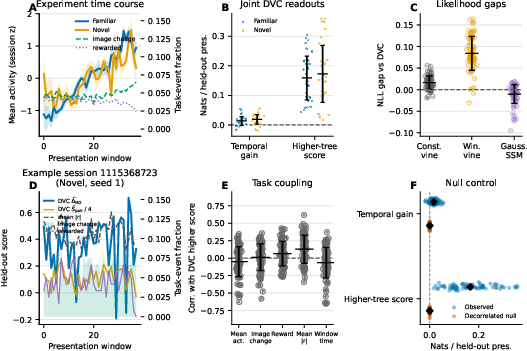
Applied to population activity in Allen Visual Behavior Neuropixels (VBN) data, DVC identifies a reproducible time-indexed higher-tree signal. The temporal model achieves positive gaps relative to constant and windowed vine controls (t0, t1 nats per held-out presentation), and a consistent higher-tree decomposition (t2 nats, t3 nats, t4 nats per presentation). Under a decorrelated null, higher-tree scores collapse, validating that the detected signal is not an artifact of marginal response structure or time sampling.
Figure 4: DVC reveals a reproducible, null-calibrated higher-tree dependence signal across Allen VBN sessions; higher-tree scores vanish with decorrelation.
Computational Advantages and Scaling
Joint DVC achieves substantial model compression by replacing repeated per-window edge fits with a single temporal trajectory per edge. For t5, the windowed vine fits t6 local edge models, while smooth joint DVC fits only t7 temporal trajectories—representing a t8 reduction in fitted dependence objects. Although the evaluated Python implementation does not yet translate model compression into wall-clock speedups, the theoretical scaling advantage is clear for large t9 and modest window sizes.
Theoretical Implications
The paper contextualizes DVC diagnostics within information-theoretic frameworks, providing explicit decompositions of total correlation into pairwise and higher-tree components. Under fixed-vine and simplifying assumptions, the higher-tree NLL gap is nonnegative and zero only when all higher-tree conditional pair-copulas are independence copulas. The method is statistically identifiable and consistent in the oracle setting, with parametric convergence rates for penalized joint estimators.
Practical and Theoretical Impact, Outlook for AI
DVC advances measurement and diagnosis of multivariate time-varying dependence in settings where dynamic Gaussian models fail—such as finance (tail risk), neuroscience (conditional population codes), and multi-agent systems (temporal conditional interaction). The higher-tree diagnostic provides a formally interpretable signal for conditional, non-pairwise structure, complementing conventional correlation-based summaries.
The framework enables future developments in:
Temporal structure learning with adaptive vine topologies
Non-simplified, dynamic copula estimation for challenging dependence regimes
Neural population analysis with interpretable, time-indexed dependence metrics
Integration with learned copula models and generative approaches
Static copula models are increasingly used in neural data analysis and generative modeling; DVC's temporal and diagnostic capabilities open new directions for time-indexed dependence quantification. However, limitations regarding non-vine-representable higher-order interactions and sensitivity to the simplifying assumption remain, prompting continued methodological development.
Conclusion
Dynamic Vine Copulas introduce a robust, order-sensitive framework for sequence-wide detection and quantification of non-Gaussian, higher-order temporal dependence. By leveraging fixed vine factorizations and coherent temporal parameterizations, DVC separates pairwise from conditional interaction mechanisms, delivers interpretable diagnostics, and compresses temporal models for efficient estimation. The approach is validated across controlled benchmarks and neural population data, with theoretical and practical implications for complex multivariate time series analysis in scientific and applied domains.
“Emergent Mind helps me see which AI papers have caught fire online.”
Philip
Creator, AI Explained on YouTube
Sign up for free to explore the frontiers of research
Discover trending papers, chat with arXiv, and track the latest research shaping the future of science and technology.Discover trending papers, chat with arXiv, and more.