Valley-locked Optical Spin Skyrmions in Valley Photonic Crystal Waveguides
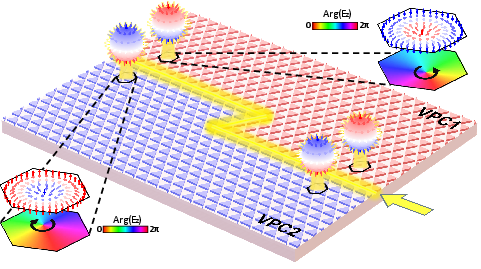
Abstract: Optical skyrmions have attracted significant attention across diverse physical systems for their promising scenarios in ultra-precise metrology, optical information processing, and quantum technologies. However, the lack of effective method for their on-chip directional transport and manipulation impedes their applications in photonic integrated devices. Here, we demonstrate a photonic platform that utilizes topologically protected valley edge state to achieve robust on-chip directional transport of optical spin skyrmions. These skyrmions originate from spin-orbit coupling within the evanescent field at the valley photonic crystal surface and exist as eigenstates of the topologically protected edge state, ensuring their robust unidirectional propagation. Leveraging the valley degree of freedom of topological edge states, we further achieve valley-locked spin skyrmions, enabling flexible control over the polarity of spin skyrmions. By endowing spin skyrmions with topological protection in momentum space, our work provides an approach for robust on-chip transport and manipulation of spin skyrmions, thereby paving the way for expanding their application potential in photonic systems.
Paper Prompts
Sign up for free to create and run prompts on this paper using GPT-5.
Top Community Prompts
Explain it Like I'm 14
What this paper is about (the big idea)
The paper shows a new way to create and move special “spin patterns” of light—called optical spin skyrmions—along tiny pathways on a chip. These patterns travel in one direction, stay stable even around sharp corners, and can be flipped (like turning a coin from heads to tails) by choosing which “valley” path the light uses. This makes them promising for future, super-stable light-based circuits.
What questions the researchers asked
- Can we make optical spin skyrmions directly on a chip and move them in a chosen direction?
- Can we keep them stable even when the path bends sharply or has defects?
- Can we switch the “polarity” (the inward vs outward twist) of these skyrmions in a simple, reliable way?
How they did it (simple explanation of the approach)
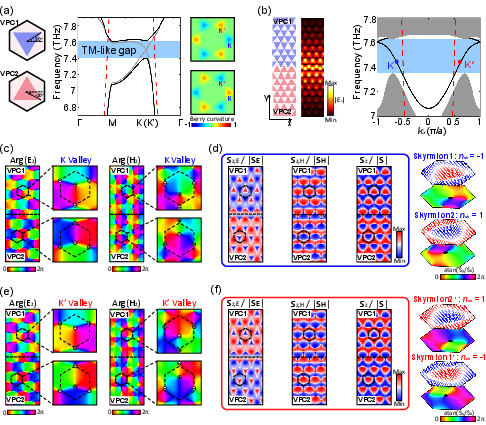
Think of light traveling through a tiny, patterned city for photons called a photonic crystal. The researchers built two mirror-image neighborhoods of this city and joined them at a border (an “interface”). Along that border, light can flow like cars on a special one‑way, protected lane called a topological edge state. These protected lanes are known to guide light without it getting easily bounced back by bumps or corners.
Here’s how the key pieces work:
- Photonic crystal: A repeating pattern (like an egg carton for light) made of tiny triangular rods. This pattern controls which light can pass and where it goes.
- Valley photonic crystal: The pattern creates two special “valley” options (labeled K and K′) that act like two different lanes for light. Choosing a valley is like choosing which of two parallel tracks you use.
- Topological edge state (TES): A “guardrail” light path at the border between the two mirror-image patterns. Light in this path moves in one direction and resists scattering, even at sharp bends.
- Evanescent field: A near-surface light field that sticks close to the crystal and fades quickly away from it, like a glow that hugs the surface.
- Spin–orbit coupling: When the light’s “spin” (its tiny built-in rotation) links with its motion, creating twisting spin patterns.
- Optical spin skyrmion: A tightly organized 3D twist of the light’s spin that wraps in all directions—imagine tiny whirlpools of spin forming a neat, stable pattern. Each skyrmion has a “polarity,” meaning it twists one way or the other.
What they actually did:
- They designed and simulated a waveguide (a light path) made by joining two rotated, triangular‑rod photonic crystals.
- This rotation opens a “bandgap” (a range of colors/frequencies that can’t travel in the bulk), forcing light to travel along the border as a protected edge state.
- The edge state’s near-surface, swirling fields naturally create 3D spin textures—optical spin skyrmions—on each side of the border.
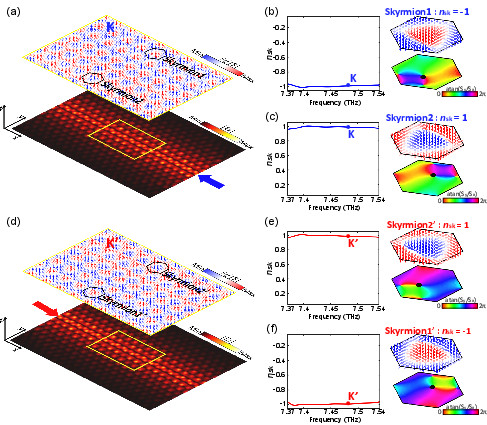
- They calculated a “skyrmion number” (a count of how the spin wraps in space) to confirm the patterns are true skyrmions.
- They launched light into the waveguide, scanned different frequencies, and tested skyrmion travel through sharp bends and defects.
What they found and why it matters
Here are the key results:
- The edge modes carry skyrmions: The natural modes of the protected edge path already contain optical spin skyrmions—no extra complicated setup is needed.
- Directional and valley‑locked control: The direction the light travels (K vs K′ valley) locks the skyrmion’s “sign” (polarity). Switching the valley flips the skyrmion, like flipping a magnet’s north–south.
- Two opposite skyrmions at once: On the two sides of the border, skyrmions appear with opposite polarity, set by the local swirl (orbital angular momentum) of the fields.
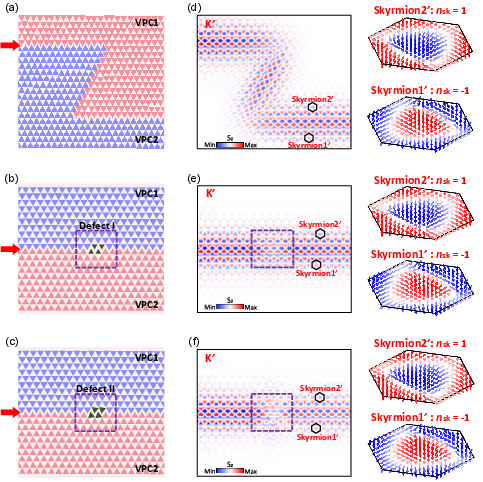
- Robust travel: The skyrmions ride along the protected edge state and keep their shape and skyrmion number:
- through sharp Z‑shaped bends,
- across structural defects (changed rod size or twist),
- over a useful range of frequencies (a bandwidth, not just one exact color).
- All‑dielectric, low‑loss platform: Because this uses dielectric materials (not metals), it avoids strong absorption losses common in plasmonic systems, making long‑distance, on‑chip travel more practical.
Why this matters:
- It turns skyrmions into reliable, on‑chip “information carriers” made of light.
- It provides an easy “switch” (choose K or K′ valley) to set the skyrmion’s polarity for encoding and processing information.
- The topological protection means less signal loss from bends and defects, a big deal for building real devices.
Why this is exciting (the impact)
- For photonic circuits: This approach could lead to compact, robust, and energy‑efficient on‑chip devices that use skyrmions to carry and process data.
- For sensing and metrology: Stable, well‑controlled spin textures can enhance precision measurements.
- For quantum technologies: Topologically protected, structured light could help build more resilient quantum light systems.
In short, the paper presents a practical, chip‑friendly way to generate, guide, and flip optical spin skyrmions with built‑in robustness—bringing topological light patterns a step closer to real, useful photonic technologies.
Knowledge Gaps
Knowledge gaps, limitations, and open questions
Below is a concise list of unresolved issues and concrete opportunities for further research identified from the paper.
- Experimental validation is absent: all results appear numerical; no fabrication, near-field measurements (e.g., NSOM), or far-field readouts are provided to confirm spin textures, skyrmion numbers, or robustness on-chip.
- Operating frequency and scaling ambiguity: the design uses n≈4 dielectric rods and a PEC substrate with a=20 μm and h=3 μm, but the absolute frequency range, wavelength, and intended spectral band (microwave/THz/mid-IR) are not explicitly specified; practical scaling to telecom or visible regimes remains unaddressed.
- Material realism and losses: the PEC substrate is not realistic for optical/IR operation; propagation loss, dielectric absorption/dispersion, metal loss (if any), and radiation leakage in a real platform (e.g., SOI, SiN, III–V) are not quantified.
- Coupling and excitation strategy: selective and efficient excitation of the K vs K′ valley TESs is assumed via a point source; practical in- and out-couplers (e.g., grating, end-fire, near-field tips, chiral/valley-selective antennas) and their efficiencies are not designed or assessed.
- Detection/readout of skyrmions: methods to read and process the on-chip skyrmion information (e.g., near-field SAM mapping, integrated spin- or valley-sensitive detectors, out-coupling to far field with preserved textures) are not proposed.
- Propagation length and power budget: no quantitative estimate of skyrmion transport distance under realistic loss, nor of the minimum field amplitude/power needed to maintain |n_sk| > 0.95 over length and bends.
- Bandwidth and dispersion: while skyrmion numbers are shown vs frequency locally, a comprehensive bandwidth, group velocity, and dispersion analysis for pulses (temporal broadening, distortion of textures) is missing.
- Robustness quantification: robustness is shown qualitatively for a Z-bend and two local defects, but no systematic study of disorder (random positional/rotational/size disorder, surface roughness), intervalley scattering probabilities, or tolerance statistics is provided.
- Valley mixing at bends and junctions: the effect of sharp corners, varying edge terminations, and multiport junctions on intervalley scattering and skyrmion integrity is not analyzed quantitatively.
- Generality to different interfaces: only zigzag interfaces are studied; performance for armchair or mixed edge terminations and arbitrary routing geometries remains unknown.
- Platform transferability: translation of the design to a planar silicon-on-insulator or SiN slab (without PEC) that still provides below-light-cone TES and strong evanescent fields is not demonstrated.
- Skyrmion control beyond polarity: only polarity is controlled via valley selection; methods to tune skyrmion size, density, type (Néel vs Bloch), chirality, and lattice geometry by design parameters (rotation angle, lattice constant, refractive index contrast, height) are not explored.
- Engineering of higher-charge textures: feasibility of multi-quantized skyrmions (|n_sk| > 1), skyrmion bags, or composite topological textures in VPCWs is not investigated.
- 3D field structure: SAM is sampled at z=2 μm; the full 3D evolution of spin textures vs height and along propagation, and sensitivity of n_sk to measurement plane (z) are not mapped.
- Topological protection linkage: a formal argument relating momentum-space topological protection (valley Chern number) to the preservation of real-space skyrmion textures under perturbations is not provided; only numerical evidence is shown.
- Quantification of OAM–SAM coupling: the strength and spatial distribution of local OAM and its conversion to SAM (SOC) are not quantified; dependence on mode profile and evanescent decay length is not analyzed.
- Energy flow and information capacity: no metrics for information encoding density, bit error rates under disorder, or achievable data rates using valley-locked skyrmion streams are provided.
- Crosstalk and interactions: potential interactions, crosstalk, or annihilation/merging between neighboring skyrmions or between the two polarity channels (on opposite sides of the interface) are not studied.
- Network-level components: routing, splitting, and recombining skyrmionic flows at T/Y-junctions, intersections, and topological channel networks are not demonstrated.
- Fabrication tolerances: sensitivity of n_sk and transmission to fabrication errors (triangle rotation angle, side length, lattice pitch, etch depth, sidewall angle) is not evaluated.
- Thermal and environmental stability: effects of temperature, thermal gradients, and cladding refractive index fluctuations on TES dispersion and skyrmion integrity are not considered.
- Nonlinearity and active control: the role of optical nonlinearity (power thresholds, self-action on textures), electro-optic or thermo-optic tuning for dynamic reconfiguration, and reconfigurable valley selection are not addressed.
- Single-photon and quantum regimes: feasibility of valley-locked skyrmions at the few-photon level, impact of quantum noise, and integration with quantum emitters or detectors are only suggested conceptually and not analyzed.
- Metrology and calibration: numerical criteria for skyrmion identification (|n_sk| > 0.95) lack uncertainty analysis; sensitivity of n_sk to mesh resolution, numerical noise, and measurement errors is not reported.
- Absolute performance metrics: figures of merit such as insertion loss, bend loss, skyrmion preservation fidelity vs length/defect density, and device footprint are not quantified.
- Application-level demonstrations: no proof-of-concept of on-chip information processing using skyrmions (e.g., logic, memory, sensing) is implemented on the proposed VPCW platform.
Practical Applications
Immediate Applications
These applications can be prototyped or deployed now using existing photonic-crystal and silicon photonics capabilities, especially in research and advanced development settings.
- Robust skyrmion-carrying on-chip interconnects for photonic integrated circuits (Sector: telecom/datacom PICs, software-defined networking)
- Use: Route optical signals along topological valley edge waveguides that carry spin skyrmions as eigenstates, providing bend/defect-tolerant links between components (lasers, modulators, detectors).
- Tools/products/workflows: Silicon-on-insulator (SOI) valley photonic crystal waveguides; valley-selective grating/metasurface couplers; compact Z-bends; design flows using FDTD/FEM and inverse design; wafer-scale e-beam or DUV lithography.
- Assumptions/dependencies: Operation within a photonic bandgap below the light line; access to valley-selective excitation; low-loss materials at target wavelength (telecom or mid-IR); compatibility with foundry design rules.
- Directional skyrmion polarity encoding and demultiplexing (Sector: optical interconnects, on-chip signal processing)
- Use: Encode bits in skyrmion polarity (±1) locked to propagation direction/valley; demultiplex channels by selecting K vs K′ propagation paths.
- Tools/products/workflows: Valley-addressable input couplers; directional Y-junctions and splitters based on valley Hall topology; skyrmion-aware modulators that flip valley excitation via phase/angle tuning.
- Assumptions/dependencies: Stable valley-selective launching; detection schemes that convert skyrmion polarity to intensity/polarization readouts; phase stability over device length.
- Topologically robust near-field probes for chiral and displacement sensing (Sector: sensing/metrology, healthcare R&D)
- Use: Leverage localized, Nèel-type SAM textures for enhanced near-field chiral interactions, pico-metric displacement sensing, and force mapping with resilience to routing imperfections.
- Tools/products/workflows: Tapered probes or microfluidic interfaces positioned at the VPCW surface; on-chip detectors to transduce SAM-induced signals; calibration routines exploiting polarity switching via valley selection.
- Assumptions/dependencies: Near-field access to evanescent SAM hotspots; stability of SAM distribution under device packaging; appropriate readout (NSOM, integrated photodiodes, polarization optics).
- Robust delivery of structured optical forces for micro/nano-manipulation (Sector: micro-robotics, lab-on-chip)
- Use: Transport optical spin textures along complex paths to apply torque/forces on particles or biomolecules with reduced sensitivity to bends/defects.
- Tools/products/workflows: VPCW networks feeding microfluidic chambers; synchronized valley control to toggle force handedness; integration with optical tweezers modules.
- Assumptions/dependencies: Sufficient field enhancement and SAM magnitude for target particles; biocompatible materials; thermal management.
- Testbeds for topological and skyrmion physics in photonics (Sector: academia/education)
- Use: Classroom and lab demonstrators for SOC-induced spin textures, valley physics, and topological protection on a chip.
- Tools/products/workflows: Scalable VPCW chips with probe stations; NSOM/near-field polarimetry for mapping SAM; open-source design kits and simulation scripts.
- Assumptions/dependencies: Access to micro/nanofabrication or procurement of demonstration chips; standard lab measurement equipment.
Long-Term Applications
These applications require further research on scaling, materials, device-circuit co-design, and/or integration with electronics and quantum systems.
- Skyrmion-based on-chip information processing and arithmetic (Sector: computing/accelerators)
- Use: Implement logic and arithmetic primitives using skyrmion polarity and interactions in topological waveguide networks for perturbation-resilient operations.
- Tools/products/workflows: Skyrmion logic gates (e.g., polarity-controlled interferometers, resonator-based thresholding); photonic control planes for valley routing; error-tolerant coding schemes.
- Assumptions/dependencies: Nonlinear elements or interferometric architectures for logic; compact, low-loss valley routers; system-level architectures and compilers mapping logic to topological networks.
- Quantum photonics interfaces with chiral, topologically protected coupling (Sector: quantum technologies)
- Use: Deterministic routing of emitter spin/valley states via skyrmion-carrying edge modes; robust distribution of entanglement using topologically protected channels with SAM textures.
- Tools/products/workflows: Integration of quantum emitters (e.g., III–V/Si, 2D materials) at SAM hotspots; cryo-compatible VPCWs; on-chip polarization/SAM analyzers; valley-controlled switches.
- Assumptions/dependencies: Spectral matching and Purcell enhancement; suppression of dephasing; low-temperature operation for many emitters; low-loss topological waveguides at quantum wavelengths.
- Skyrmion-polarity reconfigurable photonic memory and neuromorphic elements (Sector: advanced computing, AI hardware)
- Use: Store/weight information in skyrmion polarity along segments; implement reconfigurable synapses by valley-selective control of spin textures.
- Tools/products/workflows: Phase-change or electro-optic materials co-integrated to switch valley excitation or alter local band topology; read/write circuits interfacing polarity to electrical domains.
- Assumptions/dependencies: Nonvolatile, low-energy switching for valley selection; repeatable readout; endurance and retention guarantees.
- On-chip chiral spectroscopy and enantioselective separation (Sector: healthcare/biotech)
- Use: Use robust SAM textures to enhance chiral light–matter interactions for sensing and possibly enantioselective manipulation in microfluidics.
- Tools/products/workflows: Topological waveguides delivering controlled SAM to microchannels; differential measurement by toggling skyrmion polarity; integrated photodetectors/readouts.
- Assumptions/dependencies: Demonstration of measurable chiral signal enhancement; biocompatible, low-absorption platforms in aqueous environments; scalable packaging.
- Multimode/DOF photonic communications using valley and skyrmion states (Sector: telecom/datacom)
- Use: Multiplex data across valley indices and skyrmion polarity for added channel capacity and directionally aware routing on-chip and potentially chip-to-chip.
- Tools/products/workflows: Valley/skyrmion multiplexers/demultiplexers; crosstalk-optimized network topologies; error-correcting codes tailored to topological carriers.
- Assumptions/dependencies: Stable valley selectivity at high data rates; reliable modulation/detection of skyrmion states; packaging and thermal stability.
- Topologically robust optomechanical actuators for microsystems (Sector: MEMS, robotics)
- Use: Convert guided SAM textures into reproducible torques on micro-rotors or resonators with routing resilience.
- Tools/products/workflows: Co-designed optomechanical structures at SAM hotspots; feedback control via valley state switching; system integration with sensors and electronics.
- Assumptions/dependencies: Efficient optical-to-mechanical coupling at chip scale; mitigation of absorption heating; long-term mechanical reliability.
- Standards and reliability metrics for topological photonic devices (Sector: policy/standards, safety-critical systems)
- Use: Define certification and testing protocols for defect/bend tolerance, skyrmion-state integrity, and valley-selective performance in PICs.
- Tools/products/workflows: Benchmark suites (bend radii, defect densities); SAM/skyrmion verification methods; interoperability specs for foundries.
- Assumptions/dependencies: Broad stakeholder engagement (foundries, system integrators); consensus on test methodologies; correlation to field reliability.
- Structured-illumination delivery for imaging and LiDAR-on-chip (Sector: imaging, autonomous systems)
- Use: Deliver robust, structured near-fields to scene/projector interfaces for enhanced contrast or feature extraction; potential direction-locked gating using valley control.
- Tools/products/workflows: VPCW emitters coupled to metasurface out-couplers; electronic control of valley excitation; signal processing leveraging topological robustness.
- Assumptions/dependencies: Efficient out-coupling from below-light-cone modes; beam shaping while preserving skyrmion-derived advantages; eye-safety and power constraints.
Cross-cutting dependencies to monitor
- Material platform translation: Porting from proof-of-concept (metal-backed or PEC-like substrates) to CMOS-compatible SOI or SiN at telecom/visible wavelengths with low loss.
- Valley-selective excitation/detection: Practical grating/metasurface couplers and compact detectors translating skyrmion polarity to electrical signals.
- Fabrication tolerances: Maintaining bandgap and valley Chern-number contrast with rotated anisotropic unit cells at scale; yield across wafers.
- Environmental stability: Thermal drift, dispersion, and packaging stresses affecting valley/TES properties and SAM textures.
- Metrology: Inline, noninvasive tools to verify SAM/skyrmion states in production (beyond NSOM in lab).
Glossary
- All-dielectric: Composed entirely of insulating (non-conductive) materials, avoiding metals. "TESs can be realized in all-dielectric valley photonic crystals (VPCs)"
- Backscattering-immune: Resistant to scattering that would reverse the direction of wave propagation. "backscattering-immune and defect-tolerant robust transmission"
- Band structure: The dispersion relation showing allowed photonic modes versus wavevector in a periodic medium. "VPC1 and VPC2 exhibit an identical band structure"
- Berry curvature: A geometric property in momentum space that influences topological characteristics of bands. "By integrating the Berry curvature of the lower band around K and valleys"
- Bulk bands: The energy (frequency) bands of modes extended through the crystal interior rather than localized at edges. "The light-blue region indicates the CBG of VPC1's bulk bands"
- Bulk states: Photonic modes that occupy the interior (bulk) of the crystal, not the boundary. "black curves and grey areas represent the bands of TES and bulk states, respectively"
- C3 symmetry: Threefold rotational symmetry without mirror planes (point group ). "the symmetry of both VPC1 and VPC2 reduces from to "
- C3v point group symmetry: Threefold rotational symmetry with vertical mirror planes (point group ). "the point group symmetry at K (and ) ensures the degeneracy"
- Complete bandgap (CBG): A frequency range with no propagating bulk modes for any in-plane wavevector. "induces the formation of a complete bandgap (CBG)"
- Degeneracy: The condition where two or more modes share the same frequency. "breaks the degeneracy at point"
- Dielectric rods: High-index insulating pillars that form the lattice of a photonic crystal. "equilateral triangular dielectric rods ()"
- Eigenmodes: The characteristic field distributions (modes) that satisfy the wave equation under given boundary conditions. "the eigenmodes has opposite local orbital angular momentum (OAM)"
- Eigenstates: States corresponding to definite values (eigenvalues) of an operator; here, modes of the system. "exist as eigenstates of the topologically protected edge state"
- Evanescent field: A non-propagating field that decays exponentially away from an interface. "within the evanescent field at the valley photonic crystal surface"
- K valley: One of the inequivalent corners of the Brillouin zone in a hexagonal lattice, hosting valley-specific modes. "for the TES at the valley"
- K′ valley: The valley at the opposite Brillouin zone corner to K, with time-reversed properties. "for the TES at the valley"
- Light cone: The boundary in dispersion where modes transition from guided (below) to radiative (above). "their TESs are located below the light cone"
- Light line: The dispersion line separating guided modes from those that couple to free-space radiation. "The red dashed lines represent light line in air"
- Local orbital angular momentum (OAM): Spatially varying orbital angular momentum associated with the field’s helical phase around local vortices. "the eigenmodes has opposite local orbital angular momentum (OAM)"
- Magneto-optical materials: Media whose optical properties are modified by magnetic fields. "they require neither magneto-optical materials nor pseudo-spin engineering"
- Momentum space: The space of wavevectors (k-space) where band topology is defined. "topological protection in momentum space"
- Néel-type skyrmion: A skyrmion whose in-plane spins point radially (or anti-radially) from the core. "corresponds to a Néel-type skyrmion"
- Perfect electric conductor (PEC): An idealized material with infinite conductivity enforcing zero tangential electric field at its surface. "on a perfect electric conductor (PEC) substrate"
- Phase singularity: A point where field amplitude vanishes and phase is undefined, often the core of a vortex. "Since vanishes at the position of the phase singularity"
- Phase vortex: A swirling phase structure around a singularity characterized by integer topological charge. "The plus and minus symbols represent a phase vortex with a topological charge of 1 and , respectively"
- Photonic analogue of quantum valley Hall effect: A photonic realization of the valley Hall topological phase without magnetic fields. "based on the photonic analogue of quantum valley Hall effect"
- Photonic integrated devices: On-chip optical circuits and components integrated on a substrate. "photonic integrated devices"
- Projected bands: The band structure plotted along a specific momentum direction (e.g., ). "Right panel shows projected bands along direction"
- Pseudo-spin engineering: Designing synthetic spin-like degrees of freedom in photonic systems to mimic electronic spin. "nor pseudo-spin engineering"
- Quantum valley Hall effect: A topological effect where opposite valleys carry opposite Berry curvature leading to valley-polarized edge states. "based on the photonic analogue of quantum valley Hall effect"
- Skyrmion number: A topological invariant quantifying the wrapping of a vector field; the charge of a skyrmion. "i.e. skyrmion number"
- Spin angular momentum (SAM): The part of light’s angular momentum associated with polarization (e.g., circular). "their spin angular momentum (SAM) density can be calculated by"
- Spin–orbit coupling (SOC): Interaction between spin (polarization) and spatial degrees of freedom, producing spin-dependent textures. "the spin-orbit coupling (SOC) within the evanescent vortex field"
- Stokes vectors: A four-parameter representation describing the state of polarization of light. "and Stokes vectors"
- Surface plasmon polaritons: Surface-bound electromagnetic waves at metal–dielectric interfaces coupling photons to charge oscillations. "tailored interference fields of surface plasmon polaritons"
- Time-reversal symmetry (TRS): A symmetry under time reversal that pairs states at K and K′ with opposite properties. "due to time-reversal symmetry (TRS)"
- Topological charge: An integer quantifying the winding of a phase or vector field around a singularity. "a phase vortex with a topological charge of 1 and "
- Topological edge states (TESs): Boundary-localized modes protected by the nontrivial topology of the bulk bands. "Topological photonic crystals (TPCs) support robust topological edge states (TESs)"
- Topological invariant: A quantity (e.g., Chern number) that remains unchanged under continuous deformations of the system. "quantized topological invariant, i.e. skyrmion number"
- Topological photonic crystals (TPCs): Photonic crystals engineered to host nontrivial band topology and protected edge modes. "Topological photonic crystals (TPCs)"
- Topological protection: Robustness of modes or textures against perturbations due to topological constraints. "Benefitting from the topological protection of TESs"
- Transverse magnetic-like (TM-like) mode: A mode resembling TM polarization, with dominant magnetic field transverse to propagation. "the transverse magnetic-like (TM-like) mode at K and point"
- Valley Chern number: A topological invariant defined by integrating Berry curvature around each valley (K/K′) and taking their difference. "the existence of TESs can be predicted by the valley Chern number"
- Valley degree of freedom: The label distinguishing modes associated with inequivalent valleys (K and K′) in the Brillouin zone. "Leveraging the valley degree of freedom of topological edge states"
- Valley edge state: An edge mode arising from valley-dependent topology (valley Hall effect). "topologically protected valley edge state"
- Valley photonic crystals (VPCs): Photonic crystals with broken inversion symmetry supporting valley-dependent topological phenomena. "valley photonic crystals (VPCs)"
- Valley-locked: A property where a quantity (e.g., skyrmion polarity) is tied to the valley index or propagation direction. "we further realize valley-locked spin skyrmions"
- Vorticity: The winding or circulation of in-plane vector fields around a point. "the in-plane spin vectors possess a non-zero vorticity"
- VPC waveguide (VPCW): A waveguide formed at the interface of two valley photonic crystals supporting valley-polarized edge states. "valley photonic crystal waveguide (VPCW)"
- Zigzag interface: An interface along the zigzag crystallographic direction in a hexagonal lattice. "with zigzag interface"
Collections
Sign up for free to add this paper to one or more collections.

