- The paper introduces a unified framework that overcomes traditional positivity constraints by using temporal quasiprobabilities to reconstruct multi-time quantum processes.
- The paper employs a quantum snapshotting protocol with sequential measurements and a temporal Bloch expansion to achieve an informationally complete reconstruction of temporal state operators.
- The paper derives rigorous sample complexity bounds, enabling efficient characterization of non-Markovian dynamics and temporal quantum correlations.
Temporal State Tomography via Quantum Snapshotting of Temporal Quasiprobabilities
Introduction and Motivation
Quantum tomography provides the operational foundation for characterizing unknown quantum states and processes. Traditional quantum state tomography applies to spatial density matrices, while process tomography describes quantum channels, with distinct procedures dictated by the positivity of density operators and the complete positivity of channels. However, increasingly sophisticated quantum experiments motivate the reconstruction of quantum processes with temporal correlations, prompting a unified formalism that encompasses both quantum states and channels, as well as their evolution across multiple time steps.
This paper introduces the framework of temporal state tomography (TST), realized through the experimental reconstruction of temporal quasiprobability distributions (TQDs). By leveraging the TQD formalism, which generalizes classical and spatial quasiprobabilities to the time domain, the authors establish a systematic methodology for reconstructing full multi-time quantum processes. The proposed approach resolves significant operational and technical hurdles: most notably, temporal states are not positive semidefinite operators, which invalidates traditional quantum state tomography approaches predicated on positivity. The solution is a quantum snapshotting protocol that builds up informationally complete TQDs via experimentally feasible sequential measurements and classical postprocessing.
The temporal state formulation introduces a tensor product structure across different time slices, generalizing the multipartite density operator formalism from spatial to temporal correlations and placing timelike and spacelike correlations on equal footing. The key object is the temporal state operator Υtn⋯t0, living in the Hilbert space Htn⊗⋯⊗Ht0, encoding both state information at each time and the intervening quantum channels.
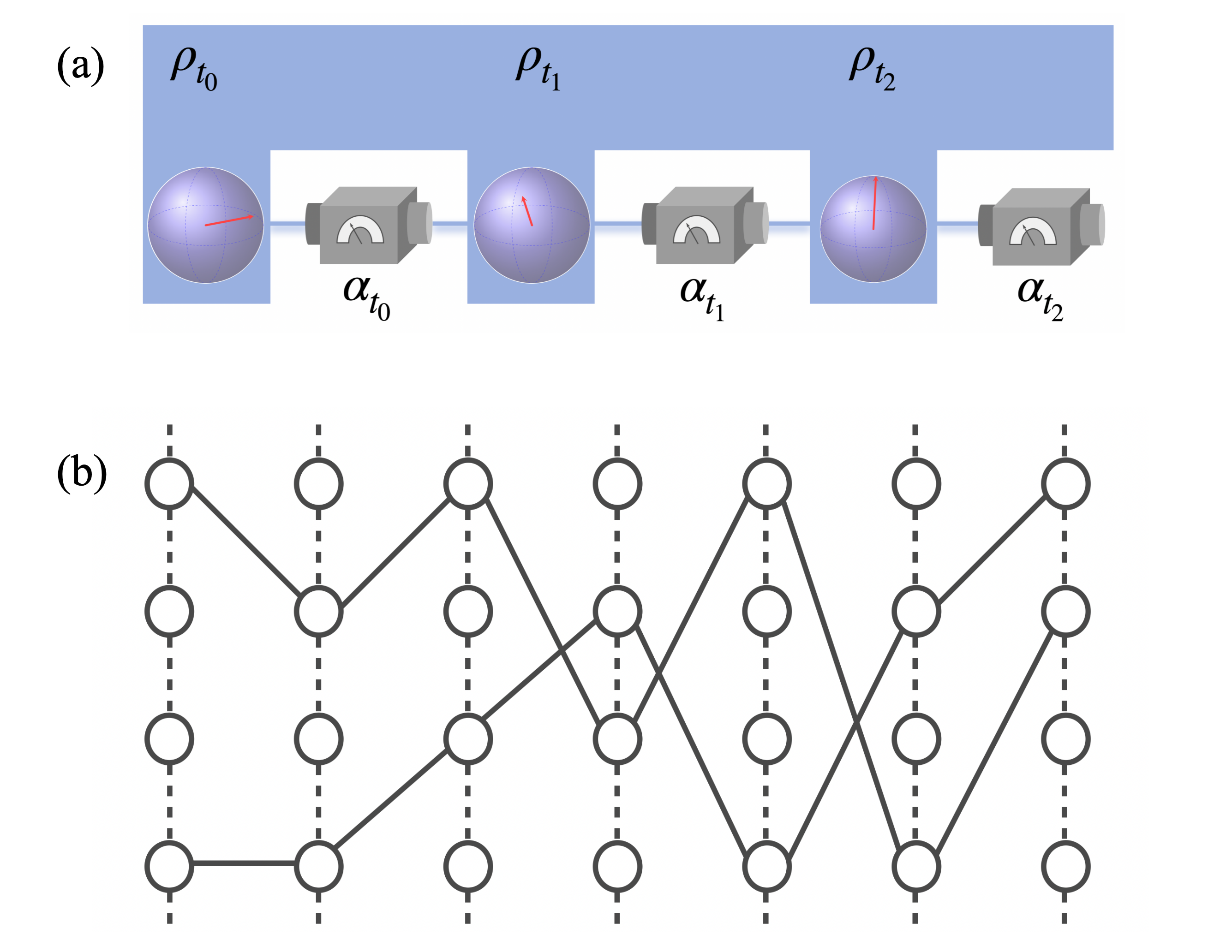
Figure 1: (a) Temporal quantum states generalize the multipartite density operator formalism to the time domain, enabling a unified description of quantum systems with both timelike and spacelike correlations. (b) By selecting an appropriate phase space at each time step, one can construct a temporal phase space; each quantum trajectory within this temporal phase space is associated with a corresponding temporal quasiprobability distribution that encodes temporal quantum correlations.
The temporal quasiprobability distribution (TQD) is defined over the temporal phase space—i.e., tuples of phase space points (βn,…,β0) labeling measurement events at each time slice—assigning complex (possibly negative) “quasiprobabilities” to each quantum trajectory. This generalizes the Wigner function and the Kirkwood-Dirac and Margenau-Hill distributions to incorporate multi-time quantum correlations and nonclassical features. For informationally complete TQDs, the temporal state operator can be reconstructed via an operator-valued temporal Bloch expansion, ensuring that all observable temporal correlations are faithfully captured.
The TQD satisfies a Kolmogorov consistency condition analogously to the spatial case: for any subset of times, the corresponding marginal TQD is a valid quasiprobability distribution consistent with the quantum reduction postulate. This ensures that reduced descriptions at intermediate times are consistent with the global temporal process.
Quantum Snapshotting Protocol for TQD Reconstruction
A central technical challenge is that the projectors or phase-space operations defining the TQD are, in general, not physically implementable quantum operations (they may not even be positive or Hermiticity-preserving). The paper circumvents this by showing, using a generalized Choi-Jamiołkowski and quantum instrument construction, that any such (possibly nonphysical) operation can be decomposed as a complex linear combination of physically implementable, completely positive trace-nonincreasing (CPTNI) quantum instruments.
By performing an informationally complete set of sequential quantum instrument measurements (the "quantum snapshotting procedure"), one collects classical data that, when appropriately postprocessed, yields samples of the desired TQD. This approach is scalable across time steps and does not require direct implementation of nonphysical operators at any point in the experiment. The explicit protocol:
- Constructs a basis of CPTNI maps corresponding to an informationally complete positive-operator-valued measure (IC-POVM) on the enlarged phase space.
- Expresses each phase-space operation as a (possibly complex) linear combination of these maps.
- Performs sequential measurements at each time step, followed by classical postprocessing to reconstruct all temporal quasiprobabilities required for the TQD.
- Uses the TQD to reconstruct the temporal state operator via a temporal Bloch-type expansion, obtaining a full classical description of the quantum multi-time process.
Temporal State Tomography: Problem Definition and Solution
The TST problem is formally posed as reconstructing a classical description Υ′ of an unknown temporal state Υ given N experimental copies, such that with probability 1−δ the reconstruction error ∥Υ′−Υ∥ does not exceed ε, with respect to natural Schatten norms. In the single-time (spatial) limit, traditional state tomography is recovered.
Key advances:
- Unification: The TST framework simultaneously reconstructs density operators (states at individual times) and dynamical maps (quantum channels between times) as operator marginals or temporal “slices” of the reconstructed Υ.
- Parametrization: By representing Htn⊗⋯⊗Ht00 in terms of the initial state and Choi matrices of the dynamical maps, TST enables tractable optimization of the reconstruction, relying on the well-characterized structure of density operators and CPTP maps.
- Generality: The framework supports left/right/doubled Kirkwood-Dirac and Margenau-Hill TQDs, showing that different choices of phase-space operations naturally yield the variety of temporal state formalisms in the literature.
Statistical Efficiency and Sample Complexity
A critical quantitative contribution is the derivation of sample complexity bounds for TST. By mapping the reconstruction of Htn⊗⋯⊗Ht01 to an informationally complete tomography problem in the operator space Htn⊗⋯⊗Ht02, standard techniques yield the scaling:
- For Htn⊗⋯⊗Ht03 total measurement settings across all time steps:
Htn⊗⋯⊗Ht04
- For local Hilbert space dimension Htn⊗⋯⊗Ht05, Htn⊗⋯⊗Ht06, giving:
Htn⊗⋯⊗Ht07
This matches the parametric dependence of spatial informationally complete tomography, with the crucial difference that the state operator being reconstructed need not be positive semidefinite. The quantum snapshotting protocol ensures that, despite this, the concentration of the empirical temporal state about the true Htn⊗⋯⊗Ht08 is governed solely by classical statistical fluctuations.
Distinctive Claims and Theoretical Implications
- Strong claim: Any temporal quasiprobability distribution is accessible as the output of a fixed quantum instrument measurement protocol and classical postprocessing, providing a direct route to operational experimental access for all formalisms in the operator tensor, pseudo-density operator, and process tensor traditions.
- Contradistinction: Contrary to standard state/process tomography assumptions, positivity is not a prerequisite for faithful reconstruction of quantum temporal processes.
- Unified framework: The TST protocol provides a common operational substrate for tomography of quantum states, quantum channels, higher-order processes, and non-Markovian dynamics; it also supports direct analysis of the nonclassical features (such as negativity or contextuality) of temporal correlations.
The protocol introduces the potential for sharper analysis of resources in spatiotemporal quantum information, especially regarding tradeoffs among memory effects (non-Markovianity), nonclassical temporal features (negativity of TQD), and statistical efficiency in tomography and estimation.
Outlook and Future Directions
The methodology establishes a foundation for experimental protocols aimed at reconstructing temporal quantum processes in quantum simulation, open quantum system characterization, or quantum computation architectures with nontrivial noise correlations over time. Practical extensions may involve:
- Optimal quantum instrument bases for minimal sample complexity in temporal state tomography.
- Sharper complexity bounds analogous to compressed sensing and shadow tomography advancements in the spatial regime.
- Comparisons with process tensor and quantum comb tomography [Antesberger2024highertomography, Li2025combtomography].
- Exploration of nonclassicality in temporal quasiprobabilities and its impact on the information-theoretic and resource-theoretic aspects of tomography and inference.
The operational accessibility of TQDs may also provide practical diagnostic and control tools for quantum technologies that operate far outside the Markovian regime.
Conclusion
This work introduces and analyzes temporal state tomography via quantum snapshotting of temporal quasiprobabilities as an operationally robust, informationally complete scheme for reconstructing quantum multi-time processes. By integrating advanced formal tools with implementable experimental protocols, the framework captures the full generality of timelike quantum correlations while quantifying statistical resources, fundamentally advancing the theory and practice of quantum process characterization.
References:
(2605.02655) Temporal State Tomography via Quantum Snapshotting the Temporal Quasiprobabilities.
Antesberger et al., "Higher-Order Process Matrix Tomography of a Passively-Stable Quantum Switch" (Antesberger et al., 2023).
Li et al., "Quantum Comb Tomography via Learning Isometries on Stiefel Manifold" (Li et al., 2024).
Jia et al., "Temporal Kirkwood-Dirac Quasiprobability Distribution and Unification of Temporal State Formalisms through Temporal Bloch Tomography" (Jia et al., 8 Jan 2026).

