- The paper introduces a framework using Hermitian self-orthogonality to construct quantum rank-metric codes that eliminate geometry restrictions.
- It integrates Gabidulin MRD codes with the Matsumoto-Uyematsu transformation to map classical codes into effective stabilizer quantum codes.
- The construction doubles the relative minimum rank distance compared to traditional CSS methods, enhancing error correction in stacked quantum memories.
Construction of Quantum Rank-Metric Codes Using Hermitian Orthogonality
Introduction and Motivation
Quantum error correction (QEC) is indispensable for large-scale quantum computation, where mitigating the effects of errors is a core challenge. The stacked quantum memory architecture arranges physical qubits in vertical layers, supporting dense layouts and efficient implementation of Clifford circuits. In this model, errors are naturally described with a rank-metric, motivating the search for quantum codes with efficient rank-based error correction.
Previous work applied the Calderbank-Shor-Steane (CSS) construction to Gabidulin codes—a class of classical Maximum Rank Distance (MRD) codes—yielding so-called quantum Gabidulin codes for stacked quantum memories (Delfosse et al., 2024). However, this approach encountered two critical limitations. First, the existence of a self-dual normal basis for the necessary CSS orthogonality conditions restricts applicability to memories whose layers and cells are both odd and equal in number, and only for square arrays. Second, the ratio of the minimum rank distance (relative to code length) is limited.
This paper addresses these constraints by introducing a novel framework for constructing quantum rank-metric codes from classical Gabidulin codes using Hermitian self-orthogonality, leveraging both the algebraic properties of self-dual bases in extension fields of even degree and the Matsumoto-Uyematsu code construction method. The proposed scheme significantly enhances the relative minimum rank distance and removes restrictions on array shape and size, thereby broadening the applicability of quantum rank-metric codes.
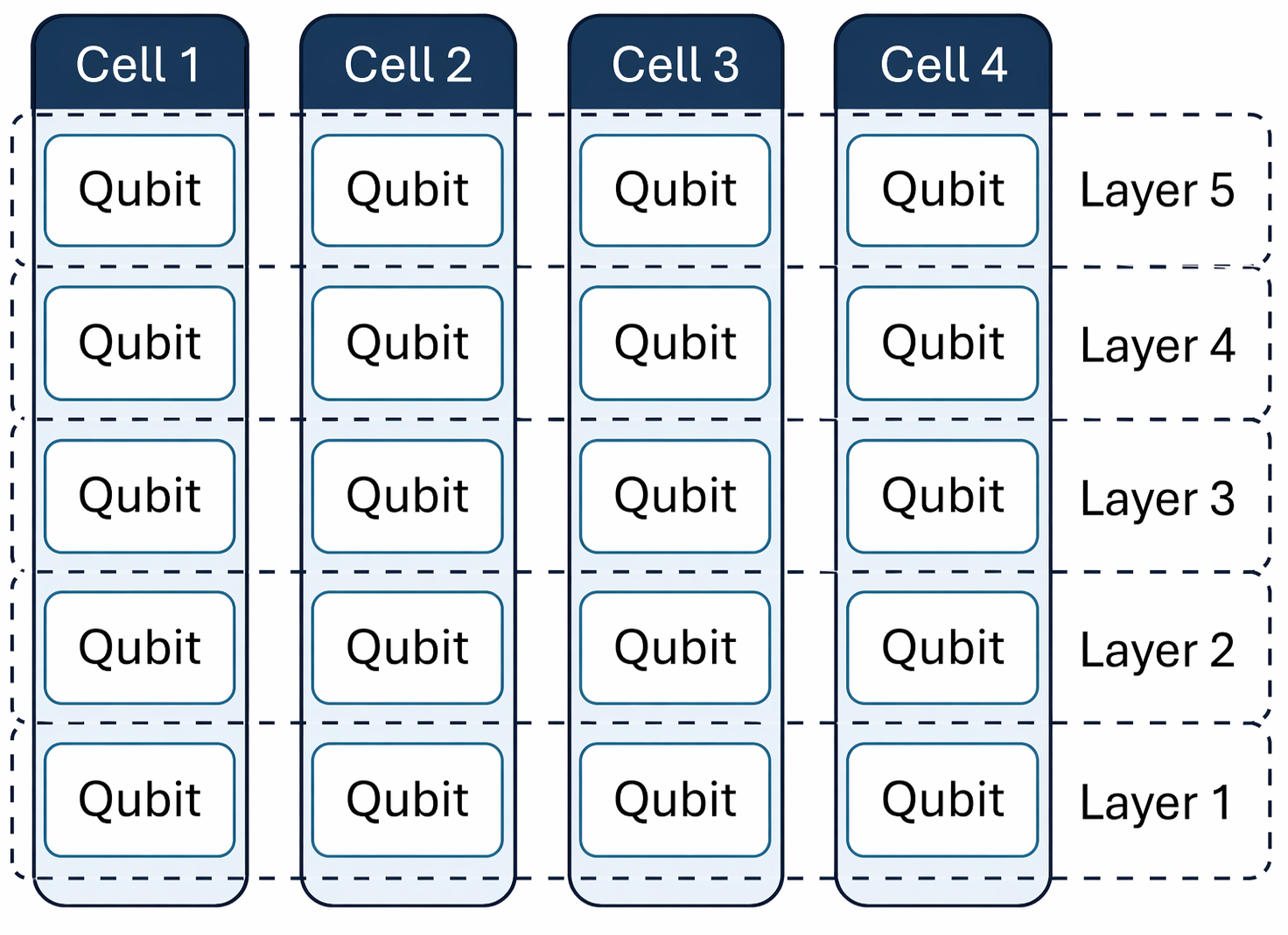
Figure 1: Conceptual diagram of a stacked quantum memory (m=5,n=4).
Background: Rank-Metric Codes and Stacked Quantum Memory
Stacked quantum memory consists of m layers of n physical qubits, with each vertical "cell" comprising m qubits. Quantum errors propagating in this architecture exhibit structure that is efficiently captured by the rank metric: each error operator is mapped to an m×2n matrix over F2 using Pauli-to-binary vector encodings. The rank of the error matrix (over F2) quantifies its impact, dictating the code's error-correcting capabilities.
Gabidulin codes are MRD codes defined over extension fields, with minimum rank distance d=m−k+1 for code dimension k. Their algebraic structure provides optimal rank distance, underpinning their use in quantum error correction. Recent advances demonstrated that Gabidulin codes can be Hermitian self-orthogonal when defined over self-dual bases of even extensions, as shown by Islam and Horlemann [IEEE Trans. Inf. Theory, 2023].
Quantum Code Construction from Symplectic Self-Orthogonal Codes
The stabilizer formalism constructs quantum codes from commutative subgroups of the n-qubit Pauli group. Commutation of generators is guaranteed if their binary vector representations (via isomorphisms from Pauli matrices) are symplectically self-orthogonal. Let m0 be a classical code with m1, where m2 is the symplectic inner product. Then the corresponding quantum code encodes m3 logical qubits into m4 physical qubits with minimum rank distance dictated by the minimum rank in m5.
Constructions founded on this paradigm must ensure suitable self-orthogonality, with conventional CSS-based rank-metric codes relying on trace inner products and self-dual normal bases.
Limitations of Previous (CSS) Quantum Gabidulin Codes
Quantum Gabidulin codes constructed via CSS require m6 square layouts with m7 odd, given the existence criteria for self-dual normal bases over m8. Orthogonality and duality under the trace inner product further restrict admissible code parameters. As a result, memories with even dimensions or rectangular layouts are excluded, and flexibility in code design is severely hampered.
Moreover, the code rate m9 and relative distance n0 (for memory of size n1) provide a baseline for error correction capacity, but additional improvements are constrained by the algebraic limitations of the CSS construction.
Proposed Construction: Hermitian Orthogonality and Matsumoto-Uyematsu Method
The core advance of this work is the synthesis of Hermitian self-orthogonal Gabidulin codes with the Matsumoto-Uyematsu quantum code construction. When the extension degree of the underlying field is even, self-dual bases over n2 always exist [Wan, 2003]. For n3, Gabidulin codes n4 satisfy Hermitian self-orthogonality for n5, i.e., n6, with the Hermitian inner product.
Via the isomorphism n7 described by Matsumoto and Uyematsu [IEICE, 2000], these codes are mapped to binary vector spaces that are symplectically self-orthogonal:
- The code n8 generates the corresponding stabilizer group for a quantum code acting on n9 stacked memories.
- The minimum rank distance is preserved under this embedding and equals m0, inherited from the MRD property of Gabidulin codes and the structure-preserving nature of the m1 mapping.
- The code encodes m2 logical qubits into m3 physical qubits, with no restrictions on parity or layout shape.
The compelling consequence is a doubling of the relative minimum rank distance over the previous CSS construction for comparable code rates and physical qubit counts, as well as complete removal of shape/parity restrictions.
Detailed Example
For m4 and m5, the construction proceeds explicitly:
- m6 constructed using a primitive polynomial m7.
- Self-dual and normal bases chosen for expansion; Gabidulin code m8 constructed.
- The Matsumoto-Uyematsu transformation yields a binary self-orthogonal code mapped into m9.
- The resultant stabilizer code m×2n0 is generated by 4 independent Pauli operators, giving a m×2n1 quantum rank-metric code.
The table below summarizes the comparison between the conventional (CSS) and proposed Hermitian-based constructions. For a fixed minimum rank distance m×2n2 and comparable number of physical qubits:
| Parameter |
CSS (m×2n3) |
CSS (m×2n4) |
Proposed (m×2n5) |
| Physical Qubits m×2n6 |
m×2n7 |
m×2n8 |
m×2n9 |
| Logical Qubits F20 |
F21 |
F22 |
F23 |
| Minimum Rank Distance F24 |
F25 |
F26 |
F27 |
| Code Rate F28 |
F29 |
F20 |
F21 |
| Relative Distance F22 |
F23 |
F24 |
F25 |
Notably, the proposed construction achieves approximately double the relative minimum rank distance F26 compared to the CSS construction, while offering nearly the same code rate F27 and eliminating oddness and squareness constraints on the array dimensions.
Theoretical and Practical Implications
The framework generalizes the stabilizer formalism to accept codes derived via Hermitian self-orthogonality, removing arduous algebraic restrictions on memory geometry. The doubling of relative minimum rank distance directly increases the tolerable number of faulty Clifford gates for a fixed logical capacity—a critical engineering parameter. Furthermore, this flexibility in code parameters, including applicability to even-sized and non-square memories, greatly simplifies physical design and potential implementation of stacked quantum memories.
From a theoretical standpoint, the mapping from Hermitian self-orthogonal MRD codes via Matsumoto-Uyematsu preserves rank-metric properties essential for practical QEC, suggesting further exploration of other field characteristics and self-orthogonality modalities may yield additional code families beyond Gabidulin codes.
Future Research Directions
Potential avenues include:
- Exploration of alternative MRD code constructions with Hermitian self-orthogonality conditions for application to quantum error correction.
- Extension to non-binary fields or heterogeneous stacking modes to further generalize the architecture.
- Analysis of syndrome decoding algorithms and their circuit complexity in the context of the new codes.
- Investigation into the application of these constructions in fault-tolerant logical gate synthesis and transversal implementations.
Conclusion
This work demonstrates that by combining Hermitian self-orthogonal Gabidulin codes with the Matsumoto-Uyematsu quantum code construction, quantum rank-metric codes for stacked quantum memory can be built with improved error correction capability and fewer design constraints. The removal of parity restrictions and the increase in the relative minimum rank distance represent substantial advancement for practical QEC deployment in architectures where dense layer/cell arrangements are advantageous. This framework widens the utility and robustness of quantum error correction in near-term and large-scale stacked quantum memory systems.
Reference: "Construction of Quantum Rank-Metric Codes Using Hermitian Orthogonality" (2605.02571)