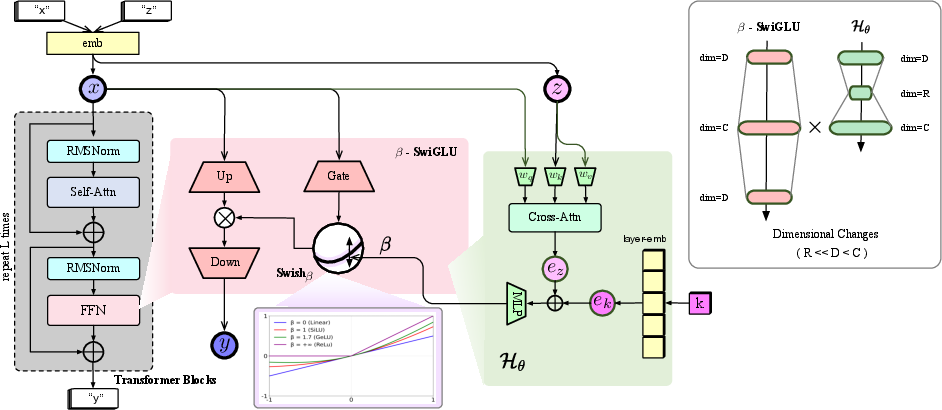
- The paper introduces MeGan, a novel meta-gating mechanism that uses hypernetworks to adapt large language models to arbitrary textual conditions without retraining the backbone.
- It leverages neuro-inspired gain control and β-SwiGLU activations to achieve parameter-efficient, context-sensitive modulation across various tasks and domains.
- Empirical results show MeGan outperforms conventional methods with significant gains in ROUGE-L, BLEU-2, and accuracy across multiple benchmarks.
Hypernetwork-Driven Meta-Gating for Arbitrary Textual Conditioning in LLMs
Motivation and Neuro-Inspired Paradigm
The paper "Learn-to-learn on Arbitrary Textual Conditioning: A Hypernetwork-Driven Meta-Gated LLM" (2605.01973) addresses the inherent limitations of LLMs in dynamic adaptation to nuanced textual conditions (e.g. task, domain, persona, style, sentiment). Standard finetuning yields catastrophic forgetting and alignment tax, whereby adaptation to new contexts compromises global capabilities. The authors propose MeGan, a paradigm modeled after neuroplasticity with neuromodulator-driven gain control: a hypernetwork computes meta-signals from condition inputs to steer the gating of FFN activations in the LLM backbone.
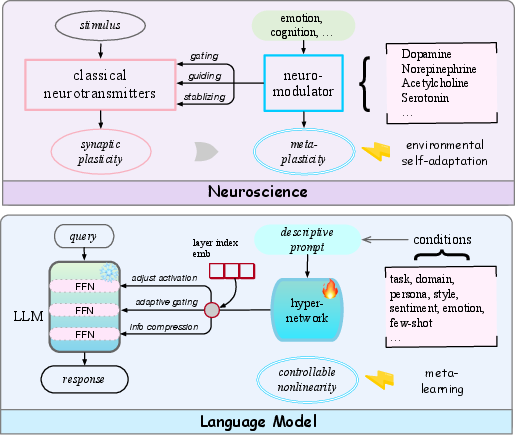
Figure 1: The MeGan paradigm, with a hypernetwork meta-controlling LLM FFN gating, analogous to neural systems with neuromodulator-driven synaptic meta-plasticity.
This neuro-inspired intervention replaces static self-gating with meta-gating, providing context-sensitive modulation of the FFN block nonlinearity—a mechanism aligning with the neuronal f-I curve, and empirically linked to semantic encoding in earlier MLP layers.
MeGan is compared to four principal meta-learning paradigms for LLMs: adapter-based PEFT, meta-in-context learning, LoRA-based adaptation, and text-driven hypernetwork architectures. Unlike text-to-LoRA hypernetworks—which generate LoRA weights from task descriptions—MeGan produces meta-gating signals (parameter β) per layer, enabling fine-grained modulation in β-SwiGLU FFNs without altering the backbone parameters.
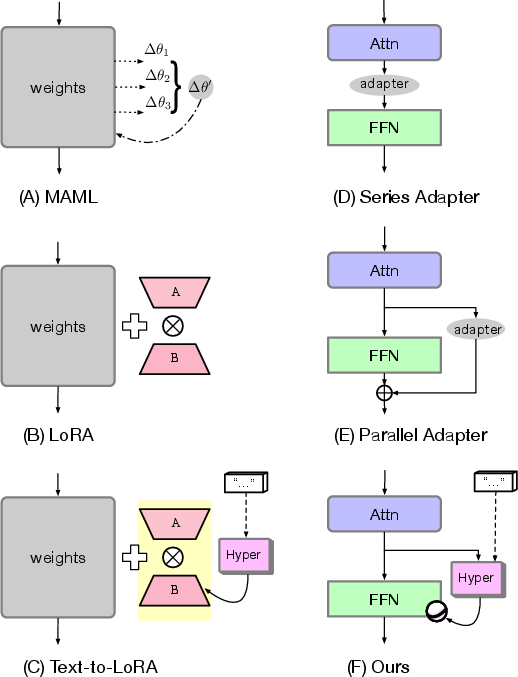
Figure 2: Comparative analysis of LLM meta-learning paradigms, highlighting the distinctiveness of MeGan’s hypernetwork-driven meta-gating architecture.
The core MeGan structure consists of:
Methodological Details
MeGan formalizes meta-learning over arbitrary textual conditions z, thus broadening the scope beyond task-specific meta-learning. Data triples (x,y,z) are constructed, allowing MeGan to adaptively generate outputs conditioned on z (e.g., style, persona, domain) at inference.
The β0-SwiGLU FFN block generalizes SiLU activation to β1, where the hypernetwork projects β2 and layer index β3 into β4 using cross-attention and bias-free MLP. The information bottleneck reduces β5 then projects to β6, enforcing compression and modularity in control signals.
The training objective is a linear combination of cross-entropy (SFT) and β7 regularization on β8 to constrain deviation, ensuring stable training dynamics.
Experimental Validation
MeGan is evaluated on diverse datasets spanning persona (Persona-Chat), domain (AdaptSum), task (CrossFit/UnifiedQA, SNI), style (GYAFC, MIC), and sentiment (SST, Amazon, IMDB). Baselines include ICL, CoT, Plan-and-Solve, Metacognitive Prompting, LoRA, SFT, meta-in-context approaches, meta-LoRA, and Text-to-LoRA. MeGan consistently outperforms all baselines on adaptation metrics (ROUGE-L, BLEU-2, accuracy), both in low-resource and unseen tasks:
- Persona-Chat: MeGan achieves 23.15 R-L, outperforming Text-to-LoRA (21.75) and LoRA (21.35)
- AdaptSum: MeGan reports 41.85 R-L, significantly surpassing MLtD and SFT baselines
- CrossFit/UnifiedQA: Average performance of 72.2% in LR and 70.9% in unseen tasks, well above MetaICL and LoRA
- SNI benchmarks: Highest average accuracy over 10 general benchmarks
Scalability is demonstrated with consistent performance across model sizes on Persona-Chat/GYAFC, validating robustness under parameter constraints.
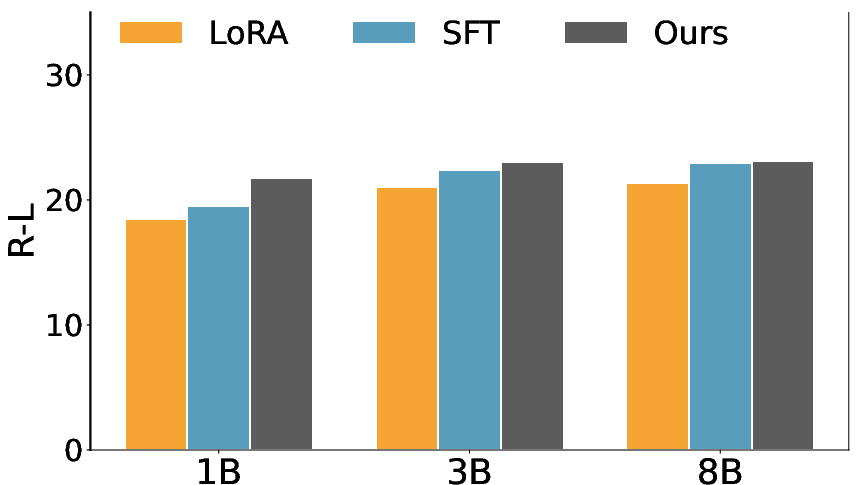
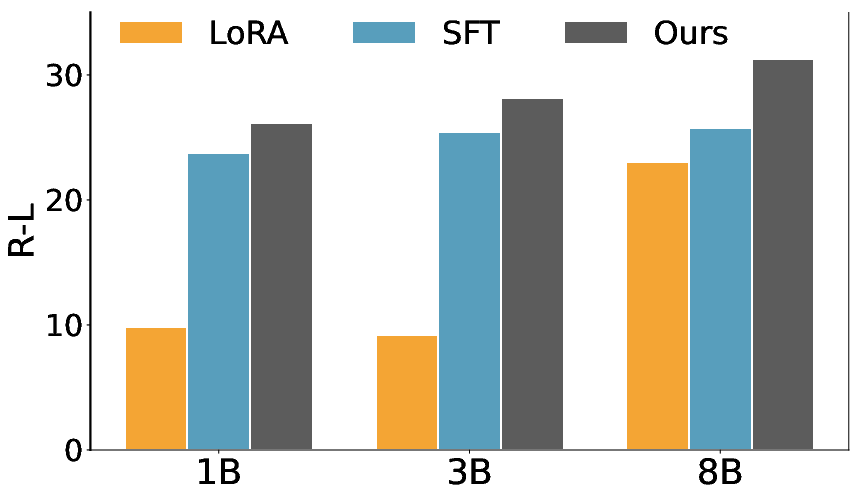
Figure 4: Model scalability across parameter ranges for low-resource and zero-shot datasets.
Distributional analysis of β9 across textual conditions reveals strong semantic alignment and adaptive modulation. For sentiment, β0 centers between β1 and β2, indicating nonlinearity encoding consistent with human intuition.
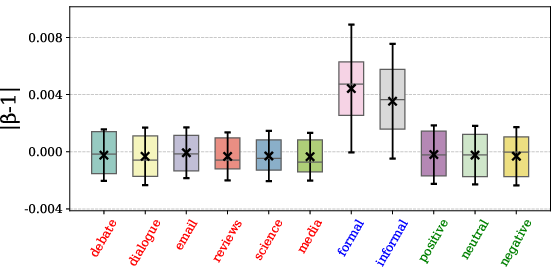
Figure 5: Distribution of β3 by textual condition: meta-gating dynamically customizes FFN activation slopes.
t-SNE visualization confirms domain-aware grouping of β4 for AdaptSum and GYAFC, signifying layerwise adaptation to semantic context.
Layerwise Modulation
Layerwise averaging of β5 demonstrates increasing nonlinearity with depth, correlating with heightened abstract semantic representation—a finding consistent with prior activation patching studies.
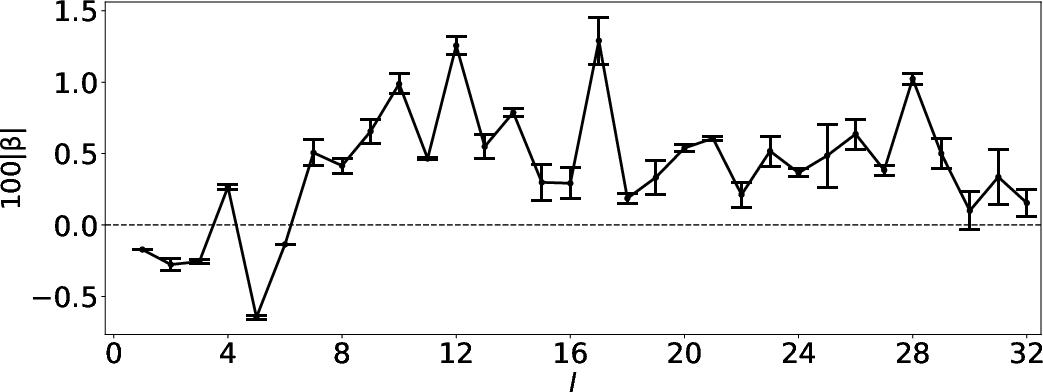
Figure 6: Layer-dependent modulation of β6 for nonlinearity in FFN blocks.
Ablation and Case Analysis
Ablation studies confirm necessity of meta-prompt, layer embedding, and regularization. Removal of any component degrades adaptation performance. Sample cases showcase MeGan’s generation quality and consistency under diverse arbitrarily conditioned prompts.
Practical and Theoretical Implications
MeGan introduces meta-control at the activation-function level, yielding parameter-efficient, context-sensitive adaptation for LLMs without retraining. The neuro-inspired paradigm supports:
- Universal adaptation across arbitrary textual conditions, not constrained to structured task descriptions
- Fine-grained, interpretable modulation via activation nonlinearity, enhancing control over stylistic, domain, persona-based, and affective outputs
- Robustness against catastrophic forgetting and alignment tax
Practically, this enables deployment of LLMs in personalized systems, expert-level emotional support agents, and multi-task dialog settings with swift, controlled adaptation. Theoretically, this underpins advances in meta-plasticity modeling and layered information bottleneck utilization. Future directions may include expanding the meta-gating mechanism to other architectural elements (e.g., attention, recurrent modules), integrating richer semantic embeddings, or exploring cross-domain transfer with compressed hypernetworks.
Conclusion
MeGan advances LLM meta-learning by equipping frozen backbones with a hypernetwork-driven meta-gating mechanism for layerwise activation control. Its parameter-efficient design, robust performance across heterogeneous tasks and conditions, and neuro-inspired architecture positions it as a versatile model for learn-to-learn across arbitrary textual contexts. The paper delivers strong empirical evidence that meta-gating of FFN nonlinearity, modulated by semantic hypernetworks, yields superior generalization and adaptation in LLMs (2605.01973).