DP-SfM: Dual-Pixel Structure-from-Motion without Scale Ambiguity
Abstract: Multi-view 3D reconstruction, namely, structure-from-motion followed by multi-view stereo, is a fundamental component of 3D computer vision. In general, multi-view 3D reconstruction suffers from an unknown scale ambiguity unless a reference object of known size is present in the scene. In this article, we show that multi-view images captured using a dual-pixel (DP) sensor can automatically resolve the scale ambiguity, without requiring a reference object or prior calibration. Specifically, the defocus blur observed in DP images provides sufficient information to determine the absolute scale when paired with depth maps (up to scale) recovered from multi-view 3D reconstruction. Based on this observation, we develop a simple yet effective linear method to estimate the absolute scale, followed by the intensity-based optimization stage that aligns the left and right DP images by shifting them back toward each other using cross-view blur kernels. Experiments demonstrate the effectiveness of the proposed approach across diverse scenes captured with different cameras and lenses. Code and data are available at https://github.com/lilika-makabe/dp-sfm-tpami.git
Paper Prompts
Sign up for free to create and run prompts on this paper using GPT-5.
Top Community Prompts
Explain it Like I'm 14
DP‑SfM: Dual‑Pixel Structure‑from‑Motion — A simple explanation
What’s this paper about?
This paper shows a new way to measure real‑world sizes in 3D models made from photos. Usually, when a computer builds a 3D scene from many pictures, it can get the shape right but not the actual scale — it’s like having a map without a scale bar. The authors use a special kind of camera sensor, called a dual‑pixel (DP) sensor, to automatically figure out the true scale (how big things really are) without needing a ruler or a known object in the scene.
1) Brief overview
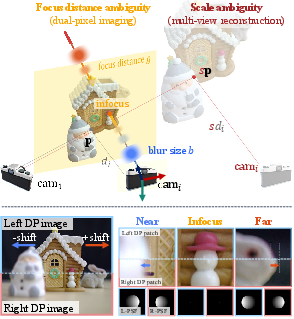
When you reconstruct 3D from multiple photos (a process called Structure‑from‑Motion, or SfM, plus Multi‑View Stereo, MVS), the result is “correct up to scale.” That means the scene could be the right shape but could be toy‑sized or life‑sized — the system can’t tell. This paper solves that “scale ambiguity” by using dual‑pixel images, which contain tiny left‑and‑right views inside every pixel. Those views reveal how out‑of‑focus each point is. The amount and direction of blur relate to how far things are, and the authors combine that with the 3D model to recover the actual scale.
2) Key questions the paper asks
- Can we figure out the true size of a 3D scene from photos without putting a ruler or known object in the shot?
- Can dual‑pixel blur information (how much parts of the image are out of focus) be combined with a normal 3D reconstruction to fix the scale?
- Can this work across different cameras (DSLRs and phones) and different lenses and settings?
3) How the method works (explained simply)
Here’s the idea using everyday language and analogies:
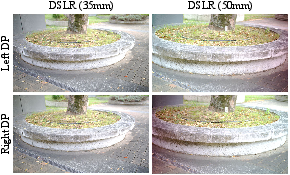
- Dual‑pixel cameras: Imagine each pixel has two tiny “eyes,” one on the left and one on the right. When the scene is perfectly in focus at a certain distance, both eyes see the same thing. When something is closer or farther than that focus distance, each eye sees a slightly shifted, blurrier version — like looking through two tiny windows. The difference between the two tells you how much blur there is and whether the object is in front of or behind the focus plane.
- Normal 3D from photos (SfM + MVS): This builds a 3D shape from many pictures, but it doesn’t know whether the scene is small or large. Think of it as a 3D model that could be scaled up or down like a model kit — the shape is correct, but the overall “zoom” is unknown.
- The key math idea (in plain terms):
- Blur amount relates to how far a point is from the camera’s chosen focus distance.
- Depth from SfM relates to true depth, but only up to an unknown scale (a single “zoom” factor).
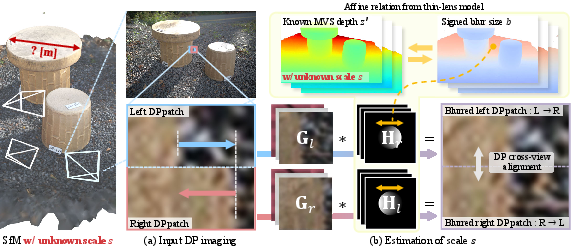
- The authors show that if you connect “blur amount” with “1/depth,” you get a simple relationship (basically a line) that depends on two unknowns: the scene’s scale and the camera’s focus distance for each photo.
- They use many image patches (small areas) across several views to “fit the line,” which lets them solve for both the true scale and the per‑photo focus distances.
- Two‑step solution:
- Measure blur sizes from DP images for selected patches.
- Combine those blur sizes with the 3D depths (which are still only up to scale).
- Solve a set of simple linear equations to get an initial guess of the true scene scale and the focus distances.
- 2) Refinement (align the two tiny views):
- They simulate the blur that should happen for a guessed scale, then “re‑blur” and compare the left and right tiny images.
- They pick the scale that makes those left/right patches line up best (smallest difference).
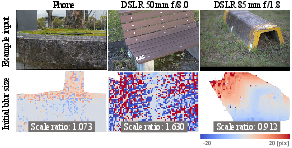
- This step helps correct errors from the first step and makes the final scale more accurate.
- Extra touches to make it robust:
- They carefully choose only the best views and patches (places with enough blur and depth change) to avoid being fooled by bad data.
- Using multiple aperture settings (like f/1.8, f/4, f/8 on a DSLR) provides different blur amounts of the same scene, which makes the solution more stable.
- They handle camera differences (DSLRs and phones) and small image artifacts by normalizing patch intensities.
4) Main findings and why they matter
Here are the main results, summarized:
- It works across different devices:
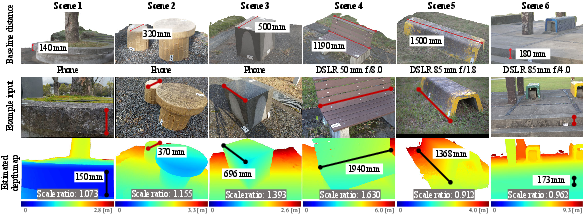
- Tested on a Canon DSLR with several lenses and on a Google Pixel phone.
- The method consistently recovered the absolute scene scale without any measuring tools placed in the scene.
- It’s accurate:
- Average scale error was about 15% using single‑aperture captures.
- When combining multiple aperture settings of the same scene, the error dropped to about 10%.
- It beats popular “metric depth” models:
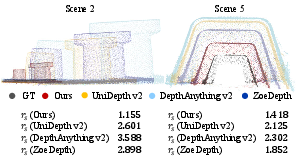
- Compared to modern single‑image depth estimators (like UniDepth v2, DepthAnything v2, and ZoeDepth), this method gave much smaller scale errors (around three times better on their tests).
- Clear examples:
- The paper shows real‑world scenes where the recovered distances (like the baseline between cameras in the 3D model) match ground truth quite well.
Why this matters:
- SfM/MVS alone cannot solve scale — that’s a known limitation.
- This paper provides a practical, camera‑only way to fix it, using a sensor feature (dual‑pixels) already found in many cameras and phones. That’s a big deal for fields like photogrammetry, AR/VR, 3D scanning, and robotics.
5) Implications and impact
- No need for rulers or known objects: You can get true sizes just by taking DP images from different viewpoints.
- Works with off‑the‑shelf gear: Many modern cameras and some smartphones already have dual‑pixel sensors.
- Better 3D for real applications: Accurate scale improves mapping, measuring, and placing virtual objects at the right size in the real world.
- What could be improved:
- The method needs some defocus (blur). If everything is sharply in focus (small blur), it’s harder to estimate scale.
- Blur estimation can fail on very smooth or repetitive textures.
- If the initial 3D reconstruction (SfM) fails (e.g., very low texture or reflections), scale estimation is also difficult.
- Future work could combine this with other cues or improve blur estimation to handle tougher scenes.
In short, this paper shows a clever way to turn a long‑standing limitation (“how big is it really?”) into a solvable problem by using the tiny left‑and‑right views hidden inside every dual‑pixel image.
Knowledge Gaps
Knowledge gaps, limitations, and open questions
The paper proposes a dual‑pixel based method to resolve scale ambiguity in SfM/MVS and evaluates it on a small set of DSLR and smartphone scenes. The following unresolved issues and gaps remain:
- Assumption of known and fixed intrinsics:
- Impact of errors in focal length, pixel pitch, and aperture (f‑number vs. true T‑stop) on the estimated scale is not analyzed.
- The paper ignores focus‑dependent intrinsics (focus breathing) and the small shift in the center of projection due to defocus; the magnitude of induced bias on scale is unquantified.
- Thin‑lens and PSF modeling fidelity:
- The method relies on paraxial and thin‑lens approximations and a simplified, symmetric, circular PSF; how non‑ideal lens behavior (coma, astigmatism, vignetting, field curvature) biases scale estimates is not examined.
- Spatial PSF variation across the field and color‑channel dependence (chromatic aberration) are not modeled beyond per‑patch normalization; the benefit of explicit aberration/PSF calibration remains unexplored.
- Dependence on defocus and scene content:
- Performance degrades for pan‑focus images or small apertures (smartphones), yet there is no demonstrated strategy for extremely weak defocus (e.g., outdoor scenes, large depth, high f‑number).
- Robustness to low‑texture, repetitive patterns, specularities, and motion blur—identified failure modes for both blur estimation and SfM—is not systematically quantified or mitigated.
- Reliance on blur‑size estimation:
- The pipeline still depends on per‑patch blur sizes from an external method; sensitivity of the final scale to systematic or spatially varying errors in those estimates is not characterized.
- There is no evaluation of alternative blur/disparity estimators or learned DP‑based blur estimators and their impact on scale accuracy.
- Optimization design and identifiability:
- The final intensity‑based stage searches only over the global scale while freezing per‑view focus distances due to instability; conditions or regularizations that would enable stable joint refinement of scale and focus distances are not explored.
- The discrete search range is fixed around the initial guess; failure modes when the initial scale is far from the truth, and strategies for global optimization or multi‑start refinement, are not analyzed.
- Patch and view selection:
- The patch selection and view filtering heuristics (e.g., blur variation thresholds, “top T%” patches) are only described in the supplement; lack of ablations leaves unclear how these choices affect bias/variance and failure rates.
- The assumption of constant depth within a patch and the effect of depth gradients or mixed in‑/out‑of‑focus content on the regression and alignment objectives are not assessed.
- Coupling with SfM/MVS quality:
- Sensitivity of scale estimates to SfM/MVS depth noise, baseline, and reconstruction biases is not quantified (e.g., how much inverse‑depth noise can be tolerated before regression becomes unstable).
- The method presumes access to reliable multi‑view poses and depth up to scale; pathways to exploit DP cues earlier (e.g., to improve SfM robustness or to jointly solve poses/scale) are not investigated.
- Camera and ISP factors:
- The approach assumes access to DP sub‑views (often proprietary) and RAW‑like processing; generality to other devices, different DP geometries, or ISP pipelines is not established.
- The observed spatially varying, channel‑dependent artifacts are handled via patch normalization; more principled radiometric or geometric calibration of DP views (e.g., left–right gain/shading mismatch, sub‑aperture misalignment) is not developed or evaluated.
- Generalization and dataset limitations:
- Experiments cover six scenes with a single DSLR body (three lenses) and one smartphone; there is no evaluation on outdoor scenes, wide depth ranges, extreme lighting, or highly reflective/translucent materials.
- The method is not validated on additional DP devices or sensors with different pixel pitches/baselines, limiting claims of generality.
- Comparison baselines:
- No empirical comparison is provided against prior defocus‑based absolute scale methods (e.g., varifocal/defocus‑SfM hybrids); only monocular metric depth methods are compared.
- The benefit of DP over single‑view defocus cues (without DP) for this scale task is not isolated.
- Quantitative reporting and uncertainty:
- The paper reports mean absolute relative error of scale ratios but does not provide confidence intervals, per‑scene variance, or uncertainty estimates on s.
- There is no analysis of how many views/patches are needed to reach a target accuracy or how error scales with apertures, focus distances, and scene depth distribution.
- Practical constraints and applicability:
- The method relies on sufficient defocus variation across views/patches; practical capture guidance (e.g., focus bracketing policies, minimal depth range) is not formalized.
- Multi‑aperture gains are shown with tripod captures at fixed viewpoints; feasibility under hand‑held capture, rolling shutter, or slight inter‑aperture pose changes is not studied.
- Computational aspects:
- Runtime, memory cost, and scalability (number of views/patches, image resolution) are not reported; suitability for large‑scale photogrammetry or on‑device usage remains unclear.
- Downstream impact:
- The paper validates scale accuracy but does not quantify improvements in downstream metrics (e.g., absolute 3D point accuracy, mesh errors, or metric camera trajectories) after scale correction.
- Reproducibility:
- Critical implementation details (patch selection, thresholds, PSF parameterization specifics, ISP/RAW handling) are deferred to the supplement; until the promised code/data release, full reproducibility is uncertain.
These gaps suggest concrete avenues for future work: calibrating and modeling lens/PSF non‑idealities, robust joint scale–focus optimization, principled patch/view selection, tighter coupling with SfM, capture policies for weak‑defocus regimes, broader device/scene coverage, and richer uncertainty and ablation analyses.
Practical Applications
Immediate Applications
The paper introduces DP‑SfM, a method that resolves the absolute scale ambiguity in multi‑view 3D reconstruction by leveraging dual‑pixel (DP) defocus blur and thin‑lens modeling, with a linear initialization and a cross‑view intensity alignment refinement. The following applications can be deployed now when DP imagery and standard SfM/MVS pipelines are available.
- Photogrammetry software add‑on for metric 3D reconstruction (Software, AEC/Construction, Surveying, Cultural Heritage)
- Use case: Produce scaled 3D models without targets/GCPs by ingesting DP image pairs alongside standard photos in tools like COLMAP, Metashape, or RealityCapture.
- Tools/products/workflows:
- A DP‑SfM plugin/SDK that estimates global scale from DP views and injects it into existing SfM/MVS pipelines.
- Workflow: capture with DP camera (record aperture/focal length metadata), run standard SfM/MVS, then apply DP‑SfM scale estimation and rescale outputs.
- Assumptions/dependencies: DP sensors (e.g., Canon EOS, Google Pixel with DP readout); access to left/right DP views; known intrinsics and aperture per frame; sufficient defocus variation (wider apertures or scenes with depth range); textured surfaces for SfM and DP blur estimation.
- Scaled site documentation without scale bars (AEC/Construction, Insurance, Forensics, Cultural Heritage)
- Use case: Quickly document rooms, façades, accident or crime scenes with metric accuracy using handheld DP cameras, avoiding manual placement of scale references.
- Tools/products/workflows: A field app guiding capture settings (e.g., aperture wide open, focus bracketing if possible) and validating defocus/texture sufficiency; automated report with scaled measurements.
- Assumptions/dependencies: Static scenes; minimal motion blur; adherence to capture guidelines ensuring some out‑of‑focus content; regulatory acceptance where applicable (for forensics).
- Smartphone 3D scanning with true scale (Consumer, E‑commerce, Interior Design)
- Use case: Capture scaled 3D models of objects/furniture for resale listings or space planning with DP‑enabled phones.
- Tools/products/workflows: A mobile app that records DP images and returns a scaled mesh/point cloud; export to USDZ/GLB with embedded metric scale.
- Assumptions/dependencies: Phone DP API access for left/right views; scenes with noticeable defocus (use portrait/large aperture modes); user guidance for best aperture and focus; good lighting.
- Robotics/SLAM scale recovery when DP cameras are present (Robotics, Drones)
- Use case: Resolve monocular VO/VIO scale drift by incorporating DP‑SfM’s scale estimate from a short multi‑view window.
- Tools/products/workflows: ROS node or C++ module that periodically estimates absolute scale from buffered DP frames and corrects the SLAM pipeline.
- Assumptions/dependencies: DP sensor on the robot; short static intervals or low‑motion segments to avoid motion blur; known intrinsics and aperture logging; sufficient texture.
- VFX and matchmoving with metric camera tracks (Media/Film)
- Use case: Derive accurate metric camera paths and scene dimensions for CGI integration using DP‑enabled rigs without on‑set calibration objects.
- Tools/products/workflows: DP‑SfM exporter integrated with matchmove software to inject scene scale and camera distances.
- Assumptions/dependencies: DP capture on set; aperture choices that yield some defocus; stable SfM feature tracks.
- Academic benchmarking and data collection with ground‑truth scale (Academia)
- Use case: Create metric‑scale 3D datasets without laser scanners or scale bars; validate reconstruction algorithms under known scale.
- Tools/products/workflows: Use the authors’ code to post‑scale reconstructions; incorporate multi‑aperture captures to improve accuracy.
- Assumptions/dependencies: DP hardware; reproducible capture protocols; logging lens/aperture values.
- Quick measurement from photos (Daily life)
- Use case: Ad‑hoc measurement of distances (e.g., shelf width, package size) from a short DP photo set instead of a tape measure.
- Tools/products/workflows: Lightweight app that takes 3–5 DP photos and returns measurements with uncertainty bounds.
- Assumptions/dependencies: DP phone; visible depth contrast producing defocus; user feedback on capture angles and aperture.
Long‑Term Applications
These applications require broader DP hardware availability, deeper integration, real‑time performance, or further research to address noted limitations (e.g., pan‑focus scenes, low texture, DP artifacts).
- Real‑time metric visual odometry using DP cues (Robotics, AR/VR, Drones)
- Use case: Continuous metric scale estimation in monocular VO/SLAM pipelines using DP disparity/defocus, reducing dependence on IMU/LiDAR for scale.
- Tools/products/workflows: Embedded DP‑aware VO algorithms; GPU‑accelerated DP PSF modeling; joint optimization of poses, depths, and scale.
- Assumptions/dependencies: DP streams at video rate; robust blur/disparity estimation under motion; accounting for rolling shutter and photometric changes; improved models beyond thin‑lens approximation.
- DP‑informed NeRFs and radiance‑field reconstructions with absolute scale (Software, AR/VR, Digital Twins)
- Use case: Train NeRFs directly at metric scale using DP blur constraints and per‑view focus distances.
- Tools/products/workflows: Differentiable rendering layers incorporating DP PSFs; joint training of scene radiance and scale.
- Assumptions/dependencies: Adaptation of DP‑SfM loss to continuous fields; stable estimation under sparse views; standardized DP data formats.
- Camera firmware and capture protocols for “metric photogrammetry” modes (Imaging Hardware, Smartphones)
- Use case: Built‑in camera modes that auto‑select aperture/focus strategies to maximize DP scale observability and tag metadata for downstream reconstruction.
- Tools/products/workflows: Firmware features for controlled focus bracketing/multi‑aperture capture; standardized EXIF for per‑shot aperture/focus distance proxies.
- Assumptions/dependencies: OEM support for DP data and metadata; power/latency budgets; user experience considerations.
- Standards and guidelines for scaled documentation without targets (Policy, Public Safety, Insurance)
- Use case: Agency/insurer SOPs accepting DP‑based scaled reconstructions as evidence/documentation when physical scale bars are impractical.
- Tools/products/workflows: Validation protocols, uncertainty reporting, and audit trails; certification of capture apps/devices.
- Assumptions/dependencies: Broad validation studies across devices/scenes; legal/regulatory buy‑in; clear capture requirements (aperture, number of views, texture).
- Low‑texture and pan‑focus robustness via multi‑aperture/varifocal capture (Software, Imaging Hardware)
- Use case: Reliable scaling in scenes with small apertures or limited defocus by fusing shots across apertures or small focus sweeps.
- Tools/products/workflows: Automated multi‑aperture/focus capture sequences; joint estimation across settings (as shown to improve accuracy in the paper).
- Assumptions/dependencies: Fast aperture/focus control; alignment under small pose variations; motion compensation.
- E‑commerce and industrial metrology pipelines with guaranteed scale (Retail, Manufacturing, Logistics)
- Use case: Scaled product models for online listings; dimensional checks in QA using handheld DP cameras.
- Tools/products/workflows: Web services that verify metric scale from DP photo sets; integration with PIM/PLM systems.
- Assumptions/dependencies: Standardized DP image ingestion at scale; capture QA; device diversity calibration.
- Training data generation and self‑supervised depth with metric scale (Academia, ML for Vision)
- Use case: Use DP‑SfM to create large metric‑scale datasets for training monocular depth/pose networks without LiDAR.
- Tools/products/workflows: Data pipelines combining SfM/MVS with DP‑based scale labels; curriculum learning using multi‑aperture scenes.
- Assumptions/dependencies: Diverse DP datasets; handling DP artifacts and lens‑dependent PSFs; domain generalization.
- Expanded hardware ecosystems (Drones, Action Cameras, Industrial Inspection)
- Use case: Adoption of DP sensors in UAVs and rugged cameras to unlock target‑less scaled reconstructions in field operations.
- Tools/products/workflows: Hardware roadmaps adding DP pixels; SDKs exposing DP sub‑aperture streams and lens metadata.
- Assumptions/dependencies: OEM adoption; size/weight/power trade‑offs; environmental robustness.
- Forensic AR overlays with metric scale (Public Safety, AR/VR)
- Use case: On‑scene AR measurement and reconstruction with DP‑assisted scale, enabling accurate overlays without fiducials.
- Tools/products/workflows: AR apps combining DP‑SfM scale with on‑device SLAM for live dimensioning and annotations.
- Assumptions/dependencies: Real‑time DP processing on mobile; standardized evidence capture; user training.
Notes on feasibility across applications:
- Core dependencies: DP sensors with accessible left/right views; known per‑shot intrinsics and aperture; scenes providing some defocus and texture; compatibility with existing SfM/MVS.
- Performance considerations: Multi‑aperture inputs markedly improve accuracy; motion blur, repetitive textures, and pan‑focus scenes reduce reliability.
- Modeling assumptions: Thin‑lens and paraxial approximations; PSF parameterization tied to blur radius; per‑patch normalization mitigates color/shift artifacts but does not remove all lens‑specific issues.
- Data access: Some phones/cameras restrict DP readout; OEM/API support is a gating factor for consumer and real‑time use cases.
Glossary
- Absolute scale: The true metric scale of a reconstructed scene, as opposed to a reconstruction known only up to a multiplicative factor. "the defocus blur observed in DP images provides sufficient information to determine the absolute scale"
- Affine relationship: A linear relationship with an added constant term between variables (e.g., y = ax + b). "the estimated blur size and (inverse) depth from SfM and MVS have an affine relationship"
- Aperture (f-number): A measure of the lens opening that controls light and depth of field; lower f-numbers mean larger apertures and shallower depth of field. "camera intrinsics, such as focal lengths and aperture sizes (f-numbers), are known"
- Camera intrinsics: Internal camera parameters (e.g., focal length, principal point, distortion) that map 3D rays to image coordinates. "the scale ambiguity in SfM is inherent even with known camera intrinsics"
- Cross-view loss: An objective that compares two views (here, left/right DP images) after applying modeled blur to encourage alignment. "the per-patch blur size is estimated from the DP image patches ... by minimizing the cross-view loss:"
- Defocus blur: The image blur that occurs when objects are out of focus relative to the focal plane of the lens. "the defocus blur observed in DP images provides sufficient information to determine the absolute scale"
- Defocus disparity: The apparent shift between sub-aperture images induced by defocus, proportional to blur size in DP imaging. "It is known that the signed defocus blur size b ∈ ℝ is proportional to the defocus disparity d between two views"
- Depth-from-defocus: A technique that estimates scene depth by analyzing the amount of defocus blur under known or modeled optics. "Calibrated depth-from-defocus is used with SfM-based depths to recover the absolute scale"
- Dual-Pixel (DP) sensor: An image sensor where each pixel has two photodiodes (left/right), enabling sub-aperture views for estimating defocus. "multi-view images captured using a dual-pixel (DP) sensor can automatically resolve the scale ambiguity"
- Euclidean world coordinate system: A 3D coordinate system with Euclidean geometry used to express camera and scene parameters. "we can set the intrinsics to be identity and write the 3D-to-2D perspective projection in some Euclidean world coordinate system as"
- Focus distance: The distance at which the lens is focused; it determines which depths are sharp and the magnitude/sign of defocus blur. "the blur sizes depend on the unknown focus distance"
- Frobenius norm: A matrix norm equal to the square root of the sum of the absolute squares of its elements, often used to measure image differences. "and is the Frobenius norm"
- Ground Control Points (GCPs): Points with known real-world coordinates used to provide metric scale and alignment in reconstructions. "such as markers and ground control points (GCPs), which is widely employed in commercial photogrammetry software"
- Homogeneous coordinates: A coordinate system used in projective geometry that facilitates perspective projection and transformations. "projected to the corresponding 2D point in the homogeneous coordinates"
- Iteratively Reweighted Least Squares (IRLS): A robust optimization method that solves a sequence of weighted least squares problems to handle outliers. "We use the Iteratively Reweighted Least Squares~(IRLS) method"
- LiDAR: A sensing technology that measures distance using laser light to obtain metric depth directly. "or using LiDAR are typical examples"
- Monocular depth estimation: Predicting depth from a single RGB image, often via learned priors, potentially providing metric scale. "recent learning-based methods use monocular depth estimation providing absolute scale"
- Multi-view stereo (MVS): A technique that reconstructs dense 3D geometry from multiple images using known camera poses. "Subsequently, multi-view stereo~(MVS) uses the estimated camera poses to reconstruct the dense shape of the scene."
- Odometry: The estimation of change in position over time, often from motion sensors, used to provide scale or motion constraints. "and odometry information are also widely used in robotics applications."
- Pan-focus images: Images shot with deep depth of field (small aperture) such that most of the scene is in focus. "scale estimation from pan-focus images becomes challenging."
- Paraxial approximation: An optical simplification that considers small-angle rays near the optical axis, making lens equations linear. "using the paraxial and thin-lens approximations."
- Perspective projection: The mapping from 3D points to 2D image coordinates through a pinhole model, causing size/distance-dependent scaling. "write the 3D-to-2D perspective projection"
- Photogrammetry: The science of making measurements from photographs, often to produce maps or 3D reconstructions. "widely employed in commercial photogrammetry software."
- Point Spread Function (PSF): A function describing how a point source is imaged (blurred) by an optical system; determines defocus blur shape. "DP's disparity gives effective cues to estimate the Point Spread Functions (PSFs) of defocus blurs"
- RANSAC: A robust estimation technique that fits models by iteratively sampling data subsets and rejecting outliers. "such as RANdom SAmple Consensus (RANSAC)"
- Scale ambiguity: The inability to recover absolute size from projective images alone; reconstructions are only determined up to a global scale factor. "multi-view 3D reconstruction suffers from an unknown scale ambiguity"
- Sensor pitch: The physical size of a pixel on the image sensor, used to convert optical blur size to pixel units. "p∈R is the sensor pitch"
- SO(3): The special orthogonal group of 3×3 rotation matrices representing 3D rotations. "formed by a rotation matrix "
- Structure-from-Motion (SfM): The process of estimating camera motion and a sparse 3D structure from multiple images. "structure-from-motion~(SfM) estimates camera poses and sparse 3D tie points of the scene."
- Sub-aperture: A portion of the lens aperture used to form a separate view; DP sensors provide left/right sub-aperture images. "Each pixel on a DP sensor has two photodiodes to acquire two sub-aperture views."
- Thin-lens model: An idealized lens model that relates object distance, image distance, and focal length, used to predict defocus blur. "the thin-lens model described in #1{eq:focas_distance_ambiguity}"
Collections
Sign up for free to add this paper to one or more collections.