- The paper demonstrates that integrating target-aware spectral analysis with time-frequency modeling significantly enhances CTR prediction by isolating low-entropy user interest signals.
- It introduces a dual-branch architecture that combines FFT-based frequency filtering with Transformer-based sequential modeling to improve noise resilience and capture periodic behaviors.
- Empirical results on Tmall, Taobao, and Alipay datasets confirm FEDIN’s superior AUC and GAUC performance over baseline models, validating its practical effectiveness.
Frequency-Enhanced Deep Interest Network: Integrating Target-Aware Spectral Analysis for Robust CTR Prediction
Introduction
The task of Click-Through Rate (CTR) prediction underpins the operational efficacy of recommender systems by mapping historical user-item interactions to actionable relevance signals. Despite the progress of sequential models, including RNN- and Transformer-based architectures, in recovering temporal dependencies from behavior sequences, their sensitivity to behavioral noise and inability to robustly extract periodic signals remain open issues. Traditionally, frequency-domain modeling—utilizing FFT and learned spectral filters—has been proposed to inject global denoising and periodicity recognition into the modeling stack. However, prior work applies frequency analysis in a target-agnostic manner and consequently fails to effectively disambiguate the multi-modal, polymorphic structure of human interests in relation to the candidate item.
This study introduces the Frequency-Enhanced Deep Interest Network (FEDIN), a dual-branch framework that proposes a target-aware spectral filtering mechanism to condition the frequency-domain analysis on the specific candidate item, empirically demonstrating that true user interests manifest as low-entropy, high-resonance patterns in the frequency domain only under the correct conditioning. Systematic ablation, robustness, and hyperparameter analyses on public benchmarks establish both the necessity of target-aware frequency modeling and the superiority of a hybrid time-frequency integration.
Empirical Spectral Analysis of User Attention
The foundational empirical observation motivating the FEDIN architecture is that attention scores—computed under target conditioning—exhibit clear differences when projected into the frequency domain. Specifically, positive target samples align with low-entropy, highly-resonant spectral profiles, while negative samples are dominated by high-entropy diffuse energy indicative of white noise. This empirical property motivates constructing a spectral denoising path that is contextually modulated by the target item, rather than operating in an unconditional regime.
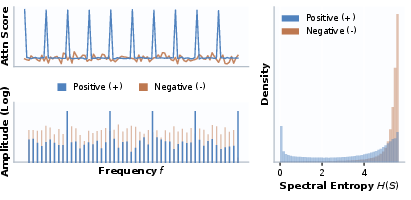
Figure 1: Target-conditioned spectral patterns demonstrate concentrated resonance and lower entropy for positive samples, and high entropy for negative samples.
FEDIN Architecture: Dual-Branch Time-Frequency Modeling
FEDIN adopts a dual-branch architecture, integrating both time-domain sequential modeling and frequency-domain resonance extraction. The user-item interaction matrix and the target item embedding are first normalized with RevIN to ensure stationary representations. The two modeling paths then proceed as follows:
- Time-Domain Branch: Target attention is applied as a coarse filter, producing a weighted, temporal sequence. This is segmented into patches to support local sequential modeling via a Transformer encoder, balancing granularity and context capture. The mechanism is robust to pointwise noise but vulnerable to long-range periodic corruption.
- Frequency-Domain Branch: Target attention scores are computed and transformed via FFT to produce a target-conditioned spectrum. A learnable complex-valued MLP acts as a spectral filter, dynamically suppressing high-entropy frequencies and amplifying dominant resonant peaks that align with user interests. An adaptive scaling gate (dependent on output entropy) modulates the contribution of the frequency path according to the confidence in periodic resonance.
The outputs of both branches are linearly summed and further aggregated using a Top-k Target Attention mechanism, retaining only the most salient candidate histories. This strategy focuses the representation on high-confidence, target-relevant histories and mitigates the risk of "interest dilution" seen in conventional softmax-based approaches.
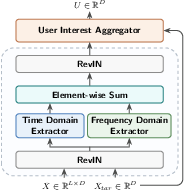
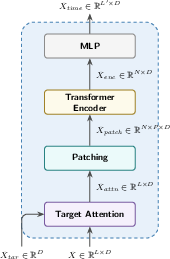
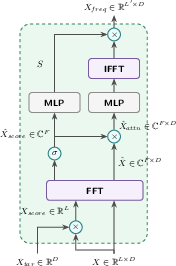
Figure 2: The overall architecture of FEDIN, highlighting parallel time- and frequency-domain extraction modules, target-aware spectral filtering, and the dynamic aggregator.
Experimental Results
FEDIN achieves superior results across three large-scale public CTR datasets: Tmall, Alipay, and Taobao. When compared to state-of-the-art baselines covering sum-pooling, attention-based, recurrent, and Transformer models (DIN, DIEN, SASRec, BERT4Rec, GRU4Rec, BST) as well as prior frequency analysis models (DIFF), FEDIN consistently outperforms in both AUC and GAUC metrics. Performance gains are statistically significant (p< 0.05), most pronounced on datasets (Tmall, Taobao) where periodic behavioral patterns are abundant.
Ablation Analysis
Ablation shows removing either the time-domain or frequency-domain branch results in significant degradation, confirming complementarity. Ablating the target-aware frequency transformation (i.e., reverting to target-agnostic spectral analysis as in prior works) yields systematic performance drops, validating the empirical hypothesis that target conditionality is essential for discriminating between signal and noise in the spectrum. Removal of adaptive resonance scaling also impacts robustness, signaling that dynamic gating according to confidence in detected periodicity is beneficial.
Hyperparameter Study
Empirical results on the Taobao dataset indicate that patch size and Top-k have nuanced impacts: excessive fragmentation (small patch size, small k) degrades context modeling, while overly coarse settings allow noise and spurious signals to propagate. There exists an optimum regime balancing diversity and denoising.
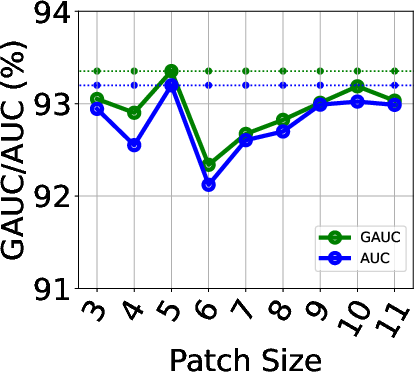
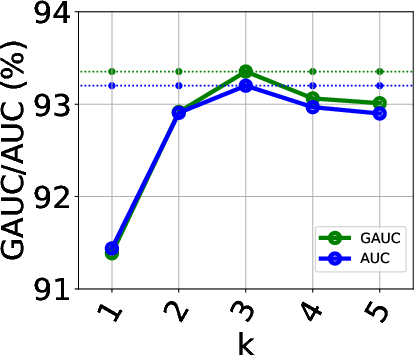
Figure 3: Hyperparameter sensitivity analysis for patch size and Top-k on Taobao; both excessively small and large values reduce AUC and GAUC.
Noise Resistance
Under synthetic noise (random drop or replace of user actions), the frequency branch demonstrates strong resistance, maintaining stable performance even as corruption rates increase, whereas the time domain branch degrades rapidly. This supports the claim that periodic interest signals, extracted via target-aware spectral filtering, are robust to the stochasticity and sparsity inherent in real user logs.
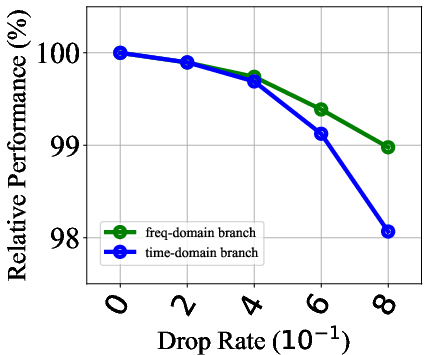
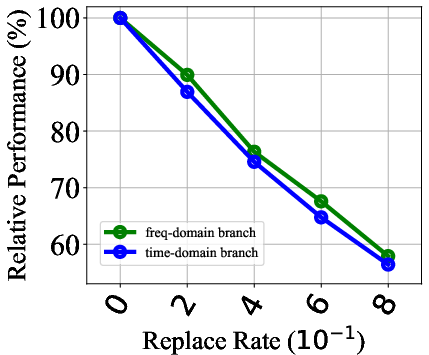
Figure 4: Relative degradation under synthetic drop and replace noise. The frequency-domain branch in FEDIN exhibits markedly superior robustness compared to the time-domain path.
Theoretical and Practical Implications
By empirically and theoretically demonstrating the necessity of target-conditioned spectral analysis, FEDIN challenges the prevailing paradigm of target-agnostic frequency filtering in sequential recommendation. The adoption of a learnable, complex-valued spectral filter in conjunction with adaptive gating enables robust, efficient interest reconstruction even under sparse and noisy conditions. Practically, the architecture is highly parallelizable, delivering computational efficiency advantages (FFT complexity O(LlogL) vs. quadratic attention costs) and suitability for real-time production environments.
Theoretically, the work re-contextualizes CTR prediction as a composition of sequential evolution (time domain) and global periodic resonance (frequency domain), both of which must be modulated by target-item context to avoid mode collapse and overfitting. The hybridization and adaptive fusion strategies serve as a blueprint for future architectures seeking data-efficient and noise-resistant recommendation pipelines.
Conclusion
FEDIN embodies a principled fusion of time- and target-aware frequency-domain modeling for CTR prediction. By grounding the frequency path in empirical observations of attention score entropy and leveraging adaptive filter/gating structures, FEDIN achieves robust, state-of-the-art performance across standard and adverse data regimes. Its dual-branch design is computationally practical and theoretically motivated, encouraging broader adoption of target-conditional spectral analysis as a fundamental protocol for sequential recommendation systems.