Dyonic Ellis-Bronnikov wormholes from warped extra dimensions
Published 2 May 2026 in gr-qc and hep-th | (2605.01602v1)
Abstract: We investigate traversable wormhole solutions within a four-dimensional effective theory derived from a five-dimensional Einstein-Maxwell-Chern-Simons action with a non-minimally coupled scalar field. A warped Kaluza-Klein compactification yields an Einstein-frame theory containing a phantom dilaton, a canonical axion, a Maxwell field, and a Kaluza-Klein vector, with the couplings fixed by the higher-dimensional origin. Focusing on the Ellis-Bronnikov geometry, we construct solutions that incorporate both dyonic Maxwell and Kaluza-Klein fields. For exponential gauge couplings, the Einstein equations determine the scalar kinetic term and the combined potentials, while the remaining field equations reduce to algebraic relations fixing the individual potentials and the radial behaviour of the electric charges. We obtain a systematic classification of configurations, ranging from the pure phantom-supported wormhole to fully coupled dilaton-axion-gauge configurations. The Kaluza-Klein sector enriches the solution space with additional structure while preserving analytic tractability. These results show that regular, asymptotically flat traversable four-dimensional wormholes arise naturally from higher-dimensional scalar-tensor theories.
The paper derives a family of traversable dyonic wormhole solutions, generalizing the Ellis-Bronnikov geometry with both electric and magnetic charges.
It exploits dimensional reduction from a 5D Einstein-Maxwell-Chern-Simons system to obtain analytic expressions for the scalar and gauge fields.
The work classifies solution families by varying the axion-dilaton mixing, demonstrating the emergence of phantom dynamics vital for wormhole stability.
Dyonic Ellis-Bronnikov Wormholes from Warped Extra Dimensions
Overview
The paper presents a systematic derivation and characterization of traversable wormhole solutions within an effective four-dimensional theory emerging from the dimensional reduction of a five-dimensional Einstein-Maxwell-Chern-Simons (EMCS) system with a non-minimally coupled scalar. The constructed solutions generalize the Ellis-Bronnikov (EB) wormhole, combining both dyonic Maxwell and Kaluza-Klein (KK) fields, and provide a detailed map of the resulting matter sector: a phantom dilaton, a canonical axion, and two Abelian gauge fields with field-dependent couplings inherited from higher dimensions. Analytic solvability is retained throughout, furnishing a complete classification of static, spherically symmetric wormholes with generic parametric families controlled by the axion-dilaton mixing and the electric/magnetic charge content.
Higher-Dimensional Origin and Effective Theory
Dimensional reduction is performed on a five-dimensional EMCS action that incorporates a scalar field with non-minimal coupling and a Chern-Simons term. Warped Kaluza-Klein compactification is realized via the metric ansatz:
ds(5)2=e2αΦg~μνdxμdxν+e2βΦ(dw+κAμdxμ)2,
where Φ is the dilaton, and Aμ is the emergent KK vector. The gauge sector produces both the Maxwell field Aμ and an axion φ from the internal component. After compactification and rescaling to the Einstein frame, the resulting 4D action reads:
Here, Ψ is the canonically normalized (phantom) dilaton, φ the axion, and the field-dependent couplings B,C are set by the compactification data.
The construction guarantees that Ψ has a phantom character for appropriate warping parameters, satisfying the NEC-violation needed for traversable throats, while Φ0 and both gauge fields (Maxwell and KK) are conventional matter.
Wormhole Geometry and Field Content
The background is the static, spherically symmetric, and horizonless EB wormhole. The metric is cast as:
Φ1
with the canonical EB shape function Φ2, throat at Φ3. Dyonic Maxwell and KK fields are supported, including both electric and magnetic charges, each with exponential coupling to the dilaton, as motivated by dimensional reduction.
Crucially, the field equations remain solvable analytically due to the symmetry and the proportionality ansatz relating axion and dilaton gradients:
Φ4
Scalar Sector and Parametric Solutions
The scalar profiles exhibit universality: the radial dependence of the dilaton is fixed by the geometry and axion-dilaton mixing parameter Φ5, completely independent of the gauge sector. After integration, the solution is:
Φ6
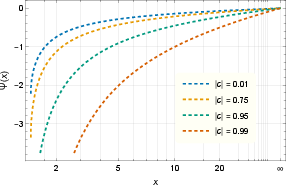
with Φ7. As Φ8 increases, the gradient flattens but the phantom character is preserved for Φ9.
Figure 1: Dilaton field Aμ0 as a function of the dimensionless radius Aμ1, shown for several Aμ2; the profile is regular and becomes less steep with increasing Aμ3.
The kinetic and potential terms, along with the total energy budgets, are encoded in auxiliary variables that clearly separate scalar, gauge, and potential contributions. The flare-out (traversability) condition directly constrains the scalar mixing, necessitating the dominance of the phantom dilaton near the wormhole throat.
Gauge Sector: Maxwell, KK, and Dyonic Structure
The Maxwell and KK fields each support both electric and magnetic charges, with the electric components having explicit dependence on the radial coordinate via their coupling to the dilaton and, for the Maxwell sector, also to the axion through the Chern-Simons term. The electric charge evolution is governed by:
Aμ4
while the KK charge is simply Aμ5 due to the absence of direct axion-KK coupling.
The scalar potentials Aμ6 and Aμ7 are fixed parametrically by the requirement of consistency with the field equations and physical boundary conditions, with all quantities expressible in closed-form or via single quadratures.
Classification of Configurations and Solution Space
The analytic structure allows a comprehensive classification:
Pure Phantom Wormholes: Aμ8, no gauge fields, standard massless phantom case. The dilaton is solely responsible for sustaining the geometry.
Dilaton + Canonical Axion: Aμ9, all gauge fields off. The axion acts as a regular scalar, but energy condition violation remains localized to the dilaton.
Dyonic Maxwell and KK Fields: Aμ0, electric and magnetic sectors active. The radial profiles for charges are determined by the phantom background.
Fully Coupled System: Aμ1, non-vanishing charges, all couplings and potentials operative. The inclusion of KK and Chern-Simons sectors enriches the number of integration constants and the dyonic configuration's structure.
The Kaluza-Klein fields expand the parametric domain, introduce new conserved charges, and introduce additional field coupling possibilities without compromising analytic tractability.
Implications and Theoretical Significance
The construction demonstrates that traversable, horizonless, asymptotically flat wormholes can be realized systematically via dimensional reduction from higher-dimensional EMCS actions, without ad hoc introduction of exotic matter. The universal dilaton/axion profiles, together with the radial evolution of electric charges, ensure the existence of broad classes of wormholes with controlled parametric freedom.
Theoretical implications include:
Systematic embedding of wormhole solutions in effective actions descending from string-inspired compactifications, highlighting the universality and robustness of the phantom sector.
Demonstration that the inverse method allows explicit determination of matter content for a broad family of nontrivial geometries, with practical analytic control over scalar and gauge potentials.
Prediction of new families of traversable wormholes with dyonic structure and non-minimal, nontrivial mixing terms, facilitating further study of their stability and phenomenological properties.
Future directions include the generalization to rotating solutions, examination of perturbative stability, and extensions to more complex compactification manifolds or higher-order curvature corrections. Embedding in explicit string/M-theory models and investigation of possible observable signatures also present relevant avenues for theoretical and phenomenological exploration.
Conclusion
The work provides a comprehensive and analytic mapping between higher-dimensional Einstein-Maxwell-Chern-Simons models and traversable wormhole solutions in effective four-dimensional theories. The resulting dyonic Ellis-Bronnikov geometries accommodate a rich spectrum of scalar and gauge field content, with full analytic control retained. This advances the understanding of traversable wormholes in the context of higher-dimensional gravity, demonstrating that the necessary exotic matter can naturally emerge from controlled geometric and field-theoretic mechanisms rather than arbitrary choices.