- The paper introduces an efficient PSD-based metric to evaluate the quality of demonstration data in imitation learning.
- It applies discrete Fourier transform to trajectory signals, enabling rapid and scalable ranking without expert annotation.
- Experiments on benchmark datasets show that filtering with the PSD metric yields smoother, higher-performance policy execution.
Efficient Spectral Metrics for Demonstration Data Quality in Imitation Learning
Motivation and Framework
Imitation Learning (IL) policy deployment in unstructured, real-world environments remains challenged by the prevalence of out-of-distribution (OOD) states encountered at deployment time. Fine-tuning pre-trained policies or training new policies directly from user-provided data is a promising mitigation strategy. However, non-expert demonstrations—frequently characterized by erratic teleoperation, oscillations, and corrective behaviors—degrade both policy robustness and trajectory smoothness. Manual and semi-automated data filtering approaches lack scalability, while automated ranking methods often depend on expensive rollouts or latent-space computations, restricting their practical applicability.
This paper introduces an efficient, offline metric for ranking demonstration data based on power spectral density (PSD) of trajectory signals. Lower PSD correlates with smoother and higher-quality demonstrations, while higher PSD tracks undesirable motion artifacts. The method is agnostic to task, environment, and policy architecture, requiring neither policy training nor expert annotation. The authors demonstrate that filtering datasets using this metric yields substantially improved downstream policy success rates and smoother execution across both learning-from-scratch and fine-tuning settings.
Spectral-Based Quality Measurement
The core metric is the trajectory-level total spectral power, computed using a discrete Fourier transform (DFT) applied to each demonstration’s low-level kinematic time series. For a demonstration τi comprising 3D end-effector positions xi(t), the PSDs for each dimension are aggregated, and the sum over all frequencies yields a scalar Wi:
Wi=∑Ω∑d=02Pi,d(Ω)
where Pi,d(Ω) is the spectral power for dimension d at frequency Ω. Demonstrations are ranked ascending by Wi; lower values denote higher-quality, smoother trajectories. Filtering can discard the highest-scoring fraction ρ to obtain a curated dataset.
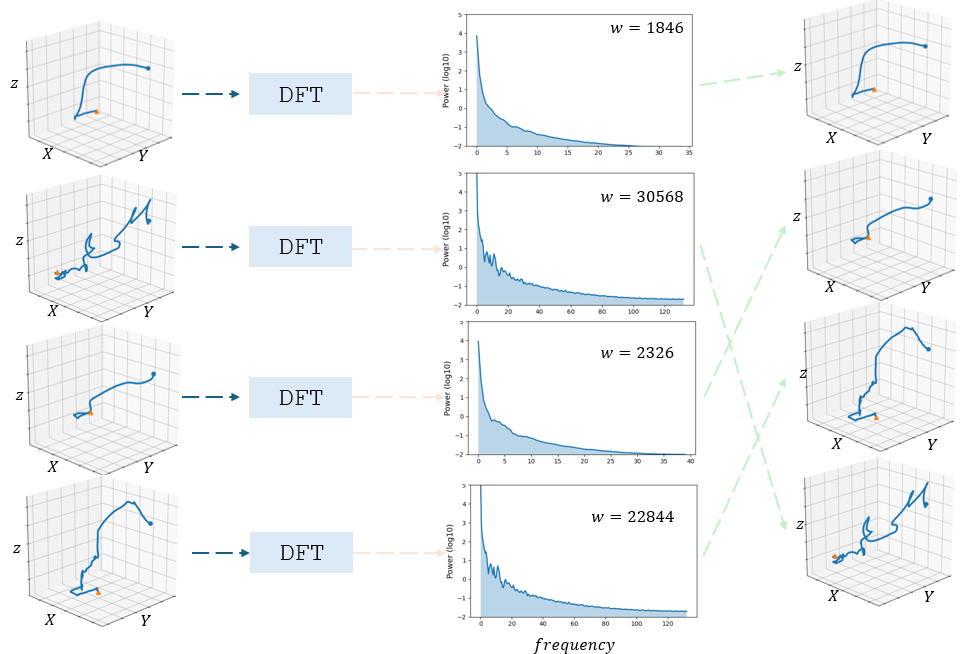
Figure 1: Demonstration trajectories (left) and their power spectrum (middle); good demonstrations exhibit strong energy at low frequencies, while poor demonstrations show broader spectral support and increased power.
Expert trajectories exhibit smooth, deliberate motion with minimal corrective actions, yielding concentrated spectral energy at lower frequencies. In contrast, non-expert (layperson) trajectories are marked by abrupt corrections and oscillatory behavior, elevating spectral content at higher frequencies and total power.
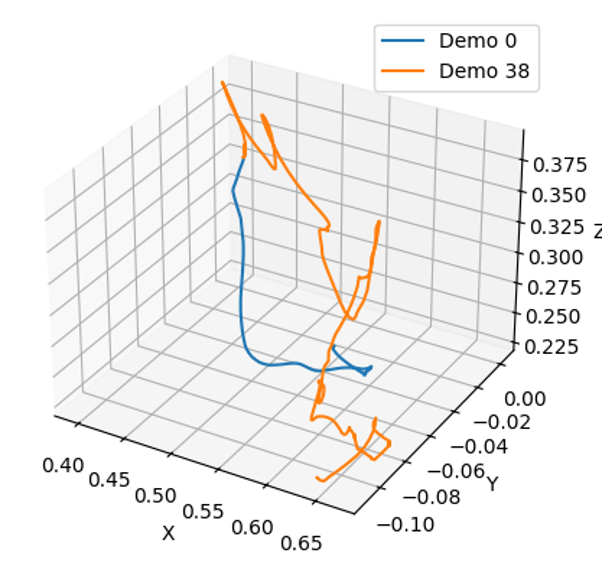
Figure 2: Comparison of expert (Demo 0) and non-expert (Demo 38) trajectories; experts produce smooth paths with fewer surprising turns than non-experts.
Experimental Evaluation
Extensive experiments for both offline policy learning and fine-tuning are conducted on two benchmark IL datasets: Robomimic-MH and Layman2. Robomimic-MH contains expert and non-expert demonstrations for simulated manipulation tasks; Layman2 consists of longer, more variable demonstrations from 15 non-expert users. Demonstration quality is assessed by ranking and removing the bottom fraction of each dataset using the PSD metric or baseline methods (DemInf, CUPID).
Curating with PSD yields notably higher mean demonstration quality among retained samples, tracking oracle ordering closely and outperforming learning-based competitors. This effect is more pronounced in the Layman2 dataset, which contains richer non-expert artifacts.
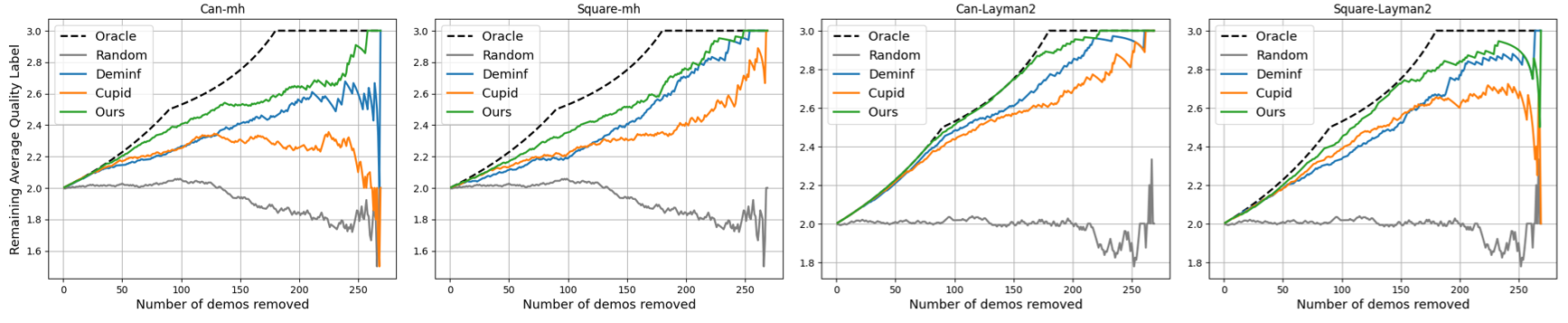
Figure 3: Remaining average demonstration quality vs. demonstrations removed; the PSD metric (Ours) closely follows oracle ranking and maintains higher quality than DemInf and CUPID.
Ablation against simpler kinematic proxies (path length, jerk norm) establishes the superiority of the PSD metric: while such proxies correlate with quality in select cases, their reliability is inconsistent and highly sensitive to task-specific factors (e.g., start/end positions).
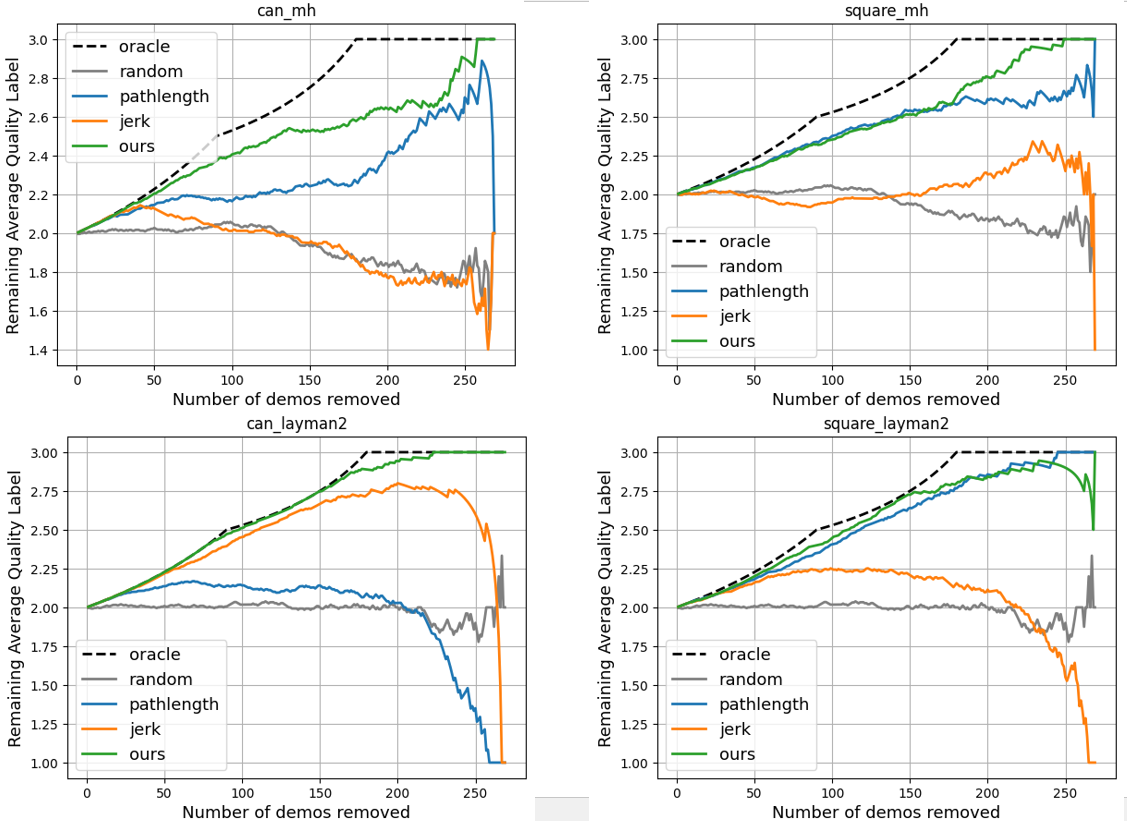
Figure 4: PSD-based method outperforms simple kinematic proxies such as jerk and path length by capturing oscillatory and corrective motion patterns agnostic to task specifics.
Computational efficiency is a distinct advantage: ranking 300 demonstrations with PSD takes ~10 seconds, compared to several hours for learning-based methods that require rollouts or expensive computations.
Fine-Tuning with Non-Expert Data
To simulate realistic deployment, non-expert demonstrations were collected from older adults teleoperating a Franka robot in a kitchen scenario. Fine-tuning a state-of-the-art pre-trained policy (π0.5) using PSD-filtered data improved average task success rates over both unfiltered and DemInf-filtered baselines.
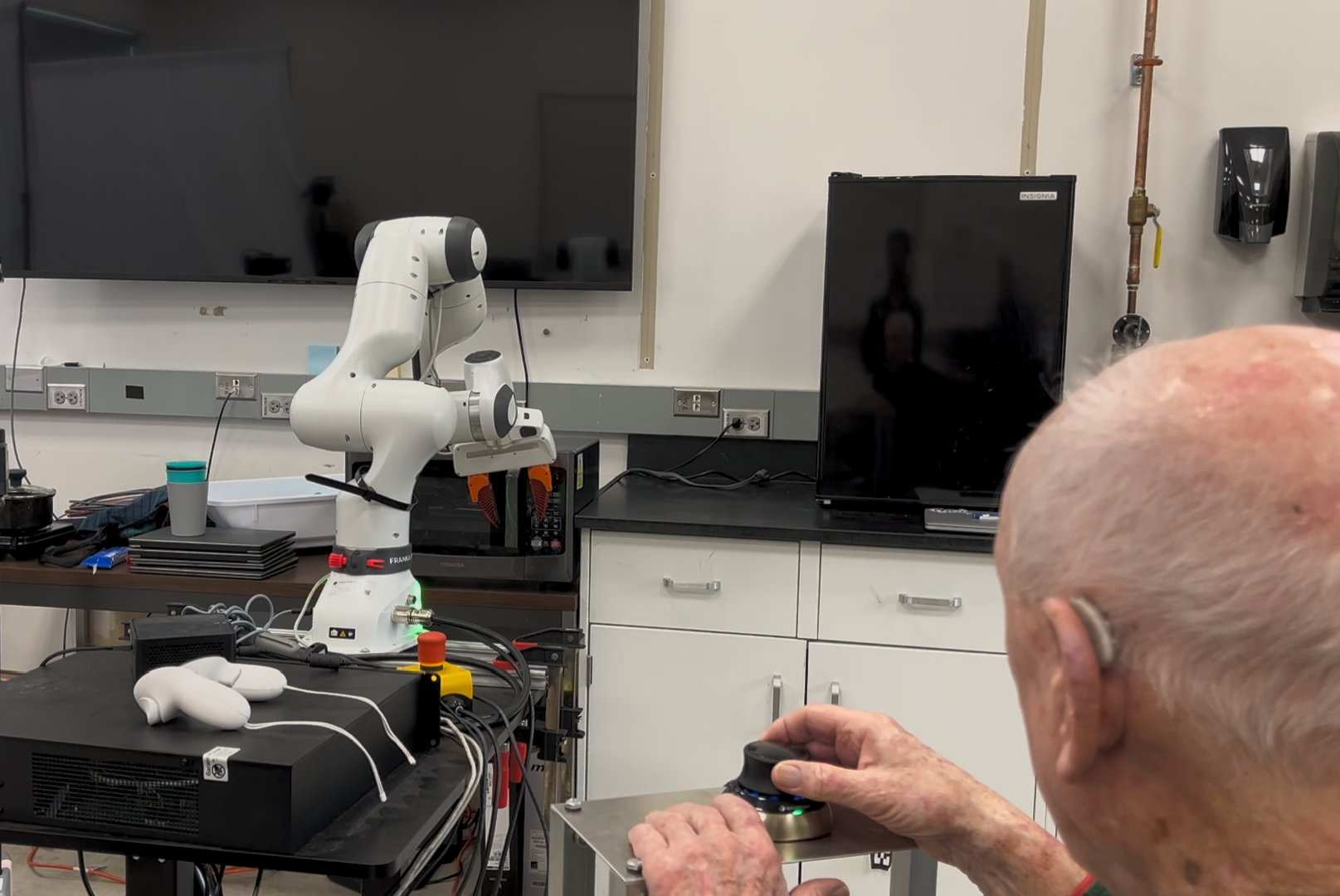
Figure 5: Older adult participant teleoperates a Franka robot using a SpaceMouse to generate demonstrations for a daily living task.
Implications and Prospects
The PSD metric represents a scalable, training-free tool for demonstration data quality curation. Its task-agnostic nature and computational efficiency render it especially suitable for rapid filtering in large-scale datasets and field deployment settings involving layperson users. By targeting oscillatory and corrective motion artifacts, the metric directly mitigates the primary source of policy degradation in motion-dominated manipulation tasks.
With the growing interest in leveraging diverse user data for generalist policy learning, efficient demonstration quality measurement will enable robust adaptation in OOD scenarios without expert intervention. Future extensions include integrating spectral analysis with online preference learning, multi-segment trajectory scoring, and task-specific post-filtering.
Conclusion
Frequency-domain analysis of demonstration trajectories provides a principled yet practical proxy for data quality measurement in imitation learning. Ranking by power spectral density enables rapid, fully offline curation of large datasets, yielding improved policy performance and facilitating real-world deployment. The approach is robust against non-expert artifacts and outperforms established learning-based ranking methods in both effectiveness and speed, marking a significant advance toward scalable, user-driven robot learning.