- The paper introduces a physics-guided U-Net model that effectively suppresses structured imaging artifacts in high-resolution X-ray imaging.
- The paper demonstrates improved quantitative metrics, with MSSIM rising from 0.345 to 0.906 and RMSPE in filament-length estimation dropping from 16.71% to 8.66% using advanced augmentation and ensemble uncertainty techniques.
- The paper validates the method’s potential for real-time, high-throughput deployment in XFEL experiments and its adaptability to out-of-distribution structures through model retraining.
Physics-Guided Deep Learning for Artifact Suppression in High-Resolution X-ray Imaging
Introduction and Motivation
Structured imaging artifacts, such as spatially varying defects introduced by compound refractive lenses or detector inhomogeneities, limit the quantitative fidelity of direct X-ray imaging in high energy density (HED) and inertial fusion energy (IFE) experiments. Classical flat-field normalization fails to robustly suppress such artifacts when even minor spatial drifts occur between shot and reference images, leading to residual patterns that degrade signal visibility and bias critical measurements (e.g., electron density, velocity, feature length). Existing methods, including Fourier filtering and dynamic flat-field normalization (DFFN), are insufficient when artifacts share overlapping frequency content with true physical signals, such as filamentary structures from Weibel-driven current instabilities. Addressing these challenges is essential for single-shot, high-repetition XFEL imaging pipelines.
Physics-Guided Deep Learning Framework
The authors introduce a U-Net-based physics-guided deep learning procedure to model and suppress structured artifact layers in single-shot X-ray imaging. Instead of treating imaging defects as stochastic noise separable by trivial filtering, the method conceptualizes the artifacts as a multiplicative, spatially structured feature layer. A two-dimensional U-Net is trained using cold-shot references to directly estimate this artifact layer from raw MXI images. Artifact correction is performed by removing this layer from both laser-driven and flat-field images prior to transmission normalization, generating robust X-ray transmission maps. Copy-paste augmentation is employed to ensure that filamentary features are not inadvertently suppressed as artifacts during training. The architecture, consisting of three encoder and decoder blocks with 32–256 channels, is optimized using weighted L1 loss to emphasize accurate treatment of filament regions.
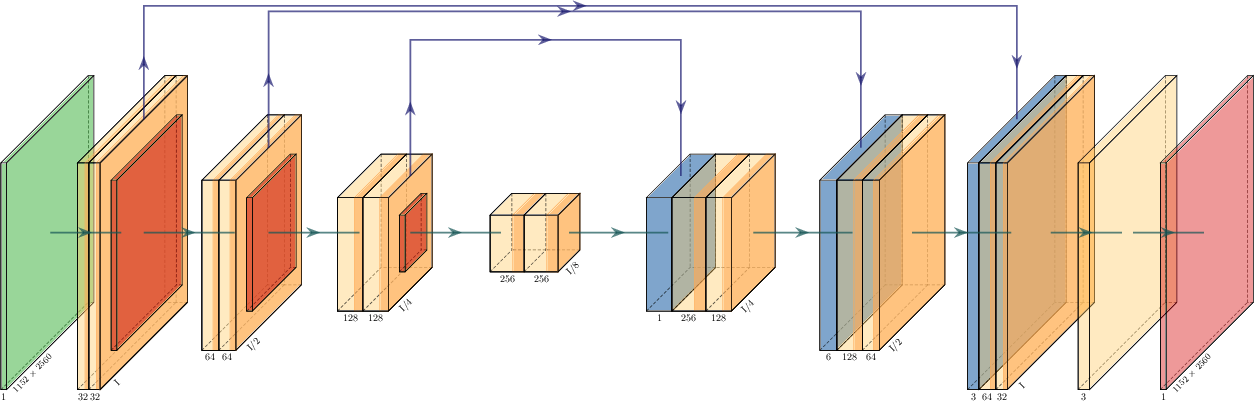
Figure 2: U-Net architecture diagram, illustrating the encoder-decoder structure and skip connections used for artifact layer estimation.
This design allows deterministic, millisecond-scale inference suitable for use in high-throughput pipelines at next-generation XFELs, where iterative post-processing is computationally prohibitive.
The U-Net approach is benchmarked against both Fourier filtering and DFFN in experimental and synthetic scenarios. On real data, Fourier filtering partially removes artifacts but unavoidably attenuates filament amplitude due to the overlapping spatial frequency content, while DFFN fails to handle chromatic or alignment-induced variations.
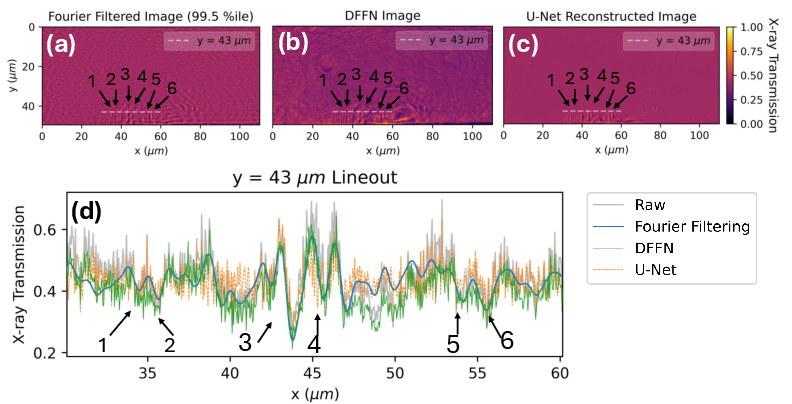
Figure 3: Defect suppression comparison for the X-ray transmission map: (a) Fourier-filtered, (b) DFFN-processed, and (c) U-Net reconstructed. U-Net preserves filament integrity and suppresses artifacts more effectively.
Synthetic injection tests further quantify performance by embedding contrast-enhanced filament structures into cold-shot backgrounds. U-Net consistently yields higher MSSIM and PSNR, and lower MSE relative to Fourier filtering and DFFN, for both strong and weak filament contrast cases. For instance, in the strong contrast test, MSSIM improves from 0.345 (raw), 0.459 (Fourier), and 0.500 (DFFN) to 0.906 (U-Net), with matched improvements in PSNR and MSE. No evidence of amplitude attenuation or morphological distortion of filaments is observed in the U-Net output.
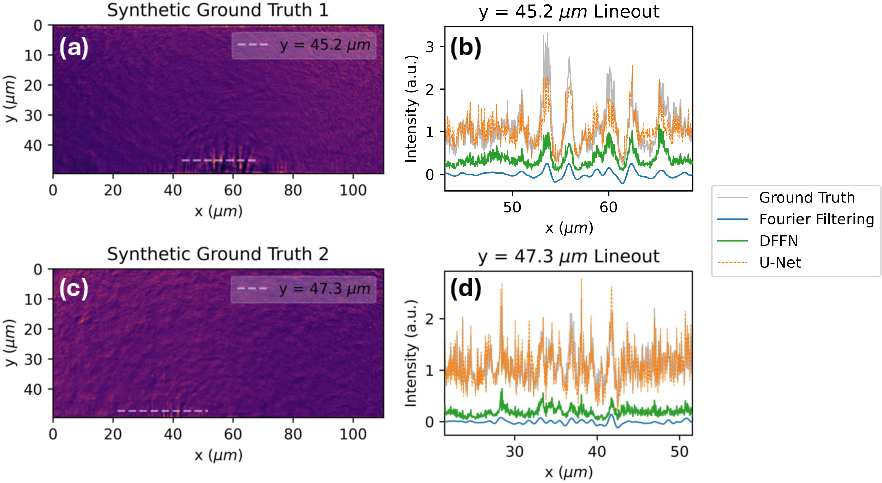
Figure 4: Signal preservation tests using synthetic filament maps—U-Net output matches ground truth more closely than other methods.
Quantitative measurements, such as filament length, are directly improved. The U-Net correction reduces RMSPE in filament-length estimation to 8.66%, compared to 16.71% for Fourier filtering and 11.3% for DFFN. These results establish that U-Net-based correction can not only suppress drifted structured artifacts but also robustly preserve physical signals for downstream quantitative analysis.
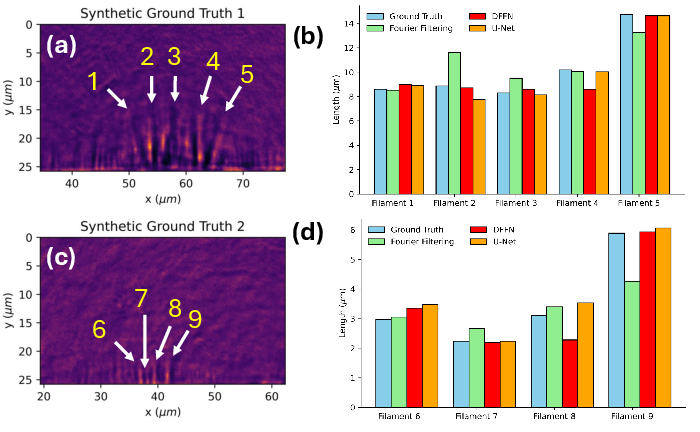
Figure 5: Filament length measurements showing reduced estimation error post U-Net reconstruction.
Generalization to Out-of-Distribution Structures and Uncertainty Quantification
A filament-trained U-Net model was challenged with spatially extended, morphologically distinct shock waves, revealing partial absorption of shock features into the predicted artifact layer and reduced signal preservation (MSSIM 0.629, PSNR 26.1 in shock ROI). Adapting the model architecture and training data (increased channels and shock-patch augmentation) partially mitigated this issue, demonstrating adaptation capability to new physics when provided with pertinent data.
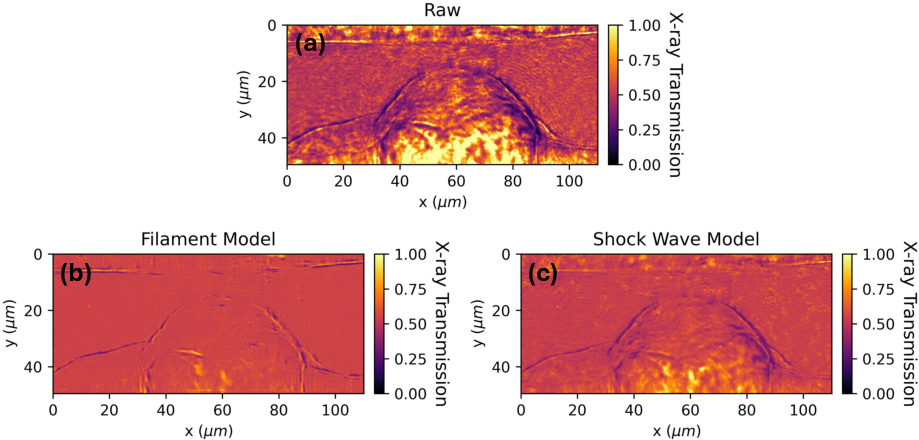
Figure 6: Transmission maps for shock waves: (a) raw, (b) reconstructed via filament-trained U-Net, (c) reconstructed with shock-aware model.
For robust deployment in real-world pipelines, the epistemic uncertainty of the learned model must be quantified. A deep ensemble (M=10 U-Nets, with independent initialization and data shuffling) is used to estimate predictive uncertainty as pixel-wise entropy. This highlights spatial regions associated with novel or OOD physics (e.g., shocks) or less confident artifact separation. Such an ensemble-based entropy map serves as an automated detector for unexpected structures or failure modes.
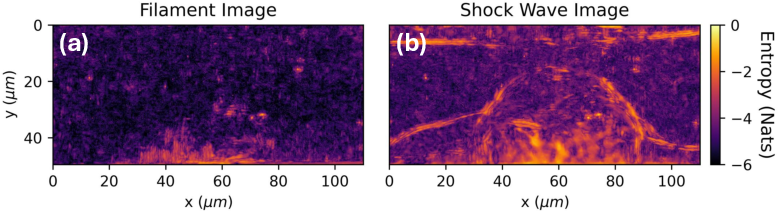
Figure 7: Pixel-wise entropy map from U-Net ensemble, signaling uncertainty in regions with physical structures distinct from training data.
Practical Implementation and Experimental Context
The full pipeline operates on data from the MEC X-ray imager at LCLS, with silicon targets and 9.5-keV XFEL pulses. Standard preprocessing includes percentile normalization and alignment procedures. For classical suppression, aggressive Fourier filtering masks are tuned empirically and DFFN estimates flat-field drift via eigen flat fields and total variation minimization. The U-Net model suppresses artifacts by predicting and dividing out the structured feature layer, followed by transmission map reconstruction. Ensemble-based uncertainty is computed for each pixel using the log-variance across model predictions. The resulting method is compatible with large-scale, automated HED/IFE experimental workflows and directly supports autonomous experiment design or real-time data curation.
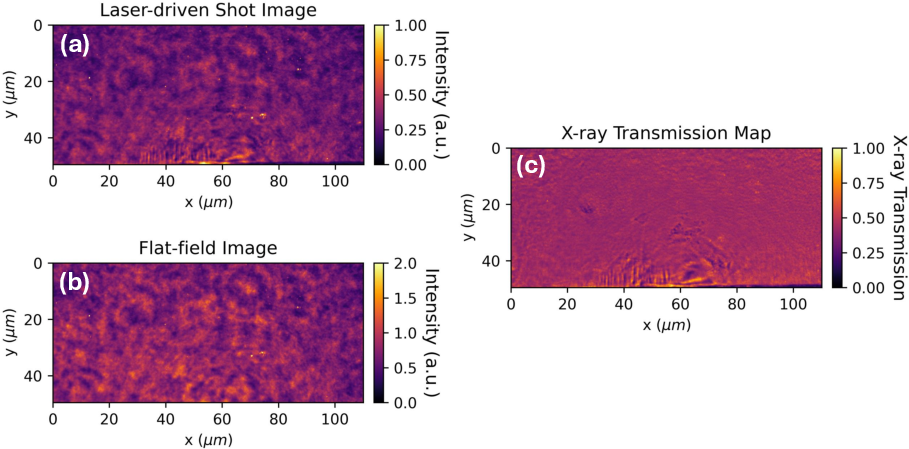
Figure 1: Example of X-ray imaging and transmission map computation pipeline.
Implications and Future Directions
The presented deep learning methodology enables robust correction of non-stationary structured artifacts in single-shot X-ray imaging, facilitating improved quantitative analysis for transport observables in HED and IFE experiments. Its data-driven and modular design allows adaptation to new contrast mechanisms (e.g., shock waves, instabilities) through transfer learning or data augmentation. Ensemble-based uncertainty quantification constitutes a practical OOD detector, essential for trustworthy high-throughput autonomous pipelines. As XFEL facilities advance toward higher repetition rates and more diverse target configurations, this approach will support scalable, real-time artifact suppression and automated data reliability assessment.
Potential future developments include integration with online experimental feedback systems, broader physical structure augmentation for enhanced generalizability, and dynamic adaptation or continual learning to accommodate evolving beamline conditions or unanticipated physics.
Conclusion
Physics-guided U-Net models, complemented by ensemble-based uncertainty quantification, outperform classical and PCA-based artifact suppression techniques in high-resolution X-ray transmission imaging under non-stationary artifact conditions. The approach provides deterministic, high-throughput correction with superior preservation of physical signal, and supports reliable extraction of quantitative observables fundamental to HED and IFE science. Its general architecture and robust uncertainty mapping make it well suited for large-scale and adaptive experimental pipelines in advanced photon science environments.

