- The paper presents two three-matrix decompositions (the + and H decompositions) that yield systematic blueprints for designing paraxial optical systems.
- It details an explicit mapping between decompositions using invariants to preserve key paraxial optical characteristics.
- The methodology facilitates automated synthesis and optimization of optical designs by controlling refractive and translational elements.
Introduction and Motivation
The matrix (ABCD) formulation for paraxial geometric optics allows optical systems with rotational symmetry to be described compactly as 2×2 real matrices with unit determinant—elements of the special linear group SL(2,R). Despite the efficacy of the ABCD formalism for analysis, the synthesis and optimization of multi-element optical designs, particularly where non-paraxial specifications such as aberrations must be optimized, necessitates decomposing these matrices into elementary transitions and refractions.
This paper provides a rigorous examination of two constructive three-matrix decompositions of SL(2,R) matrices: the “+ decomposition” and the “H decomposition.” These decompositions yield systematic blueprints for designing optical systems with freely tunable numbers of refractive or translational elements while maintaining paraxial equivalence.
Theoretical Framework and Decomposition Structures
The ABCD matrix represents the propagation of a ray vector v=(nθ y), with n the local refractive index, θ the inclination, and y the transverse displacement. The elementary matrices consist of:
- Transition (free-space) matrix: T(p)=(10 p1), where parameter p relates to physical translation.
- Refraction matrix: R(q)=(1q 01), parameterized by optical power SL(2,R)0.
Any ABCD matrix SL(2,R)1 can, except in degenerate cases, be decomposed in at least two canonical three-matrix forms:
+ Decomposition
For SL(2,R)2 with SL(2,R)3, SL(2,R)4 can be represented as
SL(2,R)5
where parameters SL(2,R)6, SL(2,R)7, and SL(2,R)8 are mapped uniquely from the elements of SL(2,R)9. This sequence corresponds physically to two spatial transitions sandwiching a refraction.
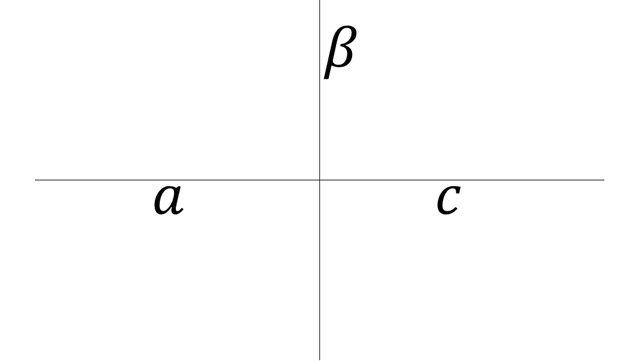
Figure 1: Schematic of the + decomposition SL(2,R)0, indicating the sequence of transition, refraction, transition operations.
H Decomposition
When SL(2,R)1, another canonical decomposition is
SL(2,R)2
where SL(2,R)3, SL(2,R)4, and SL(2,R)5 similarly relate to the ABCD parameters and correspond to a refraction-transition-refraction configuration.
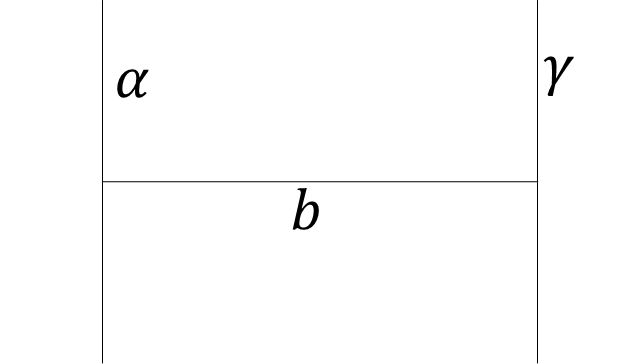
Figure 2: Schematic of the H decomposition SL(2,R)6, illustrating refraction, translation, and refraction.
Exceptional and Composite Decompositions
If SL(2,R)7 (telecentric systems), SL(2,R)8 is diagonal and represents simple magnification. Such matrices are not captured by the above three-matrix forms but can themselves be synthesized from products of SL(2,R)9-type matrices, which are each individually decomposable as above. This ensures generality of the decomposition approach within v=(nθ y)0.
A key contribution is the explicit mapping between + and H decompositions for the same v=(nθ y)1. The transformation parameters v=(nθ y)2 satisfy
v=(nθ y)3
with invariants
v=(nθ y)4
These invariants preserve critical optical characteristics such as the paraxial specification (i.e., the ABCD matrix). The mapping enables systematic adjustment of the number of refractive and translational elements in an optical system—paramount for design flexibility with respect to non-paraxial performance.
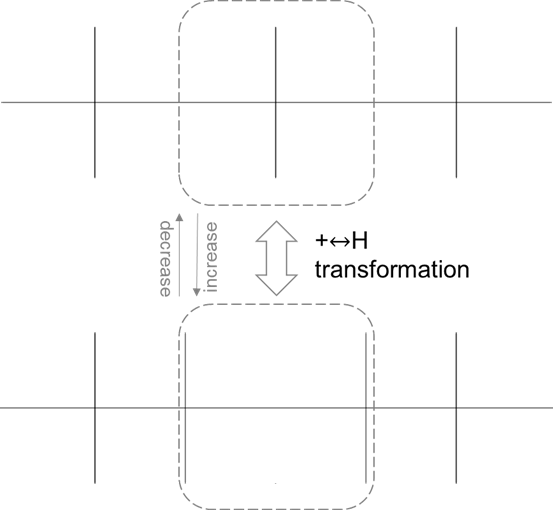
Figure 3: Transformation schematic showing how the + v=(nθ y)5 H conversion increases or decreases the count of refraction surfaces without altering the paraxial response.
Practical and Theoretical Implications
The development of constructive and invertible three-matrix decompositions enhances flexibility in optical design:
- Design Optimization: By enabling transitions between physically distinct but paraxially equivalent configurations, the method supports the exploration and optimization of non-paraxial aberrations in multi-component optics.
- Automated Synthesis: Algorithms for optical design can leverage the decomposition and the transformation rules to automatically generate alternative realizations with targeted numbers of elements or desired physical constraints.
- Group-Theoretic Interpretation: The alignment with v=(nθ y)6 structures provides a mathematically robust basis for further generalizations—potentially to non-paraxial, polarization, or quantum optical domains.
Additionally, the explicit transformation links to trace and other invariants of the ABCD matrix, deepening the mathematical understanding of the symmetries and equivalence classes inherent in optical systems.
Future Directions
Potential extensions include:
- Application to asymmetric or multi-dimensional optical systems beyond the rotationally symmetric paraxial approximation.
- Integration into global optimization frameworks for lens design, targeting specific non-paraxial metrics (e.g., aberration minimization).
- Exploration of analogous decompositions in quantum optical transformations or in non-linear propagation regimes.
Conclusion
This work rigorously formulates two three-matrix decomposition schemes for v=(nθ y)7 (ABCD) matrices relevant to paraxial geometric optics, establishes their intertransformation, and characterizes important invariants underlying the mapping. These results facilitate efficient, physically meaningful design and optimization of multi-element optical systems, ensuring paraxial specification preservation while enabling the modification of system composition for advanced non-paraxial performance control.

