- The paper presents a neuro-symbolic framework (Forking Garden) that constrains gameplay generation using recognized narrative archetypes via LLMs and symbolic reasoning.
- It details a modular pipeline from user input to Unity game instantiation, incorporating node generation, arc scoring, and DAG assembly to ensure narrative coherence.
- Empirical observations reveal strengths in narrative immersion and highlight challenges in difficulty calibration and asset generation, paving the way for future research.
Narrative Arc-Conditioned Gameplay Planning: An Expert Review of "The Garden of Forking Paths"
Introduction and Motivation
"The Garden of Forking Paths: Narrative Arc-Conditioned Gameplay Planning" (2605.01245) addresses the persistent challenge of infusing procedurally generated games with meaningful narrative structure, specifically through the explicit use of universal narrative archetypes. Prior research in LLM-driven story and game generation has primarily focused on tile/world generation [earle2025dreamgarden, huang2025word2minecraft], character agents [kumaran2024narrativegenie], and high-level structure via outlines or goal-tracking [leandro2024geneva, wu2024dramainteraction]. However, these approaches lack mechanisms to constrain generated content according to recognized narrative arcs—patterns such as the Hero's Journey or classic emotional arcs identified by Reagan et al. [reagan2016emotional]. This work proposes Forking Garden, a neuro-symbolic system for planning and instantiating branching gameplay graphs whose ludic and narrative structure is conditioned on user-specified archetypes.
System Architecture and Methodology
The system is end-to-end and modular, grounded in hybrid methods leveraging both LLMs and symbolic constraint reasoning, and is instantiated in Unity as a pipeline for generating narrative arc-constrained dungeon games.
The overall pipeline includes:

Figure 1: End-to-end system for narrative arc-conditioned game generation, mapping user input to playable Unity dungeon games through node generation, graph assembly, entity editing, sprite creation, and level instantiation.
- User Input: Users enter a brief storyline and protagonist.
- Element Brainstorming: The system extracts core narrative elements (characters, props, locations) from the input.
- Node Generation: Independent nodes (story beats) are generated from the brainstormed elements, each representing a possible game encounter, with automated entity normalization and assignment.
- Arc Scoring: Nodes are assigned soft confidence scores for emotional Rise/Fall states via hybrid sentiment/LLM analysis.
- Graph Assembly: Nodes are connected into a directed acyclic graph (DAG) using an arc-guided constraint algorithm, maximizing arc/structural consistency, entity continuity, and narrative plausibility.
- Game Entity Realization: Each node is instantiated as a level with concrete gameplay attributes (NPCs, items, enemy difficulty, dialogue), with assets generated through LayerDiffusion pipelines.
- Unity Integration: The full graph is playable in Unity, with each node instantiated as a room that encodes specific narrative and gameplay shifts (difficulty, resource allocation, dialogue) consistent with its position in the arc.
Narrative Archetype Modeling and Graph Construction
The backbone of Forking Garden is the operationalization of narrative arcs based on the six primary emotional trajectories identified by Reagan et al. [reagan2016emotional]—namely, Rags to Riches (Rise), Tragedy (Fall), Icarus, Man in a Hole, Cinderella, and Oedipus. Nodes are scored and ordered to ensure that every root-to-leaf path traces an archetype-aligned emotional signature.
Graph generation proceeds as follows. First, a large, diverse set of temporarily independent nodes is generated to ensure narrative and gameplay diversity. Each node receives a soft [0,1]2 Rise/Fall confidence based on both classifier- and LLM-derived sentiment. Edge selection is then governed by a multi-objective scoring function combining:
- Entity Overlap: Rewards continuity of characters/props.
- Arc Consistency: Ensures predicted next arc for a parent aligns with current arc of a candidate child.
- Arc Smoothness: Penalizes abrupt sentiment transitions.
- LLM Causal Validation: After rule-based narrowing, LLMs evaluate the plausibility of candidate connections.
A breadth-first or greedy search connects nodes into a DAG, allowing for flexible reuse of nodes and accommodating both strict archetype adherence and maximal branching.
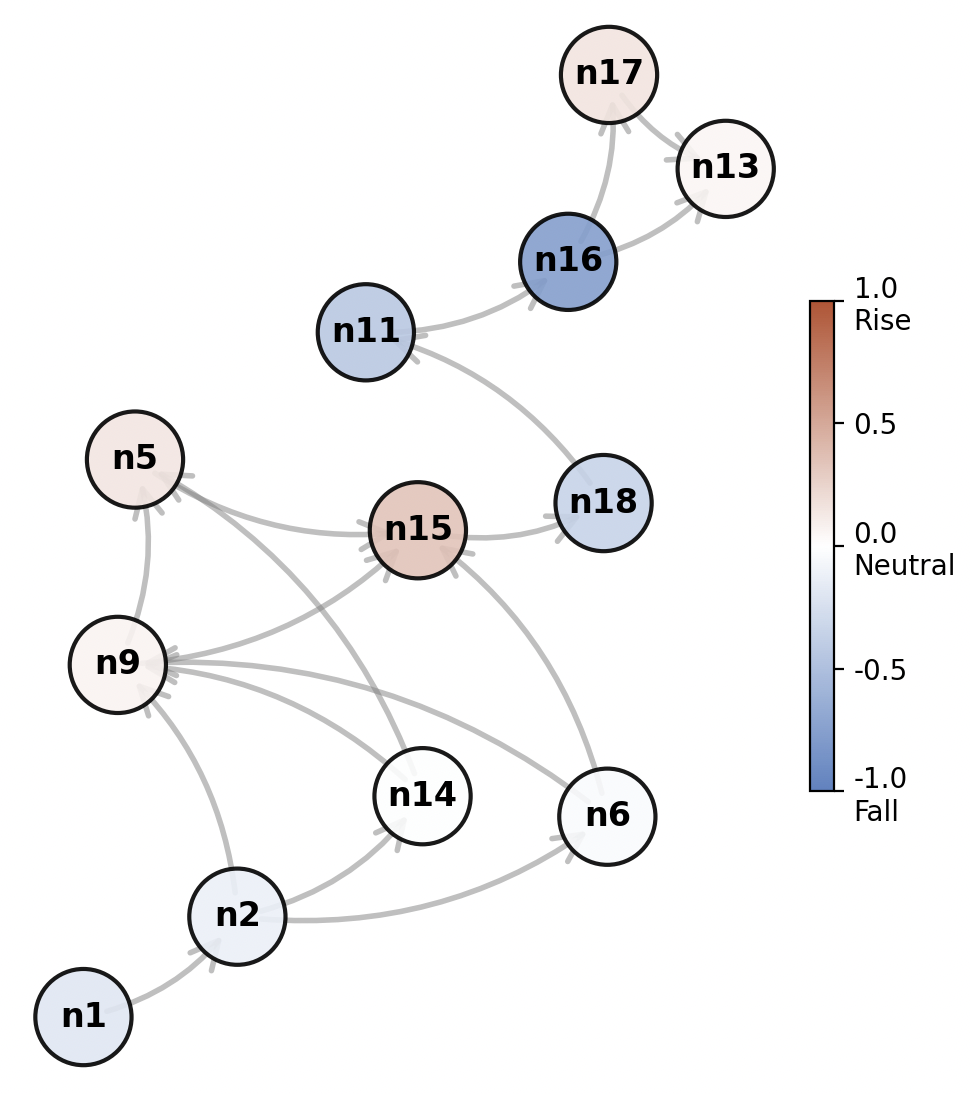
Figure 2: Example of a Rise-Fall archetype-constrained dungeon graph, where node color denotes net arc value, providing a visual mapping between emotional narrative structure and gameplay topology.
Multimodal Integration and Unity Deployment
Narrative structure is tightly mapped to gameplay through multimodal entity instantiation and arc-conditioned level generation:
- Difficulty Tuning: Quantitative attributes (enemy strength, item availability) are mapped to arc state, with Rise nodes granting resources/advantage and Fall nodes increasing challenge and scarcity.
- Dialogue Generation: NPCs and protagonists are equipped with dynamically composed dialogue reflecting both their appearance across nodes and the ongoing arc position.
- Visual Asset Generation: LayerDiffusion and Stable Diffusion pipelines generate entity sprites with semantic consistency, supporting user-driven regeneration for style alignment.
- Dynamic Narrative Recall: A retrieval-augmented generation system enables protagonists and other agents to reference prior events, ensuring cross-level narrative continuity.

Figure 3: Dungeon level example as seen in Unity, demonstrating concrete instantiation of node-derived plot elements, characters, and items.
Empirical Observations and Limitations
Preliminary user studies with six participants identified a number of strengths and open challenges:
- Engagement and Immersion: Participants demonstrated two distinct forms of narrative immersion (personal projection vs. performative role-play).
- Difficulty Adjustment: Current mechanisms occasionally overshot challenge levels, particularly in Fall/boss scenarios, underscoring the need for DDA.
- Graph Diversity: Negative sentiment bias in the classifier skews the system toward Fall-heavy archetypes unless the node pool is sufficiently large or sentiment calibration is improved. Rise-dominant structures are systematically underrepresented in smaller graphs.
- Affordance Gaps: Some plot beats lacked actionable prompts or clarity regarding protagonist presence. Item and group entity rendering is occasionally inconsistent.
- Asset Generation: Sprite generation is generally robust but fails for certain collective/composite entities. Animation is currently absent and designated as future development.
Theoretical and Practical Implications
Forking Garden constitutes a material advance in integrating symbolic narrative theory—especially archetype-constrained emotional arc planning—into the procedural generation of playable game structures via LLMs. The generate-first-constrain-later paradigm contributes to a fundamental shift away from deterministic, top-down decomposition toward hybrid models that maximize both narrative and ludic diversity. This architecture exposes new axes for empirical evaluation:
- Narrative Coherence Metrics: Path conformance scoring and LLM-based validation uniquely bridge structural archetype adherence and semantic plausibility.
- Branching Richness: The system enables richer branching gameplay than hierarchy- or goal-only models, setting a baseline for new quantitative diversity metrics.
- Generalizability: The modular architecture is extensible beyond ARPG-dungeon settings, supporting future research into genres with different arc-to-mechanic mappings.
Additionally, Forking Garden offers a platform for studying the interplay between emotional arc structure and player experience, both via subjective (immersion, engagement) and objective (behavioral telemetry) means.
Future Directions
Key research opportunities include:
- Systematic Player Studies: Quantitative ablations comparing arc-conditioned vs. unconstrained gameplay on user engagement, retention, and narrative comprehension.
- Genre and Prompt Diversity: Validation across broader narrative domains (outside of fairy-tale datasets) and larger input corpora.
- Algorithmic Improvements: Integration of richer emotion classifiers, DDA, affordance engineering for plot events, enhanced asset generation (including automatic animation via skeleton-based models), and nuanced RAG-driven dialogue systems.
- Formal Diversity Metrics: Development of robust branch divergence, entity reuse, and causal dependency metrics to quantify the theoretical expressivity of generate-first-constrain-later architectures compared to hierarchical models.
Conclusion
"The Garden of Forking Paths: Narrative Arc-Conditioned Gameplay Planning" (2605.01245) delivers an operational framework uniting LLM-driven neuro-symbolic generation, emotional arc planning, and multimodal game instantiation. By foregrounding narrative archetype conformance at both the structural and gameplay level, the system presents a novel path for procedural content generation research, expanding both the theoretical vocabulary and practical capabilities of automated storytelling in games. The architecture's flexibility and principled link between drama and mechanics underscore its potential as a research platform for future work in computational narrative and interactive entertainment.