- The paper introduces DACG-IR, leveraging degradation-aware prompts and adaptive context gating to enhance unified image restoration across various corruptions.
- It employs dual-domain modulation and adaptive gated fusion to suppress noise and preserve structural details under complex degradation conditions.
- Experimental results demonstrate significant PSNR and SSIM improvements over state-of-the-art models on both composite and single-task restoration benchmarks.
Degradation-Aware Adaptive Context Gating for Unified Image Restoration
Introduction
Degradation-aware unified image restoration addresses the ill-posed problem of reconstructing high-fidelity images from input degraded by complex, heterogeneous corruptions such as noise, haze, blur, and adverse weather. Conventional models focus on single-degradation settings or utilize large unified architectures lacking explicit degradation perception and adaptive feature regulation, leading to performance bottlenecks due to negative interference and feature contamination across tasks.
This work introduces Degradation-Aware Adaptive Context Gating (DACG-IR), a fully unified architecture that achieves robust all-in-one restoration through explicit, hierarchical degradation-aware modulation and adaptive feature selection. The key innovation is the synthesis of learned degradation-driven prompts and context-adaptive gating mechanisms that operate in both spatial and frequency domains, enabling precise suppression of harmful degradation signals while enhancing structural information required for high-fidelity reconstruction.
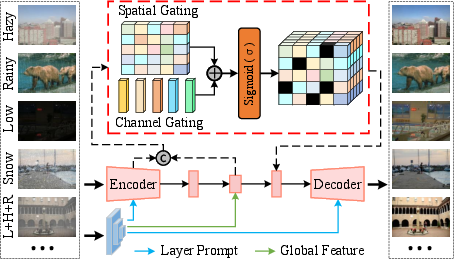
Figure 1: The proposed DACG-IR framework generates hierarchical degradation-aware prompts and applies dual-path spatial-channel gating for robust restoration across diverse adverse conditions.
DACG-IR Architecture and Components
The DACG-IR architecture is designed around four core modules: the Degradation-Aware Module (DAM), Context Gated Dual-Domain Modulation (CGDM), Adaptive Gated Fusion (AGF), and Context Adaptive Gated Attention (CAGA). These modules are orchestrated in a hierarchical encoder–decoder pipeline, with explicit injection points for degradation priors and gating-enabled feature refinement.
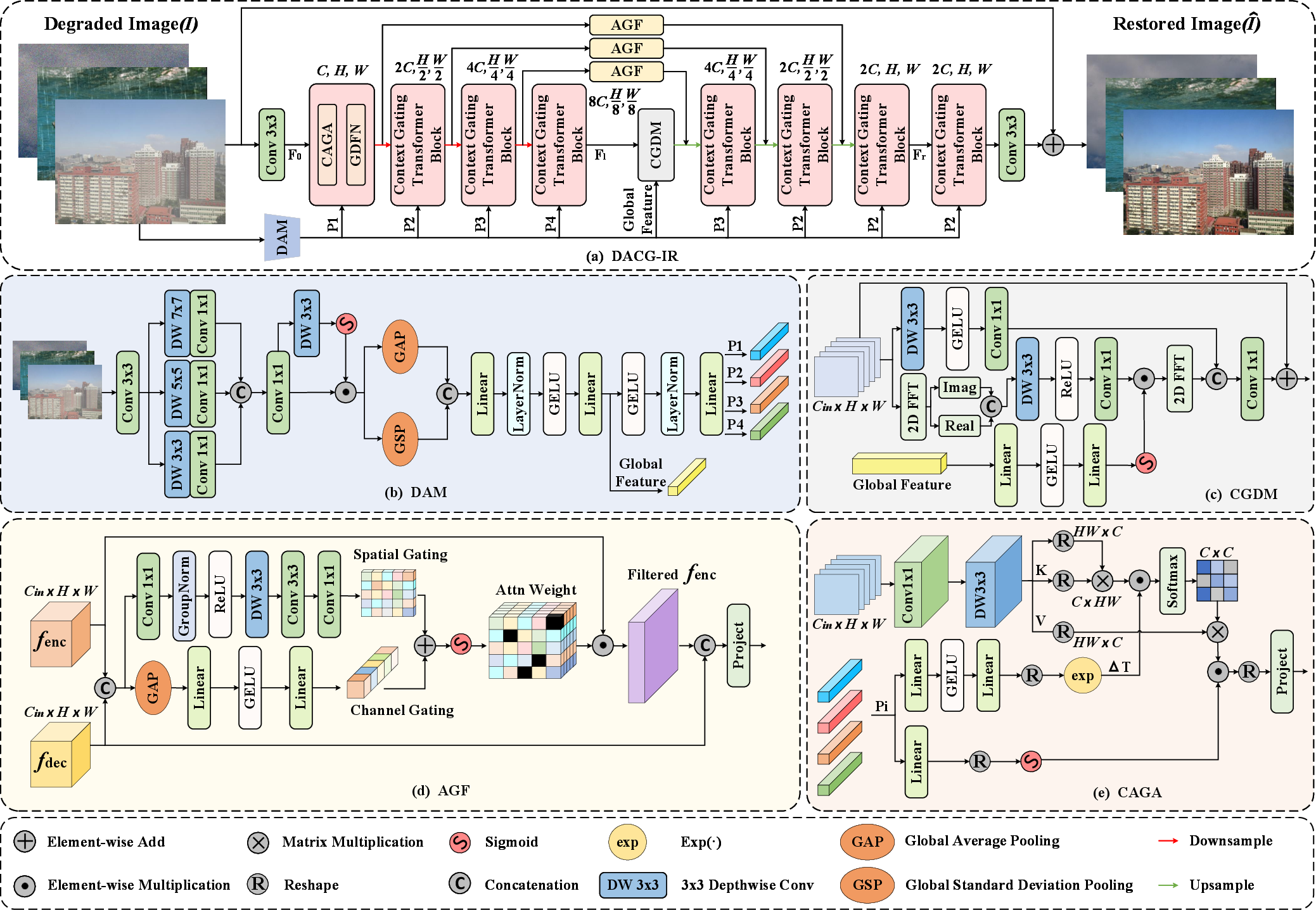
Figure 3: The DACG-IR architecture overview with four pivotal modules: DAM for prompt generation, CGDM for dual-domain modulation, AGF for skip connection fusion, and CAGA for prompt-driven adaptive attention.
Degradation-Aware Module (DAM)
DAM learns multi-scale statistical representations of the input degradation using depth-wise and point-wise convolutions across multiple receptive fields. It fuses local and global degradation features via adaptive spatial gating and dual-statistic (mean and standard deviation) pooling, forming both global context vectors and layer-aligned degradation prompts. These are projected into the corresponding latent dimensions of the encoder–decoder, informing all subsequent feature transformations.
Context Gated Dual-Domain Modulation (CGDM)
CGDM operates at the bottleneck, leveraging the global degradation prompt to perform context-sensitive modulation in both spatial and frequency domains. The spatial branch employs depth-wise convolutional filtering for detail preservation, while the frequency branch maps features to the spectral domain, applies mask-based modulation guided by the prompt, and then returns to the spatial domain via an inverse transform. This joint design effectively addresses both localized and global degradation phenomena, which are heterogeneous across restoration tasks.
Adaptive Gated Fusion (AGF)
AGF redefines skip connection processing by dynamically reweighting encoder features prior to fusion with decoder activations, explicitly suppressing residual noise and background artifacts found in shallow representations. Spatial importance maps and channel reliability scores are computed in parallel and combined into a unified gating mask; this is applied to encoder features before concatenation with decoder features and subsequent integration. This mechanism dramatically reduces degradation propagation through skip pathways.
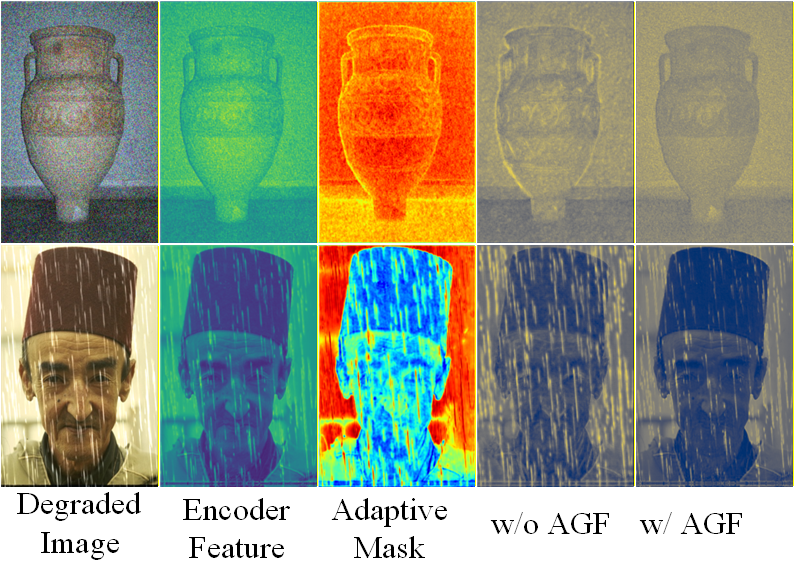
Figure 2: Visualization of AGF: degraded input, encoder features, the learned adaptive mask, output without AGF, and output with AGF. AGF attenuates degradation while preserving semantic detail.
Context Adaptive Gated Attention (CAGA)
CAGA extends multi-head self-attention by injecting layer-wise degradation prompts at two critical junctures: temperature scaling and output gating. The prompt modulates the sharpness of attention distributions by head-wise adjustment of the softmax temperature, ensuring robust aggregation even under severe degradation. Post-attention, the layer prompt further gates the output, suppressing degradation noise in the final attended feature map.
Empirical Results
All-in-One and Single Task Restoration
DACG-IR exhibits consistent, architecture-agnostic improvements over state-of-the-art baselines on all-in-one restoration benchmarks. Integration of AGF into various backbones (NAFNet, Restormer, PromptIR) leads to robust gains in PSNR and SSIM across dehazing, deraining, denoising, deblurring, and low-light enhancement.
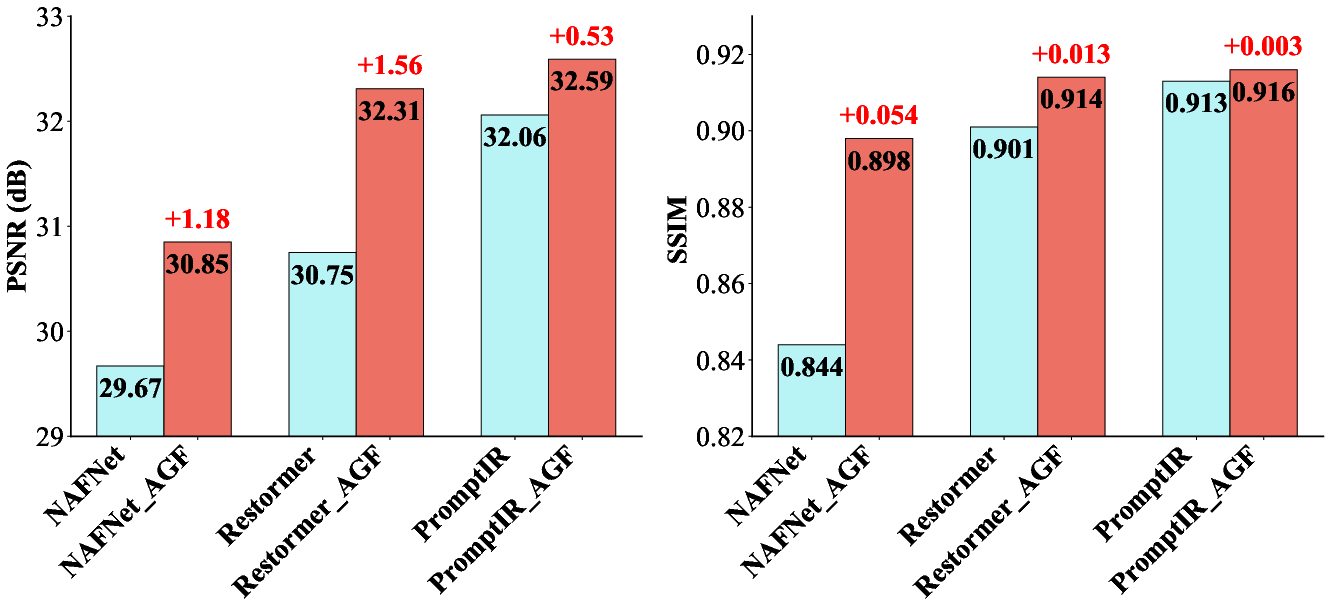
Figure 5: Average PSNR and SSIM gains from AGF integration in all-in-one restoration backbones, demonstrating performance improvements regardless of model architecture.
On composite degradation (multi-weather and artificial mixtures), DACG-IR surpasses alternative unified and mixture-of-experts architectures, especially under adverse settings such as the CDD11 and All-Weather benchmarks, where negative interference and task imbalance are marked challenges.
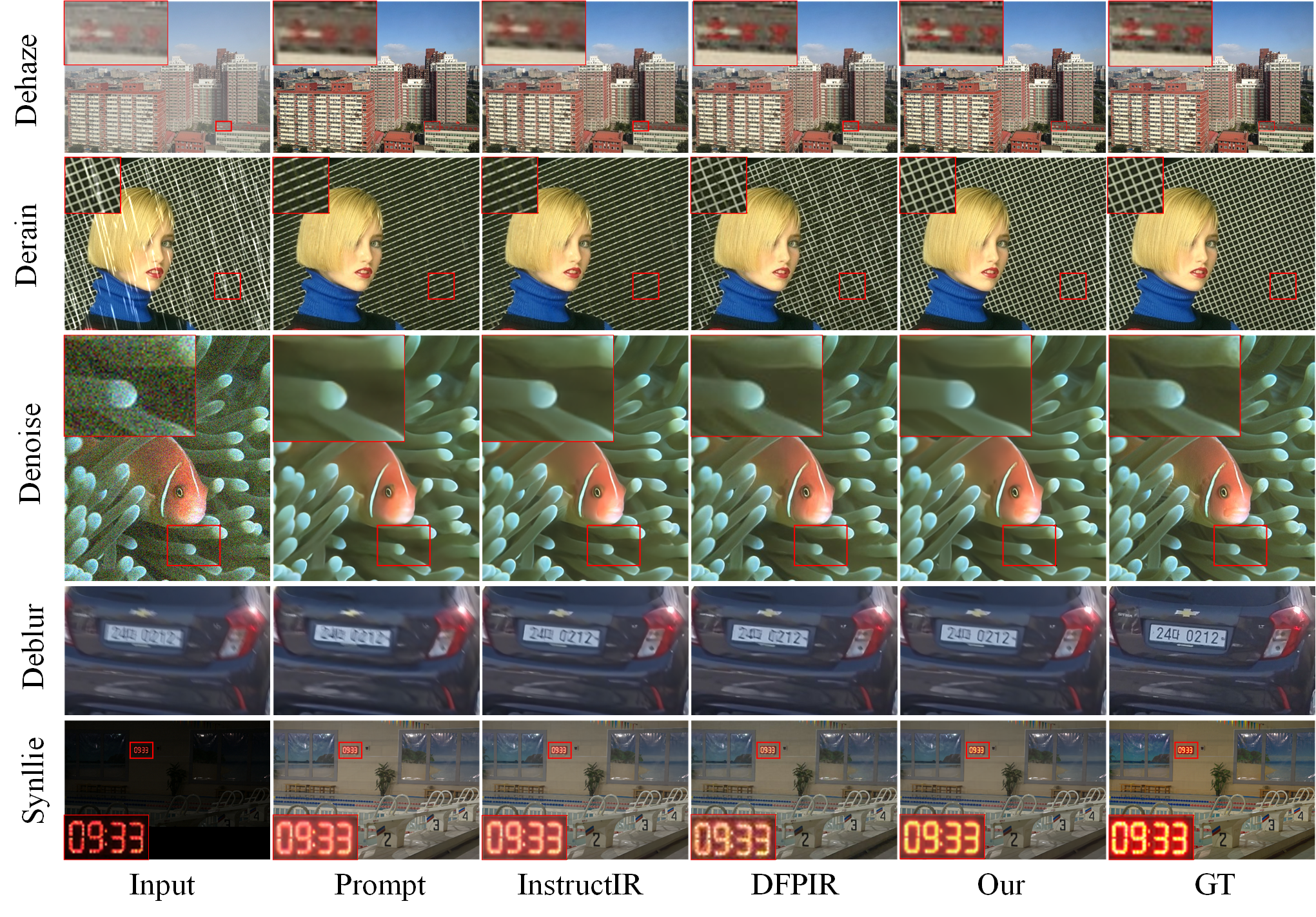
Figure 4: Visual comparison under five concurrent degradations: DACG-IR restores structures and contrast with fewer artifacts compared to contemporary unified restoration models.
Ablation and Analysis
Extensive ablation demonstrates that each component—DAM, CGDM, AGF, and CAGA—contributes positively to restoration metrics, with the combination yielding the largest gains. AGF, in particular, offers strong architecture-agnostic benefits, and the incorporation of dual-domain (spatial, frequency) modulation is crucial for addressing global artifacts that are otherwise under-modeled by spatial-only pipelines.
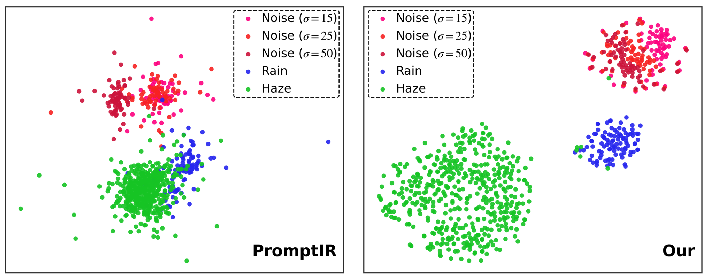
Figure 6: t-SNE visualization of intermediate features for PromptIR and DACG-IR. DACG-IR achieves clearer task separation and more compact intra-task clusters, reflecting superior degradation-awareness and reduced inter-task interference.
Implications, Limitations, and Future Directions
This work shows that adaptive, explicit degradation-awareness is essential for robust feature disentanglement and negative interference mitigation in unified restoration models. The modular, prompt-based approach enables lightweight adaptation without catastrophic performance drops when scaling to more degradations.
The current method still faces efficiency limitations due to the application of Transformer-based models and the computational overhead of dual-domain processing. Additionally, domain-specialized models retain a performance edge on certain tasks (e.g., low-light, extreme deblurring) due to specialized inductive biases.
Future research should focus on improving the efficiency of gating and modulation operators, and on domain-adaptive scaling (e.g., prompt-conditioned expert routing or hybrid vision backbones) to achieve SOTA accuracy without compromising real-world throughput.
Conclusion
Degradation-Aware Adaptive Context Gating (DACG-IR) advances unified image restoration by leveraging explicit, hierarchical, and context-driven degradation prompts for attention, feature modulation, and skip-path filtering. It demonstrates robust generalization across a spectrum of degradation types and achieves best-in-class quantitative and qualitative results under both all-in-one and composite restoration settings. This framework lays the groundwork for further development in adaptive, scalable, and efficient universal restoration networks.
Reference: "Degradation-Aware Adaptive Context Gating for Unified Image Restoration" (2605.01236)