- The paper presents a rigorous formulation of inverse scattering for 2D Dirac equations, establishing convergence criteria for both IBS and RIBS methods.
- It details efficient numerical solvers with finite differences and FFT-accelerated GMRES applied to chiral and anti-chiral models.
- Numerical experiments show that RIBS offers significant computational savings while maintaining accuracy in low- to medium-contrast regimes.
Inverse Scattering for Dirac Equations in Waveguide Arrays
This work addresses the inverse scattering problem for specialized two-dimensional Dirac equations that arise as continuum approximations of quantum-optic waveguide arrays. Two forms are considered: a chiral Dirac equation (hyperbolic) and an anti-chiral Dirac equation (elliptic), both parameterized by a compactly supported scattering potential V(x,y). The primary inverse problem entails reconstructing V from measurements of the scattered field. The study extensively analyzes the forward well-posedness and develops two inverse algorithms—the inverse Born series (IBS) and the reduced inverse Born series (RIBS)—quantifying convergence and error, and furnishing detailed numerical validation.
Forward Problem and Well-Posedness Results
The chiral model is formulated as an initial-boundary value problem, with the Dirac equation interpreted as a time-like evolution in x and spatial variable y. By recasting the system into an evolution equation and leveraging the semigroup generated by a skew-adjoint operator, the authors establish comprehensive existence and uniqueness criteria for arbitrary L∞ potentials under mild regularity and smallness assumptions.
The anti-chiral model is recast using a Lippmann-Schwinger integral equation, employing explicit Green's function representations involving Hankel functions and Pauli matrices. The authors rigorously derive conditions under which the forward scattering map is contractive, via an explicit norm bound μa that quantifies the cumulative effect of the Green’s kernel on the domain. Well-posedness is thus assured for V with ∥V∥L∞(Ω)<1/μa.
Born Series and Inverse Born Series
The Born series expands the scattered field as an explicit series in multilinear operators of increasing order in V. For both models, the text establishes convergence domains for the Born expansion, dictated by the potential strength and the specific kernel structure. The forward operators Km exhibit rapidly decaying operator norms as V0 increases, with explicit bounds provided in terms of the key parameters V1 (chiral) and V2 (anti-chiral).
For the inverse problem, the IBS is defined as a formal series inversion of the Born series. Using the recursive framework developed in [hoskinsAnalysisInverseBorn2022], the authors provide precise convergence radii and nontrivial quantitative error estimates, based on geometric function theory. The theoretical analysis is exacting, critically addressing radii of convergence, norms of the pseudoinverse operator V3, and the effect of higher-order nonlinearity. Sufficient conditions for guaranteed recovery and error rates are explicit and tight.
Reduced Inverse Born Series (RIBS)
The RIBS is a computational reduction of the IBS, motivated by observed term cancellations when only a subset of series terms meaningfully contributes to the inverse. While rigorous analytic justification for RIBS is only fully available for restricted measurement setups (e.g., single source/detector), the present study numerically verifies its effectiveness for much broader configurations. The RIBS achieves substantial computational savings and, in the numerical studies, matches or outperforms the full IBS in both convergence speed and absolute reconstruction error.
Numerical Algorithms
The paper develops robust and efficient numerical solvers for both forward and inverse problems:
- The chiral model is discretized via finite differences in V4 and Crank-Nicolson time-stepping in V5, maintaining second-order accuracy.
- The anti-chiral model leverages the convolutional structure of the discretized Lippmann-Schwinger operator, utilizing FFT-accelerated matrix-vector products and employing GMRES for the dense linear system.
- In both cases, regularized pseudoinverses are constructed via conjugate gradient algorithms on Tikhonov-regularized normal equations, providing stable inversion in the presence of potential ill-posedness.
Extensive simulations are carried out for both disks and Gaussian-shaped potentials at varying contrast levels. Reconstructions are compared quantitatively via relative error analysis across methods (projection, IBS, RIBS, multiple series truncations). The visual reconstructions and cross-sectional analyses for both chiral and anti-chiral models consistently reveal the following:
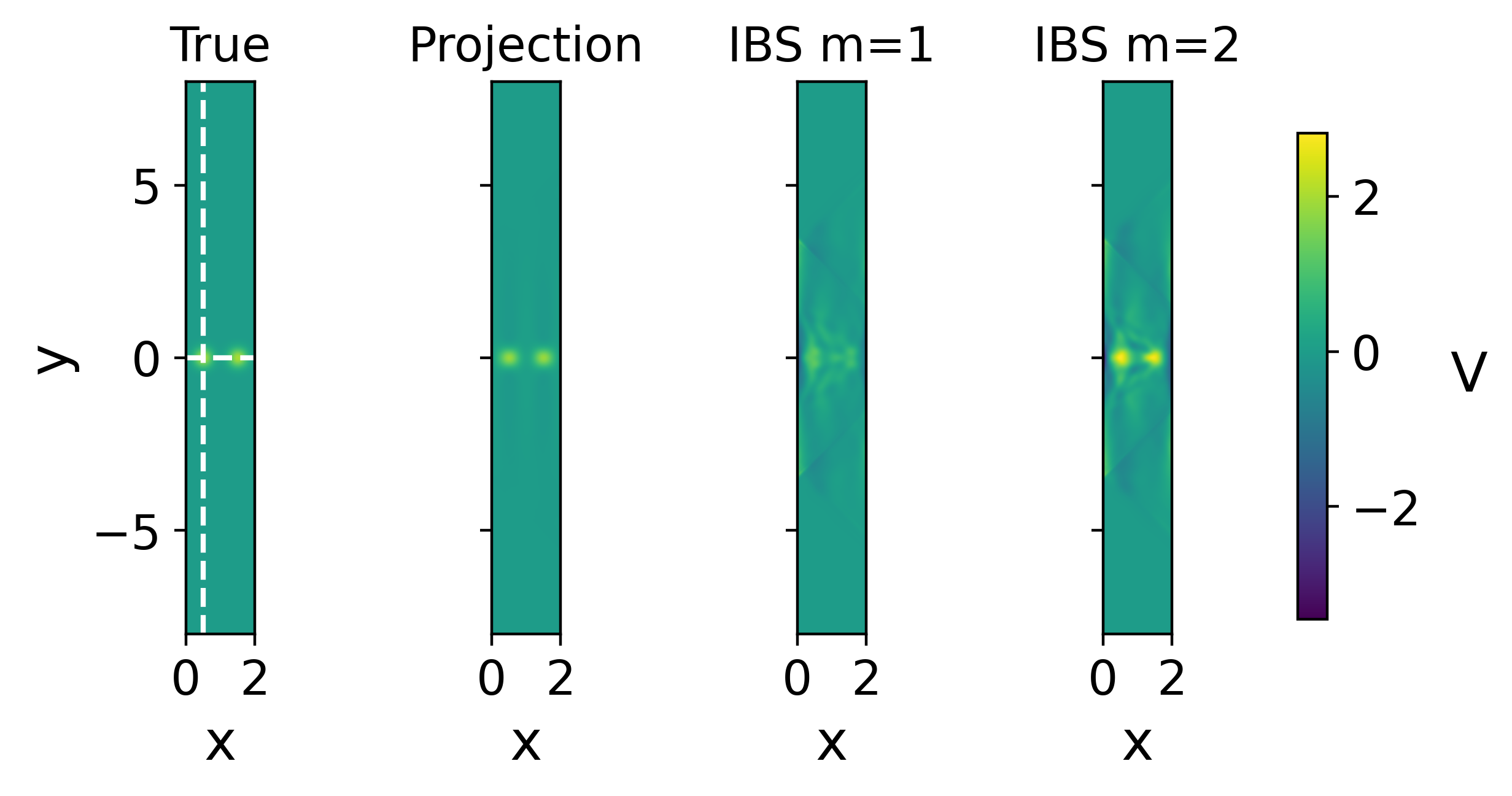
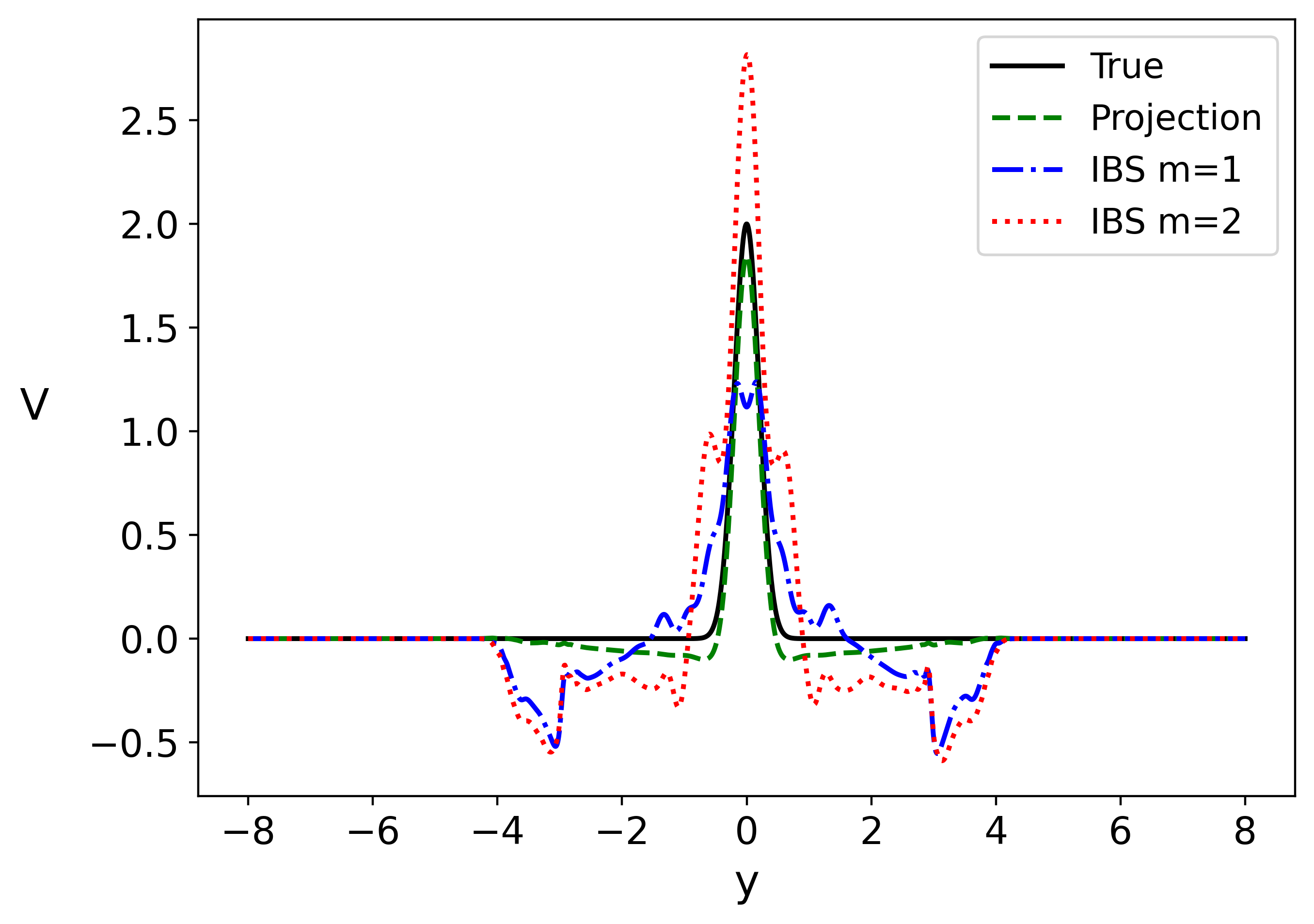
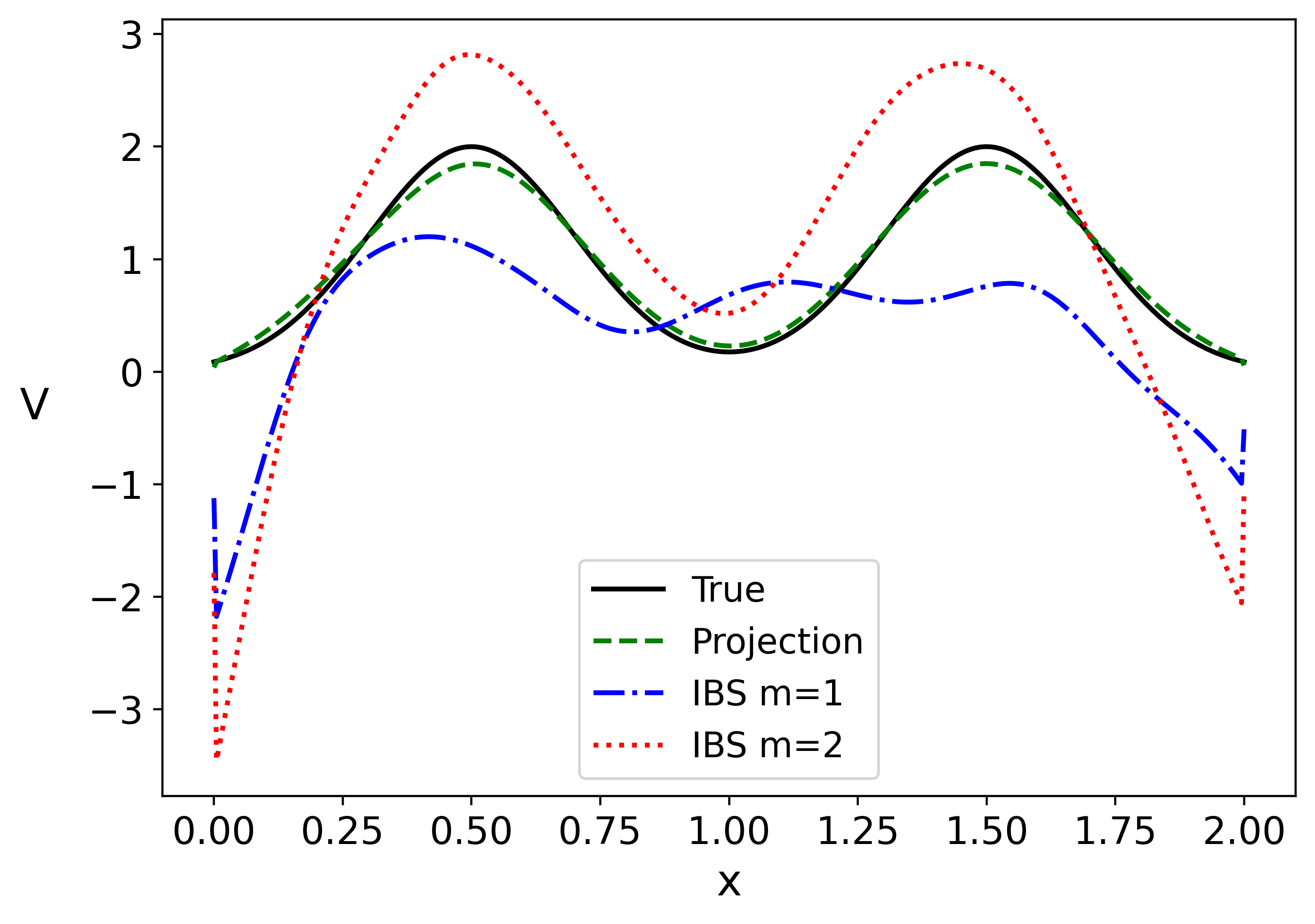
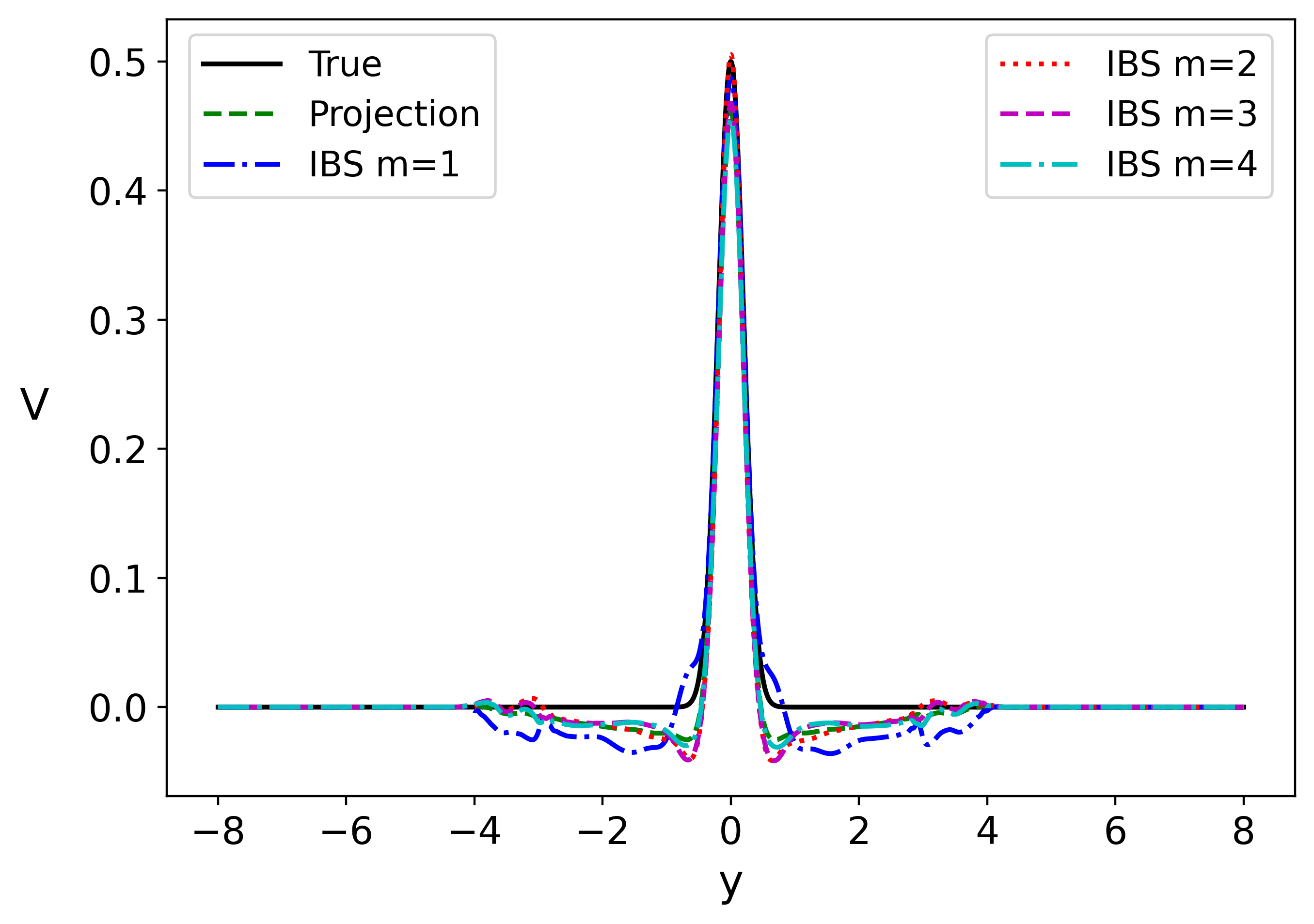
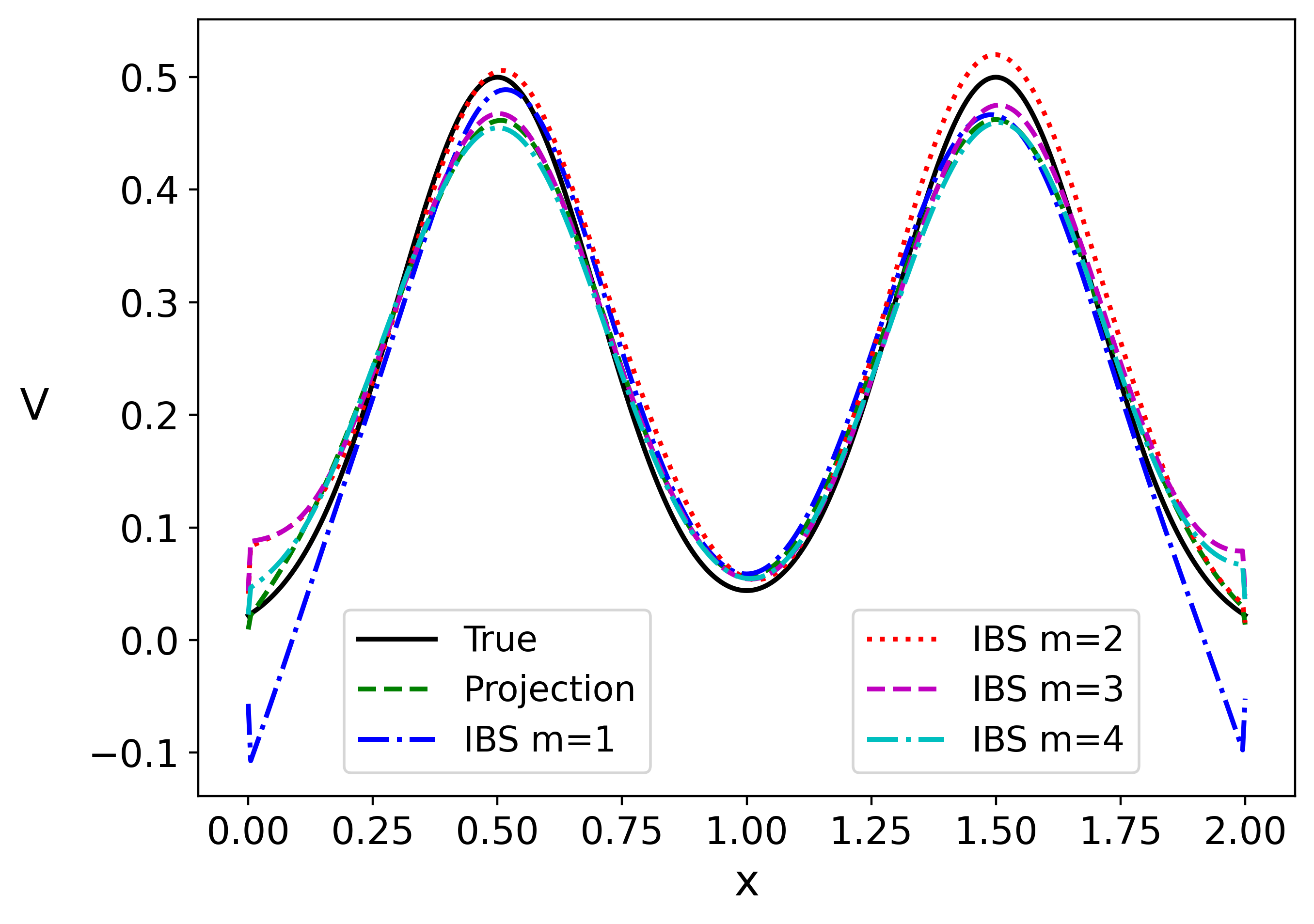
Figure 1: Reconstructions of V6 for a low-contrast disk using the chiral model, comparing IBS, RIBS, and projection methods.
Figure 2: Reconstructions of two low-contrast Gaussian scatterers using the anti-chiral model, demonstrating boundary measurement advantages.
- In the low-contrast regime, both IBS and RIBS yield highly accurate reconstructions using only one or two series terms.
- In the medium-contrast regime, converged reconstructions require higher-order terms but maintain practical accuracy, with RIBS often matching IBS performance.
- For high-contrast potentials, both methods eventually fail to reconstruct the true potential; this is consistent with the analytically established convergence bounds.
Figure 3: Error profiles and cross sections for medium-contrast disk reconstructions (chiral model) across IBS and RIBS truncation order.
Additionally, the anti-chiral (elliptic) model facilitated more robust reconstructions than the chiral (hyperbolic) counterpart. This improvement is attributed not to the operator class per se, but to the relative richness of the measurement configuration—full boundary data in the anti-chiral case versus final-time (one-sided) data in the chiral case.
Figure 4: Relative error as a function of IBS and RIBS order for the anti-chiral model, demonstrating rapid convergence for small to moderate contrast.
Implications and Future Directions
The detailed convergence analysis and numerical evidence underscore the suitability of IBS and RIBS for solving direct and inverse problems in photonics models governed by Dirac-type operators. The explicit error estimates and rigorously justified convergence domains make the approach theoretically robust. The observed success of the RIBS reduction, despite lacking full analytic justification outside certain scenarios, indicates that cancellation phenomena may be generic and warrants more systematic analytic study.
Future work may address:
- Extending rigorous convergence/backward-stability analysis of RIBS to multisource, multidetector inverse data,
- Exploring performance as the model transitions from quantum-optic to more general relativistic or nonlinear Dirac contexts, such as those studied in [defilippisBornInverseBorn2023], [defilippisNonlinearityHelpsConvergence2024],
- Incorporating experimental noise models and data-incompleteness, leveraging recent advances in stability for partial data settings [saloInverseProblemsPartial2010],
- Generalizing to fully three-dimensional and/or anisotropic media, which would involve significant numerical and analytic challenges.
Conclusion
This paper presents a thorough study of inverse scattering for Dirac equations relevant to quantum waveguide arrays, establishing the effectiveness and efficiency of IBS and RIBS algorithms for reconstructing scattering potentials from field measurements. The combined analytic and computational treatment offers both practical algorithms and a strong theoretical foundation, motivating further investigations into the interplay between measurement configuration, operator structure, and series convergence in quantum photonic inverse problems.
Figure 5: Reconstructions for high-contrast Gaussian potentials, illustrating limitations of the Born-type inversion for strongly scattering scenarios.

