- The paper presents a semi-analytic framework incorporating finite black hole seeds, realistic stellar cusps, and non-circular orbits to model dark matter spike formation.
- It demonstrates that including realistic astrophysical factors leads to significantly shallower and less dense spikes compared to idealized Gondolo-Silk predictions.
- The analysis shows that stellar relaxation and cosmic star formation rates drive the evolution of dark matter spikes, affecting indirect and direct detection benchmarks.
Introduction
This work presents a comprehensive semi-analytic framework for the formation and dynamical evolution of dark matter (DM) spikes around supermassive black holes (SMBH) embedded in realistic nuclear star clusters. The canonical paradigm, as formalized by Gondolo and Silk, suggests that the adiabatic growth of a SMBH steepens the inner DM distribution, leading to pronounced overdensities or "spikes" with inner slope γsp=(9−2γ)/(4−γ) for an initial halo profile ρ∝r−γ. Such spikes have been widely invoked to forecast enhancements in indirect and direct DM detection signals, as well as modifications to astrophysical observables near galactic centers. However, this traditional framework is predicated on idealized assumptions: vanishing black hole seed mass, spherically symmetric pure DM potentials, and circular orbits.
The present study critically re-examines these assumptions by incorporating: (i) finite black hole seeds; (ii) stellar cusps with arbitrary mass normalization and slope; (iii) non-circular DM orbits using the full radial-action conservation formalism. The analysis then proceeds to a time-dependent treatment, solving coupled Fokker-Planck equations for DM and stars, with stellar relaxation rates that naturally track the evolving cosmic star formation rate (SFR).
The work first generalizes the spike formation calculation in three distinct ways: adopting (1) the canonical Gondolo-Silk prescription, (2) the circular-orbit adiabatic invariant with realistic seed and stellar properties, and (3) full radial-action conservation for arbitrary orbits. Monte Carlo marginalization over plausible ranges for the initial black hole seed mass, stellar and dark-matter cusp slopes, and enclosed mass ratios at 1 pc is used to assess the impact of uncertainties inherent in galactic nuclei.
The results demonstrate that purely gravitational, adiabatic contraction leads to inner density profiles that are systematically less steep and less dense when accounting for either non-zero BH seeds or stellar baryonic potential, in contrast to the GS limit. The inclusion of radial orbits softens the inner spike relative to the circular-orbit invariant but maintains a denser spike compared to the GS scenario for massless seeds.
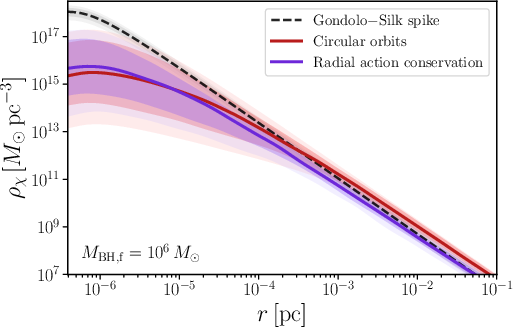
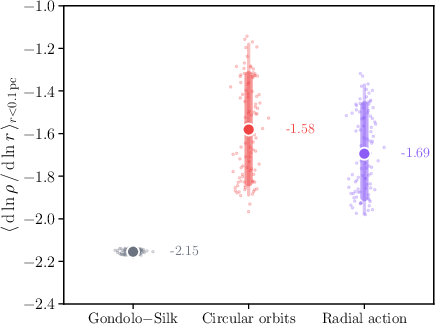
Figure 1: DM density profiles ρχ(r) after adiabatic contraction for different prescriptions and marginalized over astrophysical uncertainties (left); marginalized inner slope comparison (right).
The marginalized density profiles and inner slopes reveal up to two orders of magnitude suppression in central densities compared to the idealized GS case. Even under conservative assumptions, significant overdensities above the NFW baseline are generically produced. However, the detailed structure of these spikes strongly depends on the mass and profile of both stars and the initial black hole seed.
Time Evolution: Relaxation Through Stellar Encounters and the Role of Star Formation History
Having established initial conditions, the study traces the subsequent redshift evolution of spikes under the influence of stellar relaxation. The Fokker-Planck formalism is solved in energy space, modeling both collisionless DM and stars. The critical regime considered is the region well within the SMBH sphere of influence, where two-body relaxation with stars dominates DM heating and depletes the inner spike.
For a static stellar bath, the DM density profile evolves towards the Gnedin-Primack-Merritt attractor—with an asymptotic inner slope γχ=3/2—while stars approach the Bahcall–Wolf solution γ⋆=7/4. The cosmic SFR is used to modulate the time dependence of the gravitational heating rate, with the most efficient stellar heating near the SFR peak (z∼2). This significantly accelerates spike depletion at these epochs.
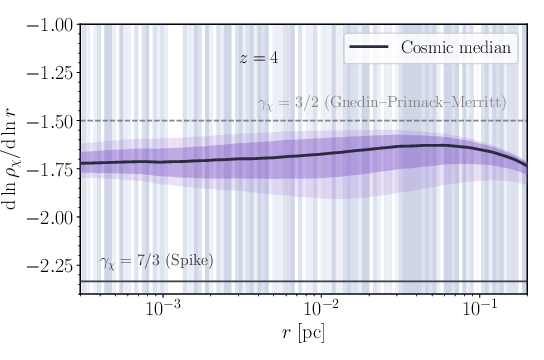
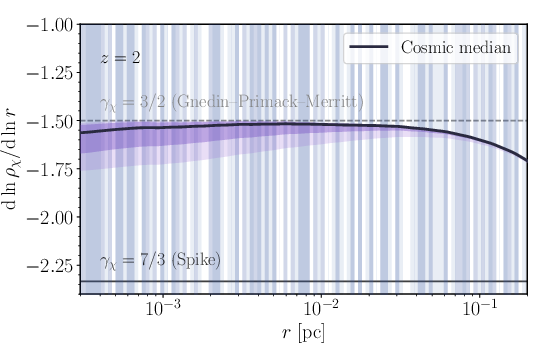
Figure 3: Marginalized radial dependence of the DM logarithmic density slope s(r) at z=4 (left) and z=2 (right).
The DM profile's inner slope, marginalized over astrophysical parameters, monotonically relaxes from the initial spike value (γχ∼7/3) towards the quasi-universal steady-state attractor (ρ∝r−γ0) by ρ∝r−γ1 for typical initial conditions.
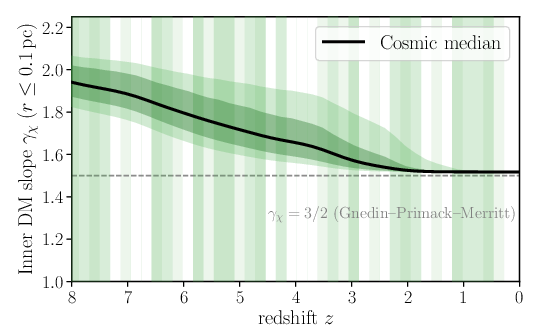
Figure 5: Cosmic evolution of the averaged inner DM density slope ρ∝r−γ2 within ρ∝r−γ3.
The framework allows for bursty, stochastic cosmic SFR histories, characteristic of low-mass or gas-rich galaxies. Temporally varying SFR alters the efficiency and timing of DM heating. While burst-induced variability can transiently modify spike slopes (at the ρ∝r−γ4–ρ∝r−γ5 level), the cumulative SFR normalization has a slightly greater effect on the redshift at which the relaxation is completed.
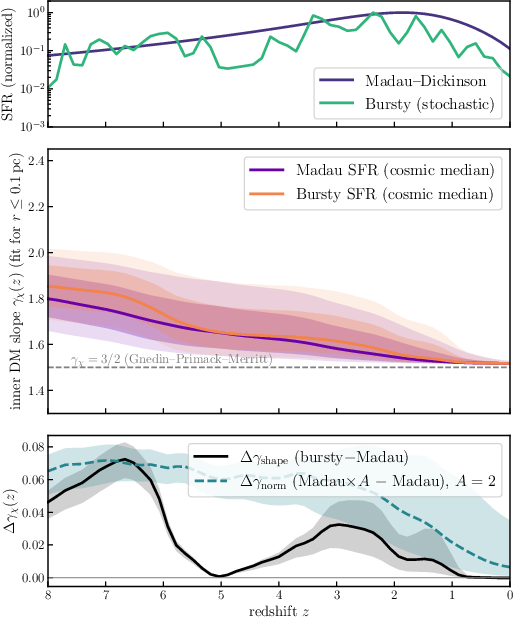
Figure 2: Impact of a bursty versus smooth SFR on the evolution of the inner DM spike slope.
The formation redshift of the BH-driven spike is a secondary driver. Later-forming spikes have less cosmic time to relax; those established at ρ∝r−γ6 may not have converged to the Bahcall–Wolf cusp by ρ∝r−γ7, retaining enhanced slopes and larger ρ∝r−γ8-factors at low redshift compared to systems with ρ∝r−γ9.
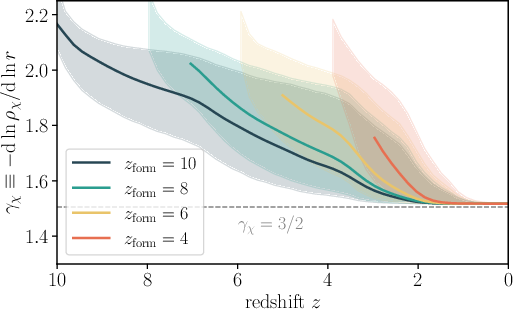
Figure 4: Impact of the spike formation redshift on the relaxation of the inner DM density slope.
Benchmarks for Indirect and Direct Dark Matter Detection
The study emphasizes the strong implications for any DM indirect detection strategy targeting galactic nuclei. The time-dependent evolution of the central column density (ρχ(r)0) and annihilation ρχ(r)1-factor are quantified; canonical GS spikes predict ρχ(r)2-factor enhancements that are depleted by ρχ(r)3–ρχ(r)4 orders of magnitude after stellar heating is accounted for. Importantly, relaxed spikes remain significantly denser than unperturbed NFW cusps, preserving an ρχ(r)5 enhancement out to ρχ(r)6.
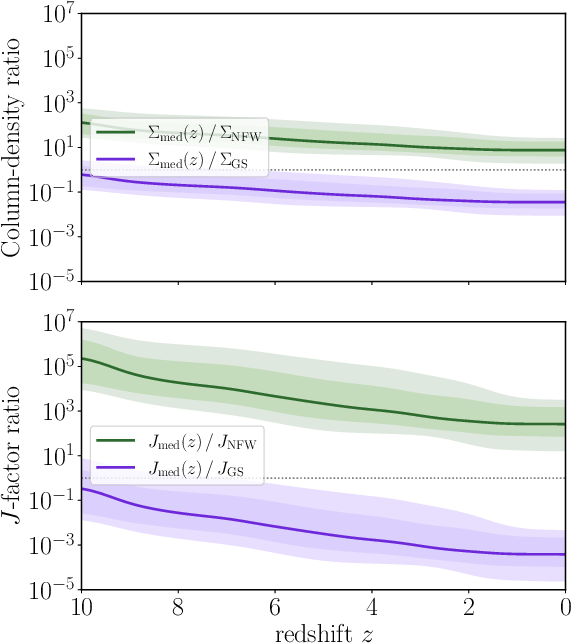
Figure 6: Redshift evolution of the central dark-matter column density and ρχ(r)7-factor ratios, integrated within ρχ(r)8.
This has direct bearing on the interpretation of gamma-ray or neutrino fluxes from the Galactic Center and external active galactic nuclei, recasting the prior literature’s signal benchmarks.
Dependence on Initial Configuration and Cusp Structure
Systematic exploration of parameter space (seed mass, stellar and DM slopes, mass ratios) reveals that larger enclosed stellar mass and steeper stellar cusps foster more efficient relaxation and spike depletion. Conversely, systems that form spikes with lower stellar mass or at later times may preserve steeper ρχ(r)9–γχ=3/20 inner slopes to lower redshift.
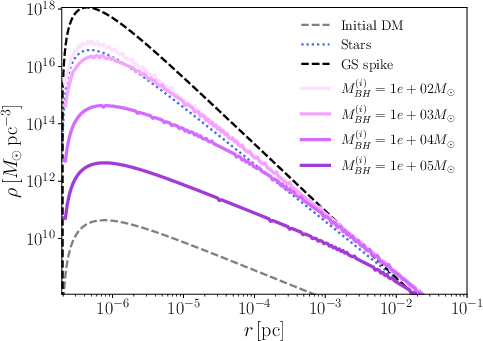
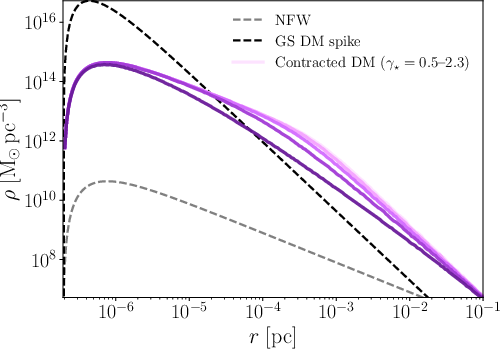
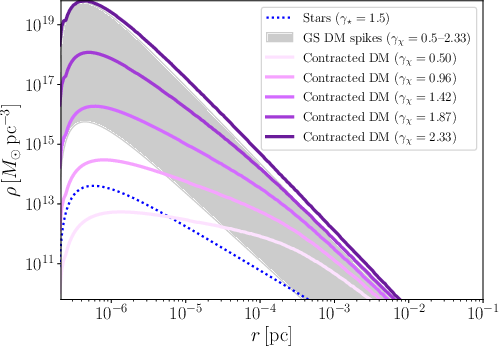
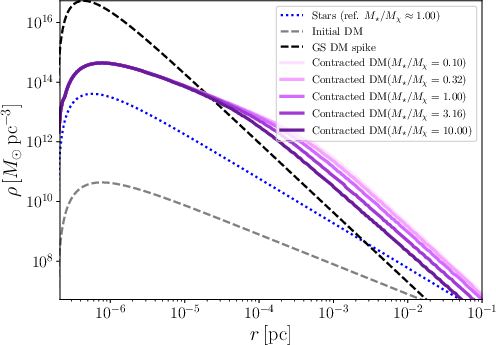
Figure 7: DM overdensity as a function of SMBH seed mass; the canonical GS spike is contrasted with a range of astrophysical scenarios.
The precise shape and normalization of the evolved spike is thus contingent upon both the detailed assembly history of the nucleus and the redshift of SMBH formation. This is critical for relating observational upper limits on DM annihilation or decay to microphysical parameters.
Conclusion
This study establishes a robust theoretical framework for the formation and cosmic evolution of dark matter spikes around supermassive black holes, incorporating physical ingredients essential for application to real galaxies. The inclusion of finite black hole seed mass, stellar clusters, and non-circular orbits systematically reduce both the steepness and normalization of formed spikes relative to canonical expectations. Dynamical heating by stars efficiently drives relaxation towards a γχ=3/21 profile on Gyr timescales for most plausible galactic environments, especially when tracking the cosmic SFR. The resulting time-evolved benchmarks for column densities and γχ=3/22-factors must be adopted in DM signal modeling, as extrapolations from idealized spike models may overestimate low-γχ=3/23 signals by several orders of magnitude.
Future work should integrate the impact of black hole mergers, spheroidal triaxiality, AGN feedback, multi-component mass segregation, gas dynamics, and relativistic corrections to further refine predictions for the central DM profile and its implications for indirect detection and gravitational wave astrophysics.
References: (2605.01023)

