Quantum Simulation of Differential-Algebraic Equations with Applications to Unsteady Stokes Flow
Published 1 May 2026 in quant-ph | (2605.00794v1)
Abstract: Differential-algebraic equations (DAEs) arise naturally in constrained dynamical systems, but their algebraic constraints and hidden compatibility conditions make them more subtle than standard ordinary differential equations. This paper initiates a quantum-algorithmic study of constrained linear DAEs. We introduce a dilation framework that embeds the generally non-Hermitian constrained evolution into a projected Schrödinger-type dynamics on an enlarged Hilbert space, [ i\frac{d}{dt}Ψ(t)=P\tH PΨ(t), ] where $\tH$ is Hermitian and P is the orthogonal projector onto the lifted constraint subspace. This identifies the DAE evolution with a quantum Zeno-type dynamics and enables the use of block encodings, QSVT-based projector construction, and Hamiltonian simulation. We apply the framework to structure-preserving discretizations of the unsteady Stokes equations, where the pressure enforces the discrete incompressibility constraint. We derive the corresponding projected Hamiltonian formulation, identify low-energy spectral cutoffs motivated by solution smoothness, and discuss the resulting quantum simulation cost in comparison with classical projection-type methods. The results provide a first step toward understanding the potential intersection of quantum algorithms, DAEs, and constrained PDE dynamics.
The paper presents a dilation strategy that embeds non-Hermitian DAEs into unitary dynamics, enabling constrained quantum simulation.
It leverages quantum Zeno dynamics and efficient block-encoding to manage operator constraints and resource complexity.
The approach is applied to unsteady incompressible Stokes flow, showing near-perfect agreement with classical solvers.
Quantum Simulation of Differential-Algebraic Equations via Unitary Dilation: Theory, Algorithms, and Applications to Unsteady Stokes Flow
Abstract
A formal framework is developed for simulating linear constrained DAEs through quantum algorithms by embedding their non-Hermitian dynamics into projected, unitary Schrödinger evolutions. This essay provides a comprehensive synthesis of the employed dilation strategy, details the block-encoding and quantum Zeno dynamics underpinning the simulation paradigm, rigorously analyzes resource complexity for both general DAE and PDE-discretization regimes, and elucidates implications and limitations based on error bounds and mesh scaling in the context of time-dependent Stokes flows.
Projected Unitary Dynamics Through Dilation: Formulation
Linear DAEs, Ex′(t)=Ax(t)+f(t) with possibly singular E, appear ubiquitously in constrained dynamical modeling. Algebraic constraints (encoded via Cx=0) necessitate the state trajectory remains in a submanifold, rendering standard quantum simulation frameworks for ODEs/LDEs inapplicable. The paper introduces a moment-matching dilation that embeds the DAE evolution into a larger Hilbert space equipped with an ancilla system, augmenting nonunitarity to an effective projected unitary Schrödinger equation:
idtdΨ(t)=PHPΨ(t)
where H is a Hermitian dilation of the original generator, P projects onto the lifted constraint subspace, and the physical solution is recovered by x(t)=(⟨l∣⊗I)Ψ(t). The implementation crucially relies on operator tensors of the original and ancilla systems for both H (Hermitian part) and K (anti-Hermitian part), and analytic control over the ancillary states to allow perfect moment-matching for Schur reduction equivalence. Lemmas in the paper guarantee that index-1 DAEs can be transformed into the required semiexplicit form.
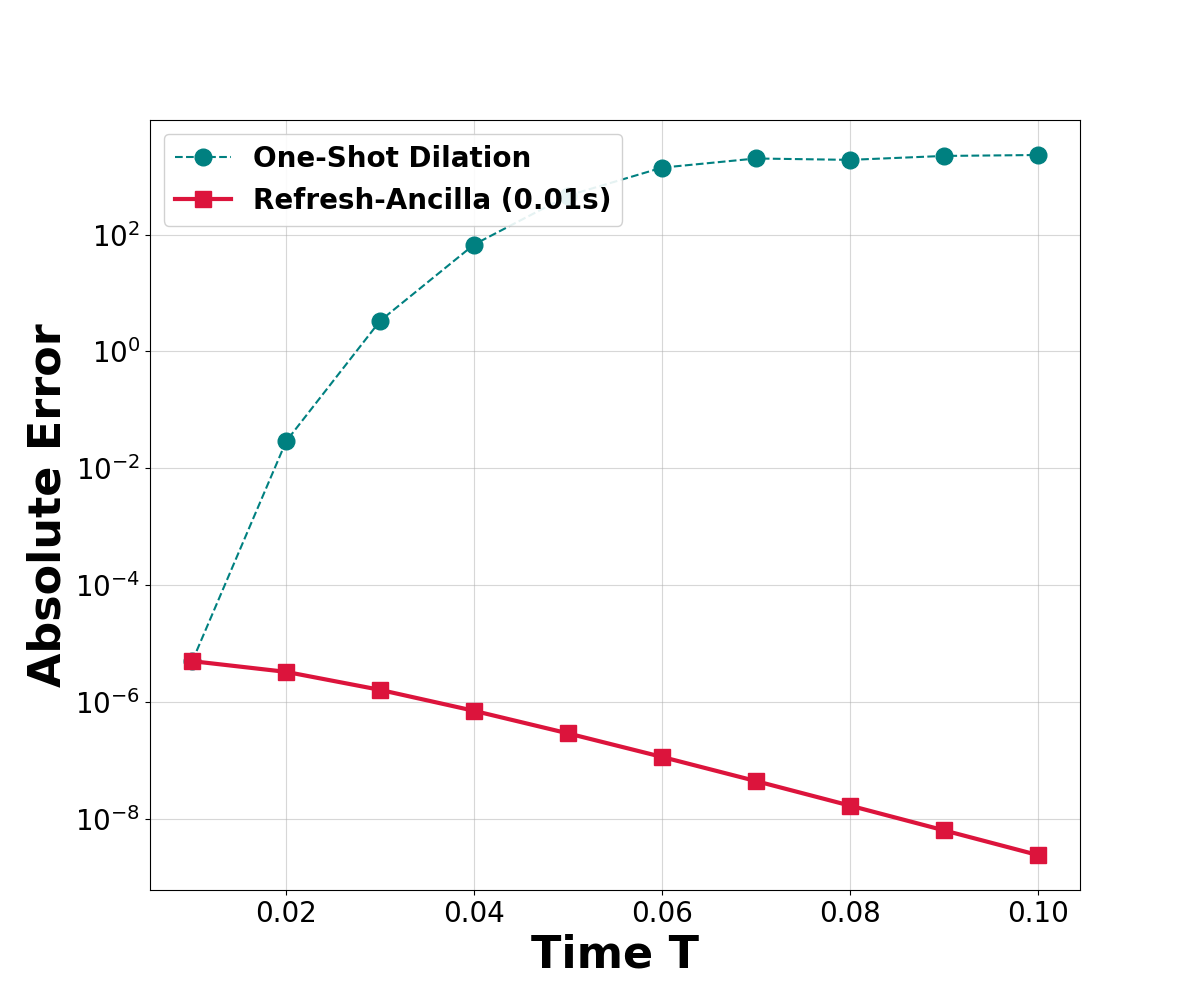
Figure 1: Error from the dilation technique described in Section 3, illustrating the numerical stability and fidelity of the quantum algorithm when compared to the classical benchmark integration.
Quantum Zeno Dynamics and Algorithmic Realization
The projected unitary evolution is rigorously interpreted using the quantum Zeno effect: repeated projective measurements confine the quantum trajectory to the admissible subspace in the N→∞ limit,
E0
enabling simulation either directly via compressed Hamiltonian or by alternations of evolution and projection. The block-encoding of both the constraint and generator is made efficient using quantum singular value transformation (QSVT), leveraging polynomial approximations to implement near-optimal projectors onto E1 and to manipulate the effective Hamiltonian in the presence of a spectral gap. The analysis outlines precise complexity scaling in terms of Hamiltonian norm, spectral gap, and block-encoding error, culminating in resource demands that scale E2 with respect to evolution time E3, where E4 is associated with the condition number of the constraint operator.
Application to Semidiscrete Incompressible Stokes Flow
The dilation framework is concretely instantiated for the unsteady incompressible Stokes equations. Structure-preserving discretizations (e.g., MAC finite differences, mixed FE methods) yield saddle-point DAE systems—velocity evolution is governed by a differential law, and pressure serves as a Lagrange multiplier enforcing discrete incompressibility. Post-dilation, the quantum simulation of the constrained dynamics proceeds according to a projected Hamiltonian built from discrete Laplacians and divergence operators, with explicit attention to enforcing physical boundary conditions and regularity.
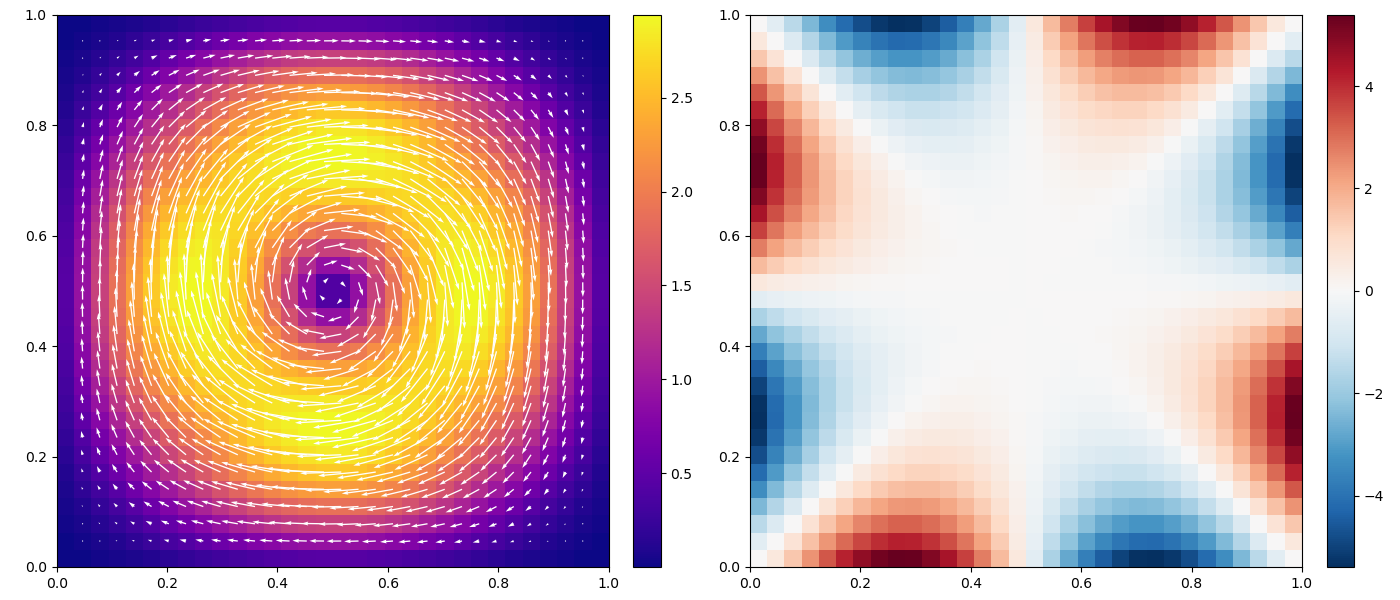
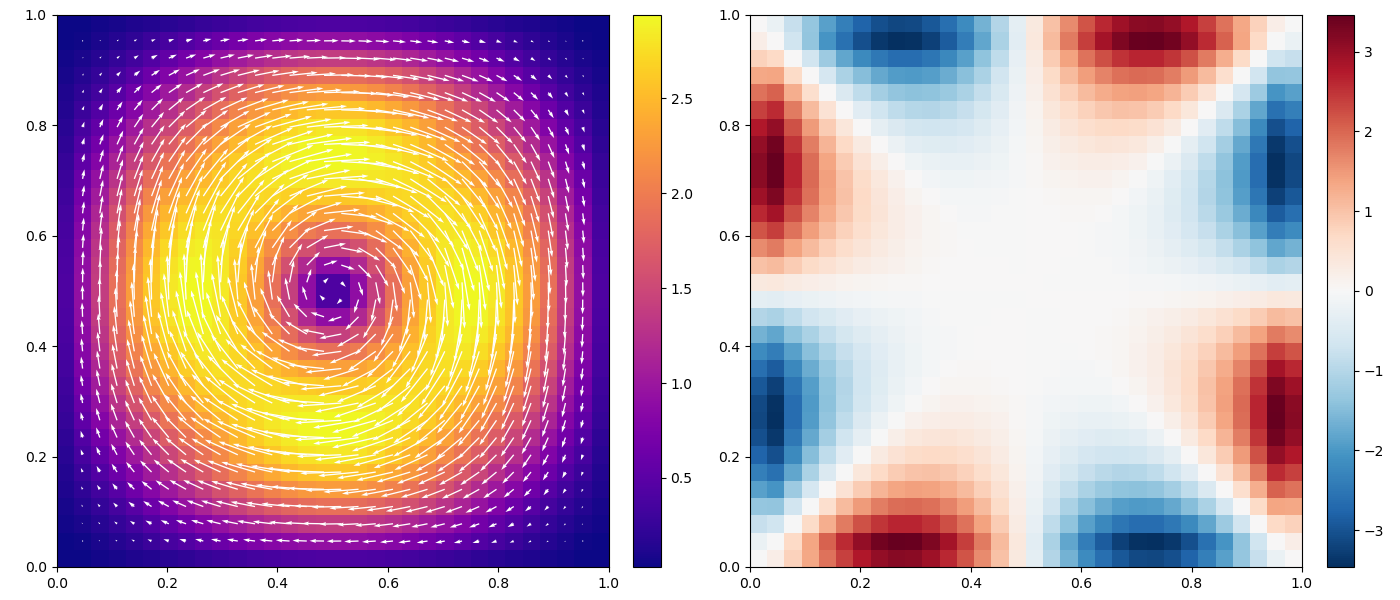
Numerical verification is provided by examining the evolution of velocity and pressure fields against reference classical solvers. The error arising from dilation—the difference in solution E5—is shown to be small, and further decreased via periodic ancilla refresh strategies.
Figure 2: Velocity and pressure field evolution from the original discretized Stokes system at E6 resolution; E7.
Figure 3: Solution recovered from the dilated DAE, showing near-perfect agreement with the reference discretized flow.
Hamiltonian Simulation Complexity: Mesh and Energy Considerations
For Stokes discretizations on a mesh of size E8, the naive Hamiltonian norm E9 leads to quantum simulation costs Cx=00 due to block-encoding overhead for the incompressibility projector. However, the projector and time-evolution costs can be mitigated in practice using low-energy subspace (spectral filtering) techniques, given regular and appropriately smooth initial data—reducing the cost to Cx=01 for spatial dimension two. This scaling is contrasted with optimal classical projection methods, where the cost scales as Cx=02 (Cx=03 spatial dimension) assuming second-order discretizations and optimal linear solvers. The quantum approach exhibits a favorable exponent in Cx=04 for Cx=05, but state preparation and measurement/observation costs are not included in the quantum resource budget, which may become significant in practical scenarios.
Contrasts and Limitations
The framework precisely transfers the challenge of constraint enforcement (algebraic compatibility) from nonunitary dynamics to the efficient quantum implementation of projectors and their block-encodings. Notably, unless the divergence operator admits special structure (e.g., global Fourier diagonalization), the norm scaling can be prohibitive and is a major contributor to complexity. The low-energy algorithmic improvement is not universal: it depends on spectral concentration of the solution, sum-of-squares operator decomposability, and mesh-independent discrete inf-sup constants. Data access, state initialization, and readout are identified as crucial open obstacles; definitive end-to-end quantum advantage thus remains a nuanced and situation-dependent question.
Theoretical and Practical Implications
The dilation and projected quantum Zeno framework establishes a conceptually transparent route for embedding constrained linear (index-1) DAEs and, more generally, structure-preserving PDE discretizations within the scope of quantum Hamiltonian simulation. This builds a bridge between quantum computation, numerical analysis of constraints via Lagrange multipliers, and large-scale scientific simulation. The explicit connection to quantum Zeno subspaces and the associated operator theory provides a template which may generalize to broader classes of constrained dynamics, including multibody and circuit DAEs, port-Hamiltonian systems, and potentially certain non-linear settings via linearization.
Regarding future AI-oriented developments, the hybrid quantum-classical solution of physical simulation tasks (e.g., integrating quantum subroutines for constrained dynamics within classical AI-driven physical modeling frameworks) may profit from exploiting such dilation-based quantum algorithms. The results demonstrate avenues for spectral filtering and mesh-dependent scaling improvement through careful algorithmic structuring, but also emphasize the need for innovative block-encoding strategies tailored for discretized constraints.
Conclusion
The quantum simulation of differential-algebraic equations via dilation offers a robust theoretical foundation for quantum algorithms targeting constrained dynamics. By leveraging projected Schrödinger evolution and quantum Zeno dynamics, this approach systematizes and clarifies the path to unitary quantum computation for DAEs, with meaningful (albeit not universal) asymptotic scaling advantages for structured discretizations such as those arising in unsteady Stokes flow. The work uncovers the critical role of operator block-encoding normalization, the utility of spectral filtering for low-energy sector restriction, and the enduring challenge of full-system end-to-end complexity accounting. Progress in quantum resource analysis, state preparation, and problem-specific block-encoding design will determine the practical reach of these results in numerical PDEs and beyond.
“Emergent Mind helps me see which AI papers have caught fire online.”
Philip
Creator, AI Explained on YouTube
Sign up for free to explore the frontiers of research
Discover trending papers, chat with arXiv, and track the latest research shaping the future of science and technology.Discover trending papers, chat with arXiv, and more.