- The paper's main contribution is a convex, scalable framework that jointly optimizes EV routing and charging using MFD and queuing models.
- It integrates demand management, dynamic grouping, and routing strategies to minimize delays and reduce queue lengths at charging stations.
- Simulation results on a 16-region network demonstrate significant improvements, with up to 5.2% reduction in travel time under heavy congestion.
Multi-Regional Traffic Control with Travel and Charging Demand Co-Management
Overview
This work presents a convex, system-level framework for joint routing and charging management in multi-regional urban traffic networks with significant electric vehicle (EV) penetration. By explicitly integrating macroscopic fundamental diagram (MFD)-based regional dynamics with charging station (CS) queuing models and demand management, the proposed approach optimizes both vehicle routing and charging assignments. The model’s convexification ensures scalability. Simulation results on a 16-region urban network are provided, evidencing improvements in system-wide metrics, especially under heavy traffic regimes.
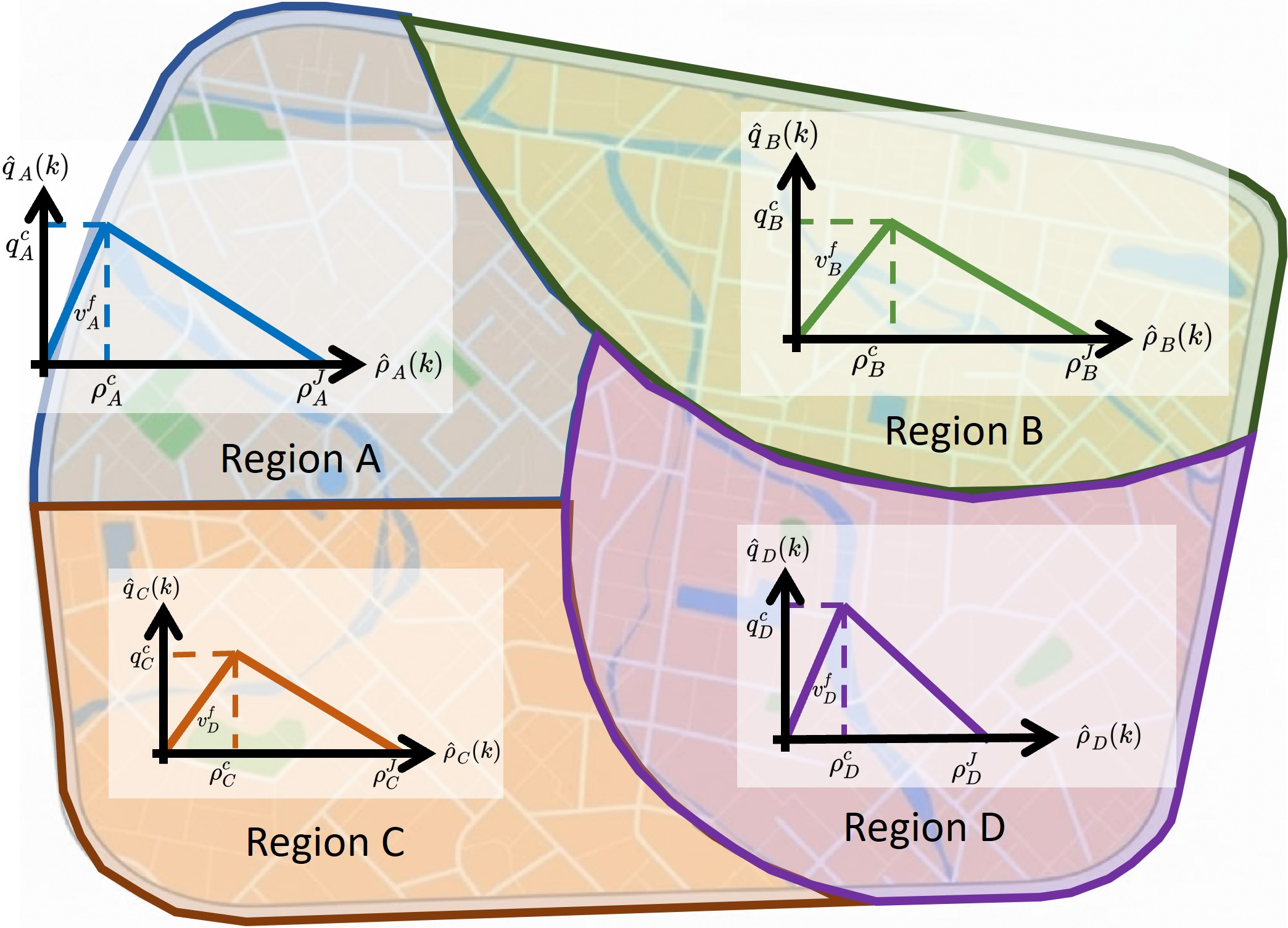
Figure 1: An urban area separated into four subregions, each governed by its own macroscopic fundamental diagram.
Technical Contributions
The framework advances prior MFD-based regional control systems by directly embedding EV charging heterogeneity. Vehicles are dynamically grouped by charging demand, and the optimization governs entry rates (via an external buffer), routing between regions, and charging station selection. The framework's main technical contributions include:
- Formulation of a cooperative optimal control problem incorporating demand management, route guidance, and charging station assignment.
- Explicit modeling of group-differentiated EV charging times and regional queuing dynamics, including finite buffer queues at CSs (Figure 2).
- Convex reformulation of the mixed-integer, nonlinear system dynamics derived from MFDs and queuing models, enabling efficient solution over large-scale networks.
- System-wide fulfillment constraints for charging demand, ensuring global EV charge completion within the control horizon.
These contributions address limitations in approaches solely targeting user equilibrium and methods that neglect charging demand coupling or model traffic only at the microscopic level.

Figure 3: The triangular MFD, central to the proposed framework, relating regional density and mean flow with piecewise-linear behavior to capture phased congestion effects.
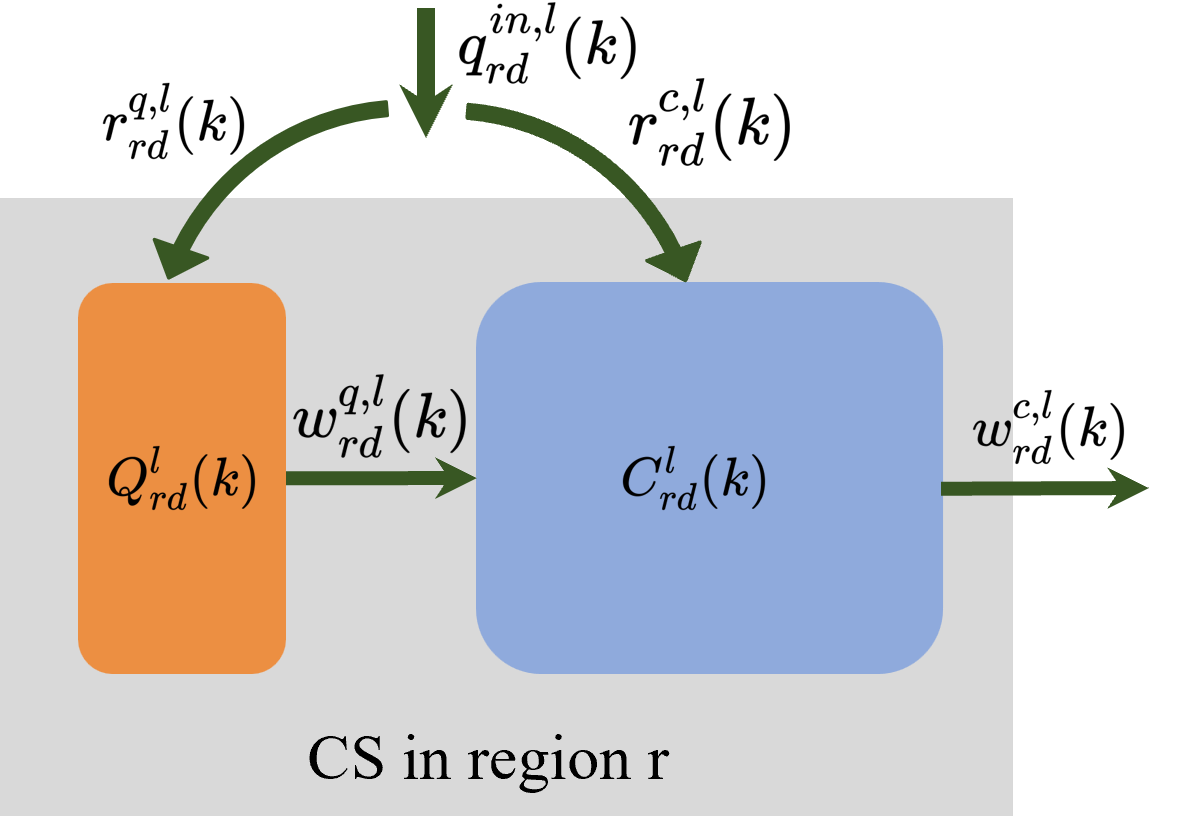
Figure 2: Regional-level charging station with queuing; EVs must queue if chargers are occupied, and charging time heterogeneity is respected.
The framework partitions the urban environment into homogeneous regions (Figure 1). Traffic dynamics in each region are governed by the triangular MFD (Figure 3), allowing compact, yet expressive, modeling of density-dependent outflow. The control policy at each time step determines:
- Which vehicles to admit (demand management via pre-entry buffer)
- How to guide admitted vehicles through the interregional network
- Assignment of charging-demand vehicles to regionally located CSs
Vehicles with charging need are partitioned into multiple classes according to their charging time requirements. The framework manages a queue and service process for each CS, modeling capacity and queue length explicitly. Decision variables include regional flows, CS inflows/outflows, and admission rates.
All nonlinear equality constraints induced by the MFD and queueing process are convexified (as relaxations)—for example, replacing the MFD with its convex hull and bounding flow-density relations via free-flow velocity. The overall OCP remains convex and tractable for real-time or large-scale optimization.
Simulation Methodology and Benchmarks
Simulations are performed on a synthetic Manhattan-style network of 16 regions (Figure 4), with exogenously specified origins and destinations. The framework is compared against three benchmarks:
- Without Demand Management (WDM): Disables entry regulation.
- Nearest Charging (NC): All EVs charge only in their entry region.
- Shortest Path (SP): Vehicles are routed purely by shortest network distance with no traffic or charging optimization.
All methods are evaluated across three exogenous traffic loads: light, moderate, and heavy.
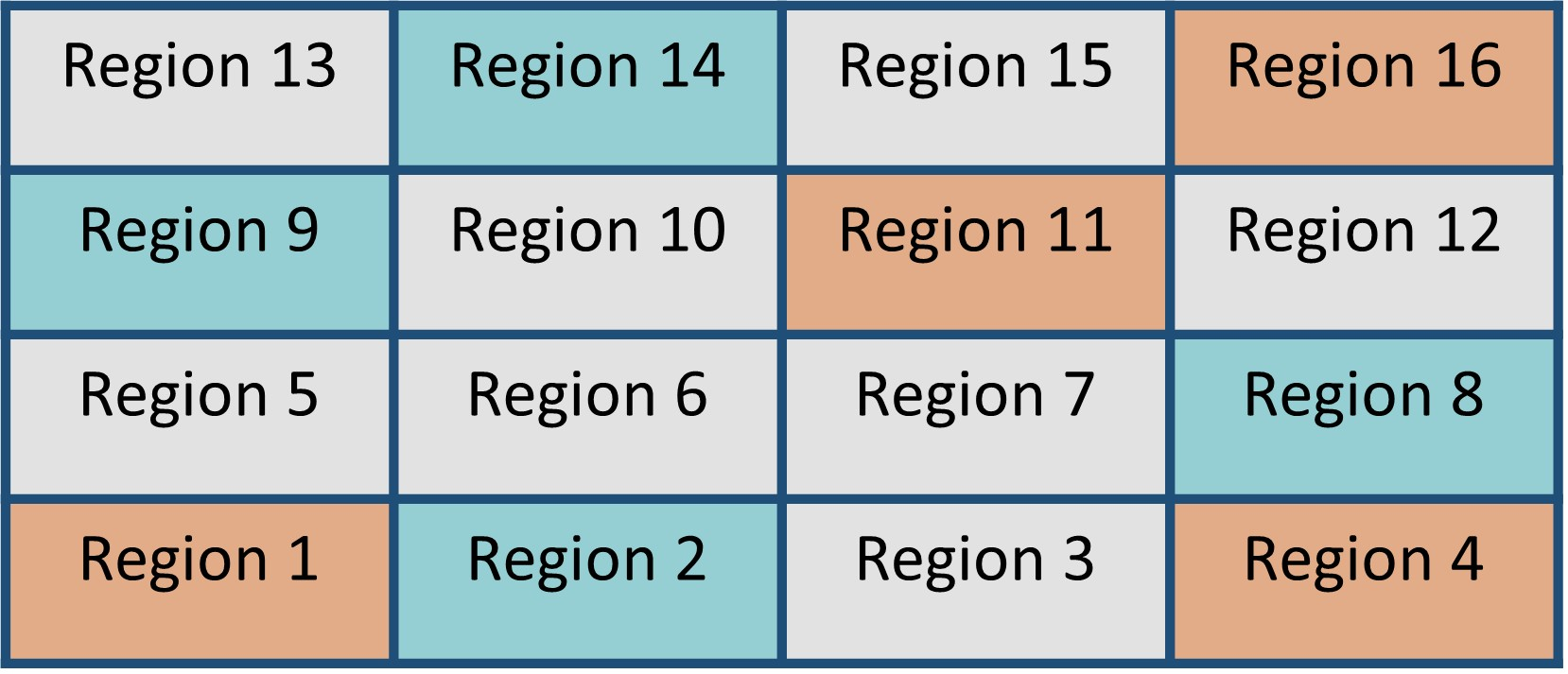
Figure 4: The test network with 16 regions: origins (orange) and destinations (green) are explicitly marked.
Numerical and System-Level Outcomes
The proposed method consistently outperforms baselines, with critical results as follows:
- Average total time per vehicle is minimized under all traffic regimes; improvements over WDM are most pronounced under heavy congestion, with 3.0% lower total time and 5.2% lower travel time.
- Relative to NC and SP, total time reductions are large (30%–37% under moderate/heavy traffic), due to superior queue balancing at CSs and global optimization of in-system flows.
- Regional densities under the proposed method avoid both bottlenecks and underutilization, in contrast to SP, where some regions reach jam density while others remain empty throughout the horizon.
- CS utilization is more evenly distributed; queue lengths at each CS are significantly lower than in alternative control cases, especially under heavy traffic loads.
Implications and Outlook
This result demonstrates the practical necessity of system-optimal control over multi-region networks, explicitly integrating charging and travel demand, especially in the presence of large-scale, heterogeneous EV penetration. The formulation’s convexity and tractability enable deployment at scale and in real urban settings, unlike microscopic or user-equilibrium approaches.
Theoretically, the approach paves the way for further research in:
- Dynamic, state-feedback implementations using data-centric or predictive models
- Joint integration with power system constraints (e.g., grid-aware charging management)
- Extension to heterogeneous infrastructures, stochastic arrivals, and demand uncertainty
The framework also motivates future work in exploring decentralized solution approximations and hierarchical traffic control architectures for urban smart mobility platforms.
Conclusion
The paper establishes a scalable, MFD-based, regional traffic and charging management framework, achieving demonstrable efficiency and congestion mitigation in mixed-traffic urban networks. Through convex, coordinated optimization of entry, routing, and charging operations, it charts a pathway for operational-level integration of EV charging logistics within traditional traffic management. The result substantiates the case for network-aware, demand-responsive control not only as a theoretical optimality target, but as a practical design principle for emerging smart cities.