- The paper presents a new experimental protocol to measure fractional impurity entropy using non-invasive charge sensing and thermodynamic Maxwell relations.
- Key findings show entropy saturation below kB ln2, aligning with theoretical predictions for Majorana and Fibonacci anyons in 2CK and 3CK regimes.
- The methodology establishes a robust, model-independent framework for probing non-Abelian quantum states in engineered quantum circuits.
Experimental Evidence for Fractional Entropy in Critical Kondo Systems
Introduction and Motivation
This paper ["Experimental Evidence of Fractional Entropy in Critical Kondo Systems" (2605.00669)] provides direct thermodynamic evidence for the existence of non-Abelian anyonic quasiparticles in engineered quantum circuits, using precise entropy measurements. Focusing on the multi-channel Kondo effect—where quantum impurities are screened by multiple baths—the authors experimentally realize quantum critical points associated with frustrated Kondo interactions. These manifest as fractional impurity entropies, directly probing the quantum dimension d of emergent anyons via the relation ΔS=kBlnd. Unlike prior indirect approaches reliant on transport modeling, this protocol employs charge sensing and Maxwell relations to extract entropy with high accuracy, without presupposing model-specific assumptions.
The physical platform consists of a micrometer-scale metallic island in a hybrid metal-semiconductor quantum circuit, capacitively coupled to two (2CK) or three (3CK) quantum point contacts (QPCs) embedded in a two-dimensional electron gas under quantum Hall conditions. The island serves as the impurity, with pseudospin states defined by neighboring charge configurations N and N−1. Equal transmission across the QPCs (τ1=τ2 or τ1=τ2=τ3) invokes frustrated screening, producing quantum critical behavior characterized by non-Fermi-liquid effects.
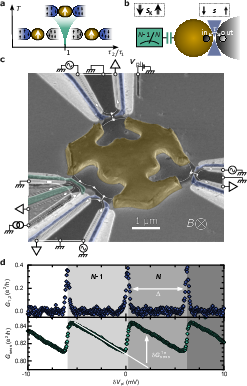
Figure 1: Charge-Kondo circuit showing the emergence of quantum criticality with symmetric channel couplings and the charge sensing protocol for impurity state measurement.
Conductance measurements across the device validate the realization of quantum criticality and allow extraction of the Kondo temperature scale TK for both 2CK and 3CK regimes. The experimentally observed conductance scaling matches theoretical NRG predictions and exact asymptotic behaviors, substantiating the device as an accurate quantum simulator for multi-channel Kondo physics.
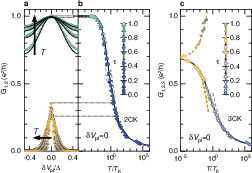
Figure 2: Conductance benchmarking across different coupling regimes and universal scaling with T/TK for both two- and three-channel Kondo configurations.
By employing a non-invasive charge sensor QPC, the authors measure the average charge on the island, enabling use of the thermodynamic Maxwell relation ∂S/∂μ=∂⟨N⟩/∂T for entropy determination. Integration along gate voltage detuning from the charge degeneracy point yields impurity entropy differences, which are interpreted as upper bounds for the critical entropy when the impurity is frozen at maximal detuning (conductance Gi(ΔE)/Gi(0)<0.075).
The entropy profile reveals strong deviations from the free-spin Boltzmann limit in the strong-coupling regime, exposing the emergence of fractional entropy as the Kondo effect sets in.
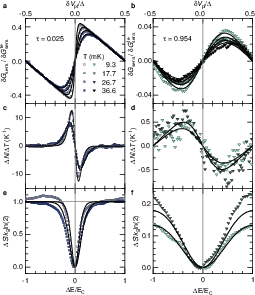
Figure 3: Charge sensor measurements and extracted entropy profiles for weak and strong coupling in the 2CK configuration.
Universal Entropy Renormalization Flow
Systematic measurements across QPC transmission and temperature parameter space display universal entropy flows in terms of ΔS=kBlnd0, matching theoretical NRG predictions. For the trusted data points (frozen impurity at maximal detuning), the observed entropy saturates well below ΔS=kBlnd1, providing an upper bound for the critical Kondo entropy: ΔS=kBlnd2 (2CK) and ΔS=kBlnd3 (3CK). Corrections for non-negligible entropy at maximum detuning in strong-coupling regimes further support saturation toward predicted fractional values.
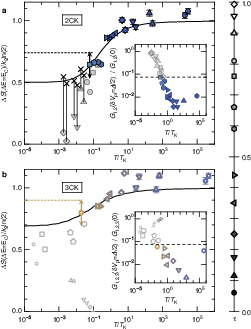
Figure 4: Universal entropy renormalization flows ΔS=kBlnd4 versus ΔS=kBlnd5 in 2CK and 3CK regimes, with upper bounds for critical entropy highlighted.
Fermi-Liquid Crossover: Lower Bounds and Universality
To establish lower bounds, the paper analyzes entropy quenching as the device is detuned away from quantum criticality along universal Fermi-liquid crossovers. Conductance and entropy data collapse onto universal scaling curves in ΔS=kBlnd6, for crossover scales ΔS=kBlnd7 defined via gate voltage detuning and channel transmission. For small detuning and ΔS=kBlnd8, critical entropy is bounded from below, yielding ΔS=kBlnd9 (2CK) and N0 (3CK).
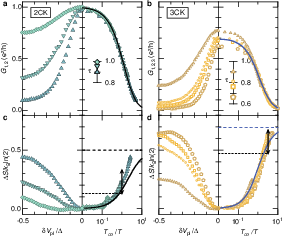
Figure 5: Universal crossover flows for conductance and entropy as detuning drives the system away from quantum criticality; lower bounds for fractional Kondo entropy.
Interpretation: Non-Abelian Anyons and Fractional Entropy
The measured fractional impurity entropy provides unbiased evidence for non-Abelian anyonic statistics. Specifically,
- For 2CK, the experimentally bounded entropy is consistent with N1, corresponding to a Majorana zero mode as predicted by conformal field theory and integrability studies [affleck1991universal].
- For 3CK, the entropy matches N2 with N3, the golden ratio, characteristic of Fibonacci anyons.
Both are direct signatures of non-integer quantum dimensions and non-Abelian braiding statistics, critical for topological quantum computation. The charge-Kondo architecture and entropy extraction via Maxwell relations demonstrate a robust, model-independent methodology ideal for further exploration of non-Abelian quasiparticles and fractionalized quantum matter.
Implications and Future Directions
This work establishes entropy measurement as an incisive tool for characterizing non-Abelian critical states and anyonic excitations in controllable mesoscopic circuits. The direct observation of fractional entropy holds practical significance for quantum information processing, as arrays of charge-Kondo impurities could be used for measurement-based topological quantum computation, although interconnection remains a technical challenge [lopes2020anyons, Lotem2022]. The protocol is readily extensible to other strongly correlated platforms, including fractional quantum Hall states and graphene-based devices [adam_entropy_2025, sankar_measuring_2023], providing a thermodynamic route to unambiguously identify quantum dimensions and topological order.
Conclusion
The paper delivers direct experimental evidence for fractional ground state entropy associated with non-Abelian anyons in multi-channel Kondo systems, realized via charge-Kondo circuits and precise thermodynamic measurement protocols. Both upper and lower bounds for the impurity entropy in 2CK and 3CK regimes are established, matching theoretical predictions for Majorana and Fibonacci anyons. The entropy characterization methodology constitutes a powerful, universal probe for exotic quantum states and criticality, with immediate relevance to condensed matter physics, quantum information, and the broader landscape of topological quantum computation.