- The paper proves the Finite Global Attractor Conjecture for glued rational maps by showing that all non-peripheral curves eventually fall into a finite set of homotopy classes.
- It employs a novel combinatorial methodology, using invariant graphs, periodic separating arcs, and adjoint constructions to manage the complexity of curve pullbacks.
- The analysis yields explicit complexity decay bounds with exponential behavior, offering a framework for extending topological classification to broader families of rational maps.
The Finite Global Curve Attractor for Glued Polynomial Maps
Introduction and Context
The Finite Global Attractor Conjecture for post-critically finite (PCF) rational maps connects the iterative dynamics on multicurves to the combinatorial and geometric framework of Thurston's theory. For polynomials, this conjecture has been resolved, but extensions to rational maps remain technically challenging due to the increased complexity in the topological configuration of post-critical sets. This paper establishes the conjecture for a class of rational maps constructed via polynomial gluing—essentially, by joining two PCF polynomials along the boundaries of their finite super-attracting basins ("On the Global Curve Attractor for polynomial gluing" (2605.00633)).
The approach synthesizes recent results on exponential decay for polynomial curve systems and introduces a concrete, combinatorial methodology adapted to the topological intricacies of the gluing construction. The main result demonstrates the existence of a finite global attractor for the pullback operator on multicurves for glued maps G(f,g), laying the groundwork for an inductive approach to broader rational classes.
The Polynomial Gluing Construction
Given two PCF polynomials f and g of degrees d1 and d2, each with a marked finite immediate super-attracting basin of degree d0, and disjoint remaining critical orbits, the construction allows gluing the complements of these basins along their boundaries, yielding a rational map F of degree d1+d2−d0.
The gluing is performed through equivariant homeomorphisms (using Böttcher coordinates), resulting in a sphere S2 partitioned into two hemispheres, with the action of F governed locally by f0 and f1 on the respective sides. The post-critical set of f2 unites those of f3 and f4, necessitating a careful combinatorial treatment of curves and their homotopy classes.
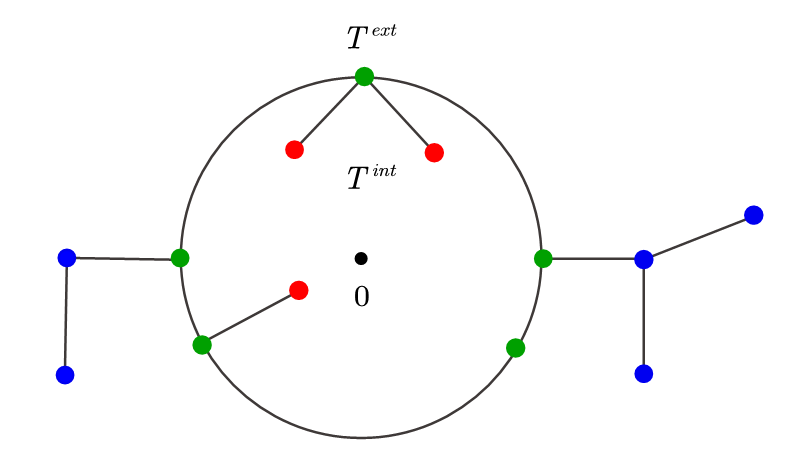
Figure 1: The invariant graph f5 constructed by gluing the Hubbard trees f6 and f7 along the gluing circle f8.
Invariant Graphs and Combinatorial Encoding
The central object is the invariant graph f9 obtained by gluing the Hubbard trees g0 and g1 along the gluing circle. Edges of the tree are classified as expanding or attracting, reflecting the local dynamical behavior, with g2 due to the independence condition on critical orbits. This invariant graph plays the dual role of encoding both the combinatorics of the curve system and the pullback properties required by the attractor framework.
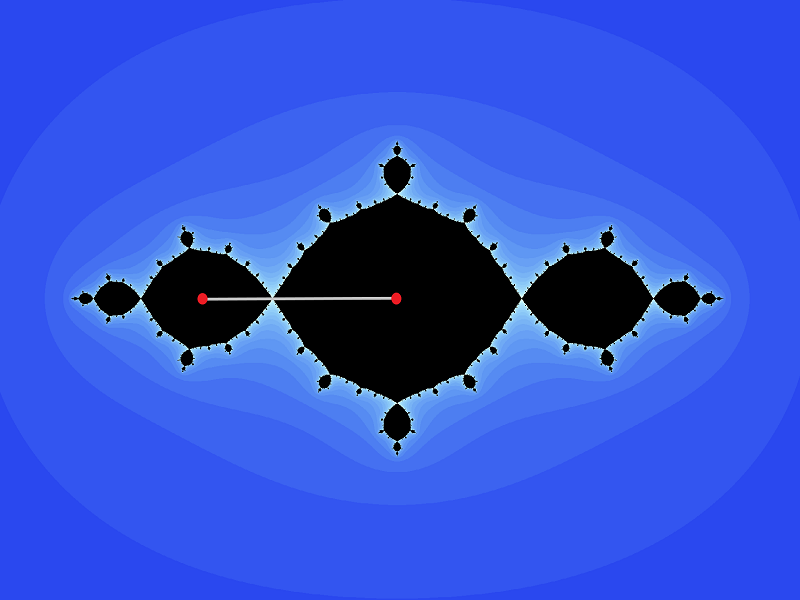
Figure 2: The Hubbard tree of g3 with the attracting edge in gray—the union of internal rays from g4 and g5 to their landing points.
Separating Arcs and Complexity Measures
To analyze the orbit of curves under the pullback operator, a finite, admissible family g6 of separating arcs is constructed, subdividing the sphere into regions containing at most one post-critical point. The arcs fall into three types:
- Type I: Unions of g7-rays (external or internal), lying in the g8-side,
- Type II: Analogous arcs in the g9-side,
- Type III: Unions of d10- and d11-rays, crossing the gluing circle.
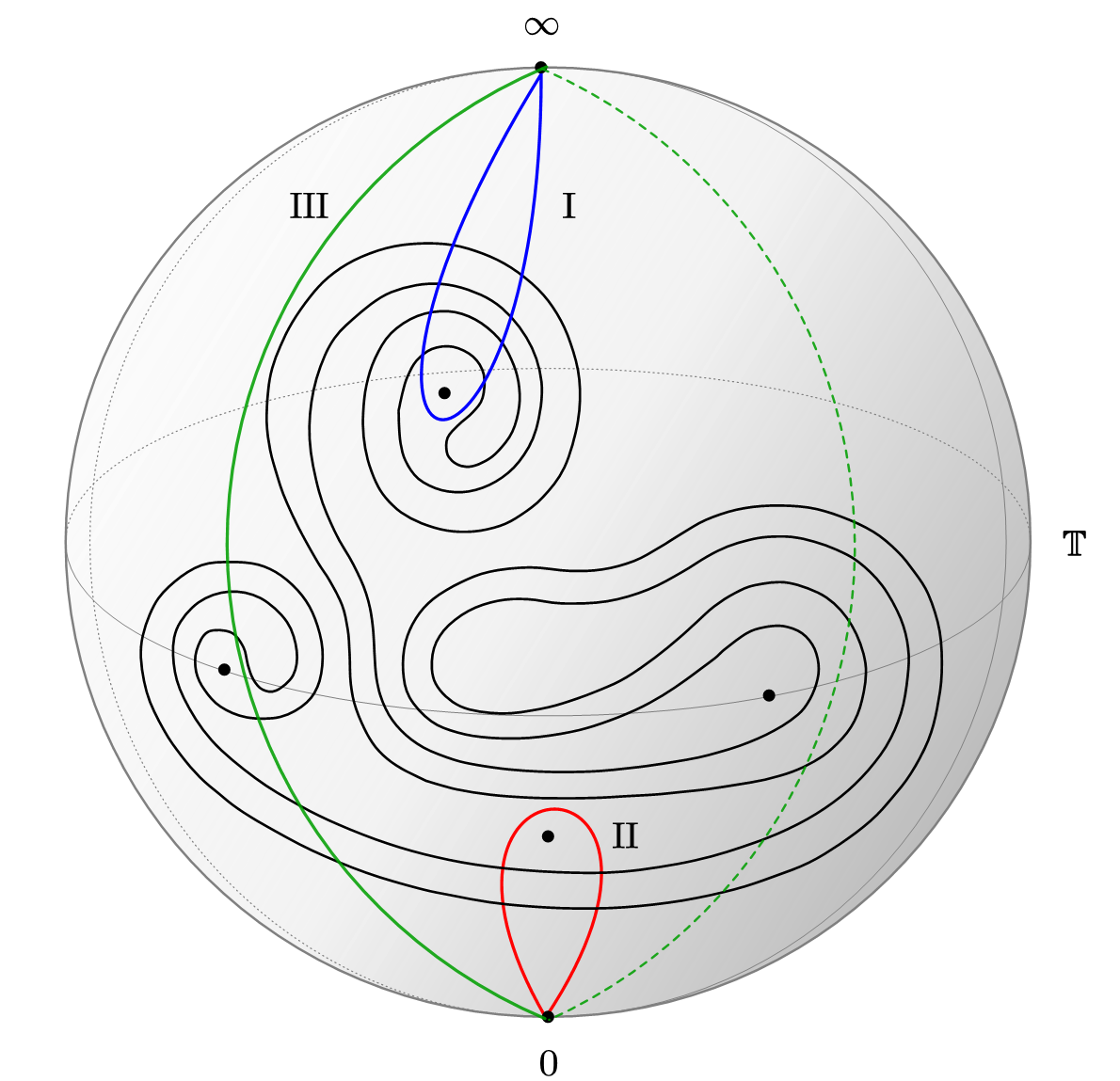
Figure 3: An admissible family of separating arcs for d12. Type I (blue), Type II (red), and Type III (green) arcs, constructed to ensure each complementary region contains at most one post-critical point.
For a non-peripheral curve d13 in d14, the complexity d15 is the minimal total intersection number with the arcs in d16, minimized over the homotopy class of d17. This measure provides a quantitative proxy for the "finiteness" of the curve's homotopy class under iteration.
Periodic Structure and Adjoint Arcs
Through an intricate combinatorial process, the original separating family d18 is promoted to a periodic family d19 with well-defined periods, enabling the construction of adjoint arcs d20 for each d21 such that d22 by orientation-preserving homeomorphisms for some suitable d23.
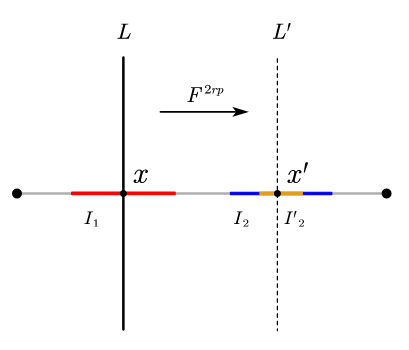
Figure 4: Construction of an adjoint arc d24 for a type~I arc d25—the expanding edge case for ensuring backward invariance and control of complexity.
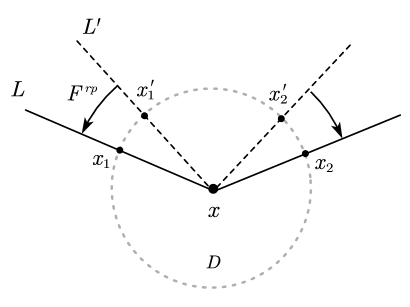
Figure 5: Constructing an adjoint arc d26 for a type~I arc d27—the attracting case, involving internal rays at super-attracting points.
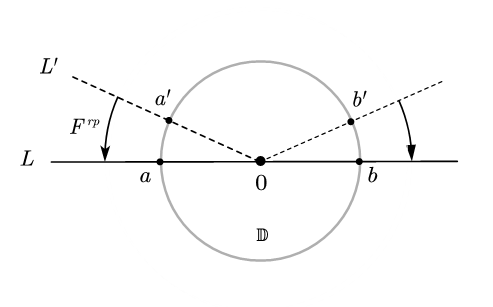
Figure 6: Construction of an adjoint arc d28 for type~III arcs crossing the gluing circle d29.
The geometric construction is carefully arranged so that the thin regions between arcs d00 and d01 are disjoint and contain no post-critical points, allowing for complexity monotonicity under pullback.
Monotonicity and Complexity Decay
One of the principal results is that the complexity with respect to d02 is non-increasing under the pullback operator (d03). In fact, unless one is already confined to a bounded region of complexity, there exists a finite iterate after which all preimages strictly decrease complexity. This is quantified by explicit constants d04 and d05 (dependent only on the degree and periodicity data), yielding exponential decay towards a finite attractor.
The key argument relies on the degree-counting contradiction: If complexity does not decrease, a preimage curve must simultaneously realize an intersection multiplicity exceeding the topological degree, which cannot occur.
Main Theorem and Implications
The main theorem asserts that for the glued rational map d06, the Finite Global Attractor Conjecture holds: Every non-peripheral curve, under iteration by the pullback operator, eventually lands in a finite set of homotopy classes determined by a bounded complexity. The proof is constructive and provides explicit finite bounds on the number of homotopy classes acting as attractors.
This result extends the polynomial case into a regime where the rational map’s structure is dictated by gluing data, indicating that the combinatorial attractor phenomenon is robust under such topological operations. The construction admits, as noted, an inductive extension: Repeated gluing with additional PCF polynomials yields maps whose curve dynamics are similarly controlled.
Outlook and Further Directions
The methods exemplified in this work not only resolve a substantial special case of the global attractor conjecture for rational maps but also suggest the viability of extending combinatorial techniques (specifically, separating arc systems and complexity measures) to more general classes arising from iterative gluing and mating constructions. The explicit use of periodicity and adjoint arc constructions may inform future attempts to control curve dynamics in the presence of complicated post-critical topologies and higher-degree mating operations.
Further developments may include:
- Generalizing to any rational map combinatorially equivalent to a sequence of gluings,
- Adapting the separating arcs framework to matings with more general superattracting cycles or higher genus boundaries,
- Exploring algorithmic implications for classification and topological recognition of Thurston maps via their separating arc structure.
Conclusion
This paper rigorously establishes the Finite Global Attractor Conjecture for rational maps arising from polynomial gluing by providing a robust combinatorial framework rooted in separating arcs and curve complexity. The explicit construction of invariant graphs, periodic separating systems, and control via adjoint arcs is a compelling paradigm for broader families of maps in complex dynamics. The results have deep implications for the topological classification of rational maps and the combinatorial understanding of their curve dynamics (2605.00633).