- The paper establishes that no linear upper bound of the form n+k+c exists for minimal witness sizes in covtree.
- It employs exchange graph techniques to derive improved bounds, including a sharp bound for k=3 cases.
- Explicit constructions using Newtonian, tall, and height-2 poset families reveal unbounded gaps relative to naive expectations.
Sizes of Witnesses in Covtree: Structure, Bounds, and Combinatorial Barriers
Introduction and Motivation
This paper addresses a fundamental question in the combinatorial structure underpinning the covariant tree (covtree) framework for poset growth, motivated by the causal set approach to quantum gravity. In covtree, nodes are sets of unlabelled posets representing possible “histories” of spacetime at a given cardinality, and the existence and size of witnesses—posets from which every node’s constituent downsets of fixed size n can be obtained uniquely—encodes critical structural constraints. The focus here is to determine upper bounds on sizes of minimal witnesses Q to a given set Γn consisting of k distinct unlabelled posets of size n, and to characterize when such upper bounds can or cannot be given in terms of simple linear formulae. This is deeply relevant for both theoretical physics, where label-independence and discrete growth models play a role in the causal set programme, and pure combinatorics, where understanding the enumeration and interrelations among posets is a significant foundational issue.
Covtree Structure and Witnesses
Covtree is constructed so that each node at level n comprises all sets Γn of unlabelled posets potentially obtainable as the collection of downsets of size n from some finite poset Q. If such Q exists, it is called a witness for Q0; if, in addition, Q1 contains no proper downset that is itself a witness to Q2, Q3 is minimal. Brute-force combinatorial construction of covtree is challenging due to the rapid growth of the number of posets with cardinality. While every Q4 that is a node may have many minimal witnesses—possibly of varying sizes—understanding the minimal possible size is critical, both for feasible enumeration and to elucidate structural obstructions.
The basic architecture of labelled versus unlabelled poset possibilities is shown below:
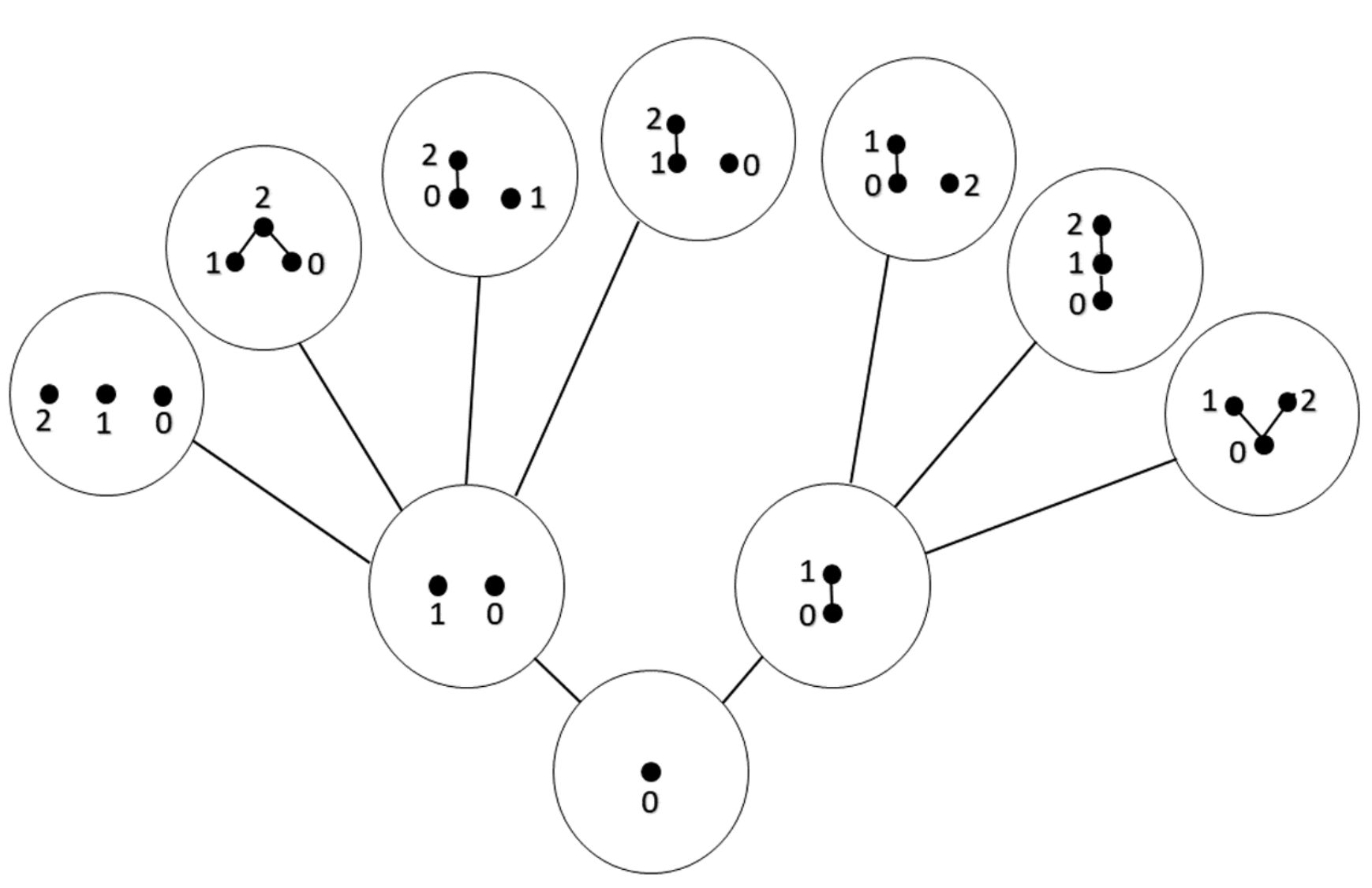
Figure 1: The tree of labelled posets, illustrating the branching of possibilities induced by sequential growth protocols.
The first three levels of covtree, emphasizing the coalescence of labelled possibilities into unlabelled nodes, are depicted here:
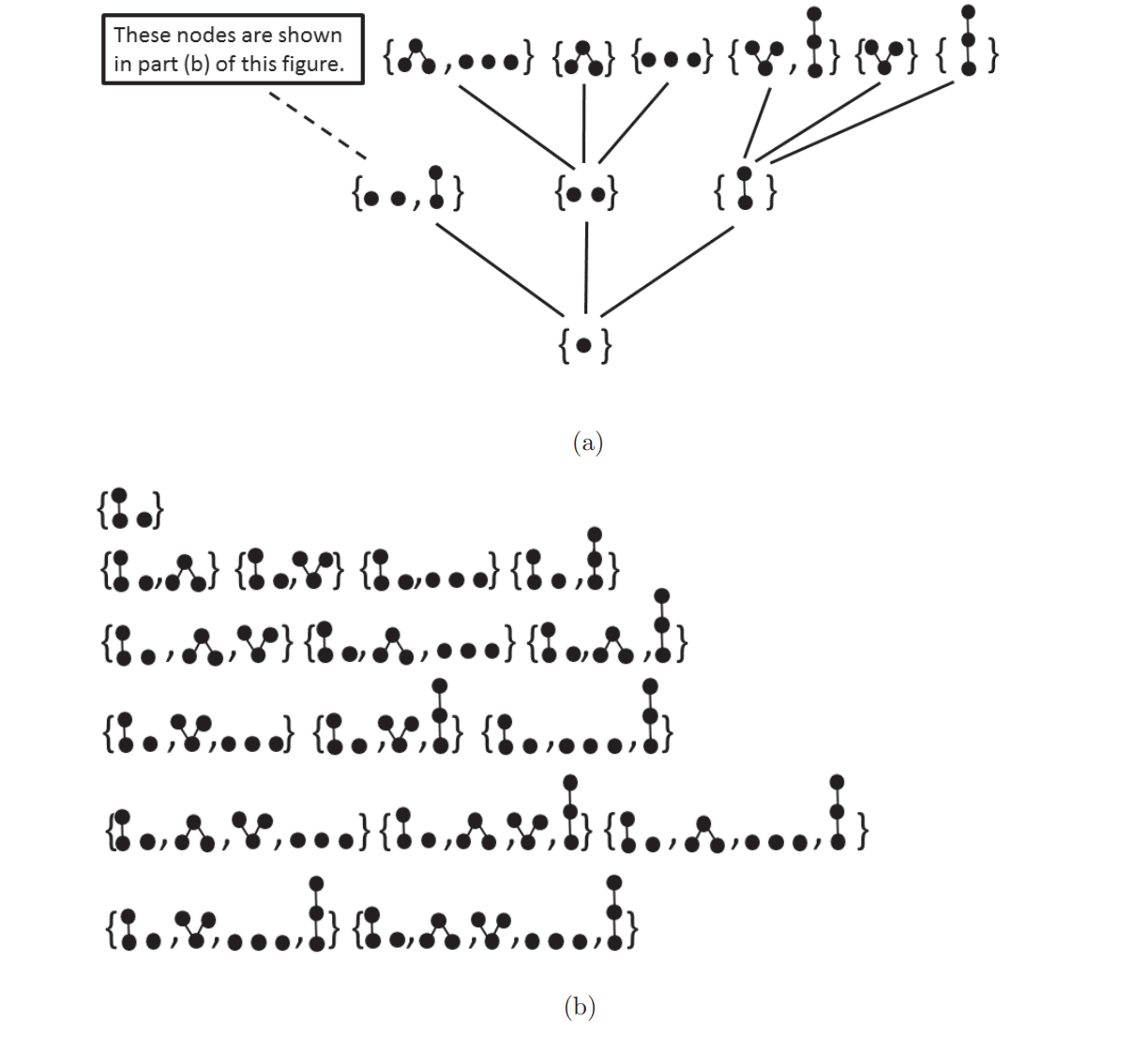
Figure 2: The first three levels of covtree, demonstrating the identification and merging of labelled paths up to isomorphism.
Upper Bounds and Obstructions for Witness Size
Known Results and Simple Bounds
From previous results, it is established that if some witness exists for Q5 of size Q6, then there is always a witness of size at most Q7 (where the union of Q8 disjoint isomorphic copies of each Q9 is sufficient). In the trivial case Γn0, Γn1 itself is necessarily a minimal witness; for Γn2, any minimal witness has size exactly Γn3.
An immediate naïve expectation arises for general Γn4 that a tight bound could take the form Γn5, by chaining Γn6 posets in a path through “maximal element swaps.” However, the paper provides concrete counterexamples to this expectation, as spurious downsets can arise, requiring longer paths to circumvent undesired intersections and thus yielding witnesses with greater sizes.
Constructing Families With Arbitrarily Large Gaps
The authors construct explicit infinite families of examples to show that no universal bound of the form Γn7 (for any constant Γn8) can hold for the size of minimal witnesses. This is accomplished via three types of families:
- Newtonian Posets: These highly regular posets, whose levels are completely connected downward, permit unions (type Γn9 posets) that exhibit the property k0 as the size increases, with k1 the minimal witness.
- Tall Families With Arbitrary Seeds: By building posets out of chains topped with arbitrary seeds (k2, k3), unioned to prevent overlaps yielding connected substructures, the gap between the size of the minimal witness and k4 can be made unbounded as well.
- Height 2 Families: Even restricting to posets of height 2 does not salvage a bound of the form k5: the constructed families show gaps growing linearly with the size parameter.
Conclusion: It is impossible to bound the size of the minimal witness for nodes of covtree by any linear expression k6 with constant k7.
The Exchange Graph and Improved General Bounds
To obtain improved, though non-tight, upper bounds valid in all circumstances, the paper introduces the exchange graph of downsets: a graph k8 whose vertices are downsets of size k9 of n0, with edges joining pairs differing by a single element.
The structural insight provided by this object is significant: n1 is always connected, and the distance between any two downsets is exactly the size of their symmetric difference (see Proposition on connectivity). Path-based analysis in n2 allows more refined counting of witness size, as illustrated in the following examples:

Figure 3: Exchange graph for a poset with a given labelling; this example demonstrates the necessity of special handling for very short paths.

Figure 4: The exchange graph n3 for a specific poset, with the minimal n4-n5-...-n6-n7 path shown bolded; this structure is crucial for precise witness size bounds.
The resulting general bound is that any minimal witness n8 for n9 with n0 must satisfy n1. For n2 the bound n3 is sharp. The improved general bound is obtained by utilizing the connectedness of the exchange graph, and constructing the witness as the union over the minimal paths between downsets.
Special Case: Tight Bounds for n4
Through an in-depth combinatorial analysis of exchange graph structure for triple-node sets, the authors prove a sharper bound for n5: If n6 consists of three elements, and a witness exists, then there is a minimal witness n7 with n8 The proof proceeds by analyzing shortest paths in the exchange graph between anchor copies, deriving structural constraints on potential downset intersections, and excluding pathological structures via careful combinatorial counting and subposet symmetries. Notably, further computational evidence in the small-n9 regime supports the conjecture that witnesses of size Γn0 suffice in all Γn1 cases, though a proof is as of yet lacking.
Implications and Future Directions
The findings impose precise limits on algorithmic approaches for explicit covtree construction: for Γn2, brute-force search may be halted at Γn3, yielding substantial efficiency savings. For higher Γn4, bounds are weaker but still informative.
The work also highlights combinatorial barriers in encoding label-independent poset growth and suggests the necessity of novel techniques to analyze the structure of witness sets and their embedding posets. The structural understanding of exchange graphs opens the possibility of “bootstrapping” covtree generation by combinatorial or algebraic invariants, potentially bypassing the need for brute-force search.
On the theoretical side, these bounds have an interrelation with causal set models of spacetime, where they inform the feasibility and uniqueness of reconstructing macroscopic histories from local downset data, and probe the interplay between growth and covariance in discrete quantum gravity models.
Conclusion
This work establishes, via explicit counterexamples and tight combinatorial reasoning, the nonexistence of linear bounds of the form Γn5 for minimal witness size in covtree, while also obtaining the best possible bounds in the Γn6 case and improved general bounds for larger Γn7 by exchange graph techniques. The results expose deep combinatorial obstacles to understanding the “growth” of unlabelled posets, with significant consequences for both physics (causal set theory) and pure combinatorics. They motivate new inquiries into the fine structure of witness posets, algorithmic enumeration, and potential bootstrapping methodologies within the covtree framework.