- The paper proposes an optimized composite geometric T gate that integrates DFS encoding to achieve fourth-order suppression of Rabi, detuning, and crosstalk errors.
- It employs tailored Hamiltonian control and closed-loop Bloch sphere trajectories on a 2D transmon lattice to implement robust logical operations.
- Simulations indicate that the method attains above 99.9% gate fidelity while mitigating decoherence and leakage through effective DFS protection.
Suppression of Universal Errors in DFS-Encoded Superconducting Geometric Logical T Gate
Introduction and Motivation
High-fidelity implementation of the logical T gate is central for universal, fault-tolerant quantum computation, given its role as a non-Clifford component in fault-tolerance schemes. Standard approaches based on magic state distillation are inefficient due to significant resource and measurement overheads, motivating the direct realization of robust logical T gates at the physical device level. This work addresses this by proposing a superconducting geometric logical T gate employing decoherence-free subspace (DFS) encoding and optimized composite geometric pulses, targeting universal suppression of dominant error channels—Rabi frequency, detuning, and residual inter-qubit crosstalk—on tunable transmon quantum circuits.
Physical Model: DFS Encoding on Tunable Transmon Lattices
Two capacitively coupled transmon devices are arranged in a 2D lattice, with qubits 1 and 2 as logical targets while adjacent transmons act as spectators. An AC microwave drive induces a tunable interaction, enabling resonance between the single-excitation subspace {∣10⟩,∣01⟩}, which is mapped to logical states. This configuration supports DFS encoding, ensuring protection against collective dephasing.
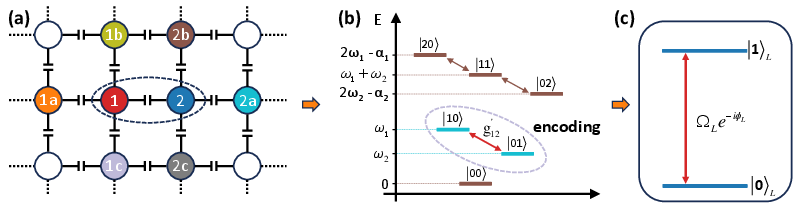
Figure 1: Superconducting implementation with DFS encoding—2D transmon lattice (a), single-excitation energy levels (b), and encoded logical basis structure (c).
This setup allows precise Hamiltonian control, with effective logical gates implemented by tuning the coupling parameters through modulation of the drive. The logical qubit benefits from hardware-level symmetry, directly suppressing dephasing noise that is spatially correlated across the physical qubits.
Gate Construction: Geometric Trajectory Design for T Gates
The geometric construction framework is based on evolution along closed paths on the Bloch sphere, engineering unitary gates through control of pulse segments and associated geometric phases. Three trajectory strategies are developed:
- Single-Loop (Orange-Slice) Protocol: Two-segment cyclic path.
- Standard Composite Multi-Loop: Multiple loops with fixed phase intervals for higher-order error cancellation.
- Optimized Composite Multi-Loop: Flexible loop parameters, allowing asymmetric phase intervals for universal error suppression.
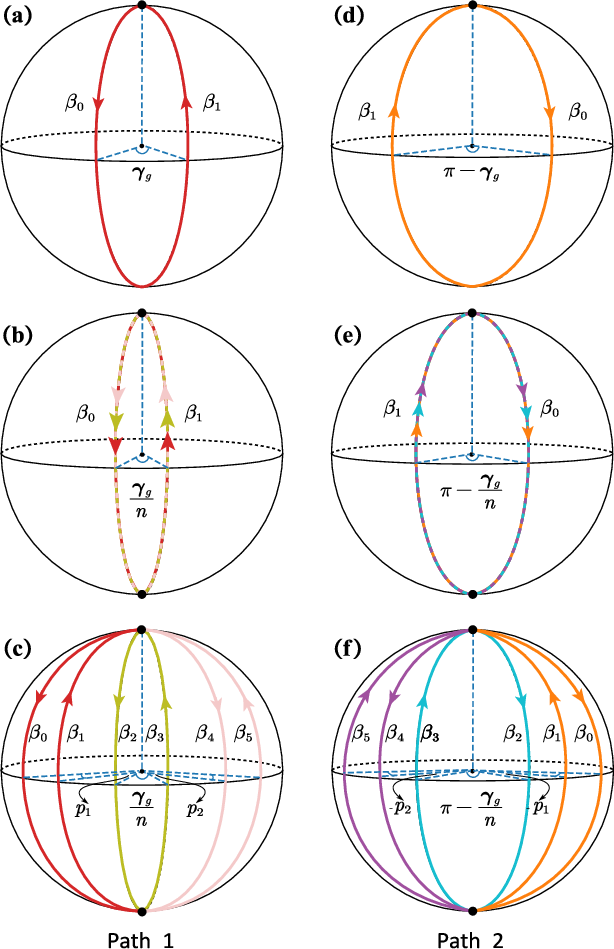
Figure 2: Evolution trajectories for different geometric T gate schemes—single-loop, standard composite, and optimized composite (Paths 1 and 2).
Gate construction exploits the relationship between Hamiltonian control parameters and trajectory geometry on the Bloch sphere, ensuring closed cyclic evolution with prescribed boundary conditions. The T gate protocol (rotation by π/4 about the z-axis) is synthesized by setting the accumulated geometric phase to π/8 and tailoring the polar and azimuthal evolution.
Error Suppression Analysis
Noise in superconducting circuits manifests predominantly as Rabi frequency miscalibration, detuning, and ZZ-type crosstalk. Simulations reveal that conventional single-loop and composite geometric approaches only afford robustness along specific axes, failing to suppress omnidirectional errors. By contrast, the optimized composite approach, leveraging additional free parameters in trajectory design, allows simultaneous high-order suppression (up to fourth order) of all three error sources within a single gate configuration.
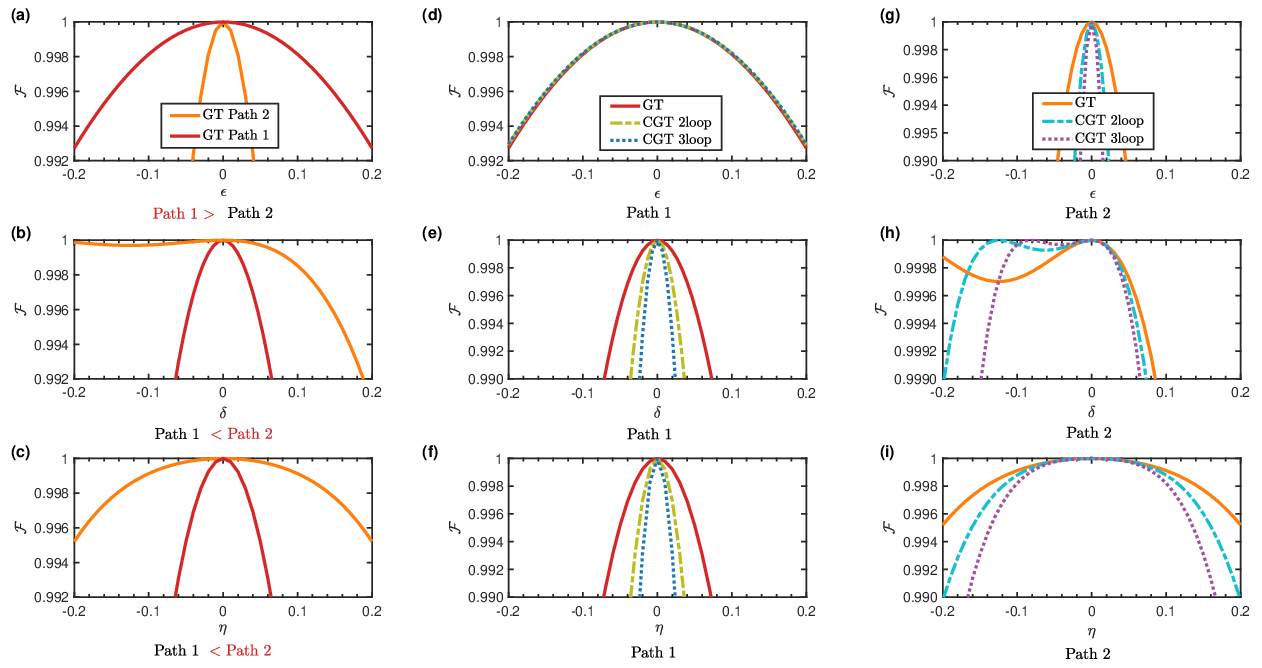
Figure 3: Gate fidelities vs. Rabi, detuning, and crosstalk errors, for single-loop, composite, and optimized composite geometric T gates.
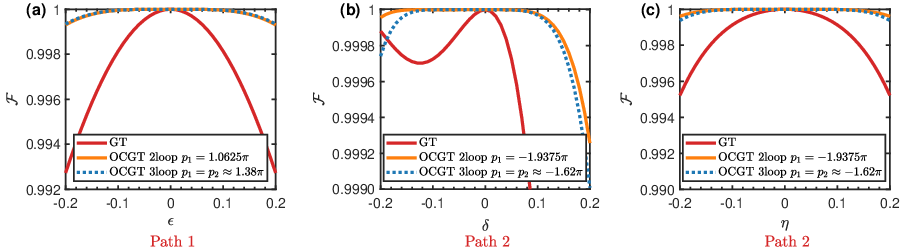
Figure 4: Comparative robustness—optimized composite geometric T gate vs. conventional schemes under all dominant error channels.
In these optimized protocols, a small set of tunable phase differences between loops (pi parameters) are scanned to maximize fidelity across all error types, with the two-loop architecture providing the optimal trade-off between error suppression and gate duration.
Decoherence and Leakage Analysis
Composite geometric gates extend gate duration, exposing the system to greater decoherence. However, the inclusion of DFS encoding, realized via the single-excitation subspace, grants strong immunity to collective dephasing. Furthermore, the tunable-coupling architecture and careful parameter selection minimize state leakage from high-anharmonicity-driven oscillatory components.
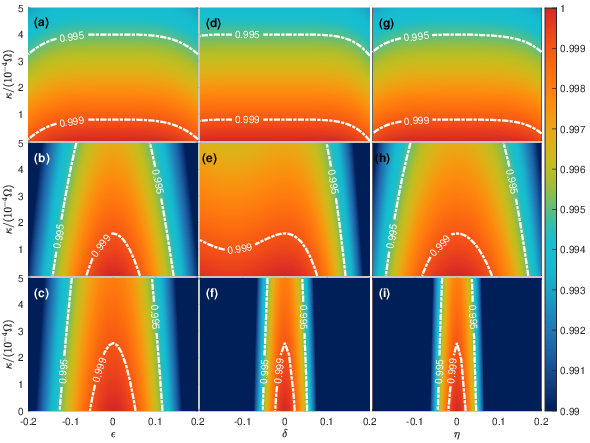
Figure 5: Gate fidelities for OCGT, GT, and dynamical T gates under decoherence and representative errors.
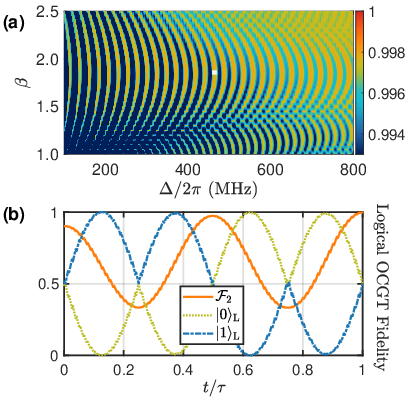
Figure 6: OCGT fidelity landscape over modulation parameters and corresponding logical state evolution.
DFS encoding is directly validated to suppress collective dephasing; comparative simulations with and without DFS encoding show significant improvement in gate fidelity when DFS protection is employed.
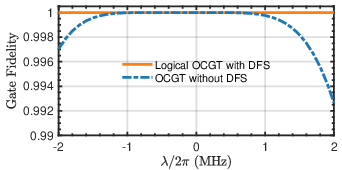
Figure 7: OCGT fidelity vs. collective dephasing strength, with and without DFS encoding.
Systematic parameter scans (modulation strength β and detuning Δ) are used to optimize the gate fidelity for all schemes. Under fixed error strengths and spectrally realistic coherence times (T1,T2 at the millisecond regime), the logical OCGT gate demonstrates above 99.9% fidelity across the full range of investigated error amplitudes for all considered noise channels, outperforming both standard geometric and dynamical gate designs.
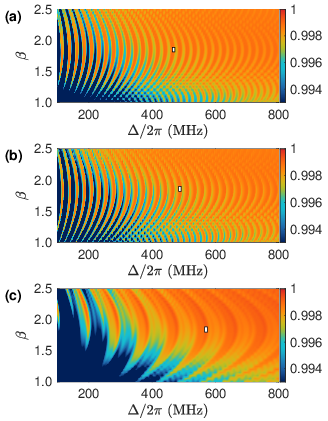
Figure 8: Optimization landscapes in (Δ, β) for GT and DT gates (for benchmarking).
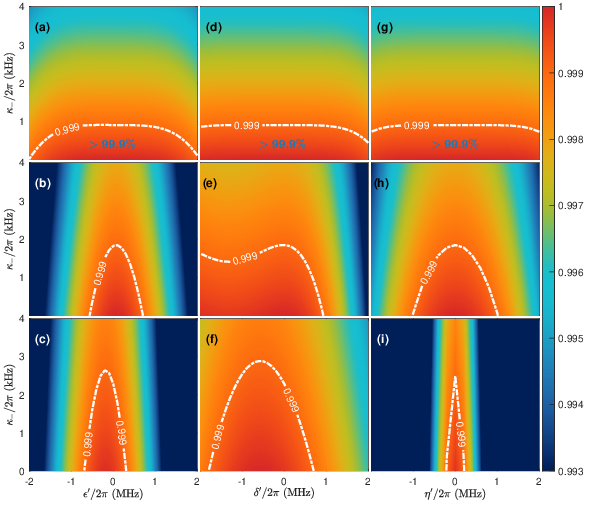
Figure 9: OCGT, GT, and DT logical gate fidelities vs. relaxation rates and error amplitudes for all main noise channels.
Path Parameter Optimization and Symmetry
The robustness of the OCGT gate is ensured through comprehensive parameter optimization, revealing that within two-loop composite strategies, optimal paths are equivalent for both path configurations, enabling simultaneous, fourth-order suppression of all errors. Three-loop configurations afford slightly better noise suppression in specific regimes at the cost of longer gate times and diminishing returns.
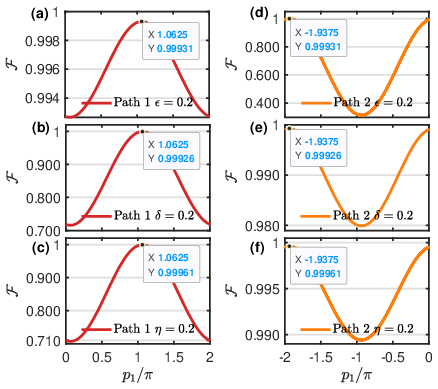
Figure 10: Gate fidelity vs. tunable path parameters in the two-loop OCGT protocol.
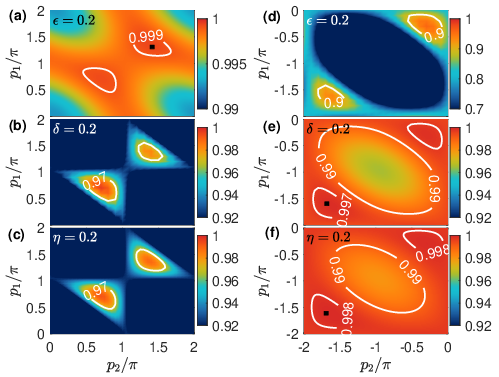
Figure 11: Fidelity landscape over two-phase parameters in three-loop OCGT protocol for both paths.
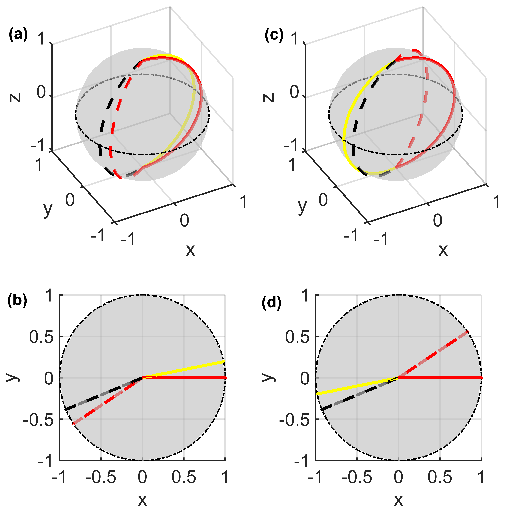
Figure 12: Optimal trajectories and projections for both symmetry-equivalent OCGT paths.
Implications and Future Directions
The integrated use of DFS encoding and geometric composite pulse optimization constitutes a physically resource-efficient and hardware-compatible route to robust logical T gate implementation in superconducting architectures. Such high-order error suppression at the physical layer can substantially reduce the resource overheads required for quantum error correction, potentially alleviating one of the primary bottlenecks in scaling up superconducting quantum processors.
The trajectory framework is extendable to short-path protocols and robust pulse modulation strategies, offering further optimization opportunities for fast, hardware-tailored gate operations. The approach is orthogonal and complementary to standard magic-state distillation, as it targets raw error rate suppression prior to code-level overhead minimization.
Conclusion
This work establishes an explicit, physically motivated protocol for universal error suppression in the logical T gate using DFS-encoded, optimized multi-loop geometric control on superconducting qubit lattices. Theoretical and numerical analysis demonstrates simultaneous, high-order suppression of Rabi, detuning, and crosstalk errors, as well as intrinsic immunity to collective dephasing, all at minimal physical-qubit overhead. These results provide a promising path toward practical, large-scale, hardware-efficient, and fault-tolerant quantum computation with superconducting devices.

