- The paper introduces Vesselpose, a deep learning approach that predicts voxel-wise direction vectors to guide a modified TEASAR algorithm for vascular graph extraction.
- It achieves state-of-the-art topological accuracy by significantly reducing false merges and splits across both synthetic and real 3D vascular datasets.
- The framework supports multi-root processing and adaptive masking, offering robust performance with promising applications in broader biomedical imaging tasks.
Vesselpose: Vascular Graph Reconstruction via Learned Voxel-wise Direction Vectors
Introduction and Motivation
Three-dimensional vascular network reconstruction underpins a diverse range of biomedical investigations, from neurovascular development to cardiovascular pathology. Legacy pipelines typically segment vessel foreground and then apply skeletonization (often TEASAR or Lee-style algorithms), but such modular approaches are fundamentally flawed with respect to topological accuracy. They are prone to false merges and splits—particularly in regions where vessels run in close proximity or display discontinuities due to imaging artifacts. Recent methods inspired by image-to-graph transformations (e.g., DETR-style centerline extraction frameworks) offer topological improvements but still lack robustness and generalizability, especially in real, multi-tree datasets where multiple vascular trees co-exist within the imaging volume.
The Vesselpose framework introduces a paradigm shift: it leverages a deep learning (DL) model to predict voxel-wise direction vectors, encoding local vessel orientation and rootward bias, combined with conventional segmentation. A modified TEASAR algorithm then reconstructs the vascular skeleton by tracing the learned vector field, explicitly guiding path extraction to respect both vessel centerline orientation and biological priors. This results in improved topological fidelity, robust separation of closely apposed branches, and handling of multiple disconnected trees.
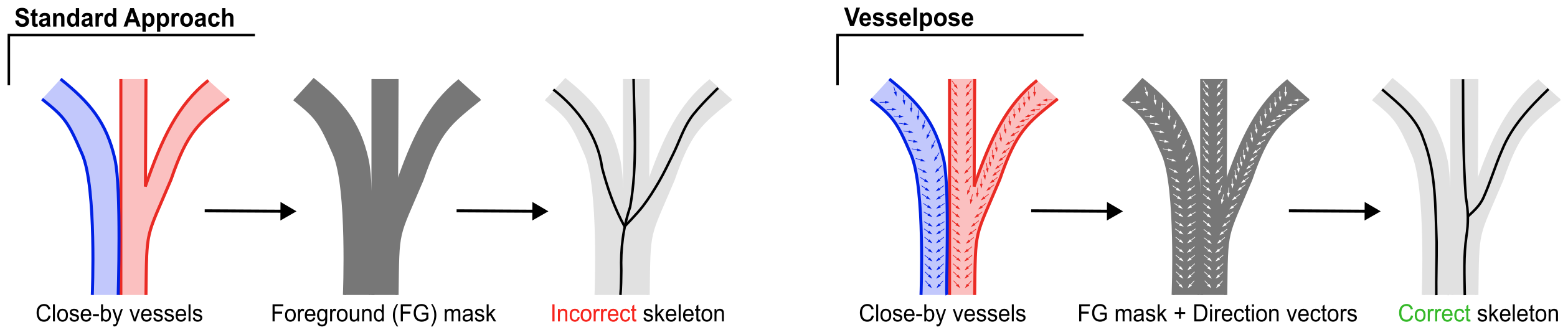
Figure 1: Traditional segment-and-skeletonize pipelines confound closely apposed vessels, whereas Vesselpose robustly separates vascular trees using direction-vector fields.
Methodology
Voxel-wise Direction Vector Prediction
Vesselpose employs a 3D U-Net to jointly predict a binary foreground mask and a direction vector (R3) for each voxel within the volume. Ground-truth vectors point from each foreground voxel towards the vessel centerline, and are biased rootward via a fixed stepsize, leveraging the anatomical gradient of vessel radii. This approach circumvents directional ambiguities at bifurcations and encodes explicit flow along the tree.
The training objective combines Binary Cross-Entropy (BCE) loss for mask accuracy and Mean Squared Error (MSE) for vector alignment. Vectors near the vessel boundary have larger norm, encoding their distance and orientation to the centerline.
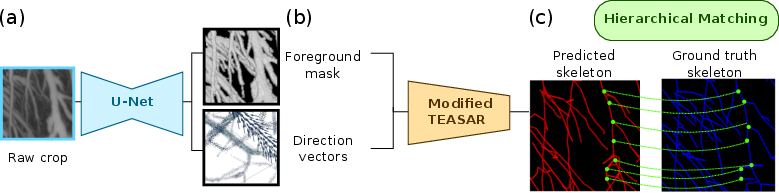
Figure 2: Overview of Vesselpose workflow: U-Net predicts both vessel foreground and orientation vectors; a direction-aware TEASAR extracts the centerline; evaluation uses hierarchical graph matching.
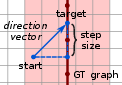

Figure 4: (a) Direction vectors are generated by stepping rootward along the ground-truth skeleton (blue vectors), yielding larger magnitudes near vessel boundaries. (b) The angular penalty promotes path tracing aligned with the predicted orientation field.
Modified TEASAR Skeletonization
Standard TEASAR finds centerlines by maximizing the distance from boundary and rooting from endpoints. Vesselpose modifies the penalty function to incorporate (a) boundary distance, (b) vector norm (minimal at the centerline), and (c) angular difference between the predicted vector and candidate path directions. This composite penalty dramatically reduces false merges, especially in regions with parallel branches, by discouraging paths that deviate from learned vessel orientation.
Further, Vesselpose supports multi-root processing within connected components, as manual or automated root detection initializes skeletonization for each disjoint tree. Adaptive masking schemes, parametrized by local radius, improve robustness across scales and vessel calibers.

Figure 5: Schematic of modified TEASAR handling multi-root and adaptive masking to avoid topological errors and merge disambiguation.
Postprocessing and Correction
Disconnected components without roots undergo neighbor analysis for reconnection based on spatial proximity, radius similarity, and orientation congruence. Spurious merges and splits are filtered via cycle detection and ancestor tracking.
Topology-Aware Evaluation Metrics
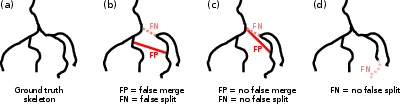
Conventional graph comparison metrics—pixelwise or naive edgewise F1—fail to capture structural impacts of specific errors. Vesselpose introduces topology-aware measures:
Experimental Results
Datasets
Vesselpose is evaluated on four representative datasets:
- Single-Tree Synthetic: Procedurally generated via SVT, containing isolated vascular trees.
- PARSE2022: Real pulmonary artery CT angiography with semi-automated segmentations.
- Multi-Tree Synthetic: Generated by tissue growth simulation; multiple disjoint trees.
- Micro-CT Rat Heart: Real volumetric micro-CT data with manual annotations.
Numerical Results
Across all benchmarks, Vesselpose delivers substantial improvements in edge-wise F1, lower absolute and relative FM/FS, and improved branch-level F1 compared to U-Net+TEASAR, vesselFM, Vesselformer, and Trexplorer(-Super) pipelines.
- On single-tree synthetic data, Vesselpose attains an edge-wise F1 of 0.89/0.93/0.87 (mean/stdev miniscule), surpassing all competitive methods.
- On the complex, multi-tree synthetic benchmark, Vesselpose achieves F1=0.80, more than doubling the F1 of segmentation-based baselines, while reducing FM/FS rates by over 40%.
- Qualitatively, Vesselpose preserves tree separation in regions of spatial proximity, whereas classical pipelines yield erroneous merges and loss of fine peripheral branches.
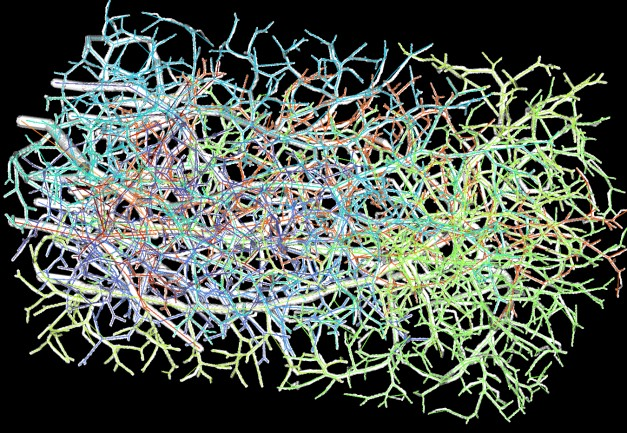
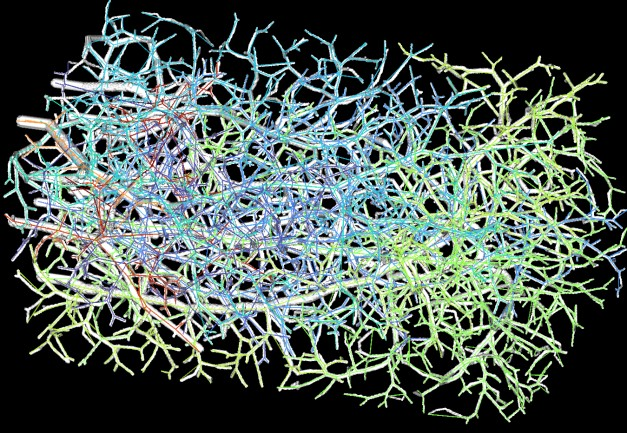
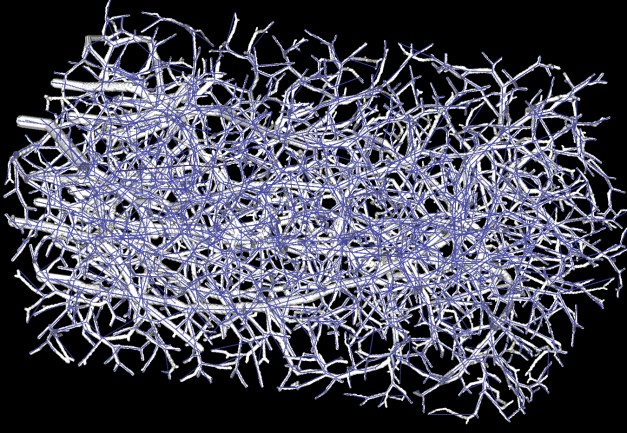
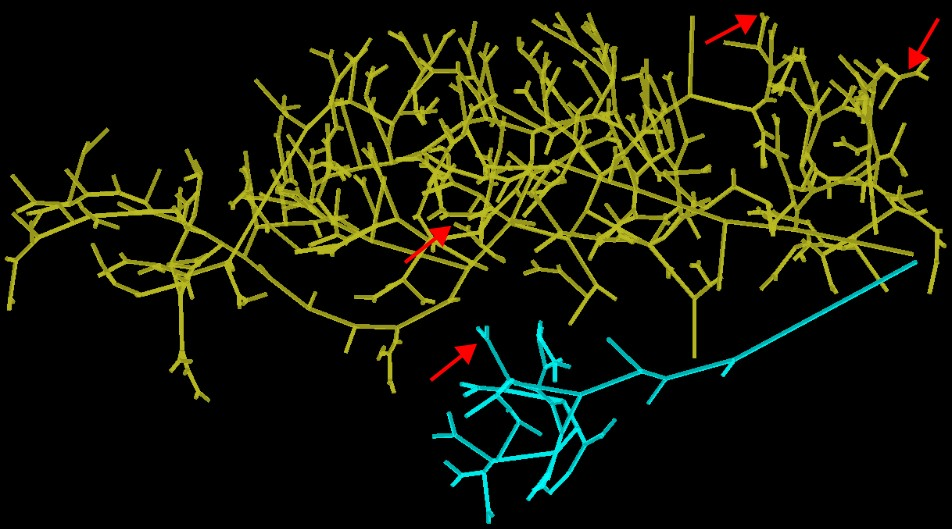
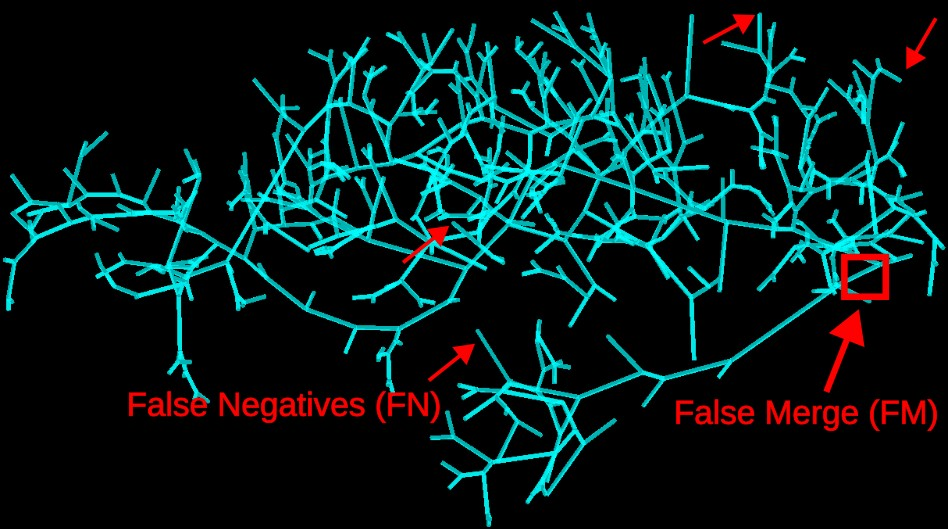
Figure 3: Qualitative results—Vesselpose recovers multi-tree topology and fine branches; U-Net+TEASAR merges all trees and misses significant detail.
On micro-CT data, despite limited annotated samples, Vesselpose reconstructs granular coronary subtrees with an absolute FM/FS count commensurate with the increased reconstruction completeness, which is not achieved by U-Net baselines.
Robustness Analysis
Vesselpose demonstrates robustness to vector field noise and image perturbations—edge-wise F1 remains stable for substantial vector noise magnitude (ε≤1.0), with only gradual degradation at extreme levels. Adaptive penalty scaling and masking parameters further tune skeletonization resilience.
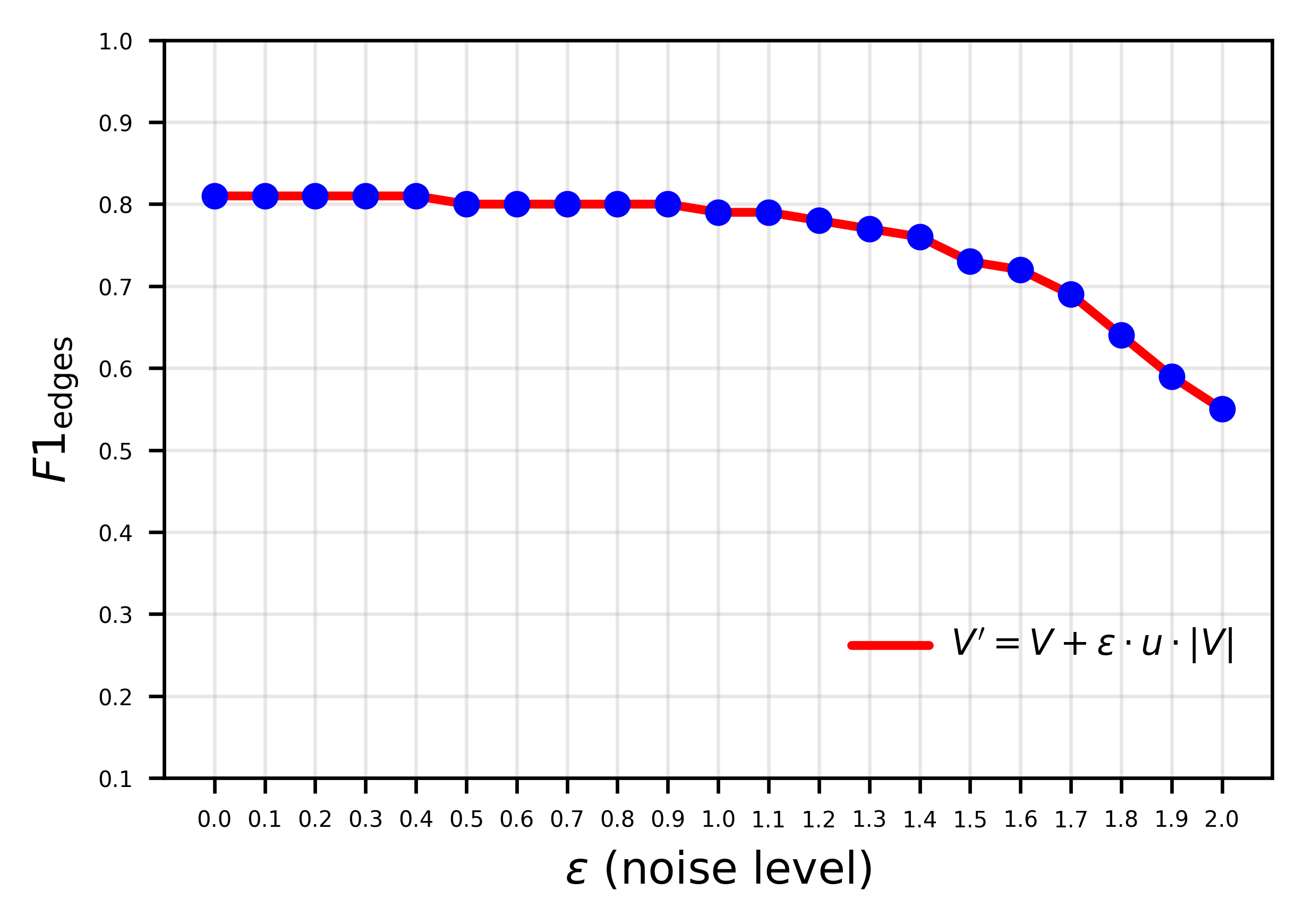
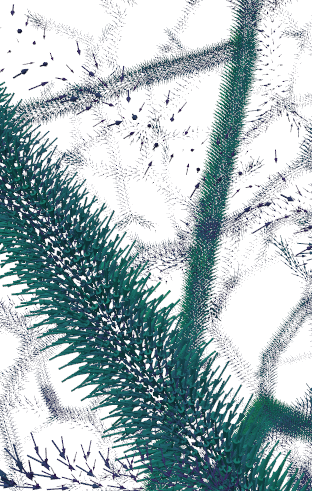
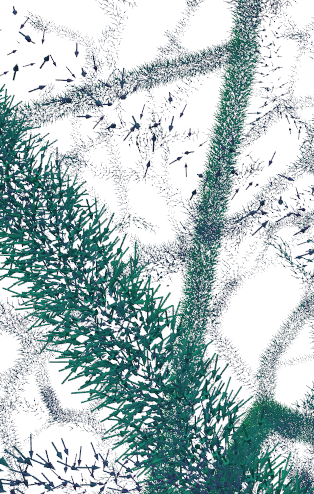
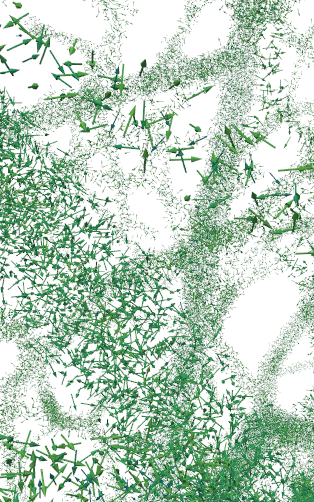
Figure 8: Edge-wise F1 resilience to increasing vector field perturbations; qualitative visualization of the direction field illustrates maintenance of orientation integrity up to moderate noise.
Implications and Future Directions
Vesselpose fundamentally advances the extraction of vascular graphs by fusing voxel-level orientation fields with vector-guided skeletonization. This framework harmonizes anatomical priors with machine-learned local structure, yielding improved topological correctness without dependence on computationally intensive global optimizers or limiting assumptions (e.g., single-tree only, restricted branching). The approach generalizes across synthetic and real, single- and multi-tree datasets, thus raising the bar for vascular graph extraction.
Practically, accurate vascular graphs underpin physiological modeling (e.g., hemodynamic analyses), facilitate atlas construction, and enable pathology quantification at unprecedented fidelity. The vector field approach could generalize to other tree- or graph-like biological structures (airways, neurons), especially where disambiguation of adjacent structures is paramount.
Nevertheless, the evaluation discussion highlights challenges: benchmarking is sensitive to node/edge sampling and matching. Future work should standardize datasets, annotations, and matching protocols, fostering fair and reproducible comparison.
Methodologically, adaptation to transformer backbones, incorporation of uncertainty estimation in vector fields, and explicit cycle detection are promising extensions. Automated root detection—already partially addressed—could be further refined to enable fully unsupervised operation.
Conclusion
Vesselpose introduces a direction vector-guided paradigm for vascular graph extraction, leveraging deep learning and a modified skeletonization algorithm to achieve state-of-the-art topological accuracy across complex datasets. Its topology-aware evaluation metrics and robust architecture set a new technical standard for vascular analysis in medical imaging, with broad implications for downstream biomedical applications and future algorithmic advancements.
Reference: "Vesselpose: Vessel Graph Reconstruction from Learned Voxel-wise Direction Vectors in 3D Vascular Images" (2605.00538)