- The paper presents Tempo, which models digital behavior with a four-level property graph to co-create and refine users' latent life goals.
- It demonstrates that incorporating user context and hierarchical abstraction significantly boosts the precision and representativeness of goal inference.
- The approach enables proactive personalization and reflective editing, paving the way for agents and coaching systems aligned with long-term objectives.
Co-Creating Life Goals from Computer Use: Hierarchical User Modeling with "Striving Co-Creation"
Introduction and Motivation
Most user modeling systems operate with a limited scope, detecting observable activity but failing to infer the latent, long-term goals (“strivings”) that drive these actions. "What Are You Really Trying to Do?: Co-Creating Life Goals from Everyday Computer Use" (2605.00497) contends that true support for users—whether by proactive agents or adaptive interfaces—demands representations that connect granular digital behavior with high-level life purposes. The authors propose striving co-creation: an approach operationalized in their system, Tempo, where the user and system jointly infer and iteratively revise these latent goals through hierarchical abstraction and interactive editing.
Tempo System Architecture: Induction and Co-Creation
Hierarchical Striving Induction
Tempo models user behavior with a four-level property graph: operations (atomic events), actions (goal-directed sequences), activities (generalized motives), and strivings (enduring life pursuits). The induction pipeline incrementally abstracts raw screenshot-based digital traces using in-context learning from LLMs (Gemini 3 Flash), blending observed screen events with a structured user-provided context.
Key aspects of the hierarchy:
- Operations: Atomic screen observations, e.g., application usage or document edits.
- Actions: Multi-operation segments reflecting contiguous intentionality, segmented through semantic and temporal cues.
- Activities: Thematic clusters spanning cross-application behaviors and time; for example, different research tasks grouped as an ongoing activity.
- Strivings: High-abstraction, persistent goals integrating multiple activities, closely aligned with Emmons’ personal strivings framework.
These relationships are encoded as a property graph, with nodes for each level and edges for parent-child and temporal relations (follows, co-occurs, overlaps).
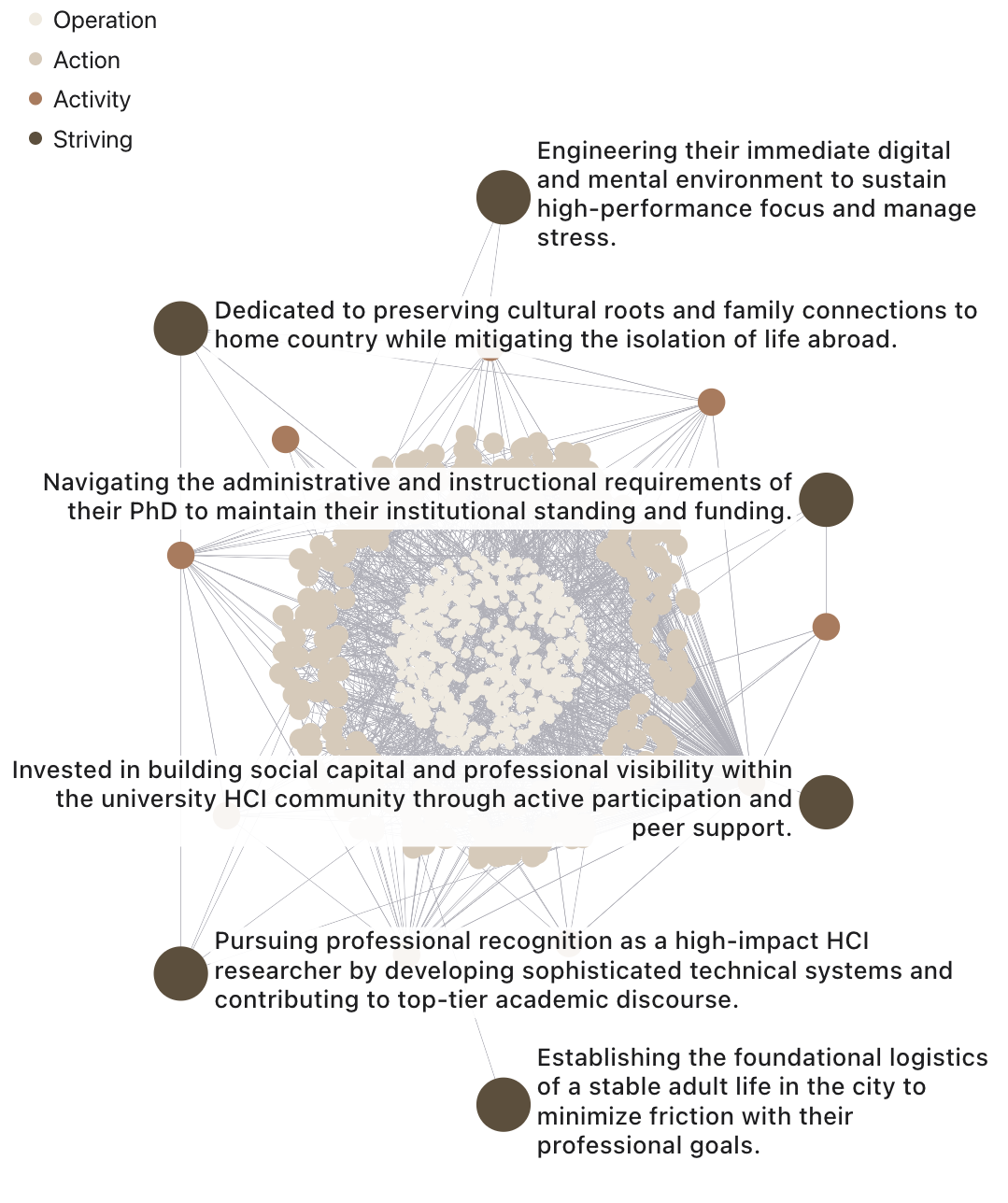
Figure 1: Tempo stores the striving hierarchy as a property graph, representing multi-level abstractions and temporal links between behavior.
User-Guided Editing
Given intrinsic ambiguity in inferring intent from digital traces, Tempo enables users to edit the inferred hierarchy via four operations—inline edit, reassign, remove, and merge—implemented as persistent constraints on future induction cycles. Edits apply not only to the labels of strivings/activities but also to structure, ensuring user agency over representations.
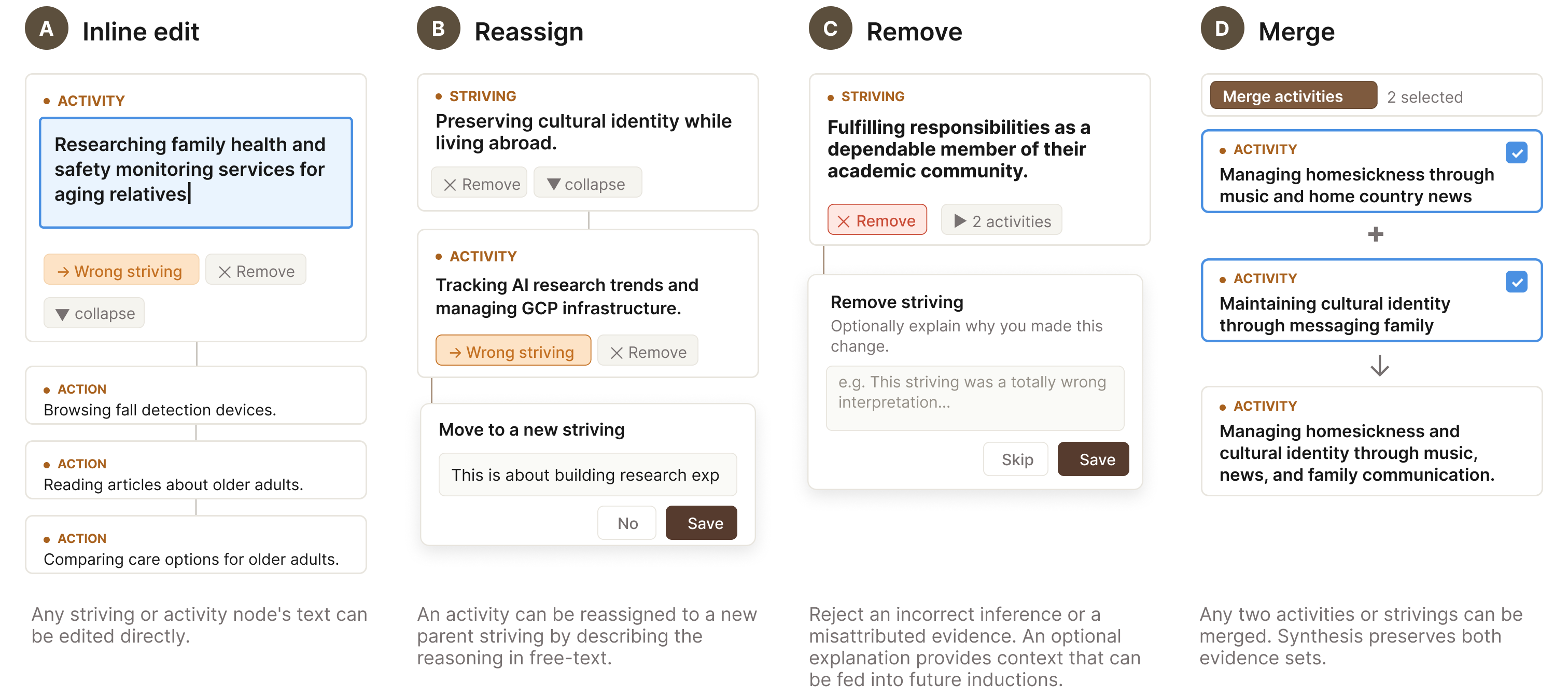
Figure 2: Four operations in the editing interface: inline edit (A), reassign (B), remove (C), merge (D); all edits persist as induction constraints.
Evaluation: Field Deployment and Quantitative Impact
A week-long deployment (N=14) assessed the system’s capacity to induce precise, representative strivings and to provide effective mechanisms for user correction.
Ablation Framework
Three system variants were compared:
- Tempo: Full system (hierarchy + user context).
- Tempo –{User Context}: Hierarchical inference without user context.
- Tempo –{Hierarchy, User Context}: No hierarchy or context; direct striving inference from behavioral windows.
Precision and Representativeness
Individual striving quality was measured across four dimensions (accuracy, alignment, abstraction, characteristicness), while set-level representativeness was assessed via coverage, discovery, and motive reflection. Mixed-effects modeling showed:
- User context provides significant improvement in per-striving ratings: Tempo outperformed Tempo –{User Context} (β=0.29, p<0.05).
- Hierarchical structure produces a significantly more representative goal set: Tempo –{User Context} outscored Tempo –{Hierarchy, User Context} for set-level measures (β=0.72, p<0.05).
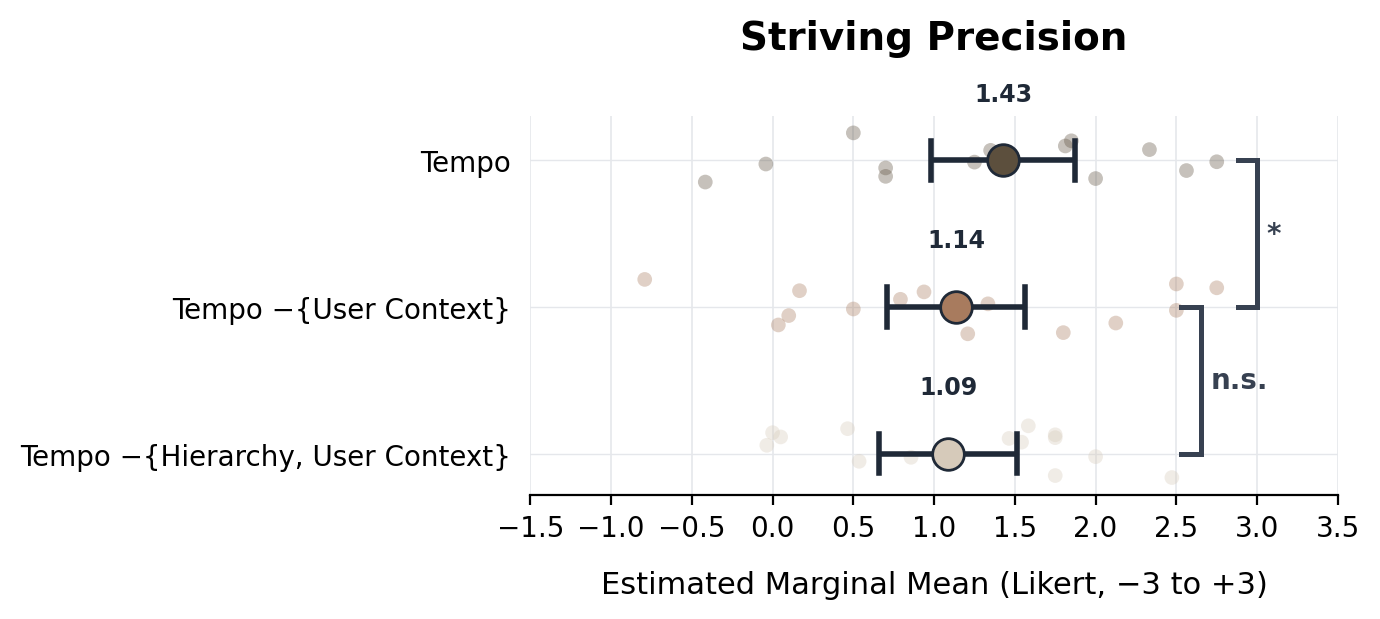
Figure 3: User-provided context significantly increases per-striving precision across four dimensions.
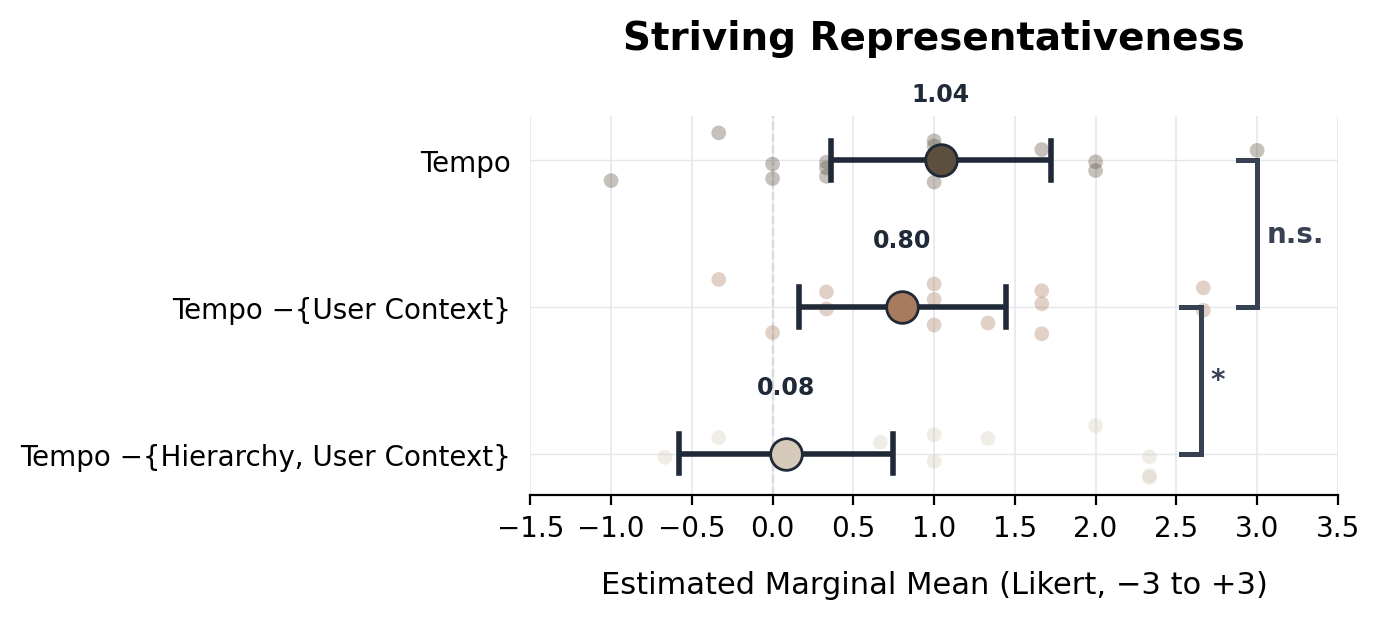
Figure 4: Hierarchical abstraction yields superior set-level representativeness as compared to flat inference methods.
Participants’ qualitative responses further underscore that the full approach surfaces personally meaningful, high-level strivings (e.g., “These are my inner thoughts”) rather than mere recitations of digital actions, but over-weighting context can occasionally yield confident but unsupported generalizations.
Striving Hierarchy as Editing Surface
The edit module was evaluated via two interfaces: a hierarchical view and a flat screenshot-view baseline. Quantitative ratings (transparency, evidence utility, control, agency, reflection, confidence, ease) and interaction logs revealed that:
- The hierarchical reasoning trace substantially increases editing efficacy, agency, and transparency (all p<0.001).
- Legibility of inference steps enables targeted correction: Users could localize disagreement and amend structure or semantics without reconstructing intent from raw observations.
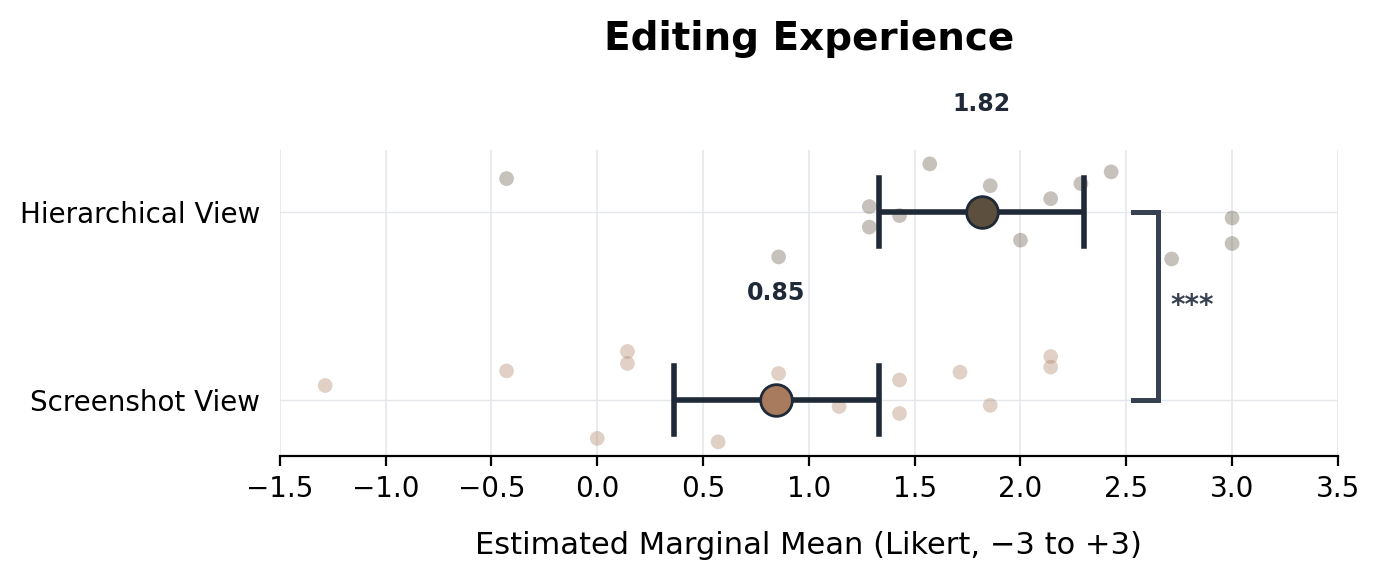
Figure 5: Hierarchical view markedly improves experience across all rating dimensions.

Figure 6: The hierarchical edit interface organizes strivings, activities, actions, and screenshot evidence, supporting granular edits.

Figure 7: Baseline screenshot-centric interface for editing, lacking hierarchical abstraction.
Theoretical and Practical Implications
Modeling "Why", Not Just "What"
Unlike prior context-aware or user modeling systems—which typically infer short-term tasks, explicit goals, or rely on upfront user specification—Tempo advances techniques to infer enduring, cross-contextual strivings, and links digital traces to latent motivational structure. The method’s integration of Activity Theory and personal strivings operationalizes a layered approach for long-term, value-aligned personalization.
Co-Creation and Reflection
Striving co-creation transforms user modeling from passive observation to an interactive, mixed-initiative process where users' corrections propagate as model constraints. This not only addresses ambiguity and cold-start problems but also supports user reflection, allowing individuals to interrogate both their actual and aspirational goals as revealed by their behavioral traces.
Agent and Coaching Applications
The striving hierarchy enables new classes of agentic behaviors: proactive agents that reason about long-term goals (not just immediate tasks) and coaching systems that identify and address tensions or momentum across life domains. The property graph supports programmatic retrieval and subscriptions for downstream application integration.
Systemic Risks and Open Problems
- Privacy and Security: The striving hierarchy aggregates highly sensitive, cross-domain inferences, increasing the need for robust privacy controls and local data storage.
- Sycophancy and Overfitting: There is a risk that persuasive, LLM-generated strivings may be accepted by users due to articulation rather than behavioral rigor (alignment with Barnum/Forer effects and LLM sycophancy).
- Observer Effect: Continuous observation can drive performative behavior, with users self-modulating activity based on being observed—a transient but important consideration for deployment.
Limitations and Future Directions
Practical challenges remain, including scaling beyond desktop contexts, integrating multi-modal and longitudinal sources, tightening the user-driven constraint-propagation feedback loop, and automating re-evaluation of stale or misaligned strivings. Expanding the co-creation interface into conversational paradigms or suggestion-based corrections may further reduce user burden and unlock richer self-knowledge.
Conclusion
This work operationalizes "striving co-creation" through hierarchical behavioral abstraction, user-guided editing, and constraint-propagation, culminating in the Tempo system. Empirical results confirm that both explicit user context and hierarchical design are critical for producing strivings that are precise, representative, and actionable. The co-creative pipeline sets new requirements for AI systems that aim to proactively support users' long-term objectives: not only robust hierarchical inference but also mechanisms for users to contest and reshape how systems represent and act on their behalf.

