- The paper presents a detailed balance framework that integrates realistic optical and excitonic absorption models to set stringent upper limits on TMD solar cell efficiency.
- It quantifies carrier multiplication effects, showing modest gains (up to 5–6%) in bulk absorbers and negligible improvements in monolayer TMDs due to wide optical gaps.
- It reveals that while hot-carrier extraction can significantly boost efficiency (up to ~50%), even minute cooling losses (e.g. κ = 0.2 W/m²/K) rapidly diminish these benefits.
Introduction
This work rigorously explores the thermodynamic efficiency limits of solar cells based on transition-metal dichalcogenides (TMDs), incorporating the effects of carrier multiplication (CM) and hot-carrier (HC) extraction. It addresses the intricate balance between photonic absorptance, energetic partitioning of absorbed photons, and the parasitic cooling losses that fundamentally constrain photovoltaic (PV) performance. An upper-bound, detailed-balance framework grounded in realistic optical and excitonic absorption models is combined with generalized radiative recombination theory, benchmarking TMD solar cell potential under AM1.5G illumination.
Optical Modeling and Absorptance Baseline
Central to accurate efficiency limits is the treatment of photon absorptance within layered TMD films. For bulk-like absorbers, the study incorporates a physically consistent Lambertian light-trapping model:
a(E,d)=1+4n2α(E)d4n2α(E)d
where n is the refractive index and α(E), d are the absorption coefficient and film thickness, respectively. The model, derived from Tiedje–Yablonovitch limits, provides a transparent interpolation between weak- and strong-absorption regimes and is compatible with detailed-balance (DB) calculations. For monolayers, absorptance spectra are anchored by experimentally calibrated excitonic absorption peaks, ensuring the correct absolute scale and line shape. An explicit hard cutoff is enforced at the optical gap, precluding sub-gap recombination artifacts in DB integrals and stabilizing the physicality of optimal voltage predictions.
Carrier Multiplication: Detailed-Balance Thermodynamics
Carrier multiplication is modeled by a quantum yield function m(E)≥1, following a piecewise Beard-type form parameterized by ηCM, which is set optimistically close to unity based on transient-absorption measurements. The formalism rigorously includes the increased radiative recombination penalty imposed by higher carrier extraction rates, as emphasized in prior thermodynamic analyses [Brendel et al. 1996; Hanna & Nozik 2006]. The net current is
JCM(V)=q∫0∞m(E)a(E)[ϕ⊙(E)−ϕbb(E,T,m(E)qV)]dE
The result is a nontrivial voltage penalty that generally offsets the naive CM-induced current gain.
Hot-Carrier Regime: Endoreversible Benchmarking
To probe the upper limit imposed by hot-carrier extraction, the study employs a nonequilibrium carrier reservoir at temperature TH>TC. The extracted energy per pair, ΔE, and terminal voltage V obey the De Vos–Queisser relation:
n0
Practically, any finite phonon-driven cooling loss, characterized by the areal heat conductance n1, rapidly degrades the HC efficiency benefit. The analysis spans n2 from the ideal reversible n3 limit to values representative of state-of-the-art and technologically plausible cooling suppression.
Efficiency Results: Quantitative Trends
Efficiency results across representative TMDs demonstrate several key trends:
- Bulk-like TMDs (e.g., MoTen4, WSen5, MoSn6) in the reversible HC or HC–CM regime can attain absolute efficiencies up to ~50% under AM1.5G, far above the corresponding Shockley–Queisser (SQ) limits (29–32%).
- Carrier multiplication alone induces only modest efficiency gains in bulk absorbers (e.g., n7 up to 5–6%), even under stress-test quantum yields (n8). In monolayer TMDs, CM yields negligible gains, due to the wide optical gaps and limited absorptance.
- The imposed cooling leakage parameter, n9, is critical: even at aspirational leakage (α(E)0 W/mα(E)1/K), the HC–CM enhancement collapses by 10–15 percentage points.
For MoTeα(E)2-like gap materials, practical upper-bound efficiencies are tightly clustered near the HC–CM maxima (Figure 1). The results corroborate the notion that narrow-gap TMDs are optimally positioned for potential HC/CM exploitation.
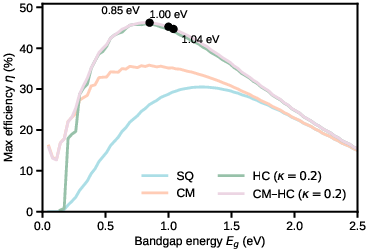
Figure 1: Efficiency versus optical gap for optically thick TMDs at α(E)3W/mα(E)4/K, highlighting clustering of MoTeα(E)5-like materials near the combined HC–CM optimum.
Theoretical Consistency: No Double Counting of Thermodynamic Resources
An explicit derivation demonstrates that in the reversible (α(E)6) limit, the maximum attainable power is identical for HC and HC–CM scenarios, with CM only repartitioning the extracted power between increased current and reduced voltage but not offering an independent thermodynamic advantage. Any efficiency gain for CM–HC over HC at finite α(E)7 is attributable to differential current–voltage allocation preceding dissipation, not to access to additional photonic free energy.
Practical Implications and Future Outlook
The analysis underscores several pivotal implications for ultra-thin and layered TMD PVs:
- Suppressing hot-carrier cooling to the sub-0.2~W/mα(E)8/K regime is essential for realizing HC-enhanced conversion. This remains a formidable challenge technologically, constrained by intrinsic phonon lifetimes, carrier-phonon coupling, and interface heat conductance.
- Carrier multiplication, even with unrealistically high quantum yield, provides only a modest enhancement. For wide-gap monolayer TMDs, practical CM effects are entirely negligible.
- Device architectures must rigorously account for optical thickness and excitonic absorption if efficiency projections are to be physically meaningful.
Further theoretical work should explore the interplay between excitonic effects, nanophotonic light trapping, and nonradiative loss channels. Experimentally, advances are required in interface engineering for heat-suppression and in spectral domain tailoring of absorption to flatten the above-gap response.
Conclusion
This study provides a stringent, reproducible upper bound on solar energy conversion efficiency in TMDs, integrating realistic absorption, carrier multiplication, and hot-carrier extraction within a unified, DB-consistent thermodynamic framework. The findings reveal that, barring revolutionary advances in hot-carrier cooling suppression, the practical efficiency augmentation from carrier multiplication is tightly limited, while hot-carrier approaches are fundamentally constrained by even minute parasitic heat leakage. Optimization of TMD PVs therefore depends critically on material synthesis, optical design, and phonon engineering to approach, but not exceed, these robust thermodynamic ceilings.

