- The paper introduces a graph-based discrete denoising diffusion framework that formulates MIMO detection as a reverse process over the symbol space.
- It leverages a gated graph message-passing network and innovative cold-start and warm-start inference strategies to reduce computational load while improving symbol error rates.
- Experimental analysis on 16-QAM systems shows that GD4 outperforms traditional detectors in both over-determined and under-determined settings, demonstrating strong robustness and generalization.
Graph-based Discrete Denoising Diffusion for MIMO Detection: The GD4 Detector
Introduction
Multiple-input multiple-output (MIMO) detection is a well-established NP-hard problem, especially under under-determined channel conditions (Nr<Nt). Classical approaches such as the box-constrained Babai point and its randomized variants encounter severe limitations, particularly as system dimensions grow and the channel matrix becomes ill-conditioned. Recent advances in diffusion-based generative models have inspired new inference methods, but their reliance on continuous relaxations and iterative sampling steps at inference time hampers real-world viability and limits their effectiveness, especially in under-determined cases. The GD4 approach introduces a fully discrete, graph-based denoising diffusion framework that leverages the structure of the MIMO detection task and enables efficient, high-quality inference.
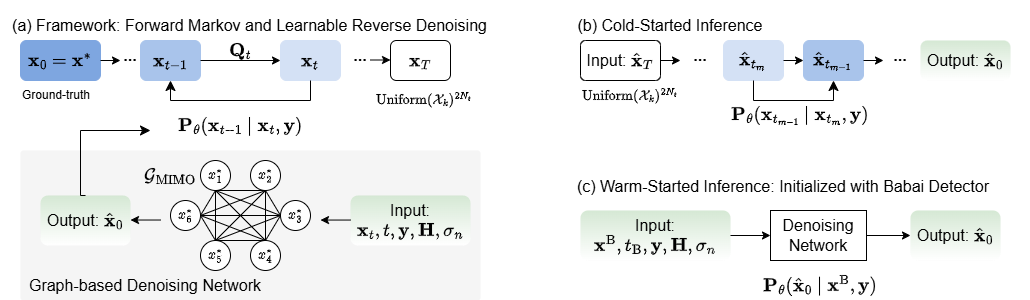
Figure 1: Framework of the proposed graph-based discrete diffusion for MIMO detection, highlighting the discrete forward process, graph message-passing denoising network, and accelerated inference strategies.
Theoretical Framework
GD4 formulates MIMO detection as a discrete denoising diffusion process parameterized over the symbol space directly. The forward process employs a time-inhomogeneous Markov chain, driven by multinomial noise over the MIMO symbols, gradually corrupting the ground truth until it approaches the uniform distribution. This corruption is parameterized through per-symbol transition matrices Qt, capturing the ordinal nature of modulation constellations such as QAM.
The reverse denoising network is realized via a gated graph message-passing network. Each instance is represented as a fully connected graph whose nodes correspond to the transmitted symbols and whose edges encode the pairwise interactions dictated by the channel matrix H. Node and edge features are meticulously constructed from local evidence and the channel statistics, ensuring that the network can effectively exploit the intricate dependency structure inherent in the MIMO posterior.
Training objectives comprise both a variational bound minimizing the Kullback-Leibler divergence between the true and model reverse posteriors and a cross-entropy term ensuring direct recovery of clean symbols from corrupted input. Consistent with discrete diffusion models, network outputs parameterize a discretized logistic distribution, maintaining ordinal awareness and improving symbol-level accuracy.
Efficient Inference Strategies
GD4 introduces two practical inference strategies:
- Cold-started Detection: Reverse denoising begins from pure noise (uniform samples) and proceeds via a reduced number of denoising steps, leveraging step-skipping along the reverse process to minimize computational cost.
- Warm-started Detection: The denoising network refines classical suboptimal solutions, specifically the Babai point, using only a single denoising evaluation. The step t is chosen such that the expected SER introduced by forward corruption approximately matches the SER of the warm-start point, allowing for seamless integration with classical detectors and minimal overhead.
These strategies provide a favorable performance-complexity trade-off and maintain robustness across over-determined and under-determined configurations.
Experimental Analysis
The effectiveness of GD4 is empirically demonstrated on large-scale 16-QAM MIMO systems, including both over-determined (Nr=Nt) and under-determined (Nr<Nt) settings. Runtime benchmarks on GPU reveal that warm-started GD4 (one denoising step post-Babai) is faster or comparable to the best classical methods, while cold-started inference can operate effectively with as few as a single denoising step.
In terms of detection quality:
- GD4 (warm-started, 1 step) achieves lower SER than both 10-best randomized Klein-Babai and previous diffusion-based approaches (ALD, ADD), at similar or lower computational cost.
- In under-determined settings, both ALD and ADD suffer notable degradation, while GD4 maintains high performance and robustness. This demonstrates the unique capability of discrete denoising diffusion with graph inference in mitigating the ill-conditioning often encountered in practical deployments.
- Network generalization is validated: a GD4 network trained on overdetermined problems generalizes without retraining to under-determined cases by directly conditioning on new instances.
As the number of denoising steps increases in cold-started detection, error rates improve monotonically, illustrating that the network captures effective denoising over the distribution of MIMO posteriors.
Implications and Future Directions
The GD4 detector marks a decisive step toward integrating discrete generative models with signal detection in high-dimensional, structured random systems. By fully operating in the symbol space and utilizing message-passing for denoising, GD4 sidesteps the limitations of continuous relaxations and the inefficiency of iterative score-based diffusion. Its demonstrated robustness to channel degeneracy and ability to effectively combine classical and modern generative techniques establish a concrete path for practical, ML-powered communication receivers.
Theoretically, this work bridges advances in discrete diffusion modeling for structured data (combinatorics, text) to the classical domain of digital communications. Practically, the modularity of cold- and warm-started inference provides immediate integration points for legacy receivers, and the graph-based parameterization can straightforwardly accommodate further constraints or extensions encountered in emerging wireless systems (e.g., higher-order modulations, spatial correlation, hardware impairments).
Future extensions may include adaptive denoising schedules tailored to instance-specific hardness, integration with learned channel estimation, and hybrid inference mechanisms that meld discrete and continuous diffusion for even larger or more complex systems.
Conclusion
GD4 is a graph-based discrete denoising diffusion detector that achieves strong detection accuracy and sample efficiency for both over-determined and under-determined MIMO systems. By leveraging discrete diffusion and GNN-based denoising, it surpasses both classical and existing diffusion-based baselines in accuracy and runtime. GD4 sets a foundational paradigm for discrete generative inference across a wide range of communication signal processing tasks.