- The paper demonstrates that geometric attractor boundaries and critical SNR thresholds cause abrupt storage collapse in kernel Hopfield networks.
- It employs kernel logistic regression to extend memory capacity far beyond classical limits, achieving robust recall at high pattern loads.
- The analysis reveals that dynamic stability, rather than mere geometric separability, is the key factor governing retrieval failure.
Geometric Analysis of Attractor Boundaries and Storage Capacity in Kernel Hopfield Networks
Introduction
This work conducts a systematic investigation into the geometric and dynamical factors delimiting the storage capacity of kernel logistic regression (KLR)-trained Hopfield networks. Departing from classical restrictions of quadratic Hopfield energy functions, the paper focuses on the empirical and theoretical characterization of sequence and static memory performance, with an emphasis on attractor geometry, morphing dynamics, and the interplay between geometric separability and dynamic stability. This approach provides a fine-grained perspective beyond basic empirical results, advancing an understanding of both statistical and geometric phase transitions that ultimately restrict memory performance.
Exceeding Classical Hopfield Capacity: Empirical Results
Sequence Memory Scaling and Breakdown
The KLR Hopfield network breaks conventional memory bounds by sustaining sequence recall performance through storage loads up to P/N≈16, more than two orders of magnitude above the classical Hopfield model limit. As documented in Figure 1, the network maintains robust limit cycles well beyond the traditional phase transition in pattern load.
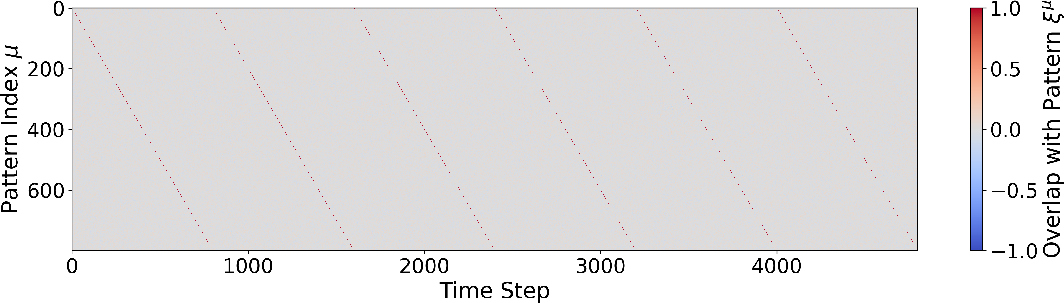
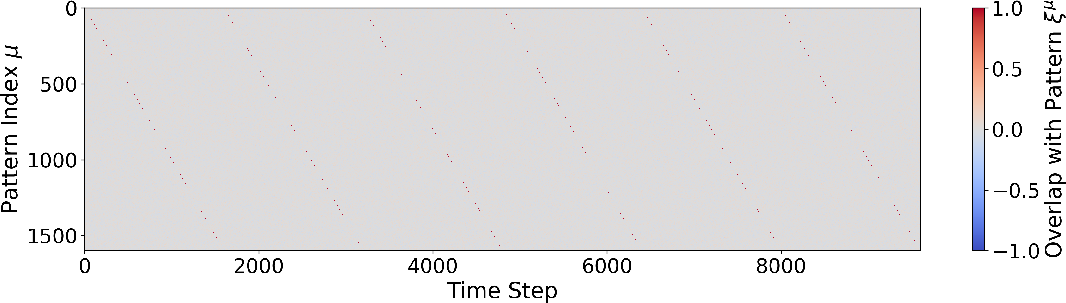
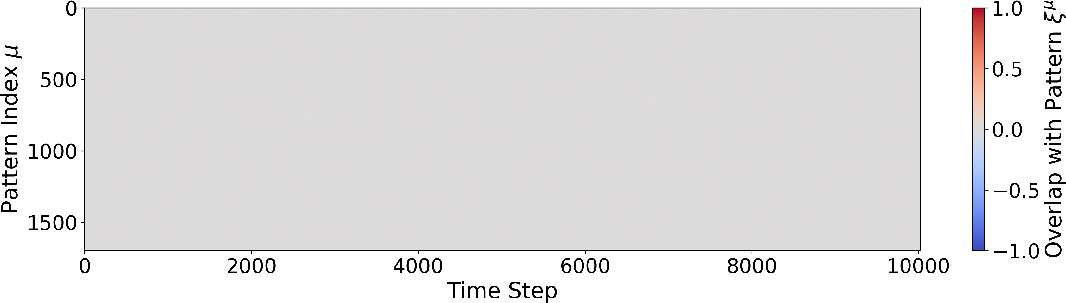
Figure 1: Sequence recall dynamics at increasing storage loads show sharp transition from near-perfect retrieval to complete dynamical collapse as P nears and exceeds $16N$.
Notably, recall success deteriorates sharply in a phase-transition-like manner. At the critical region (P/N≈16), recall degrades not gradually but through an abrupt collapse, accentuating the existence of a hard storage threshold.
Structured Data Storage
The experiments are extended to real-world data using binarized CIFAR-10 embeddings (dimension N=512). The KLR network achieves flawless retrieval across the entire test set at P/N≈19.5 (100% accuracy, even with 10% bit noise), evidencing that data manifold structure dramatically increases effective capacity. The kernel mapping leverages the low intrinsic dimensionality and redundancy in image feature representation, allowing the network to pack dense, non-interfering attractor basins.
Geometry of Attractor Boundaries
Sharp Separatrices and Phase-Like Transitions
To elucidate the separators between memory basins, the paper deploys a morphing protocol interpolating between stored patterns. In the "Ridge" regime (γ=0.02), boundaries are sharply localized, both for inter- and intra-class pattern pairs.
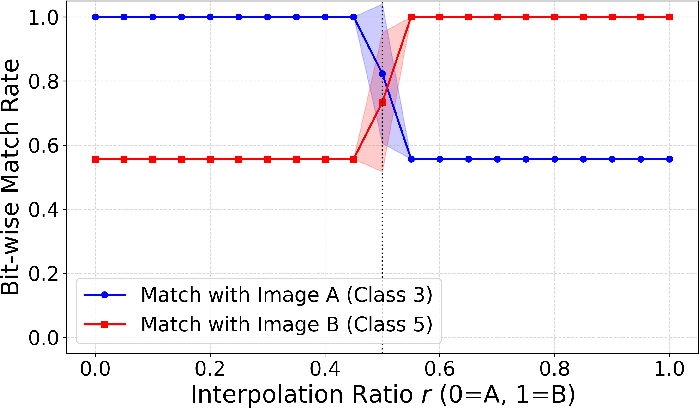
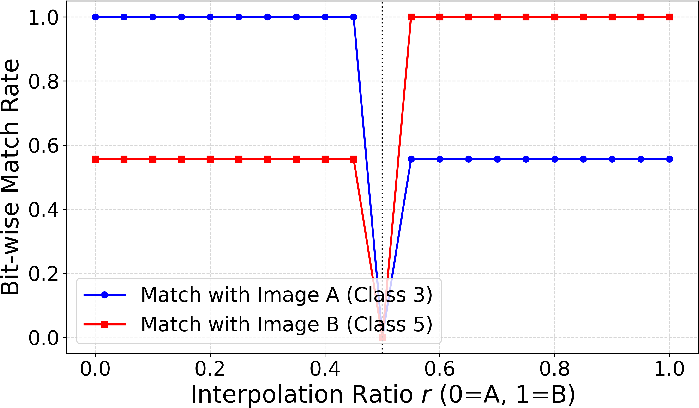
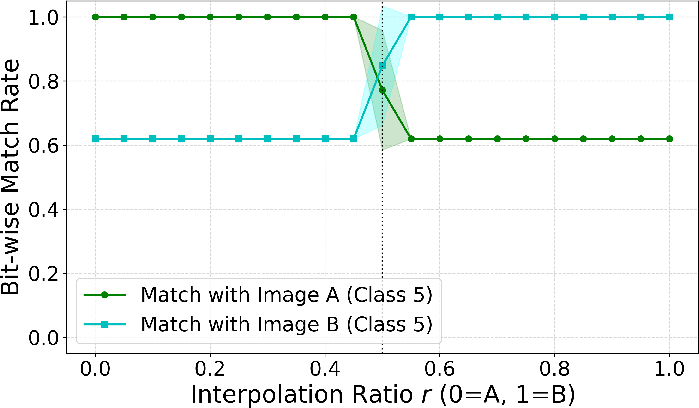
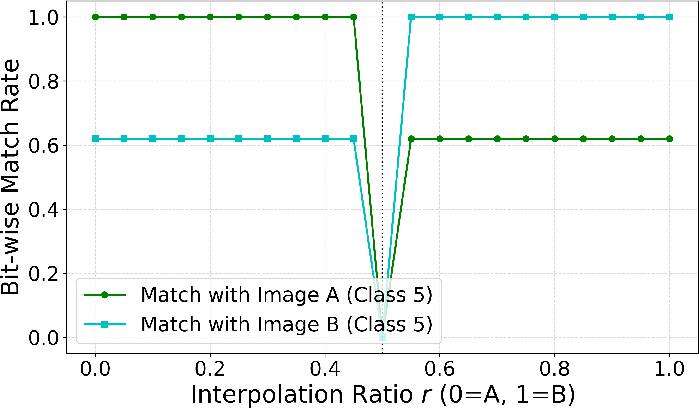
Figure 2: Morphing analysis reveals abrupt attractor transitions on the Ridge (γ=0.02), contrasting with ambiguous, spurious-state-prone transitions in the Local regime (γ=5.0).
Intermediate initializations close to the class boundary rapidly converge to one attractor or the other with almost no intermediate states. The only exception is a vanishingly narrow band near r=0.5 interpolation, as further analyzed by energy landscape visualization.
Effective Potential and Critical Dynamics
Analysis of a heuristic pseudo-energy along the morphing path reveals a steep double-well profile in the Ridge, with a high barrier and no metastable plateau. In contrast, the Local regime is characterized by flat, broad plateaus conducive to the formation of spurious attractors.
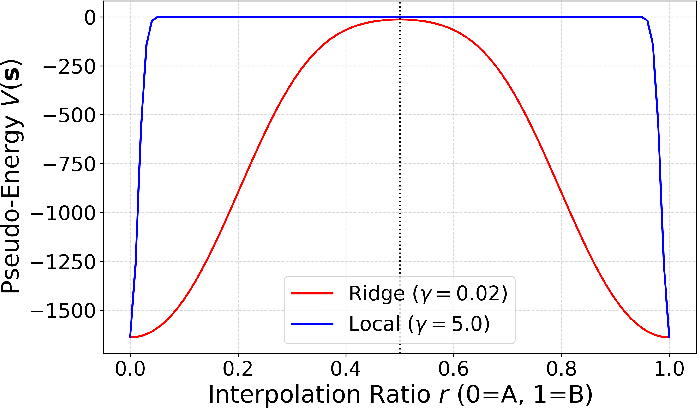
Figure 3: Effective potential along interpolation exhibits a pronounced barrier in the Ridge regime, indicating sharp dynamical separatrices between attractors.
This geometry is directly associated with “critical slowing down”: convergence times peak sharply only at the boundary region, being rapid in almost all other portions of the state space.
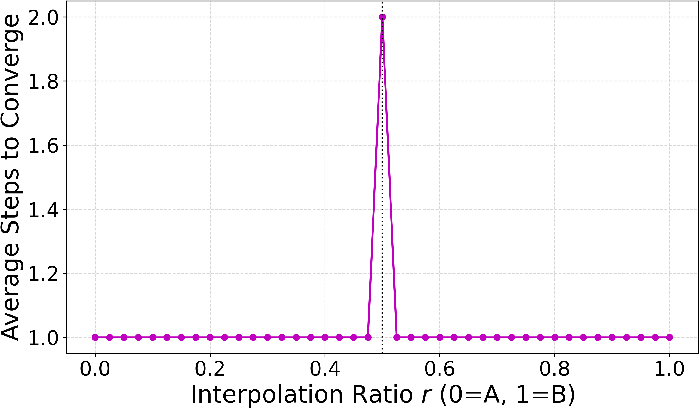
Figure 4: Convergence times as a function of interpolation parameter show a sharply peaked critical slowing down exclusively at the attractor separatrix.
Mechanism of Memory Collapse: SNR Versus Geometric Bounds
Dynamical Stability Analysis
The empirical storage limit is demonstrated to be determined by the signal-to-noise ratio (SNR) of the local field input during retrieval. As the storage load approaches a network-specific threshold (P0 for P1), the SNR drops below a well-defined value (P2), at which point retrieval undergoes catastrophic breakdown.
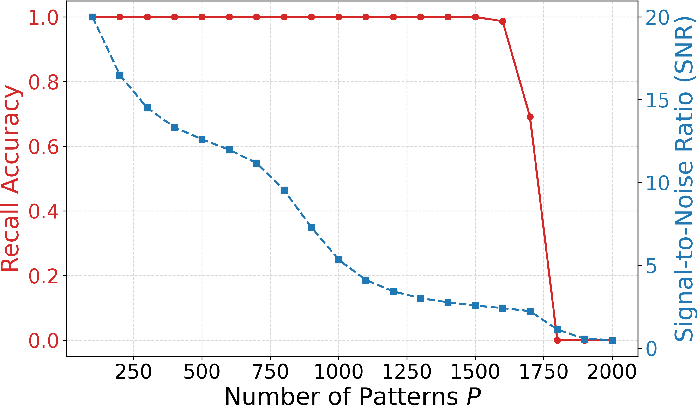
Figure 5: Storage capacity collapses as SNR falls below the critical threshold, defining the boundary of the stable memory regime.
This finding underscores that the bottleneck is not the geometry per se, but the competition between the magnitude of signal and the cumulative crosstalk noise.
Geometric Separability: Cover’s Theorem Versus Empirical Limit
Using the effective dimension (participation ratio of the kernel Gram matrix), a geometric separability bound of P3 (inspired by Cover's theorem) is computed and compared to the empirically observed storage limit.
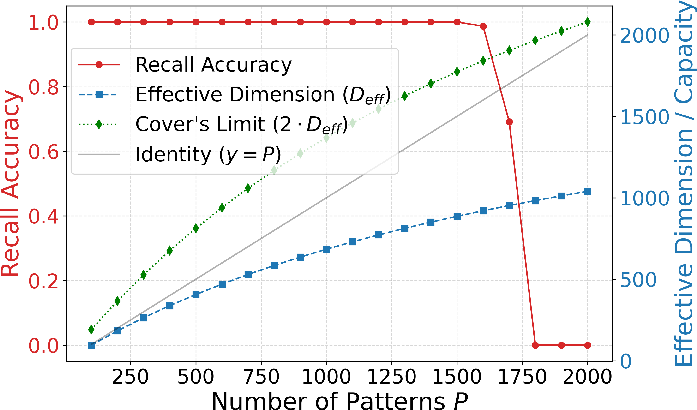
Figure 6: Geometric separability reference point (“P4”, green) exceeds the actual memory limit (red), demonstrating that dynamic SNR rather than geometry determines breakdown.
Actual storage breakdown occurs well before the data lose their statistically guaranteed separability in the feature space, revealing a new kind of phase transition: robust retrieval is dynamically, not geometrically, delimited. The margin of separation remains nonzero even after dynamical instability sets in.
Theoretical and Practical Implications
The KLR Hopfield network, in its optimal regime, acts as a highly localized, exemplar-based memory. The sharp geometrical attractor partitions parallel those in deliberately engineered high-order or exponential Hopfield schemes, yet arise purely from quadratic energy and data-driven weight learning. The practical storage constraint is the maintenance of a minimum SNR for iterative convergence, not the disappearance of a linear solution.
This insight has dual implications. Theoretically, it necessitates a re-evaluation of memory models that only account for geometric separability. Practically, it suggests that further improvements in associative memory design must focus on controlling and reducing retrieval-time crosstalk, possibly via new regularized learning rules or explicit SNR optimization.
Additionally, the observed properties generalize well to structured, correlated datasets with low intrinsic dimension, supporting the role of KLR Hopfield mechanisms as large-scale, robust retrieval engines for high-dimensional, real-world embeddings. Network operation near the Ridge, close to self-organized criticality, combines maximal capacity with sharply defined, noise-resistant separatrix geometry.
Limitations and Future Work
The computational cost of KLR retrieval scales linearly with both P5 and P6, and although sparse or quantized kernel methods have been suggested to ameliorate this, scalability to order-of-magnitude larger memories will depend on continued algorithmic innovation. Analytically, while the SNR analysis is supported by numerics and statistical intuition, a full statistical mechanical derivation of the phase boundaries and their dependence on kernel choice remains open, as does the extension of this geometric analysis to temporally and hierarchically correlated data sources.
Conclusion
This work offers a comprehensive geometric and dynamical analysis of KLR Hopfield networks, showing that memory breakdown is governed by statistical instability to crosstalk, not by the loss of geometric separability. The “Ridge of Optimization” regime is defined by sharp attractor partitions, critical slowing down at basin boundaries, and maximal memory load just prior to phase transition, firmly situating the performance envelope at the intersection of information geometry and stochastic dynamics. The insights derived inform the future development of associative memory systems that are both high-capacity and robustly stable for large-scale, high-dimensional tasks.

