- The paper presents a model-based, vision-driven system that accurately localizes contact and estimates force in compliant robotic grippers using RGB-D data, deep keypoint extraction, and iFEA simulation.
- The method leverages iterative contact localization and mesh registration to overcome occlusion and sensor integration challenges, achieving sub-0.8 N RMSE in force estimation.
- The system generalizes robustly to unseen objects and supports real-time control, demonstrating practical improvements over purely data-driven models in both static and dynamic tests.
Model-Based Visual Force Sensing for Compliant Robotic Grippers: An Authoritative Analysis
Introduction
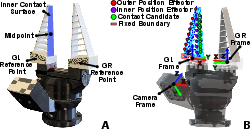
The presented work introduces a model-based, vision-driven contact localization and force estimation system for compliant robotic grippers, specifically fin-ray geometries. The system leverages real-time RGB-D data, deep keypoint extraction, mesh-based object pose estimation, and inverse FEA (iFEA) simulation in SOFA for the indirect measurement of contact forces. This approach addresses persistent limitations in sensorized and camera-based force estimation—namely, trade-offs among mechanical robustness, sensing accuracy, cost, the complexity of sensor integration, occlusion-induced errors, and the brittleness of end-to-end deep learning models.
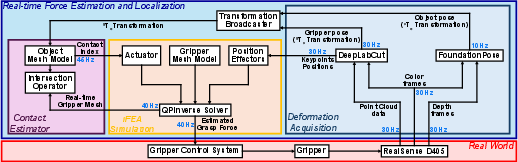
Figure 1: System-level flowchart detailing the pipeline and frame rates for visual keypoint extraction, mesh reconstruction, pose estimation, contact localization, and iFEA-based force estimation.
System Architecture
The system comprises physical fin-ray soft gripper jaws, a wrist-mounted RGB-D camera, and a digital processing pipeline.
Evaluation: Static and On-Robot Force Sensing
Static Benchtop Assessment
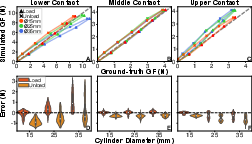
Comprehensive static evaluations were conducted with controlled loading of single gripper jaws across various object diameters (15/25/35 mm) and contact positions (upper, middle, lower), with ground-truth forces measured via a Nano17 F/T sensor.
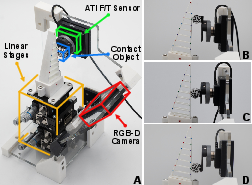
Figure 4: Benchtop setup for static evaluation and contact positions: upper, middle, and lower (panels B–D).
Results demonstrate:
Direct comparison between fixed actuator constraints and the proposed contact estimator shows that only the iterative contact localization algorithm enables robust force estimation under unknown and potentially shifting contact conditions. Fixed (incorrect) actuator positions cause substantial RMSE increases (>5 N).
On-Robot Generalization and Dynamic Evaluations
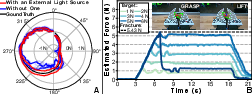
Three object geometries (cylinder, cube, asymmetric) with embedded load cells were grasped by the dual-jaw system. The mesh normalization workflow yields high-fidelity digital twins, preserving sub-4 mm Chamfer L2 error with minimal pose bias against CAD.
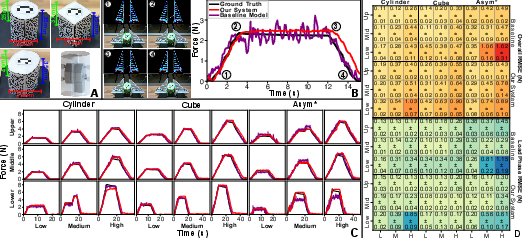
Figure 5: On-robot experimental setup, physical and digital objects with load cells, and force estimation results across conditions, including for previously unseen objects.
Key findings:
Practical and Theoretical Implications
This model-based, visually driven approach establishes a new standard in indirect force sensing for soft, compliant robotic grippers. It offers distinct advantages over data-driven models:
- Transferability: The system robustly transfers across geometric and material variations, requiring only minimal data for keypoint retraining (50–200 frames for DLC), with no object-specific force ground-truth supervision.
- Occlusion Robustness: Iterative contact localization significantly mitigates estimation failure modes due to occlusion or ambiguous deformations.
- Real-Time Control: The pipeline supports real-time feedback (up to 30 Hz limited by the camera rate) for dynamic manipulation tasks, including force-controlled grasping of delicate objects.
- Generalization Beyond Training: The approach generalizes to previously unseen objects, as evidenced empirically, in contradiction to the sharp generalization failures observed for purely data-driven visual models.
Theoretically, the work demonstrates the feasibility and utility of combining geometric simulation (iFEA), model-based reasoning (contact localization), and deep learning (keypoint extraction) for indirect force estimation. The use of mesh-based object registration and contact inference in the context of non-rigid, highly occluded, and unknown-contact scenarios extends the reach of visual-tactile estimation paradigms.
Limitations and Future Directions
- Material Modeling: Current iFEA implementations assume linear elastic behavior. Nonlinearities under large deformation, viscous effects, and material aging remain sources of error, particularly in highly strained or dynamic scenarios.
- Frame Rate Bottlenecks: FoundationPose and the overall contact estimator limit the pre-contact update rate to 10 Hz; future optimizations should parallelize or further optimize these components.
- Lighting Sensitivity: While robust under moderate lighting, severe occlusions or poor illumination degrade keypoint and mesh quality, requiring either high-quality point clouds or improved markerless vision networks.
Anticipated directions include integrating nonlinear viscoelastic simulation, augmenting the perception stack with multimodal cues (e.g., vibration sensing), and expanding materials and gripper morphologies validated by this paradigm.
Conclusion
This paper provides an authoritative demonstration that model-based, vision-centric force estimation for compliant grippers can achieve high accuracy, robustness to occlusion, and generalization to unseen objects—exceeding the limitations of traditional sensorized or end-to-end learned approaches. The system's practical utility is validated in dynamic robotic manipulation, and its methodological contributions supply a strong foundation for future research in indirect force and tactile inference in soft robotics.