Quantum in Biology, Quantum for Biology, and Biology for Quantum: Mapping the Evidence and the Road Ahead
Abstract: Quantum science and biology now intersect in three complementary directions: quantum in biology, quantum for biology, and biology for quantum. This review provides a structured narrative evidence map of that interface rather than an exhaustive catalogue or formal systematic review. For each topic, we ask what the mechanistic or technological claim is, which quantum resource is invoked, what the strongest experiments and models establish, which classical alternatives or engineering confounds remain competitive, and what decisive tests or benchmarks would most strongly change confidence. The most mature quantum-in-biology cases remain mechanistically constrained tunneling in some enzymatic hydrogen-transfer reactions and radical-pair spin chemistry as a viable framework for magnetoreception, whereas several higher-visibility topics remain suggestive but unresolved under physiological conditions. In quantum for biology, the central issue is whether quantum-enabled tools improve biological inference relative to strong classical baselines under realistic calibration, dose, throughput, and uncertainty constraints. In biology for quantum, the strongest claims arise when biomolecular structure or self-assembly measurably improves fabrication, integration, or robustness in quantum devices. Summary tables in the Appendix provide a compact cross-map view of the current evidence, major confounds, and the experiments or benchmarks most likely to discriminate between competing explanations.
Paper Prompts
Sign up for free to create and run prompts on this paper using GPT-5.
Top Community Prompts
Explain it Like I'm 14
What Is This Paper About?
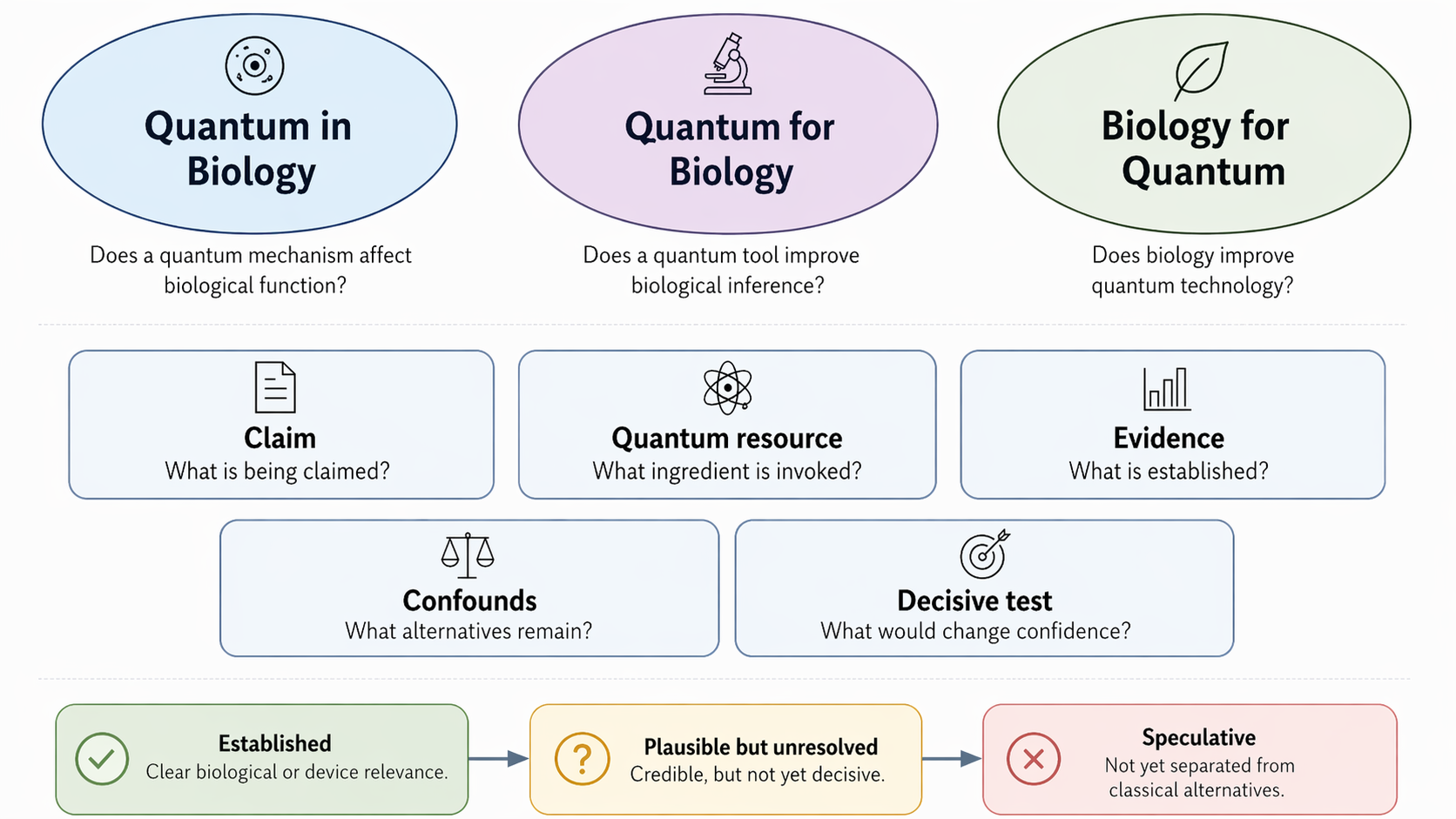
This paper is a “map” of how quantum physics and biology meet. It organizes the evidence into three directions:
- Quantum in biology: Do living things actually use specific quantum effects to work?
- Quantum for biology: Do quantum tools help us study or treat biology better than regular (classical) tools?
- Biology for quantum: Can biology help build better quantum devices?
Instead of listing every paper, the authors compare topics using the same simple test: What’s being claimed, which quantum effect is involved, what’s the best evidence, what simple (classical) explanations could also work, and what experiments would settle the question.
What Questions Does the Paper Ask?
In plain terms, for each topic, they ask:
- What exactly is the claim?
- Which quantum “resource” does it rely on? (For example: tunneling, coherence, spin.)
- What are the strongest experiments and models that support it?
- Could ordinary, non-quantum explanations still explain the data?
- What clear test or benchmark would most change our confidence?
They also rank topics on an “evidence ladder”:
- Established: Strong, repeated evidence under realistic conditions.
- Plausible but unresolved: Good clues, but other explanations still compete.
- Speculative: Interesting ideas with little decisive evidence yet.
How Do They Do This? (Methods and Helpful Analogies)
This is a structured review (not a lab experiment). The authors read and compare studies, then judge each topic with the same checklist above. They use simple, consistent meanings for quantum terms:
- Tunneling: Like a tiny particle “sneaking” through a wall it couldn’t climb over—relevant for electrons or protons moving in enzymes.
- Coherence: Like many tiny waves staying in step; if they lose step, that’s dephasing.
- Entanglement: Two things linked so that measuring one tells you about the other, even if apart—stronger than normal correlation.
- Vibronic mixing: Electronic energy (electrons) and vibrations of atoms are coupled—like riding a swing while the seat itself vibrates.
- Spin: A tiny magnetic property, like a microscopic compass needle; in “radical pairs,” spin affects chemical outcomes.
They then place each topic on the evidence ladder and point out the cleanest future tests.
What Did They Find, and Why Does It Matter?
Here are the main takeaways, grouped by the three directions.
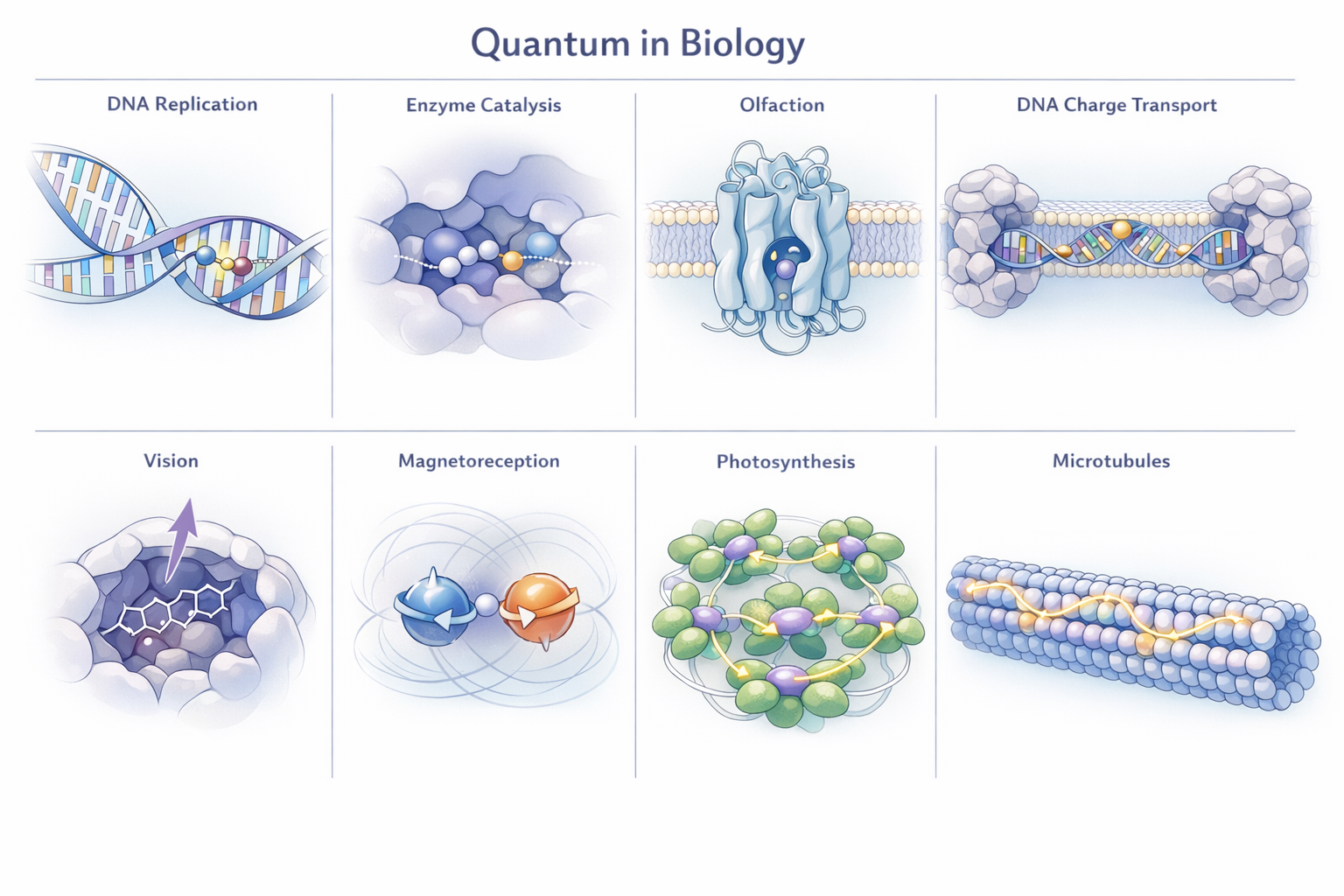
1) Quantum in Biology: Where quantum effects may help living systems work
Most mature (strongest) cases:
- Enzyme hydrogen tunneling: Some enzymes pass a hydrogen (or a proton) in a way best explained by tunneling. Clues include how reaction speed changes with different isotopes (hydrogen vs. deuterium) and with temperature. This is repeated across systems and fits careful models.
- Radical-pair magnetoreception: Birds (and possibly other animals) may sense Earth’s weak magnetic field using “radical pairs” whose spin dynamics depend on the field. Physics says this can work; experiments and models are consistent, but the exact biological molecules and signal path are still being nailed down.
Promising but unresolved under real-life conditions:
- Photosynthesis coherence and vibronic effects: Lab signals show wave-like excitations in light-harvesting complexes. It’s still unclear if these wave-like effects truly boost efficiency in living cells, beyond what good classical models can do.
- DNA charge transport and redox signaling: Electrons can move along DNA stacks in ways sensitive to damage. This is real in test tubes; how much it matters inside cells (with all their complexity) is still being worked out.
- Vision at the quantum limit: Rod cells can detect single photons, and retinal switches state super fast. Quantum models help describe this, but exactly which quantum features are essential for function is still debated.
- Proton-coupled electron transfer and respiration: Many energy processes likely include tunneling corrections, but proving a unique quantum advantage inside cells is hard and requires careful controls.
- Chiral induced spin selectivity (CISS): Chiral biomolecules can filter electron spins in devices. Direct biological roles remain uncertain because device setups don’t always match natural conditions.
Speculative or needing stronger, cleaner tests:
- Vibrational olfaction (smell by inelastic tunneling): Interesting theory; needs receptor-level, carefully controlled evidence to rule out simpler explanations like shape-based binding.
- Ion-channel coherence: Selectivity and flow are well explained by classical models; unique quantum signatures are not yet required by the data.
- Microtubule quantum transport or spin effects: Some new in vitro photophysics and spin-related hints exist, but the field needs standardized samples, replications, and tests that clearly distinguish truly quantum behavior from classical hopping or artifacts.
- Posner clusters (long-lived nuclear spins in the brain): Current physics suggests it’s unlikely under real conditions; key steps (cluster formation, long coherence, and biological readout) are unproven.
Why it matters: This sorting helps researchers focus on experiments that really decide whether a quantum effect is necessary, not just possible.
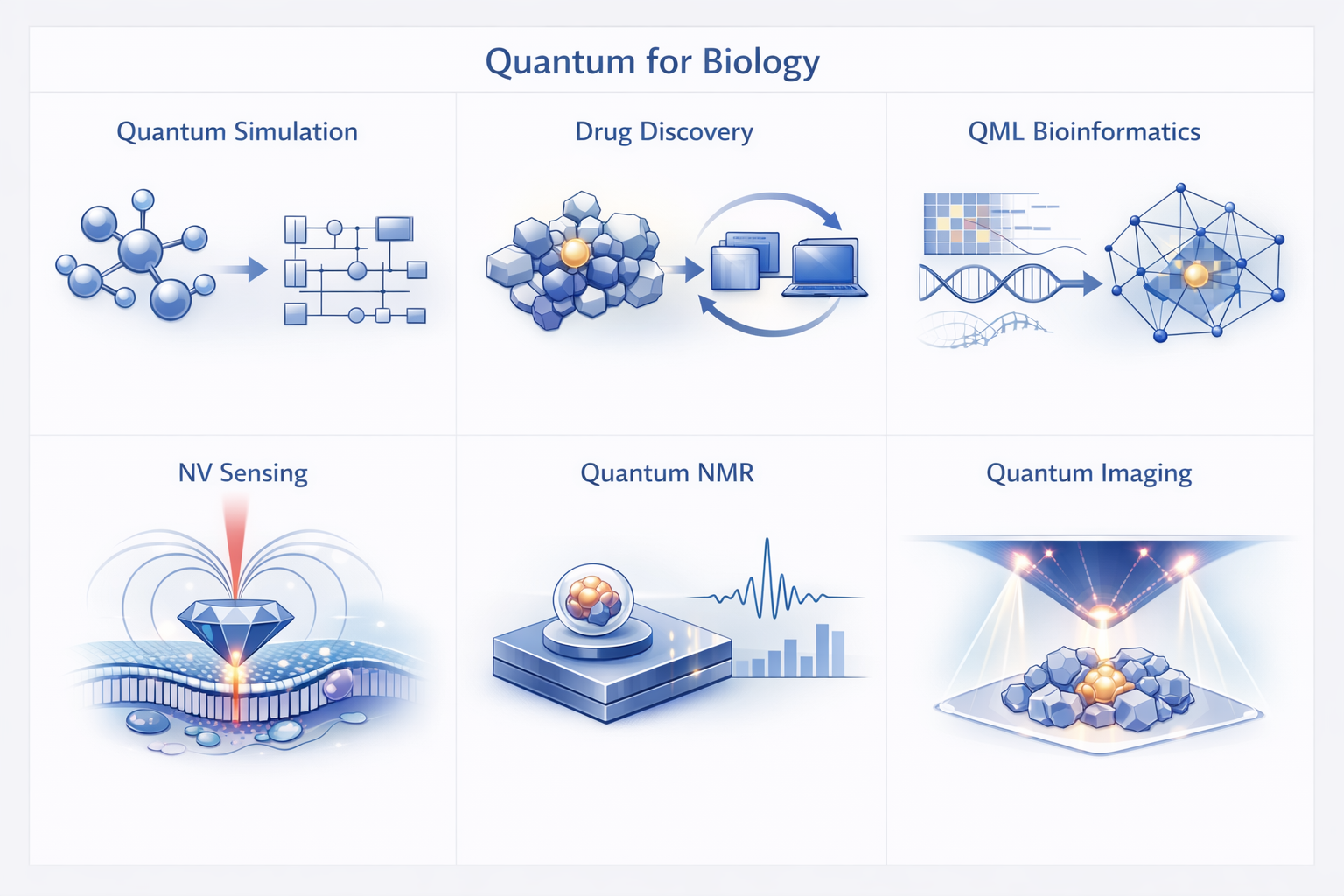
2) Quantum for Biology: Using quantum tech as tools
Core message: Quantum sensors, imaging, simulations, and analysis tools are exciting, but they must beat strong classical baselines in realistic settings—considering calibration, safety/dose, speed, cost, and uncertainty. Some areas show promise (for example, ultra-sensitive magnetic sensing), but claims should always include fair head-to-head comparisons with the best classical methods.
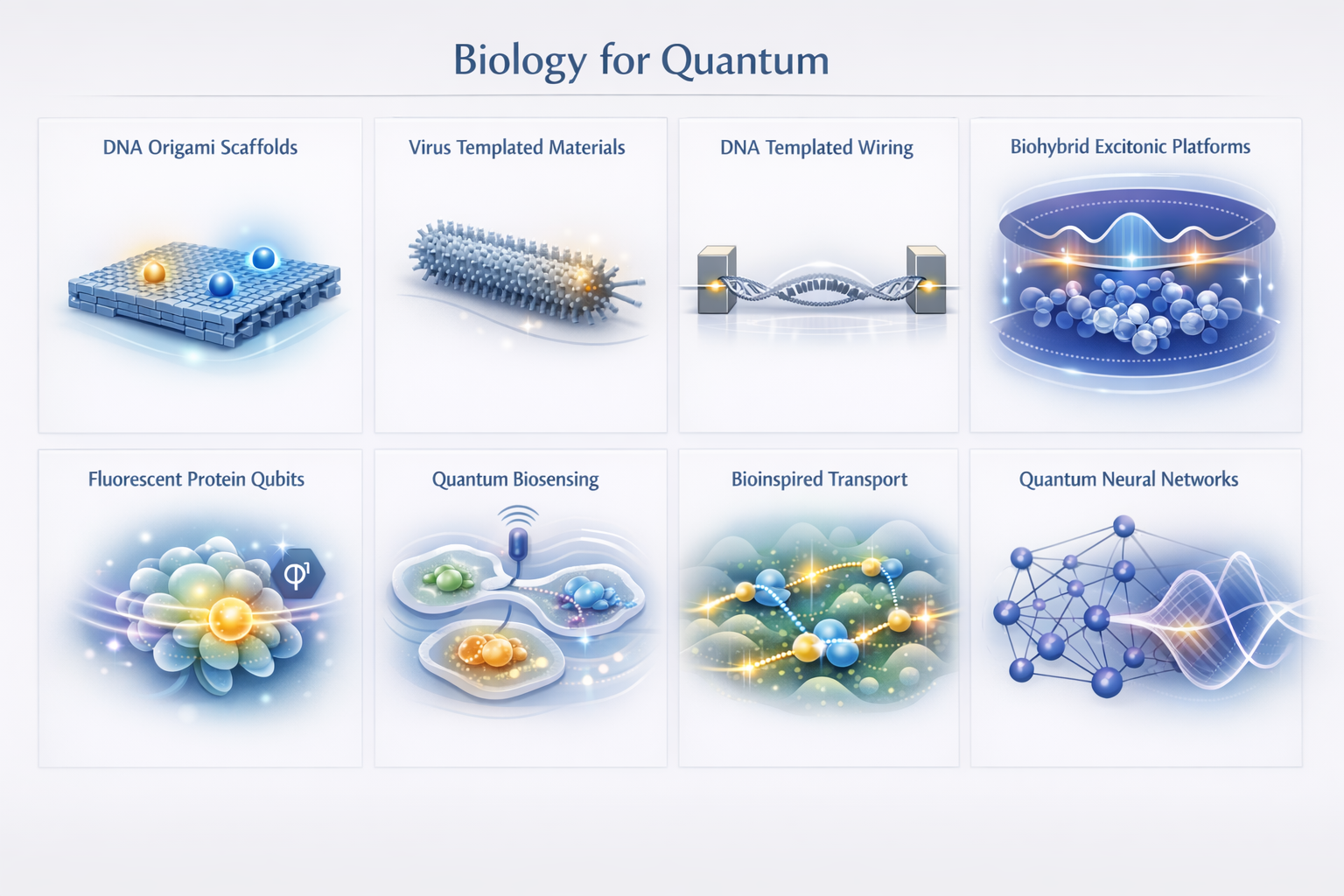
3) Biology for Quantum: Letting biology help build quantum devices
Best-supported ideas:
- Using biomolecules to build nanoscale structures (like DNA origami) that position quantum parts precisely.
- Borrowing biological self-assembly to make devices that are easier to build, integrate, or that last longer.
The strongest claims are those where a biological structure clearly makes a quantum device work better in measurable ways (fabrication, stability, or performance)—not just in principle.
So What’s the Big Picture?
- Strongest evidence so far: Enzymes that use tunneling for hydrogen transfer, and the radical-pair framework for animal magnetoreception.
- Solid physics but unsettled biology: Photosynthetic “coherence,” DNA electron transport in signaling, ultrafast vision chemistry, parts of respiration and redox, and spin-selective transport in chiral systems.
- Interesting but speculative: Vibrational olfaction, ion-channel coherence, microtubule-wide quantum roles, and Posner nuclear-spin ideas.
Across all topics, the authors emphasize clear, discriminating tests: tweak dephasing without changing structure, swap isotopes to test tunneling, control classical confounds, and look for signatures that classical models cannot mimic.
What Could This Change in the Future?
- In biology, sharper tests may confirm where quantum effects are truly necessary, not just present in a minor way. This could reshape how we understand enzymes, senses, and energy flow in cells.
- In technology, quantum tools could unlock gentler, more precise ways to measure, image, or analyze living systems—if they prove real advantages over current methods.
- In engineering, biological self-assembly and design principles might help us build scalable, robust quantum devices.
Overall, this “evidence map” aims to lower the hype, raise the standards, and guide the most decisive experiments—so future work can confidently say where quantum really matters in life, and where biology can push quantum tech forward.
Knowledge Gaps
Below is a single, consolidated list of concrete knowledge gaps, limitations, and open questions highlighted or left unresolved by the paper, organized to guide actionable next steps for researchers.
- DNA proton transfer and replication fidelity: Lack of direct, polymerase-resolved evidence linking specific proton-transfer/tautomer lifetimes in base pairs to misincorporation probabilities in situ; need assays combining isotope substitution and temperature scaling that decouple proton dynamics from binding/conformational checkpoints and proofreading.
- Open-system modeling for replication errors: Absence of quantitatively constrained open-system models that connect proton delocalization/tunneling in polymerase active sites to observed mutation spectra across conditions and polymerase variants.
- Context dependence of hydrogen bonds: Insufficient experimental mapping of how base stacking, hydration, and electrostatics modulate partial covalency and proton delocalization in DNA within functional replication complexes.
- Enzymatic tunneling attribution: Persistent difficulty isolating the chemical step from shifting rate-limiting steps in multi-step cycles; need for unified experiments (mutations, solvent/substrate isotopes, pressure/viscosity) with independently constrained structural/dynamical parameters.
- Dynamic gating quantification: Limited direct measurements of donor–acceptor distance distributions and timescales of gating/promoting vibrations that are hypothesized to sustain tunneling in enzymes.
- Generality across enzyme families: Insufficient comparative/evolutionary series showing how hydrogen tunneling signatures co-vary with active-site mutations and catalysis under controlled rate-limiting regimes.
- Proton-coupled electron transfer (PCET) step isolation: Need for experimental isolation of tightly coupled electron–proton steps within complex catalytic cycles, with definitive scaling predictions under isotope, pH, and electrostatic perturbations while holding redox landscapes fixed.
- Vision—coherence necessity: Unresolved functional role of vibronic/electronic coherence in retinal photoisomerization under natural-light (incoherent) excitation; need perturbations to dephasing/vibronic coupling that leave energetics intact and test for predicted changes in quantum yield and response statistics.
- Vision—operational bounds: Limited empirical tests of thermomajorization/quantum thermodynamic bounds on retinal switching efficiencies; require experiments that can falsify or validate these operational predictions.
- Translational vision (pupillometry/biometrics): Absence of large, blinded cohort studies establishing accuracy/robustness versus classical baselines under real-world attention, adaptation, dose, and privacy/security constraints.
- Olfaction—inelastic tunneling evidence: Lack of receptor-level, single-receptor assays showing responses uniquely attributable to vibrationally assisted inelastic electron tunneling rather than binding/pose differences; need matched isotopologues minimizing nonvibrational binding changes.
- Olfaction—mechanistic observables: No direct detection of transient charge-transfer intermediates or current-like signals in olfactory receptors; need perturbations that selectively disrupt hypothesized electron-transfer pathways while preserving ligand binding.
- Magnetoreception—identity and lifetime of radical pairs: Unresolved identification of in vivo radical-pair species, their lifetimes under natural illumination, protein embedding, and competing relaxation channels.
- Magnetoreception—transduction mechanism: Poorly characterized biochemical/biophysical pathways translating spin-dependent reaction-yield changes into neural signals; need convergent genetics, spectroscopy, and behavioral assays with predicted angle/spectral/isotope dependences.
- Magnetoreception—alternative mechanisms: Insufficient cross-species discrimination between radical-pair-based and magnetite-based mechanisms; require standardized multi-lab protocols that can adjudicate competing models within the same taxa.
- Photosynthesis—functional advantage of coherence: Ambiguity between vibronic coherence signatures and vibrational/ensemble artifacts; need targeted perturbations of specific vibronic resonances/dephasing channels and measurements of transport efficiency under near-native conditions.
- Photosynthetic in vivo tests: Scarcity of in vivo or near-physiological tests linking spectroscopic coherence changes to altered energy-transfer or photoprotection performance within regulated photosystems.
- DNA-mediated charge transport in cells: Limited evidence that DNA CT impacts lesion search/repair kinetics in chromatin contexts; need quantitative perturbations (redox-active mutants, defined lesion densities) in nucleosome/chromatin and live-cell systems contrasted with diffusion-binding models.
- DNA repair photochemistry—coherence role: Unclear whether coherent dynamics in photolyase contribute beyond standard ET frameworks; need selective dephasing/ bath-coupling perturbations that leave driving forces intact, tested under physiological excitation.
- Cellular respiration—tunneling vs classical rates: Lack of perturbations that change tunneling probabilities without globally altering redox landscapes/membrane potential, and of links from microscopic transfer changes to macroscopic respiratory outputs.
- Long-lived coherence in respiration: No compelling in vivo evidence for long-lived coherence/entanglement in respiratory complexes; need stringent bounds or targeted spectroscopies under physiological conditions.
- CISS—biological relevance in solution: Unresolved spin-selective transport in native-like, solution-phase biochemical contexts independent of electrodes/interfaces; need experiments perturbing chirality while tightly controlling distance/electrostatics/dynamics.
- CISS—spin polarization readouts: Lack of direct, independent detection of spin polarization during biological electron transfer correlated with functional biochemical outcomes.
- Ion channels—coherent transport tests: Absence of channel-specific perturbations that modulate predicted coherence times/resonance without altering classical energetics, and of spectroscopies distinguishing coherent transport from hopping within the same filter structure.
- Microtubule photophysics—replication: Need independent replication (across labs) of reported UV collective effects, extended transport, and magnetic-isotope-dependent polymerization, with standardized sample preparation and quality controls.
- Microtubule mechanism discrimination: Insufficient observables that differentiate coherent delocalization from structured incoherent hopping (e.g., dephasing-sensitive lineshapes, disorder scaling, controlled bath coupling) in tubulin/microtubule assemblies.
- Microtubule physiological relevance: Unclear excitation conditions and quenching pathways in cells; need in vivo-compatible measurements linking any photophysical/spin signatures to defined cellular functions.
- Genetic code—predictive/causal tests: Quantum-inspired formalisms lack falsifiable, out-of-sample predictions that outperform classical evolutionary/robustness models; need strict model comparison to avoid flexible overfitting.
- Physical quantum signatures in coding: No measurable quantum effects (e.g., coherence/entanglement) demonstrated to influence coding/translation/regulation; need targeted physical probes with clear null models.
- Posner clusters—existence and symmetry in vivo: Uncertain formation, structure, and persistence of the proposed high-symmetry calcium phosphate clusters under physiological conditions.
- Posner clusters—spin coherence in situ: Lack of direct measurements of phosphorus spin relaxation/coherence times in biologically relevant environments; need in situ NMR or equivalent probes with controlled ion composition and temperature.
- Posner clusters—entanglement generation: No demonstrated biochemical pathway that reliably prepares entangled phosphate spins with sufficient lifetime; need realistic spin-dynamics experiments on pyrophosphate hydrolysis or alternatives.
- Posner clusters—transduction to biology: Missing mechanistic bridge from putative nonclassical spin states to biochemical signaling or neural function; require experiments showing spin-dependent biochemical outcomes that cannot be mimicked classically.
- Review methodology limitations: The evidence ladder is qualitative and the review is a structured narrative (not a systematic review/meta-analysis), leaving potential selection bias and incomplete coverage of competing datasets.
- Benchmarking across “quantum for biology” and “biology for quantum”: For quantum-enabled tools and bioinspired quantum devices, the paper highlights need but does not provide standardized, field-wide benchmarks versus strong classical baselines under realistic calibration, dose, throughput, and uncertainty constraints.
Practical Applications
Immediate Applications
Below are deployable applications that can be implemented with today’s capabilities, drawing on the review’s best-supported mechanisms, tools, and benchmarking mindset.
- Enzyme engineering guided by hydrogen tunneling and PCET signatures
- Sectors: biopharma, industrial biocatalysis, chemicals
- Use cases: Improve turnover and selectivity in hydrogen-transfer and proton-coupled electron-transfer (PCET) enzymes; de-risk inhibitor design by anticipating isotope-sensitive off-targets.
- Tools/products/workflows: Kinetic isotope effect (KIE) panels (H/D/T), temperature/viscosity/pressure scaling protocols; directed-evolution campaigns that track tunneling-sensitive observables; mixed quantum–classical rate modeling constrained by structural data.
- Assumptions/dependencies: Rate-limiting chemistry is isolated and not masked by upstream/downstream steps; structural and solvent environments are well-characterized; isotope effects are interpreted against strong classical baselines.
- DNA charge-transport biosensors for lesion/mismatch detection
- Sectors: diagnostics, biosensing, research tools
- Use cases: Electrochemical DNA devices that report on base-stacking disruptions (mismatches, lesions) for point-of-care or lab QA workflows; screening DNA-binding drugs for off-target damage signatures.
- Tools/products/workflows: Redox-active probes on DNA-modified electrodes; signal-change thresholds tied to base-stacking integrity; multiplexed arrays for variant or lesion panels.
- Assumptions/dependencies: Surface functionalization quality and passivation; calibration against diffusion/binding confounds; translation from in vitro performance to complex matrices.
- Photolyase-enabled dermatology and UV-repair formulations
- Sectors: dermatology, cosmetics, agriculture
- Use cases: Topical formulations delivering photolyase (e.g., for actinic damage adjunct care); seed/foliar treatments to mitigate UV stress in crops.
- Tools/products/workflows: Encapsulation/liposomal delivery of photolyase; UV-dosimetry-linked application protocols; stability and shelf-life controls.
- Assumptions/dependencies: Enzyme activity maintained in formulation and on skin/leaf surfaces; regulatory claims reflect clinical endpoints; dosing aligned to real UV exposure patterns.
- Radical-pair-based chemical magnetometers for low-field sensing
- Sectors: chemical analytics, materials QA, instrumentation
- Use cases: Weak magnetic field detection in lab environments (e.g., mapping field homogeneity around instruments); educational kits demonstrating spin chemistry.
- Tools/products/workflows: Photoinitiated radical-pair reactions in flow cells; lock-in detection with angle and spectral modulation; reference samples and field-calibration routines.
- Assumptions/dependencies: Controlled illumination and oxygen levels; careful isolation from electromagnetic interference; device comparisons against fluxgate/Hall baselines.
- Quantum pupillometry and single-photon vision testing
- Sectors: ophthalmology, neurology, biometrics (R&D), human factors
- Use cases: Sensitive assessment of retinal/visual-pathway function (e.g., rod pathway integrity); laboratory-grade retinal biometric prototyping with explicit privacy models.
- Tools/products/workflows: Calibrated single-photon or few-photon stimulators; standardized temporal protocols; error-rate characterization across cohorts; stimulus–response mapping pipelines.
- Assumptions/dependencies: Protocol standardization (adaptation, attention control); robust privacy and presentation-attack defenses if used for identification; clinical validation for diagnostic indications.
- DNA origami for precision nano-assembly of quantum/photonic components
- Sectors: quantum hardware, nanophotonics, sensors
- Use cases: Placement of emitters, plasmonic structures, and color centers at nanometer precision; hybrid bio–inorganic assemblies for light routing and coupling.
- Tools/products/workflows: Design–simulate–fold toolchains for DNA origami; site-specific conjugation chemistries; cryo- and ambient-stable assembly protocols.
- Assumptions/dependencies: Structural stability under device processing; compatibility with cryogenic or vacuum conditions; metrology that verifies placement and orientation.
- CISS-inspired chiral interfaces in electrochemistry and spintronics
- Sectors: energy (electrocatalysis), sensors, spintronics
- Use cases: Chiral monolayers to bias spin at electrodes for improved selectivity in oxygen reduction/evolution; spin-polarized injection layers in sensors.
- Tools/products/workflows: Chiral SAMs/polymers on electrodes; control experiments eliminating contact artifacts; spin-polarization readouts (e.g., MOKE, spin-valves).
- Assumptions/dependencies: Interface reproducibility; suppression of classical confounds (distance/electrostatics); durability under operating potentials.
- Evidence-ladder and decisive-test playbooks for research programs
- Sectors: academia, funding agencies, R&D management
- Use cases: Prioritize projects with clear discriminating experiments; benchmark “quantum for biology” tools against strong classical baselines; reduce hype-driven misallocation.
- Tools/products/workflows: Pre-registered decisive-test matrices (isotope, dephasing, angle/spectrum, genetic perturbations); cross-lab replication plans; standardized reporting checklists.
- Assumptions/dependencies: Community adoption; incentives for negative/replication studies; access to calibration standards and shared datasets.
- Open-system modeling toolchains to design perturbation experiments
- Sectors: academia, software, instruments
- Use cases: Predict how dephasing, vibronic coupling, spin relaxation, and disorder shift observables; plan perturbations with maximal diagnostic value.
- Tools/products/workflows: Open-source packages for radical-pair dynamics, PCET rate theories, exciton–vibration models; uncertainty quantification workflows.
- Assumptions/dependencies: Realistic parameterization (from structure/spectra); validation against proxy systems; careful separation of model flexibility from predictive power.
- Quantum-enabled bio-sensing under realistic constraints (select cases)
- Sectors: life-science tools, medical devices, materials
- Use cases: NV-center thermometry/magnetometry on cells and materials; quantum-enhanced microscopy in low-photon regimes where it outperforms classical baselines.
- Tools/products/workflows: NV scanning probes and widefield platforms; photon-flux and dose budgeting; side-by-side classical vs quantum benchmark suites.
- Assumptions/dependencies: Phototoxicity and heating controls; calibration/traceability; throughput compatible with biological variance and sample sizes.
Long-Term Applications
These applications are plausible but require further evidence, engineering maturity, or convergence across confounds before broad deployment.
- Bio-inspired excitonic transport for energy and optoelectronics
- Sectors: photovoltaics, photodetectors, OLEDs
- Use cases: Materials that exploit noise-assisted transport or tailored vibronic mixing for robustness and efficiency under disorder.
- Tools/products/workflows: Pigment–protein–mimetic scaffolds; dephasing-engineered polymers; disorder-scaling tests linking spectroscopy to device metrics.
- Assumptions/dependencies: Functional advantage of coherence-like effects in operational conditions; scalable synthesis with controlled disorder.
- Radical-pair molecular compasses and magnetogenetic actuators
- Sectors: sensors, synthetic biology, neuroscience (research tools)
- Use cases: Engineered proteins/pathways with predictable low-field magnetic responses for orientation sensors or light-and-magnet co-controlled actuators.
- Tools/products/workflows: Protein engineering of radical-pair lifetimes/hyperfines; in vivo angle- and spectrum-dependent response assays; spin-relaxation engineering.
- Assumptions/dependencies: Identified biological radicals with transduction to signaling; control over decoherence channels; safety/ethics for in vivo control.
- Olfaction-inspired inelastic tunneling e-noses
- Sectors: environmental monitoring, food safety, security
- Use cases: Detector arrays that discriminate odorants by vibrational-energy fingerprints via inelastic electron tunneling.
- Tools/products/workflows: Low-noise tunneling junctions with molecular recognition layers; isotopologue-resolved response libraries; machine-learning classifiers.
- Assumptions/dependencies: Unique vibrational matching signatures beyond binding; robustness to humidity and complex mixtures; scalability of junction fabrication.
- Microtubule-based bio-optoelectronic and spin-chemistry materials
- Sectors: photonics, sensors, advanced materials
- Use cases: Cytoskeletal polymers as UV light-guiding/transport scaffolds; spin-sensitive polymerization control as a probe of nonequilibrium assembly.
- Tools/products/workflows: Purity-controlled polymer preparations; dephasing-sensitive spectral measurements; magnetic-isotope substitution series.
- Assumptions/dependencies: Replicated evidence of nontrivial transport or spin effects; mapping from in vitro signatures to usable device behaviors.
- Quantum-aware ion-channel pharmacology
- Sectors: biopharma, safety pharmacology
- Use cases: Drug-design heuristics that account for hydrogen-bond network covalency and proton-wire dynamics in selectivity filters.
- Tools/products/workflows: QM/MM pipelines for filter energetics; perturbation screens that tune predicted coherence/resonance conditions without grossly changing energetics.
- Assumptions/dependencies: Existence of measurable quantum transport signatures beyond classical hopping; translation to in vivo efficacy.
- CISS-enabled enantioselective synthesis and low-power spintronics
- Sectors: fine chemicals, catalysis, spintronics
- Use cases: Chiral catalysts/electrodes that exploit spin selection to enhance enantioselectivity; room-temperature molecular spin filters.
- Tools/products/workflows: Scaffolded chiral catalysts on conductive supports; artifact-immune spin readouts; durability and recyclability testing.
- Assumptions/dependencies: Mechanistic disentanglement from classical effects; process-scale stability; standard QC for spin polarization.
- DNA-mediated redox signaling therapeutics and live-cell diagnostics
- Sectors: therapeutics, imaging, oncology
- Use cases: Modulators that alter repair-protein redox pathways to influence lesion search; live-cell probes reporting on DNA redox state.
- Tools/products/workflows: Redox-active protein mutants; chromatin-context assays with controlled lesion densities; orthogonal readouts (imaging + electrochemistry).
- Assumptions/dependencies: Contribution of DNA-mediated transport to rate-limiting steps in cells; specificity vs general oxidative stress pathways.
- Quantum thermodynamic design rules for molecular photochemical switches
- Sectors: molecular computing, synthetic biology, low-energy electronics
- Use cases: Devices and bioswitches tuned by thermomajorization-style bounds for minimal energy per state conversion.
- Tools/products/workflows: State-conversion analyses for design targets; bath engineering for dephasing/dissipation; benchmarking against kBT limits.
- Assumptions/dependencies: Transferability of bounds from biomolecules (e.g., retinal) to synthetic platforms; stability in ambient conditions.
- Clinical quantum bioimaging and sensing at scale
- Sectors: medical devices, diagnostics
- Use cases: NV-based thermometry/magnetometry for microvascular or metabolic diagnostics; quantum-enhanced endoscopy in low-light.
- Tools/products/workflows: Clinical-grade hardware, sterilization-compatible probes; regulatory-grade calibration traceability; head-to-head clinical utility studies.
- Assumptions/dependencies: Demonstrated superiority over classical alternatives on cost/benefit, dose, and throughput; regulatory approvals.
- Quantum computing for chemical/biochemical reaction design (PCET, enzymes)
- Sectors: pharma, energy, materials
- Use cases: Accurate simulation of PCET landscapes and enzyme active sites beyond classical approximations to guide catalyst/biocatalyst design.
- Tools/products/workflows: Error-mitigated quantum algorithms for reactive dynamics; embedding/hybrid QM–MM strategies; validation on benchmark reactions.
- Assumptions/dependencies: Hardware scale and fidelity; credible advantage over best classical and ML surrogates; integration with experimental cycles.
- Privacy and security standards for quantum-influenced biometrics
- Sectors: policy, security, standards bodies
- Use cases: Frameworks governing retinal/pupil-based IDs (error rates, spoofing defenses, consent, data retention).
- Tools/products/workflows: Standardized test corpora; attack models (presentation, sensor, replay); certification protocols and governance policies.
- Assumptions/dependencies: Multi-stakeholder adoption; alignment with evolving privacy laws; continuous red-teaming and auditing.
- Posner-inspired aqueous nuclear-spin qubits and quantum memories
- Sectors: quantum hardware, materials science
- Use cases: Long-lived nuclear-spin platforms in solution-like environments for sensing or memory.
- Tools/products/workflows: Controlled synthesis of candidate clusters; direct T1/T2 measurements in relevant solvents; spin-entanglement preparation/detection schemes.
- Assumptions/dependencies: Formation of high-symmetry clusters under operational conditions; entanglement generation with acceptable yield; robust readout.
Cross-cutting assumptions and dependencies
- Benchmark against strong classical baselines: Many proposed quantum advantages disappear when careful classical controls, uncertainty budgets, and dose/throughput constraints are applied.
- Perturbation specificity: Decisive tests require perturbations (isotope, dephasing, spectrum/angle, genetic/biochemical) that change the target quantum resource without confounding energetics or structure.
- Scalability and integration: Translating lab signatures to products needs robust fabrication, QC, and environmental stability (temperature, hydration, interfaces).
- Ethics and governance: Biometric and neuro-adjacent applications require early attention to privacy, consent, and misuse prevention.
- Replication and standardization: Cross-lab protocols, reference samples, and open datasets are essential to sort genuine effects from preparation artifacts.
Glossary
- Antibonding orbital: A higher-energy molecular orbital that, when occupied, weakens the bond between atoms. "donor X--H antibonding orbital"
- Bell-type consistency tests: Statistical tests inspired by Bell inequalities used to probe nonclassical correlations in latent representations. "Bell-type consistency tests applied to latent representations in autoencoders"
- Chiral induced spin selectivity (CISS): Spin-dependent electron transmission effect arising from transport through chiral molecular structures. "Chiral induced spin selectivity, often abbreviated CISS, describes the observation that electron transmission through a chiral structure can depend on the electron spin orientation."
- Conical intersection: A point or region where two electronic potential energy surfaces meet, enabling ultrafast nonradiative transitions. "a conical-intersection landscape shaped by the protein pocket"
- Decoherence: Loss of quantum phase relationships due to interaction with the environment, degrading quantum effects. "decoherence sets the sensitivity window but does not necessarily eliminate directional information"
- Dephasing: Randomization of relative phases between quantum states due to environmental interactions, reducing coherence. "perturb dephasing or vibronic coupling"
- Dipolar coupling: Magnetic interaction between two spins due to their magnetic dipole moments and spatial separation. "exchange and dipolar couplings"
- DNA photolyase: An enzyme that repairs UV-induced DNA damage via light-driven electron transfer. "DNA photolyase, where absorption by a flavin cofactor initiates ultrafast electron-transfer steps that drive repair of ultraviolet-induced lesions"
- Entanglement: Nonclassical correlations between quantum subsystems that cannot be explained by shared classical information. "Entanglement refers to nonclassical correlations between subsystems that cannot be reduced to ordinary shared history or classical statistical dependence."
- Excitonic dynamics: Behavior of bound electron–hole pair excitations (excitons) as they move and interact in molecular assemblies. "coherent or vibronically mixed excitonic dynamics"
- Exchange coupling: Quantum mechanical interaction arising from electron exchange that can split spin states in paired systems. "exchange and dipolar couplings"
- Förster hopping: Incoherent resonance energy transfer between chromophores mediated by dipole–dipole interactions. "F\"orster hopping"
- Hyperfine interaction: Magnetic interaction between electron spins and nearby nuclear spins that can split energy levels. "hyperfine and Zeeman interactions"
- Inelastic electron tunneling: Electron tunneling accompanied by energy exchange with vibrational modes, enabling vibrational discrimination. "through inelastic electron tunneling"
- Kinetic isotope effect: Change in reaction rate when an atom is replaced by one of its isotopes, often used to probe tunneling. "kinetic isotope effects and their temperature dependences"
- Magnetoreception: Sensory ability to detect magnetic fields, potentially via spin-dependent chemical reactions. "radical-pair spin chemistry as a viable framework for magnetoreception"
- Noise-assisted transport: Enhancement of energy or charge transport due to optimal levels of environmental fluctuations. "often discussed in the context of noise-assisted transport"
- Nonadiabatic coupling: Interaction between electronic and nuclear motions that enables transitions between electronic states. "nonadiabatic coupling in coupled electron and proton coordinates"
- Open-system model: A framework that treats a quantum system interacting with an environment, allowing dissipation and decoherence. "open-system models can reproduce many observables across temperature and disorder regimes."
- Proton-coupled electron transfer (PCET): Mechanism where electron transfer is directly linked to proton motion, impacting reaction energetics and rates. "Proton-coupled electron transfer provides a unifying mechanistic motif"
- Proton delocalization: Quantum spreading of a proton’s position across a hydrogen bond rather than localization in one well. "proton delocalization along a partially covalent hydrogen bond"
- Quantum yield: The efficiency of a photochemical process, defined as the fraction of absorbed photons that produce a specified outcome. "quantum yield, isomerization-time distributions"
- Radical-pair mechanism: Magnetosensitive chemical reaction pathway involving correlated radical pairs whose spin dynamics affect reaction yields. "The radical-pair mechanism is a leading hypothesis for magnetoreception."
- Radical-pair spin chemistry: Study of chemical reactions involving radical pairs where spin states influence reaction pathways and yields. "radical-pair spin chemistry likewise provides a concrete framework by which weak magnetic fields could influence reaction yields"
- Singlet--triplet interconversion: Transitions between singlet and triplet spin states in a radical pair, influenced by magnetic interactions. "such as singlet--triplet interconversion in radical pairs."
- Spin–orbit coupling: Interaction between a particle’s spin and its motion that can induce spin selectivity in chiral systems. "spin--orbit-coupled electron transmission"
- Superexchange: Indirect quantum coupling between sites mediated through an intermediate, enabling tunneling over short distances. "superexchange-like tunneling"
- Tautomerization: Rearrangement of protons and double bonds that interconverts isomers with different hydrogen-bonding patterns. "transient tautomerization that alters pairing preferences"
- Thermomajorization: A resource-theoretic ordering of quantum states under thermodynamic constraints, yielding bounds on state transformations. "using thermomajorization and related state-conversion tools"
- Vibronic coherence: Coherent superposition involving coupled electronic and vibrational states. "transient vibronic coherence"
- Vibronic coupling: Interaction between electronic transitions and nuclear vibrations that shapes spectra and dynamics. "perturb dephasing or vibronic coupling"
- Vibronic mixing: Coupling between electronic and vibrational degrees of freedom that hybridizes states without requiring long-lived electronic coherence. "Vibronic mixing refers to coupling between electronic and vibrational degrees of freedom,"
- Watson–Crick-like mispair: A noncanonical base pairing that mimics standard geometry, potentially arising from rare tautomers or ionized states. "rare Watson--Crick-like mispairs"
- Zeeman interaction: Splitting of spin energy levels in an external magnetic field, affecting spin dynamics. "hyperfine and Zeeman interactions"
Collections
Sign up for free to add this paper to one or more collections.