- The paper introduces seven QNN-specific mutation operators that efficiently explore fault spaces in quantum machine learning models while minimizing redundant mutations.
- Experimental results show significant reductions in mutant generation time and near-perfect mutation scores, particularly for operators like APGC across diverse datasets.
- The framework enhances robust testing by addressing high-level architectural semantics and parameter perturbations, making QNN evaluation both scalable and precise.
Efficient Mutation Testing for Quantum Machine Learning Models
Introduction
The paper "Efficient Mutation Testing of Quantum Machine Learning Models" (2605.00107) advances the formal assessment of quantum machine learning (QML) models through a novel mutation testing framework. Driven by the increasing complexity and deployment of quantum neural networks (QNNs), the paper identifies critical limitations in existing quantum mutation testing: current approaches are primarily gate-oriented, suffer from redundant mutants, and inadequately cover fault spaces induced by QML-specific structures. The work introduces domain-targeted mutation operators explicitly designed for QNNs and presents a directed mutant generation scheme to minimize redundancy and computational overhead. Comprehensive experimentation demonstrates that the proposed framework yields higher mutation scores, reduces mutant generation and evaluation time, and finds faults unreachable by previous techniques.
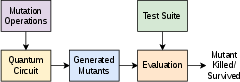
Figure 1: An overview of mutation testing applied to quantum circuits, showing model mutation and evaluation against a test suite.
Background and Limitations of Existing Mutation Testing
Standard Quantum Mutation Testing
Recent works leverage mutation testing in quantum circuit verification by intentionally inserting faults via basic gate-level mutations: addition, removal, replacement, and measurement modifications. While exhaustive, these approaches (e.g., Muskit [mendiluze2021muskit], QMutPy [fortunato2022mutation]) cannot efficiently scale with circuit complexity due to exponential mutant growth and a prevalence of redundant mutants—particularly acute in parameterized and structured circuits, as typical in QML. Moreover, they are agnostic to high-level architectural semantics such as feature maps and layer compositionality.
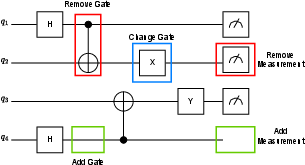
Figure 2: Canonical mutation operations illustrated: gate (add/remove/change), and measurement (add/remove). Typically, one mutation is performed per mutant.
QNN Circuit Structure
QNNs introduce an architectural hierarchy absent in generic quantum circuits, comprising feature mapping (classical-to-quantum embedding), an ansatz (learnable parameterized gates in layered blocks), and measurements. This nuanced structure requires mutation strategies sensitive to both data and architectural elements.
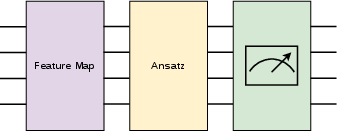
Figure 3: QNN architectures consist of feature mapping, parametric ansatz, and measurement, each serving distinct roles in QML pipelines.
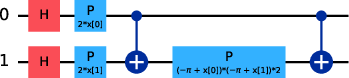
Figure 4: An example two-qubit ZZ feature map, illustrating how classical data is embedded via parameterized quantum gates.
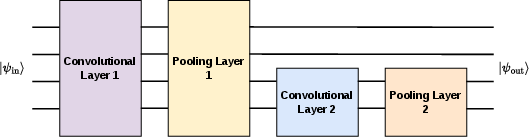
Figure 5: Schematic of a QCNN, demonstrating layered convolution and pooling over qubits, analogously to classical CNNs.
Proposed Mutation Framework
QNN-Specific Mutation Operators
The framework introduces seven QNN-specific mutation classes that expand beyond traditional gate-level faults:
- Ansatz Parameter Change (APC): Systematic perturbation of ansatz parameters (zeroing, sign flipping, phase shifts), directly targeting the learnable weights of parametrized rotations.
- Data Sample Feature Change (DFC): Mutates input data features, breaking embedding symmetries—especially relevant for feature map-driven circuits and models operating on high-dimensional inputs (e.g., images).
- Ansatz Parameterized Gate Change (APGC): Swaps a parameterized gate (RX, RY, RZ) with another of the same arity but with distinct action (bit- vs phase-rotation), preserving original parameter values.
- Layer Shuffling (LS): Permutes the sequential order of layers in the ansatz.
- In-Layer Shuffling (ILS): Rearranges gates within a single layer, modulating entanglement and feature extraction order.
- Ansatz Layer Addition (ALA): Inserts structurally coherent layers, with initialized or borrowed parameters, increasing model depth.
- Ansatz Layer Deletion (ALD): Removes whole layers or subcomponents (e.g., all parametrized or all entangling gates) from the ansatz.
Through directed selection guided by architectural analysis, these operations systematically cover the mutant space relevant to QNN generalization and decision boundary robustness while avoiding the combinatorial explosion of redundant, commutativity-induced mutants.
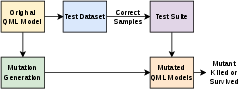
Figure 6: Workflow overview of the proposed framework—test suite construction, mutant generation, and survival assessment.
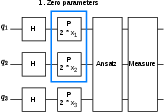
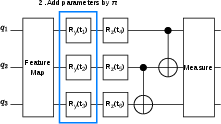
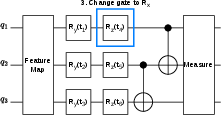
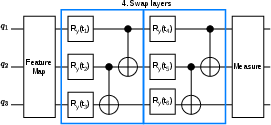
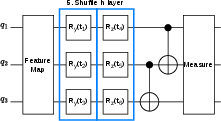
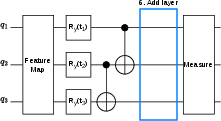
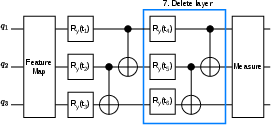
Figure 7: Visualization of an ansatz parameter change (APC) operation.
Experimental Results
Efficiency and Mutant Diversity
Evaluation across tabular (Iris, Wine, Wisconsin BC) and image (MNIST, FashionMNIST, KMNIST) datasets with a spectrum of QNN/ansatz architectures (RealAmplitudes, EfficientSU2, QCNN) demonstrates several key outcomes:
- Mutant Generation and Evaluation Time: By restricting attention to high-impact mutations, the framework achieves marked reductions in both generation and evaluation times (average per-mutant generation as low as 0.00025s; evaluation per mutant at 0.123–0.246s depending on dataset/architecture).
- Redundancy Elimination: The maximal number of mutants per configuration decreases by an order of magnitude (e.g., from >60,000 to <7,000 for BC with SU2 ansatz), without loss of fault coverage.
- Mutation Score Superiority: QNN models achieve consistently higher or competitive mutation scores (killed/total mutants), with new operators outperforming previous approaches even under matched test suites. Notably, APGC consistently scores near or at 100%, and QCNN architectures exhibit full test suite sensitivity for structural mutations.
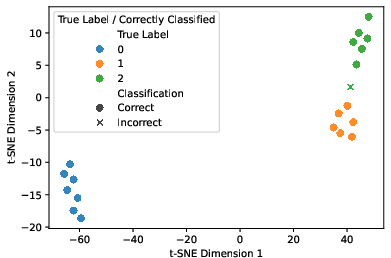
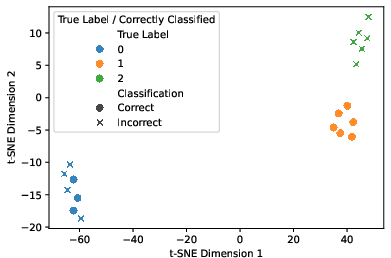
Figure 8: Example t-SNE visualization of test suite samples before and after application of APGC mutations, illustrating the impact on model decision boundaries.
Operator Efficacy and Coverage
- Architectural Operators (APGC, LS, ILS, ALA, ALD): Substantially more effective in revealing architecture-dependent faults, especially in highly structured models such as QCNN.
- Parametric/Data Operators (APC, DFC): Probe model robustness w.r.t. parameter perturbations and adversarial/noisy data, with mutation effectiveness depending on dataset and model sensitivity (e.g., classical tabular models vs. highly redundant image models).
The framework also facilitates robust cross-simulation, as all mutants are exportable via QASM and compatible with multiple quantum software stacks, broadening utility in heterogeneous testing environments.
Theoretical and Practical Implications
This work establishes that naive extrapolation of classical or generic quantum circuit mutation techniques is fundamentally inadequate for QML. The findings suggest that QNN testing demands architectural and data-aware mutation strategies both to adequately explore the behavioral fault space and to maintain computational tractability. The introduced operators directly probe QNN learning dynamics, decision boundary integrity, and generalization—areas where architectural redundancy and quantum-specific phenomena (e.g., entanglement, parameter shift symmetries) conspire to create hidden vulnerabilities.
For practitioners, the directed mutation framework offers efficient, automatable means of QML regression testing, robustness evaluation, and certification, especially vital for applications where quantum models are expected to operate under noisy, adversarial, or hardware-varying conditions.
Conclusion
The paper extends the state-of-the-art in quantum circuit testing by making QNN-oriented mutation both expressive and scalable. By formulating high-level, structure-targeted mutation operators and a redundancy-averse generation methodology, the framework achieves superior mutant diversity, higher detection rates, and substantial computational efficiency versus legacy quantum mutation approaches.
As QML circuits scale in width and depth—mirroring trends in deep classical models—efficient formal testing mechanisms as provided here will be integral not only for assessment but also for the co-design of robust quantum AI architectures, hardware-aware compilers, and verifiable deployment in safety-critical applications. Future research may extend these operators to variational quantum algorithms beyond NISQ devices, and to integration with quantum-aware data poisoning and adversarial robustness pipelines.

