- The paper presents a robust JWST analysis showing LHS 3844 b’s emission matches a dark, ultramafic (olivine-rich or basaltic) surface at ~1000 K.
- Researchers applied two independent data reduction pipelines to achieve a 39σ eclipse detection with minimal systematic errors.
- The study constrains atmospheric compositions by ruling out thick CO₂-, O₂-, or SO₂-dominated envelopes, favoring an airless rocky planet.
Surface and Atmospheric Characterization of LHS 3844 b with JWST Mid-Infrared Spectroscopy
Overview
The paper "The dark and featureless surface of rocky exoplanet LHS 3844 b from JWST mid-infrared spectroscopy" (2605.00100) presents a detailed analysis of the airless super-Earth LHS 3844 b, utilizing JWST MIRI/LRS thermal emission spectra in the 5–12 μm range. The study leverages the high signal-to-noise ratio of three JWST secondary eclipses combined with Spitzer and TESS data to robustly constrain the planet's surface and atmospheric properties, advancing exo-geology via direct dayside surface characterization.
Observational Strategy and Data Reduction
LHS 3844 b was observed during three JWST MIRI/LRS eclipses, each spanning 2.58 h and comprising 1887 integrations across 5.060–12.368 μm. Two independent pipelines (Eureka! SZ and ABA) processed the data blindly with respect to each other, demonstrating high consistency in derived spectra, minimizing reduction-based systematics. The pipeline decorrelated against instrumental and engineering mnemonics, achieving residual RMS within 3–7% above the photon noise limit.
The phase-folded white light curve revealed an eclipse depth of 696±18 ppm, yielding a 39σ detection (Figure 1).
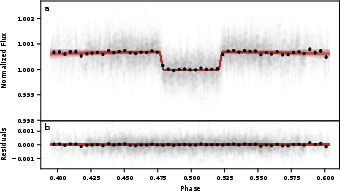
Figure 1: Phase-folded JWST MIRI/LRS white light curve showing a robust secondary eclipse detection and minimal residuals.
Joint fits with five TESS sectors established a refined ephemeris and eccentricity upper limit (e<0.017 at 2σ), supporting a circular orbit and maximizing the reliability of secondary eclipse interpretation. Spectroscopic light curves were binned into 12 segments, each 0.609 μm wide.
Surface Properties: Spectral Library Comparison
The planet's emission spectrum is consistent with a blackbody at 1000−14+15 K, with a brightness temperature ratio R=0.96−0.04+0.03 compared to the theoretical maximum, indicating a low Bond albedo (AB=0.14−0.14+0.13). The spectrum lacks notable features—especially the Si-O stretching band at 8–10 μm, which would be expected for high-silica surfaces.
Comparison to the newly published spectral library [Paragas2025] demonstrated strong agreement with slab-textured, low-SiO₂ surfaces—specifically olivine clinopyroxenite and mafic basalts (Figure 2). Granite, a high-SiO₂ and water-associated crustal type, was excluded at the 9σ level.
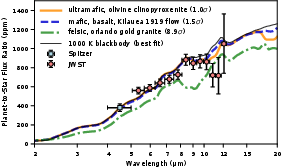
Figure 2: Measured planet-to-star flux ratio versus wavelength compared to slab surfaces; dark olivine clinopyroxenite and mafic basalt match, granite is excluded.
Texture analysis revealed that crushed and powdery surfaces are generally ruled out due to their higher reflectivity and cooler predicted dayside brightness, unless significant darkening occurs via space weathering, such as nanophase Fe or carbon addition (Figure 3).
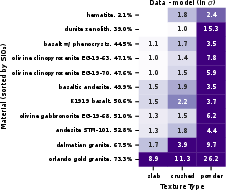
Figure 3: Surface composition and texture grid showing increasing model/observation disagreement with higher SiO₂ and powder texture.
These conclusions are further supported by fits to RELAB lab spectra, indicating olivine-dominated lunar basalts and fayalite can replicate the measured spectrum at <1σ discrepancy (Figure 4 in the paper).
Space Weathering and Regolith Effects
Space-weathering-induced darkening, via micron-scale Fe particles or carbon, can adjust powdered surface emission sufficiently to reconcile them with the spectral data. Quantitative modeling with 0.5–5% npFe brings basaltic powders into agreement (1.9σ with weathering vs 2.5σ fresh); even extreme weathering cannot mask granitic spectral features.
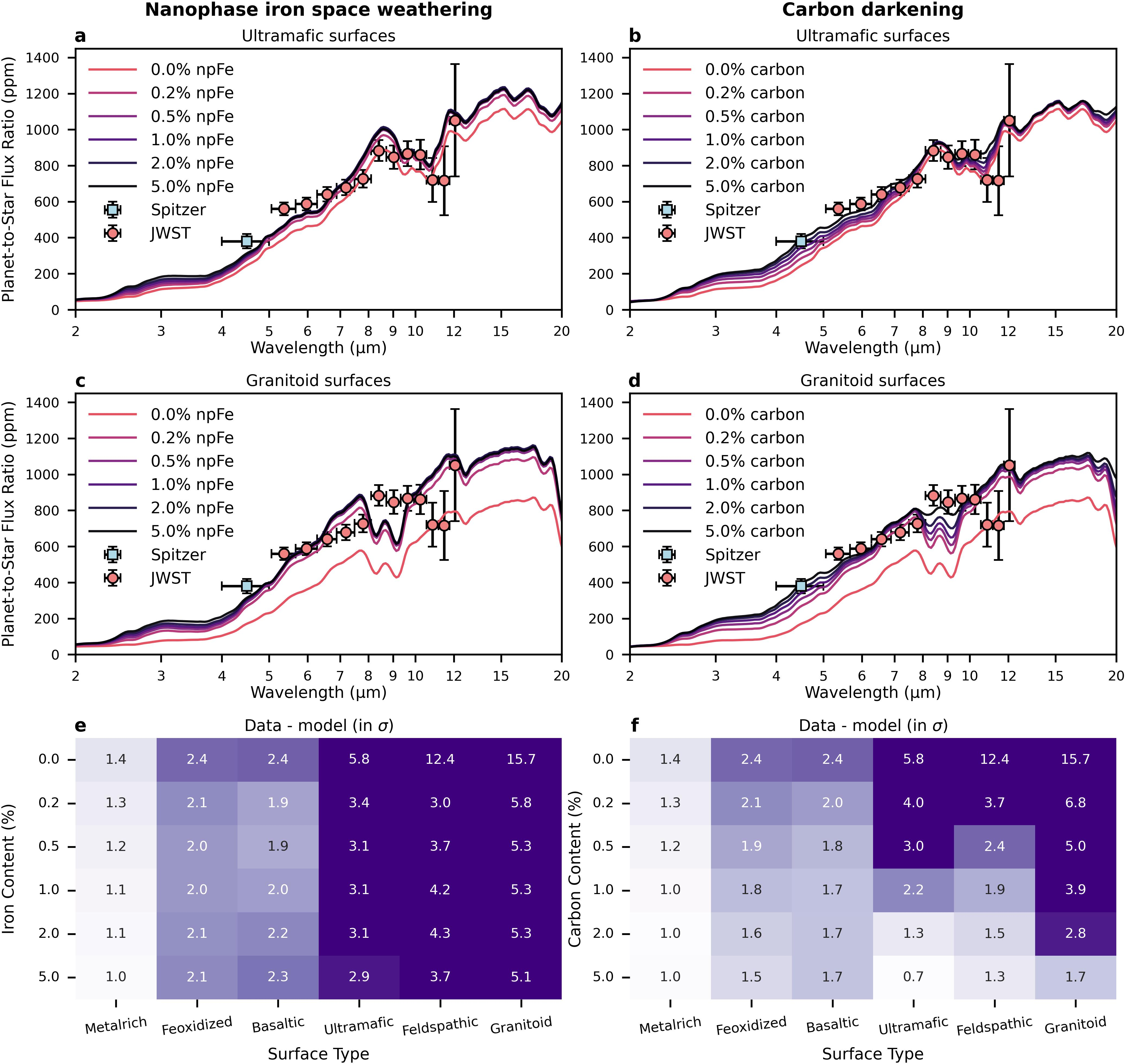
Figure 5: Impact of space weathering on ultramafic and granitoid powdered surfaces; only mafic/ultramafic compositions fit after darkening.
Weathering timescales (102–103 yr) for LHS 3844 b are rapid, given the short orbital period; regolith formation likely dominates surface texture evolution, analogous to lunar and Mercury surfaces.
Atmospheric Constraints and Volcanism
The analysis incorporates radiative-convective forward modeling [malik2017helios, Hu2013] to evaluate tenuous atmospheres, primarily CO₂/O₂/SO₂ compositions. The data exclude CO₂-dominated atmospheres with surface pressures ≥100 mbar (5σ), O₂-dominated atmospheres e<0.0170 bar (4σ), and SO₂ partial pressures e<0.0171 μbar (3σ).
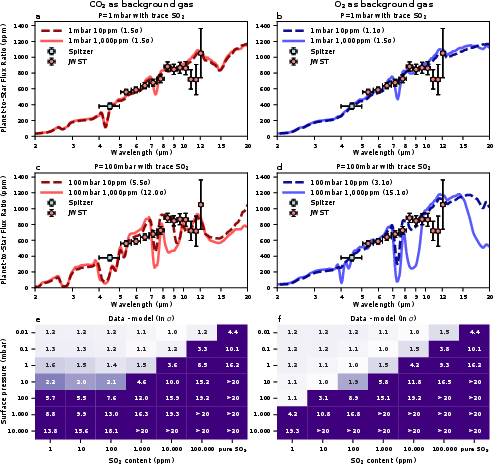
Figure 6: Comparison of observed spectrum to atmospheric models with varying background gas and SO₂; all scenarios with detectable volcanic gas are ruled out.
Venus-, Io-, and Earth-like SO₂ concentrations are robustly excluded, indicating no currently accumulated volcanic volatiles in the dayside atmosphere.
Geological Interpretation
The absence of high-SiO₂ spectral features and the darkness of the observed surface imply inefficient water-assisted crustal differentiation and no evidence for an Earth-like continental crust. The (ultra)mafic mineralogy and olivine-rich surface support mantle-driven, pyroxene and olivine crust formation, possibly aided by high Mg/Si ratios associated with older host stars. The darkness is compatible with both ancient space-weathered regolith and fresh basaltic lava flows; distinction between these requires future phase curve and texture-specific observations.
Stellar Model Calibration
Accurate planet-to-star flux extraction leverages JWST in-eclipse absolute stellar spectra for LHS 3844. Simulated stellar spectra (PHOENIX, SPHINX) systematically overestimate actual mid-IR flux; SPHINX achieves better calibration (3.5% high vs. 5.5% for PHOENIX), but correction remains vital for rock composition inference.
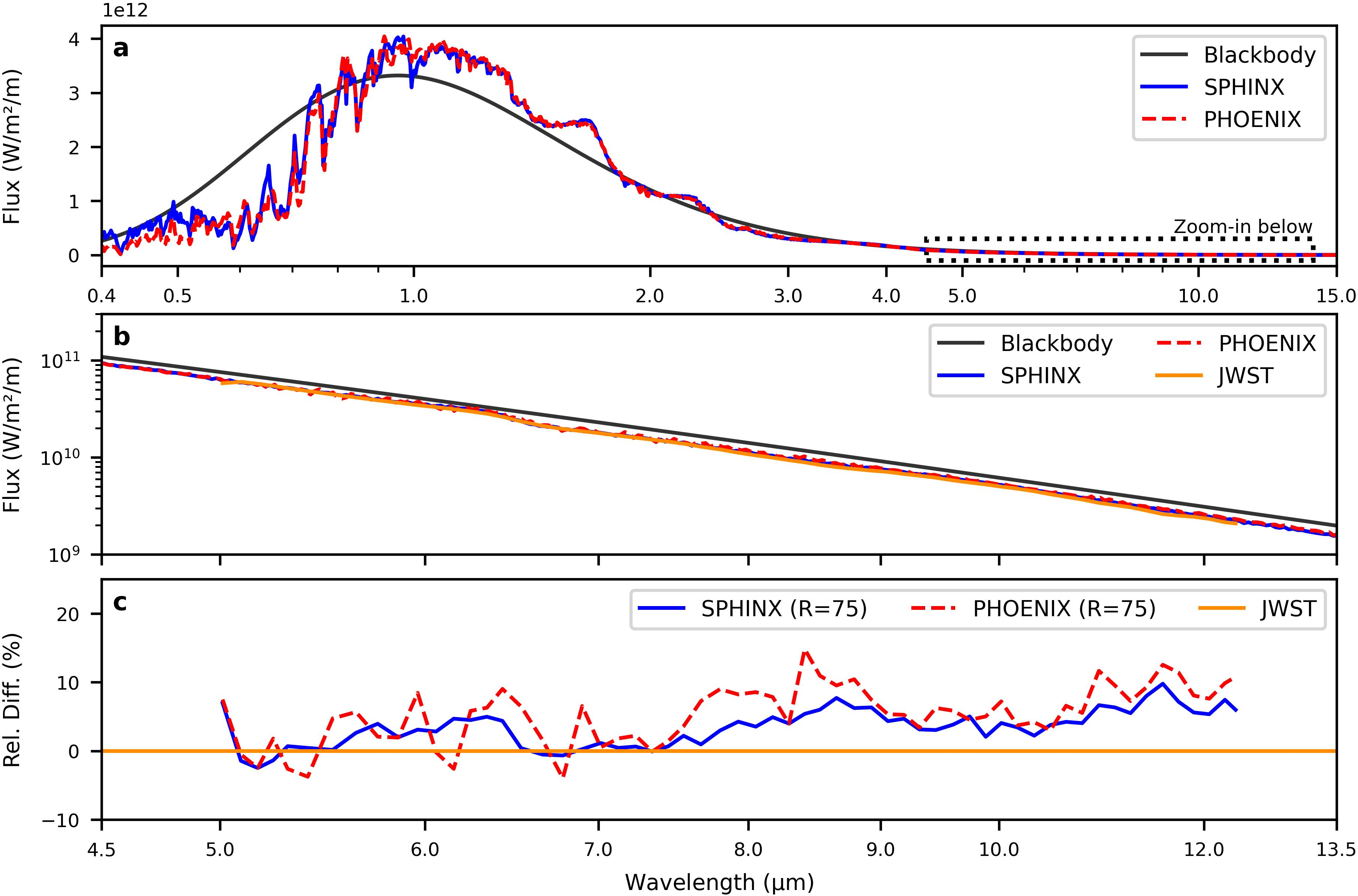
Figure 7: Comparison between observed JWST stellar spectrum and stellar atmospheric models; model bias is present at mid-IR.
Implications and Future Directions
Practically, the study demonstrates JWST's capability for exo-geological surface characterization from mid-IR emission spectra, establishes stringent atmospheric limits, and provides benchmarks for spectral libraries and stellar calibration. Theoretically, it constrains planetary crustal evolution outside the solar system, indicating limited water-driven differentiation and rapid regolith formation for close-in, airless rocky planets.
Upcoming JWST programs (GO 7953, GO 4008) will deliver higher SNR and texture-sensitive datasets, enabling discrimination between smooth lava and rough regolith textures and possible silicate features near 8–12 μm. These advances will further resolve the ambiguous origin—young volcanism vs ancient weathering—of LHS 3844 b's surface, guiding broader exoplanet geology investigations.
Conclusion
Mid-infrared JWST emission spectroscopy has provided decisive constraints on the surface composition and atmosphere of LHS 3844 b, identifying a dark, ultramafic (olivine-rich or basalt) surface and ruling out significant volcanic gas accumulation. The spectral data indicate an ancient, space-weathered regolith or a freshly surfaced dayside, both airless and low-albedo. These results refine exoplanet surface and geological evolution models, informing the design and interpretation of future observatories targeting M-dwarf terrestrial planets.

