On the Asymptotic Causal Structure in Gravitational EFTs
Published 30 Apr 2026 in hep-th | (2605.00089v1)
Abstract: It is usually assumed that a healthy EFT should not allow superluminal propagation. In the presence of gravity, however, the notion of superluminality becomes subtle, since there is no invariant way to compare with an underlying Minkowski light cone. One can instead resort to an asymptotic criterion: whether the EFT can induce signal propagation faster than what allowed by the asymptotic structure of spacetime. In this work we study the asymptotic causal structure of gravitational EFTs by analysing signal propagation in black-hole backgrounds in the presence of higher-derivative operators. We show that in spacetime dimensions D>4 the effective light cones can lead to genuine asymptotic superluminality, which can be used to constrain the regime of validity of the EFT. By contrast, in D=4 the asymptotic causal structure is universally identical to that of Schwarzschild: prompt null curves remain insensitive to higher-derivative corrections and no asymptotic time advance is possible. We first study the representative operator $R_{μνρσ}F{μν}F{ρσ}$, then show that this conclusion is true for any EFT, as it relies only on the asymptotic behaviour of the metric. Finally, we discuss two ways to define superluminality in D=4 spacetimes: introducing a covariant cut-off by putting the theory in an asymptotically-AdS background, or imposing a hard cut-off by working at finite distance.
The paper shows that in four dimensions, gravitational EFTs preserve the Schwarzschild causal structure, while in D>4, higher-derivative operators can induce genuine time advances.
It employs an asymptotic analysis of photon propagation in black hole backgrounds, highlighting polarization-dependent modifications of the effective light cones.
Results imply that causality constraints and EFT cut-offs depend critically on spacetime dimensionality, necessitating UV corrections in higher dimensions.
Asymptotic Causal Structure in Gravitational EFTs: Dimensional Analysis and Constraints
Introduction and Background
The paper "On the Asymptotic Causal Structure in Gravitational EFTs" (2605.00089) provides a systematic investigation of causality in gravitational effective field theories (EFTs), with particular focus on the distinction between four and higher spacetime dimensions. The canonical principle that healthy EFTs should not permit superluminal signal propagation is reexamined under the framework of dynamical gravity, where causal comparisons against a Minkowski reference light cone are gauge-dependent and lack general invariance. The main technical innovation is the adoption of an asymptotic criterion, using signal propagation in black hole backgrounds and analyzing corrections from higher-derivative operators, to probe whether EFT dynamics modify the underlying causal structure set by the spacetime itself.
Effective Metrics and Signal Propagation
The authors analyze a representative higher-derivative operator, αRμνρσFμνFρσ, which modifies the photon propagation metric in stationary black hole backgrounds. This leads to polarisation-dependent changes to the effective light cones governing high-frequency wave packet propagation. The EFT action governing dynamics is:
S=∫dDx−g[2MP2R−41FμνFμν+αRμνρσFμνFρσ],
where the α parameter controls the scale below which new physics becomes important (α), and determines the UV cut-off (Λ<1/α).
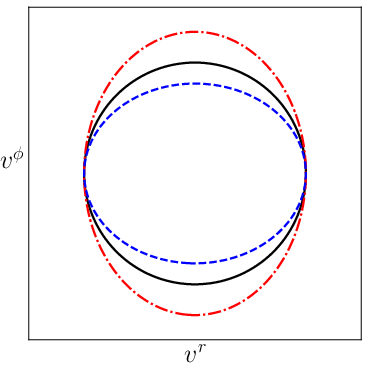
The analysis reveals that photons subject to this operator do not necessarily follow null geodesics of the background Schwarzschild metric. Instead, the effective metrics governing their propagation are determined by angular functions cS(r) and cV(r), leading to a hierarchy of light cones depending on polarisation and the sign of α.
Figure 1: A cross-section of nested light cones for black holes in D=4, showing the effective metric for different photon polarizations as described by αRμνρσFμνFρσ.
Phenomenology: Large vs. Small Black Holes
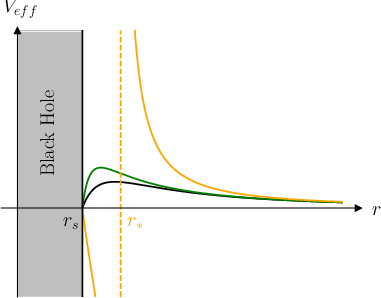
For large black holes (S=∫dDx−g[2MP2R−41FμνFμν+αRμνρσFμνFρσ],0), the effective potential experienced by photons retains the Schwarzschild-like shape, meaning photon scattering and absorption remain qualitatively similar to GR. However, for small black holes (S=∫dDx−g[2MP2R−41FμνFμν+αRμνρσFμνFρσ],1), the effective metric develops a potential barrier at radius S=∫dDx−g[2MP2R−41FμνFμν+αRμνρσFμνFρσ],2, implying repulsive dynamics and a breakdown of hyperbolicity below S=∫dDx−g[2MP2R−41FμνFμν+αRμνρσFμνFρσ],3. This breakdown signals the need for additional UV corrections and is an indicator for the EFT's validity regime.
Figure 2: Effective potentials for S=∫dDx−g[2MP2R−41FμνFμν+αRμνρσFμνFρσ],4; small black holes exhibit an infinite barrier at S=∫dDx−g[2MP2R−41FμνFμν+αRμνρσFμνFρσ],5, highlighting the influence of the S=∫dDx−g[2MP2R−41FμνFμν+αRμνρσFμνFρσ],6 operator.
Null Geodesics and Asymptotic Causality
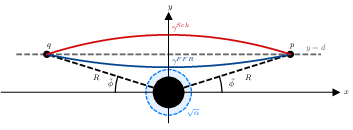
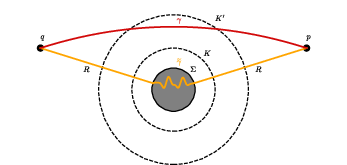
The authors demonstrate the existence of two distinct types of null geodesics in the presence of the S=∫dDx−g[2MP2R−41FμνFμν+αRμνρσFμνFρσ],7 operator: the Schwarzschild-like geodesic (which increases its distance of closest approach as endpoints recede) and an S=∫dDx−g[2MP2R−41FμνFμν+αRμνρσFμνFρσ],8-dominated geodesic which maintains proximity to the scale S=∫dDx−g[2MP2R−41FμνFμν+αRμνρσFμνFρσ],9.
Figure 3: Two possible null geodesics connecting spatial points at infinity for small black holes, illustrating the distinction between Schwarzschild and α0-dominated trajectories.
A careful time-of-flight analysis quantifies the difference between these geodesics and general null curves. The key finding is that in α1, non-geodesic prompt null curves can be faster than both classes of geodesics, yielding genuine time advances and violating the asymptotic causal structure determined by the background metric. These time advances are robust and allow for the application of causality constraints on the EFT cut-off.
Four-Dimensional Case: IR Divergence and Universality
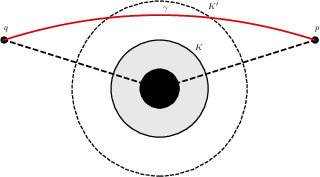
In sharp contrast, for α2, the prompt causal curves (those connecting spatial points with minimum coordinate time) are always the Schwarzschild-like null geodesics, regardless of the inclusion and form of higher-derivative operators. This conclusion is formalized via an extension of the Gao-Wald theorem, which asserts that the asymptotic causal structure is universally identical to that of GR for any stationary, asymptotically-Schwarzschild four-dimensional spacetime.
Figure 4: Illustration of the Gao-Wald theorem for the Schwarzschild spacetime, emphasizing prompt curves avoiding the near-horizon region.
The physical origin of this behavior is the logarithmic infrared divergence in the α3 gravitational delay, which grows without bound as the spatial endpoints recede. As a result, null geodesics always remain far from the region where higher-derivative corrections are localized, precluding asymptotic time advances and ensuring the causal structure remains as in GR.
Figure 5: The proof setup for the extended Gao-Wald theorem, showing causal curves circumnavigating compact regions for asymptotically distant endpoints.
IR Regulation and Alternative Causality Criteria
To address the obstruction caused by the IR divergence in four dimensions, the paper examines covariant IR regulators such as asymptotically-AdS backgrounds, where the AdS radius α4 provides a natural cutoff. In these settings, the causal structure can be rendered finite, and meaningful causality constraints can, in principle, be imposed. However, the flat-space limit (α5) reintroduces the divergence, compromising the universality of such bounds.
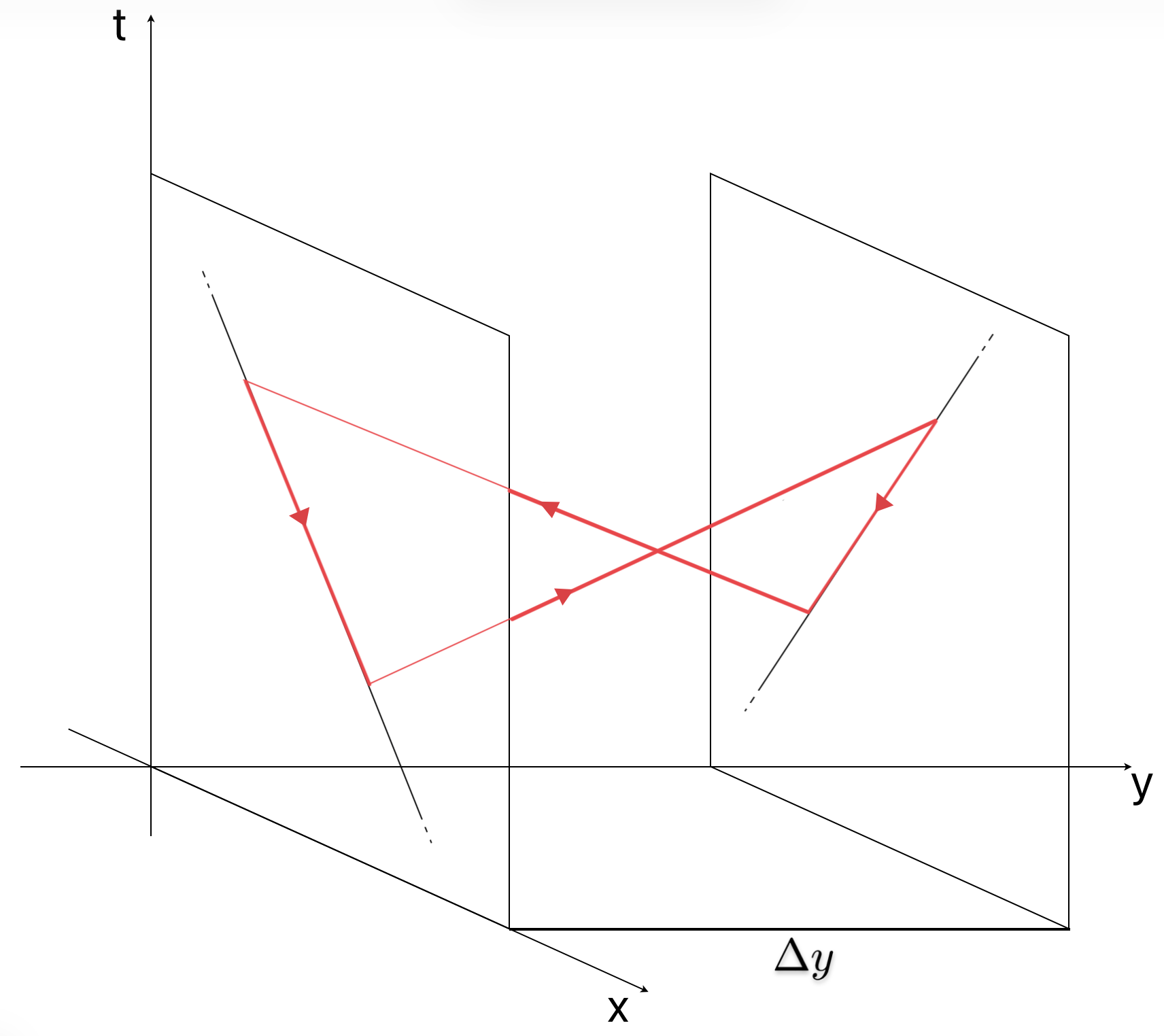
Finite-distance analyses are also considered, but are susceptible to coordinate ambiguities. The relation to closed timelike curves (CTCs) is scrutinized, and it is shown that exponentially large boosts needed to reverse time ordering expand the gravitational field in the transverse direction, obstructing CTC formation in α6.
Figure 6: Schematic superposition of two boosted solutions to construct a closed timelike curve, illustrating the physical obstruction in α7.
Implications and Future Directions
The dichotomy between α8 and α9 is robust and has significant implications for the formulation of causality constraints in gravitational EFTs:
In α0: Genuine asymptotic superluminality is possible, providing sharp constraints on the EFT cut-off, requiring α1.
In α2: Asymptotic causal structure is unaffected by any irrelevant operators, and constraint mechanisms must instead rely on local hyperbolicity breakdowns.
The analysis bridges propagation-based and S-matrix-based causality frameworks, noting that the IR divergence in α3 has a parallel in the gravitational α4-channel pole in S-matrix positivity bounds. The paper also discusses the utility of alternative constructs such as stripped amplitudes and the prospects for extending the geometric approach to asymptotically de Sitter backgrounds.
Conclusion
This work rigorously delineates the conditions under which causality constraints derived from signal propagation in gravitational EFTs are meaningful. It establishes the universality of the Schwarzschild causal structure for four-dimensional stationary spacetimes, while demonstrating the possibility of asymptotic superluminality and corresponding stronger bounds in higher dimensions. The theoretical insights and formal theorems presented clarify the interplay between local and global causal properties, the role of dimensionality, and the limitations intrinsic to regulating IR divergences. Future directions include extending the geometric analysis to more general backgrounds and exploring connections to S-matrix positivity in regulated spacetimes.
“Emergent Mind helps me see which AI papers have caught fire online.”
Philip
Creator, AI Explained on YouTube
Sign up for free to explore the frontiers of research
Discover trending papers, chat with arXiv, and track the latest research shaping the future of science and technology.Discover trending papers, chat with arXiv, and more.