- The paper presents a novel SI-QKD protocol that eliminates source trust requirements and achieves composable security against all known source-side attacks.
- It employs high-purity non-classical photon sources and polarization encoding with independent, randomized basis measurements to detect and mitigate vulnerabilities.
- Performance simulations demonstrate secure key rates surpassing single-photon BB84, maintaining robustness up to 400 km fiber transmission, highlighting practical feasibility.
Source-Independent Quantum Key Distribution Without Pre-Sending Entanglement
Background and Motivation
Quantum key distribution (QKD) enables information-theoretic security grounded in quantum mechanics. While advances in prepare-and-measure schemes and decoy-state protocols have enabled QKD over practical distances, device vulnerabilities that deviate from idealized theoretical models introduce critical security loopholes. Device-independent QKD provides maximal security by removing assumptions about sources and detectors but imposes prohibitive requirements for channel loss and hardware. Measurement-device-independent (MDI) QKD protocols, notably, remove all detector-side assumptions, leaving source-side vulnerabilities, as summarized by numerous attacks exploiting source imperfections (e.g., photon-number splitting, Trojan-horse, wavelength-dependent, and hidden multidimensional side channels). This has motivated the quest for QKD protocols that are independent of source trustworthiness.
SI-QKD Protocol: Architecture and Operation
The work introduces a source-independent QKD (SI-QKD) protocol that achieves security against all known and unknown source-side attacks without relying on pre-distributed entangled states. The central innovation is leveraging high-purity non-classical single-photon sources (e.g., quantum emitters or Schrödinger cat states) within a polarization encoding framework, and modeling source generation/distribution as a fully untrusted process.
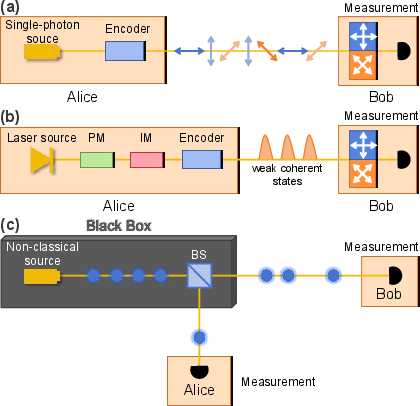
Figure 1: The protocol comparison: SI-QKD treats the source as a black box, trusting only Alice and Bob's local measurements.
The protocol proceeds as follows:
- State Preparation and Distribution: An untrusted third party ("Charlie") uses two independent non-classical sources with low g(2)(0), emitting synchronized ∣+⟩-polarized single-photon pulses. Alternatively, a single source with an active optical switch can be used for temporal pulse routing.
- Measurement: Alice and Bob independently measure received signals in randomly chosen {Z,X} polarization bases, recording all detection events.
- Sifting: Basis reconciliation is performed, retaining only events with matched bases.
- Parameter Estimation: The Z-basis events form the raw key, while X-basis outcomes enable estimation of the phase error rate.
- Key Extraction: Applying error correction and privacy amplification yields the final secret key, with composable security against general attacks ensured via the entropy uncertainty relation.
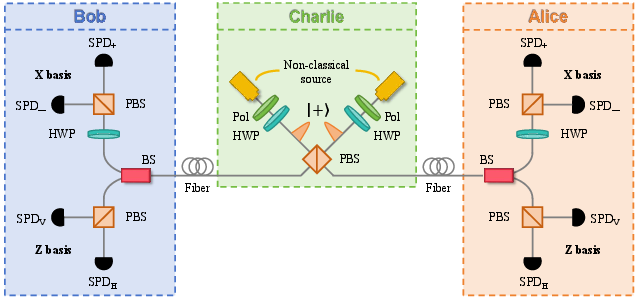
Figure 2: Polarization-based SI-QKD scheme with interference at a PBS and randomized local basis choices.
Notably, unlike conventional protocols, quantum correlations between Alice and Bob are generated without pre-shared entanglement. Non-classicality of the source is essential, as WCS-based or classical states result in separable outputs incapable of supporting SI security.
Security Proof and Theoretical Foundation
The security of SI-QKD is derived under the assumption that the source is fully untrusted and potentially adversarial. The proof leverages the entropy uncertainty relation between complementary bases, providing finite-size composable security without any assumption on state preparation. Crucially, the protocol's security is independent of the dimension or specific structure of source side channels, encompassing both known and unknown vulnerabilities.
For the polarization architecture, security is established by independent, well-characterized measurements in mutually unbiased bases. The secret key length in the finite regime is given by
ℓ=nz[1−h(ϕz)]−λEC−log2εcor2−2log2εsec1
where nz is the number of sifted Z-basis events, ϕz is the Z-basis phase error rate, and λEC is the error correction cost. This framework guarantees that any attempt to exploit the source to leak information is detectable via the complementary basis statistics.
Rigorous simulations are provided that benchmark SI-QKD against the single-photon BB84 protocol and the WCS-based decoy-state BB84 under physically realistic parameters, including finite key sizes, detector specifications, and source imperfections.
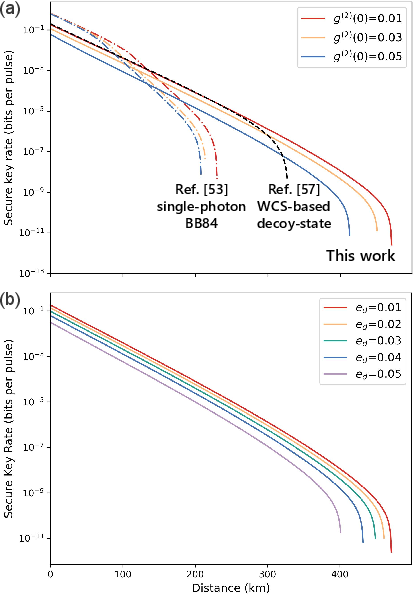
Figure 3: (a) Finite-key SKR for SI-QKD (solid), single-photon BB84 (dash-dotted), and WCS-decoy BB84 (dashed); (b) SKR vs. misalignment error rate.
The protocol achieves secure key rates exceeding single-photon BB84 beyond 140 km, and secure key generation up to 400 km fiber transmission. Superior performance is traced to noise suppression in the coincidence measurement architecture and enhanced signal-to-noise ratio. SI-QKD outperforms notable prepare-and-measure QKD approaches by doubling the secure transmission distance compared with single-photon BB84, and surpasses WCS-based protocols even under misalignment or increased ∣+⟩0. The protocol demonstrates high tolerance to hardware noise and source imperfections, maintaining security at ~400 km even with ∣+⟩1.
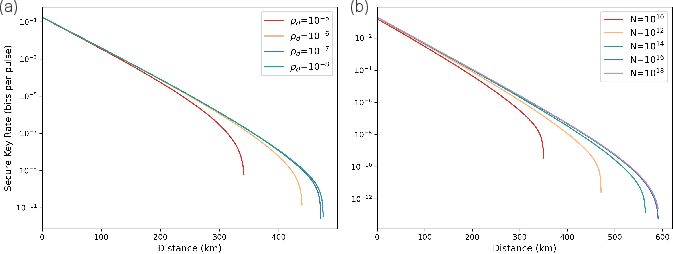
Figure 5: Secret key rate dependency on detector dark counts and data size; high performance is retained across practical hardware scenarios and transmission distances.
Experimental feasibility is discussed comprehensively. High indistinguishability and brightness in quantum-dot or cat-state sources, efficient Sagnac-based optical switching, and dynamic polarization stabilization are available with current or near-term technology for realizing the full protocol stack at GHz repetition rates.
Implications and Future Directions
The SI-QKD protocol achieves composable security against source-side attacks without pre-distributed entanglement. Numerically, it demonstrates both superiority over prepare-and-measure and decoy-state protocols in transmission range and robustness to implementation imperfections. By elevating non-classical quantum sources to a pivotal cryptographic resource, this work reframes the practical trade-offs between source performance and system security. The elimination of source trust enables direct integration into heterogenous quantum networks with minimal extra resource assumptions.
Potential future developments include:
- Hybridization with other quantum networking primitives (e.g., repeater architectures, multipartite SI conference or secret sharing) to further boost efficiency and scalability.
- Exploring avenues for SI-QKD protocols capable of surpassing repeaterless bounds.
- Tailoring SI-QKD to chip-integrated quantum photonic platforms for scalable network deployment.
Conclusion
The SI-QKD protocol presents a significant advancement in practical quantum cryptography, offering source-independent security guaranteed by fundamental quantum principles and readily implementable with established photonic technologies. The protocol's robust numerical performance underlines its practical viability for secure, long-distance key distribution in realistic scenarios. SI-QKD establishes a new, stringent security standard and paves the way for future quantum information infrastructure based on non-classical sources.

