- The paper reveals that current DeepFake detectors fail to recognize semantically mismatched but artifact-free audio-video pairs, resulting in significant accuracy and F1 drops.
- The paper proposes a five-class detection framework incorporating a new RARV-SMM category with systematically generated variants (V1, V2, V3) to capture semantic divergences.
- The paper demonstrates that integrating semantic reinforcement via a frozen ImageBind model significantly improves AUC and accuracy across multiple architectures.
Semantic Mismatch: A Novel Challenge for Audio-Visual DeepFake Detection
Introduction
The audio-visual DeepFake detection landscape has historically focused on distinguishing between manipulated and authentic data at the signal level, using either binary or four-class frameworks. While recent progress enables systems to detect manipulations in audio, video, or both streams, these methods make a limiting assumption: that all "real audio -- real video" (RARV) pairs are semantically consistent. The work "Are DeepFakes Realistic Enough? Exploring Semantic Mismatch as a Novel Challenge" (2604.28022) systematically interrogates this assumption, introducing a fifth class—Real Audio–Real Video with Semantic Mismatch (RARV-SMM)—representing authentic audio and video from diverging semantic contexts. The paper critically demonstrates that current state-of-the-art solutions fail to robustly identify such manipulations and introduces methodology and architectural modifications required for detecting these highly plausible DeepFakes.
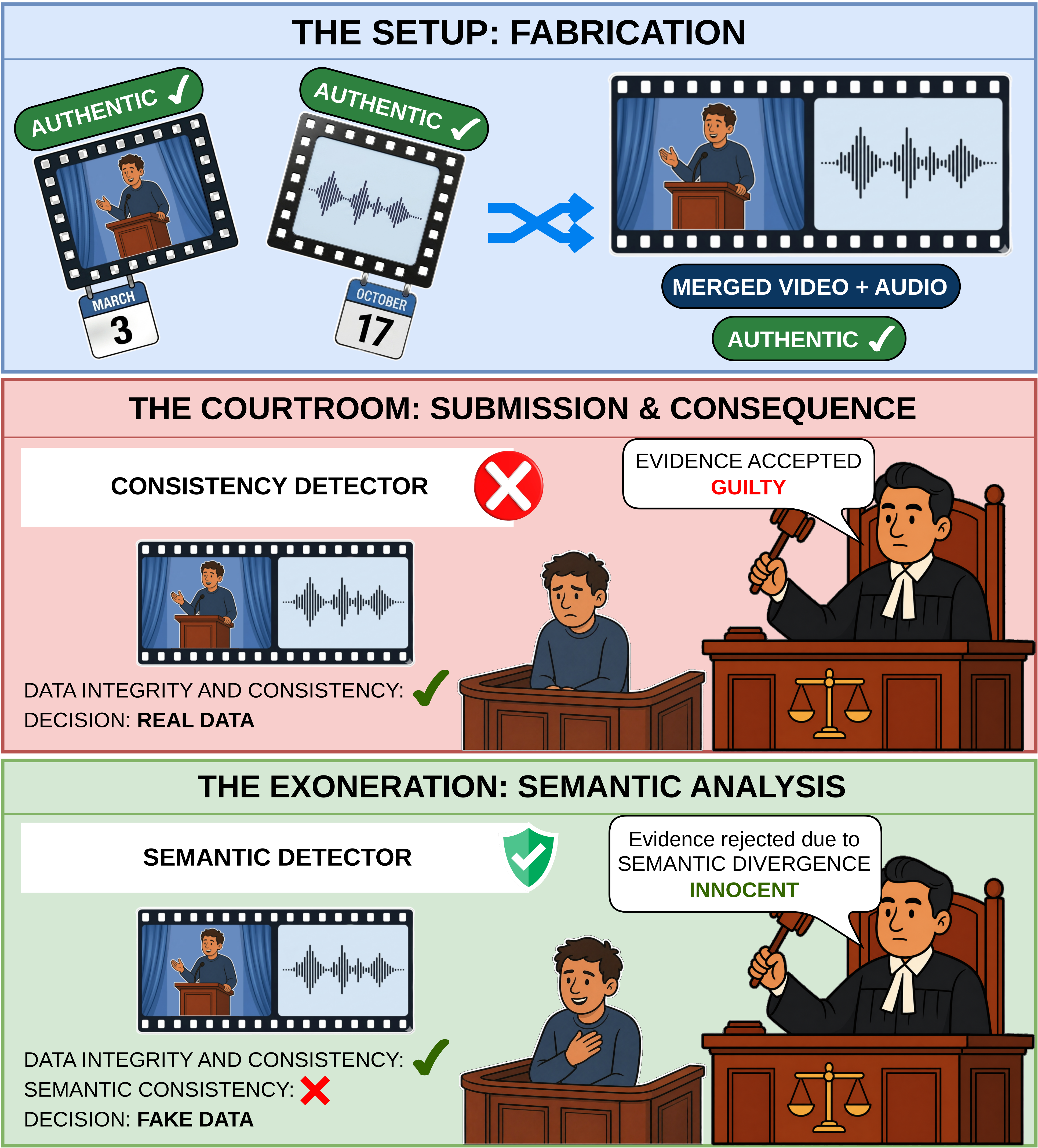
Figure 1: Illustration of a DeepFake detector that passes a semantically inconsistent but artifact-free audio-video composition as authentic, motivating the semantic mismatch challenge.
The paper expands the standard four-class DeepFake detection paradigm by constructing a more forensic-robust five-class system. In addition to RARV, RAFV, FARV, and FAFV, the RARV-SMM class is introduced. This new class explicitly models legitimate audio and video pairs that, while artifact-free in both modalities, are semantically incongruent (e.g., real speech from one event combined with real footage from another). The absence of synthesis artifacts in such samples renders all signal-level artifact detectors ineffective, as highlighted in the motivating scenario.
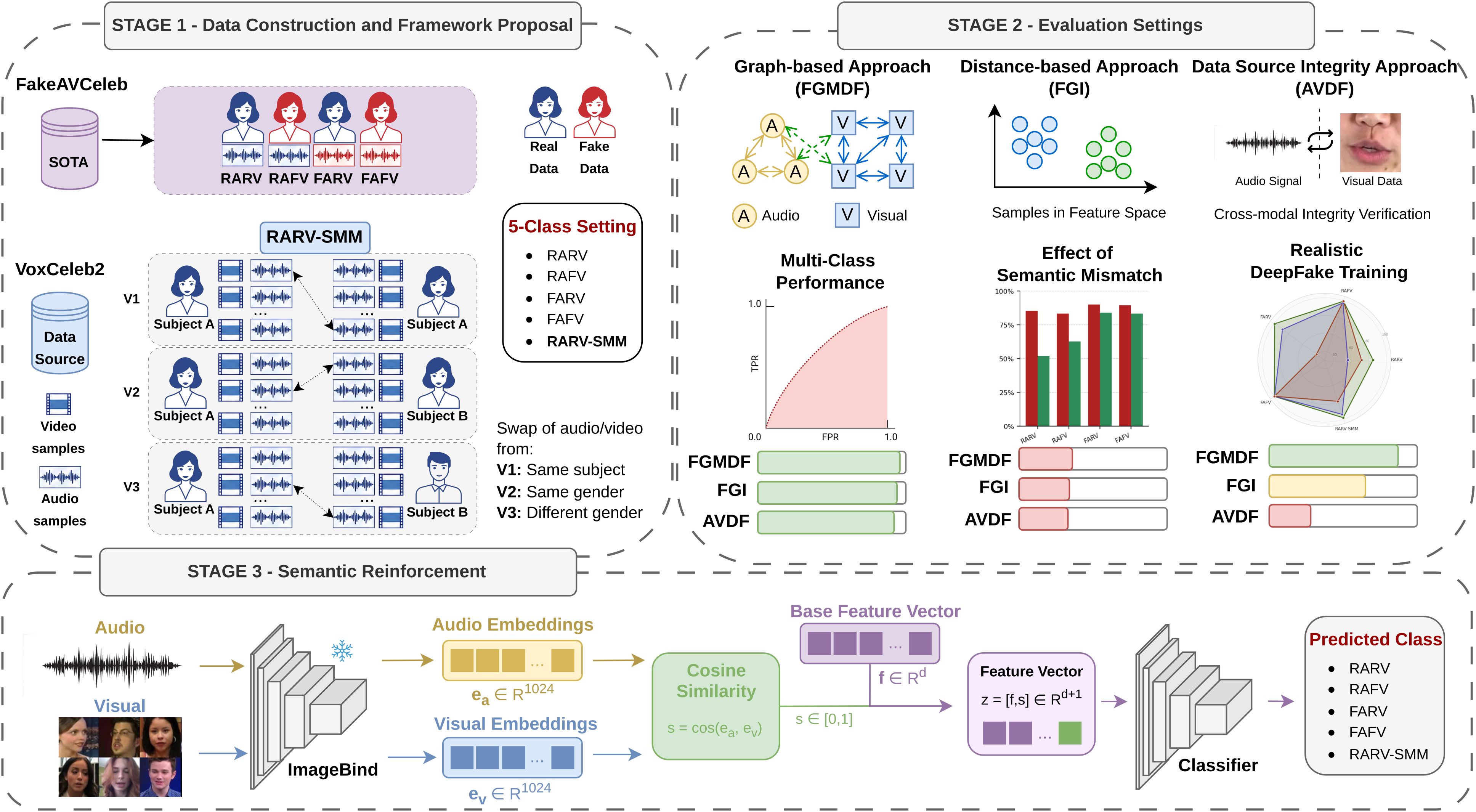
Figure 2: Schematic of the five-class detection framework, dataset creation, model architectures tested, and semantic reinforcement pipeline.
The RARV-SMM class is constructed using VoxCeleb2, yielding samples with three granular mismatch variants:
- V1: Same identity, different contexts.
- V2: Different identities, same gender.
- V3: Different identities, different gender.
This stratification tests model sensitivity to increasing semantic divergence.
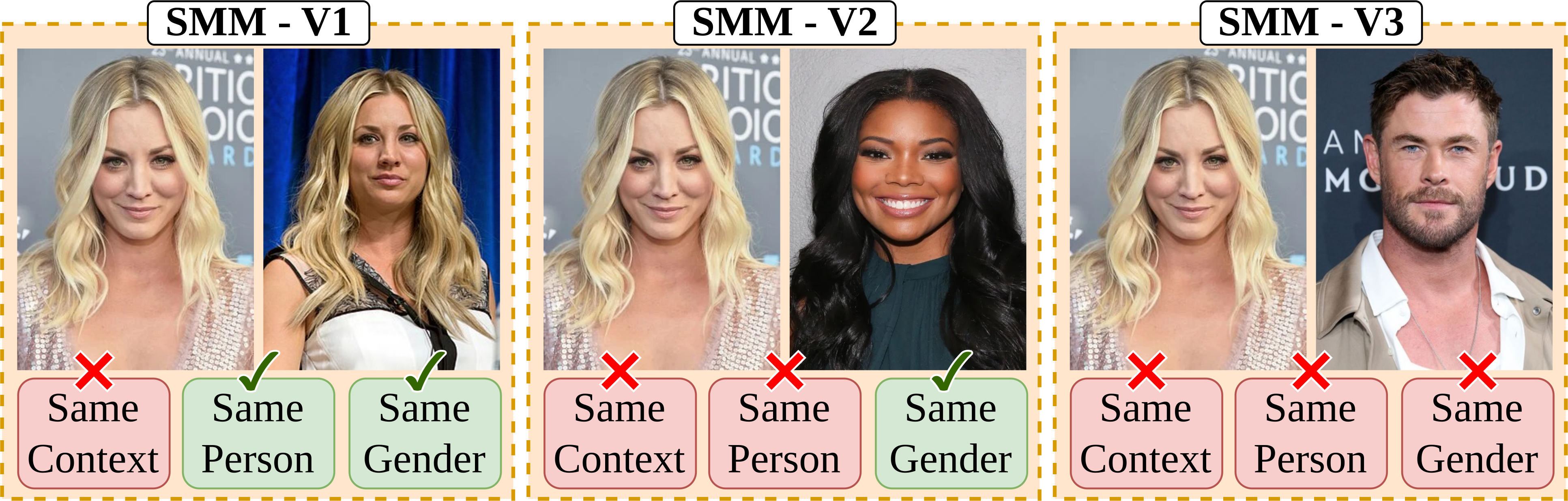
Figure 3: Visualization of RARV-SMM variants, systematically increasing semantic incongruence from context to identity and gender.
Experimental Protocol and Baseline Models
Three representative state-of-the-art architectures are rigorously evaluated:
- FGMDF: Heterogeneous graph-based cross-modal reasoning.
- FGI: Distance-based measurement of audio-visual feature discordance.
- AVDF: AV-HuBERT-based detection grounded in lip-sync and integrity cues.
These are contrasted in four-class (standard) and five-class (proposed) training/evaluation regimens on FakeAVCeleb. The RARV-SMM samples are strictly constructed so that both streams remain authentic and aligned in duration, but with semantic mismatch.
Empirical Findings
Impact of Introducing Semantic Mismatch
Including the RARV-SMM class exposes a previously latent vulnerability in DeepFake detectors—dramatic accuracy and per-class F1 drops were observed, especially for RARV, when models were tested on semantic mismatch samples without explicit training for the fifth class. For FGMDF, almost the entire degradation is concentrated in the RARV class due to reliance on data source integrity. For FGI and AVDF, confusion is observed between RARV and RAFV due to the models’ partial sensitivity to origin and content relationships.
Training with the five-class supervision enables FGMDF and FGI to recover discriminative power, with FGMDF achieving near-perfect detection of RARV-SMM, given its cross-modal graph-based reasoning architecture. In contrast, AVDF—reliant on lip-sync and artifact-level features—remains fundamentally incapable of semantic-level discrimination.
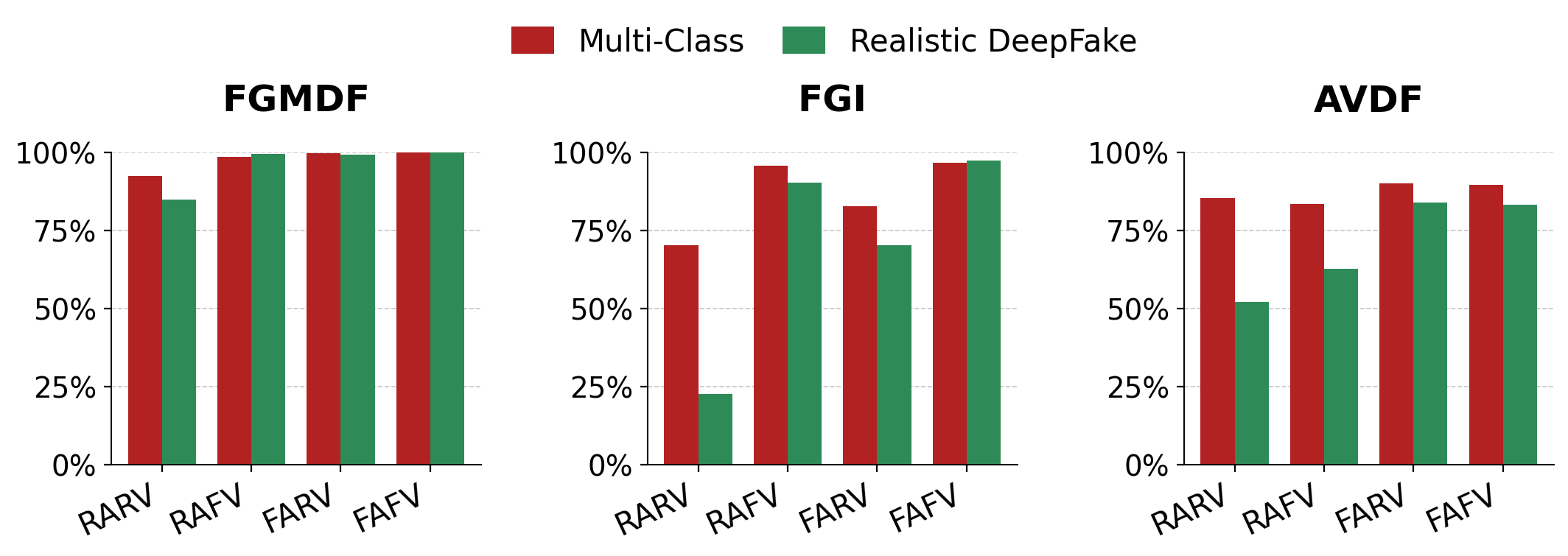
Figure 4: Per-class F1 degradation when transitioning from four-class to five-class evaluations, highlighting semantic mismatch as a critical vulnerability.
Analysis of Semantic Mismatch Variants
Assessment across V1, V2, and V3 variants reveals that as semantic divergence increases (especially with differing gender), models’ discriminative ability for RARV-SMM diminishes, with misclassifications increasingly spread over classes corresponding to fake audio or fake video. For FGMDF, confusion migrates towards FARV with maximally divergent identities; for FGI, pronounced separation for RARV-SMM emerges only when the mismatch is clear and substantial.
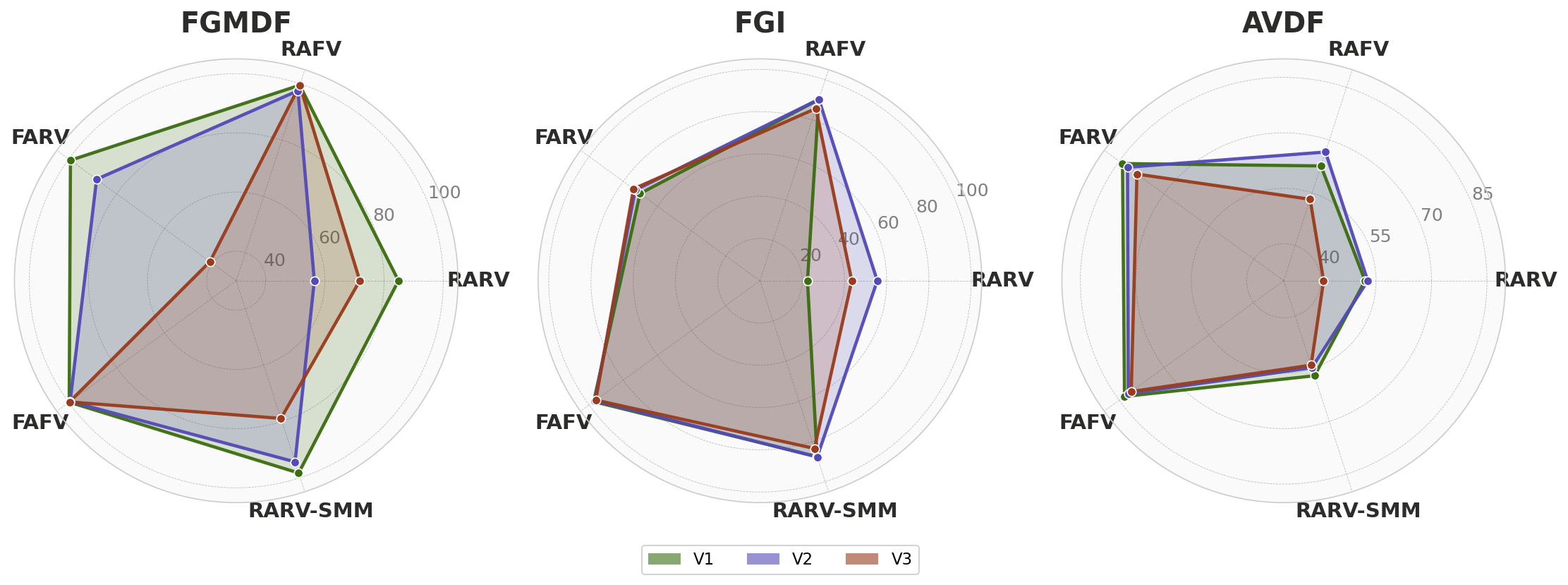
Figure 5: Per-class F1 performance across RARV-SMM variants for each model, illustrating shifting classifier confusion boundaries as semantic divergence increases.
Semantic Reinforcement: ImageBind Integration
To address semantic-level incongruence, the paper introduces a model-agnostic semantic reinforcement strategy. A frozen ImageBind model computes the cosine similarity between audio and video embeddings; this score is appended to the output of any model's fusion module before final classification. The addition consistently improves AUC and accuracy across architectures, especially for AVDF, whose previously rigid detection boundaries limited by signal-level features are significantly relaxed by explicit semantic cues.
Comparative Evaluation and Implications
Beyond forensic interpretability, the five-class approach with semantic reinforcement provides direct performance uplifts over leading multimodal DeepFake detectors on both FakeAVCeleb and LAV-DF. Notably, inclusion of semantically mismatched samples during training leads to better generalization, even on standard benchmarks, indicating that models exposed to a richer class structure develop more robust representations sensitive to both signal-level and content-level manipulations.
Theoretical and Practical Implications
The results convincingly demonstrate that current audio-visual DeepFake detectors can be subverted in artifact-free, highly plausible forgery scenarios unless explicit semantic analysis is integrated. Practically, this underscores the need to augment deployed systems (e.g., biometric security, evidentiary video authentication) with modules capable of reasoning over semantic, narrative, and event-level integrity, beyond traditional artifact or synchronization analysis. Theoretically, this work identifies a new axis—semantic consistency—on which multimodal forensics research must progress, and positions explicit representation of cross-modal narrative coherence as an essential future direction.
Conclusion
The study systematically exposes an unaddressed failure mode in state-of-the-art DeepFake detectors and delivers a rigorous methodology—five-class detection with semantic mismatch reinforcement—that outperforms extant solutions on the semantic axis. The integration of semantic similarity metrics (e.g., via ImageBind) demonstrably complements structural and statistical architectures, especially where traditional methods plateau. Future investigations should focus on generalizing semantic mismatch detection to broader domains and constructing architectures where narrative-level semantic reasoning is an intrinsic capability.
This work aligns audio-visual forensics research with the new realities of DeepFake generation and manipulation, compelling a paradigm shift toward models that reason not only about what is seen and heard, but also about what makes sense semantically.