- The paper demonstrates a parametrically driven iSWAP gate that achieves 99.92% fidelity by suppressing residual ZZ interactions using a capacitively shunted double-transmon coupler.
- The study employs a second-harmonic AC flux drive with a smooth tanh-profile envelope and full multi-mode Hamiltonian simulations for accurate gate characterization.
- The findings reveal reduced calibration overhead and minimal leakage, highlighting the potential for scalable, high-coherence operations in fixed-frequency superconducting circuits.
Parametrically Driven iSWAP Gate Using a Capacitively Shunted Double-Transmon Coupler at the Zero-Flux Sweet Spot
Introduction and Motivation
Two-qubit entangling gates with high fidelity and speed underlie fault-tolerant quantum computation using superconducting circuits. Fixed-frequency transmon architectures benefit from improved noise resilience, but efficient tunable coupling is mandatory to overcome the limitations posed by residual ZZ interactions and decoherence during gate operations. The capacitively shunted double-transmon coupler (CSDTC) advances the double-transmon coupler (DTC) framework by achieving effective suppression of static ZZ interactions over a broad flux range centered at zero flux bias. This work introduces the first experimental realization of a parametrically driven iSWAP gate at the CSDTC's zero-flux sweet spot, addressing long-standing challenges in gate calibration overhead and decoherence associated with large flux excursions.
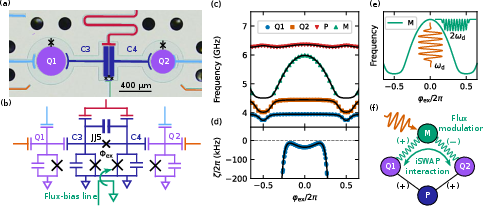
Figure 1: Device and operating principle of the parametrically driven iSWAP gate at the zero-flux sweet spot.
Device Architecture and Operating Principle
The device comprises two widely detuned, fixed-frequency transmon qubits (Q1 and Q2) coupled via a CSDTC. The coupler's internal P and M modes are hybridizations of two transmons, engineered for strong tunability of the M-mode's frequency with flux, while the P-mode remains relatively static. The CSDTC's architecture ensures that the residual ZZ interaction is minimized and remains nearly flat over a significant flux interval around zero, efficiently suppressing coherent ZZ errors both at idle and during gate operations.
Parametric activation of the iSWAP is achieved by applying a resonant AC flux drive at half the qubit–qubit detuning to the coupler loop. The quadratic flux dependence of the M-mode frequency enables second-harmonic modulation, which mediates an exchange between the ∣01⟩ and ∣10⟩ states. This approach confines the quantum state evolution to the computational subspace and eliminates the need for static flux offsets, unlike first-order parametric protocols.
iSWAP Gate Characterization
Gate Calibration, Dynamics, and Benchmarking
The iSWAP gate is implemented with a smooth, tanh-profile envelope modulating the sinusoidal AC flux. The total gate time, including 12ns of idling, is 112ns. The simple analytical waveform employed obviates the requirement for predistortion corrections, drastically simplifying calibration. Phase errors induced by ac Zeeman shifts and exchange-axis misalignment are compensated by systematic frame tracking—virtual-Z rotations and phase updates for both qubit and coupler control oscillators.
Direct characterization of the iSWAP interaction demonstrates expected chevron patterns in population transfer as a function of flux modulation amplitude and frequency.
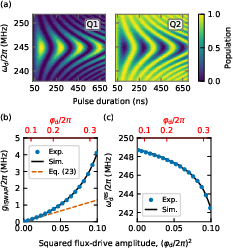
Figure 2: Characterization of parametrically driven iSWAP interaction; chevron patterns and extracted exchange rates as functions of drive amplitude.
Randomized benchmarking (RB and leakage RB) is employed to quantify gate performance. An average gate fidelity of 99.92(2)% is reported for the 112ns iSWAP, corresponding to a gate error of ZZ0. Leakage error is suppressed to ZZ1, and the total infidelity is primarily limited by incoherent processes.
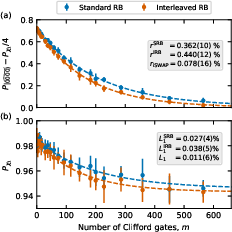
Figure 3: Randomized benchmarking results for the iSWAP gate, showing sequence fidelity decay and negligible leakage.
Error Mechanisms and Incoherent Limits
The error analysis isolates three principal contributions: coherent ZZ2 error, leakage, and incoherent relaxation/dephasing. The coherent ZZ3 error remains quadratic in the accumulated phase and is efficiently mitigated using calibrated virtual-Z frame updates. Leakage is minimal, even as drive amplitude increases, as verified both experimentally and in full Hamiltonian simulations.
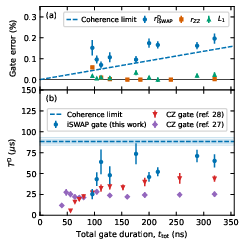
Figure 4: iSWAP depolarization-induced error, ZZ4 error, and leakage versus gate duration, alongside extrapolated error limits from measured coherence times.
The primary constraint on fidelity is incoherent error accumulated over the gate duration. Effective coherence times during operation (ZZ5) are quantitatively extracted and displayed to be systematically longer for the iSWAP gate (approximately ZZ6s) compared to CZ implementations, which require substantially greater hybridization with short-lived coupler modes.
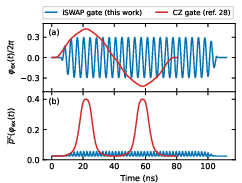
Figure 5: (a) Optimized flux-drive waveform for the iSWAP gate versus symmetric net-zero flux pulse for CZ. (b) Simulated coupler hybridization showing reduced participation during iSWAP.
Suppression of ZZ7 Interaction: Static and Dynamical Contributions
Through direct measurement and simulation, the effective ZZ8 interaction during iSWAP operation is demonstrated to be suppressed below its static value due to a dynamical, drive-induced component that partially cancels the static contribution. The CSDTC's unique flux response further amplifies this effect by providing wide flux intervals with minimal static ZZ9, and the dynamical term takes a positive value under second-harmonic drive, nearly nullifying the total ZZ0 error at optimal amplitude.
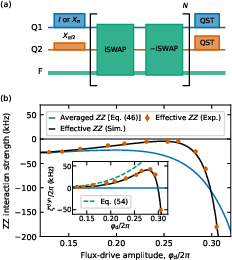
Figure 6: (a) Pulse sequence for effective ZZ1 evaluation, (b) measured and simulated effective ZZ2 interaction as a function of drive strength. Inset: decomposition of static and dynamical contributions.
Agreement with Full-Device Modeling
Theoretical predictions using the full multi-transmon Hamiltonian in the Cooper-pair basis yield quantitative agreement with experimental data for static spectra, iSWAP/exchange rates, effective/dynamical ZZ3, and hybridization fractions throughout the full dynamical modulation protocol. The analytic models using the lowest-order perturbative expansion remain accurate at modest drives; full numerics are required for strong-drive corrections.
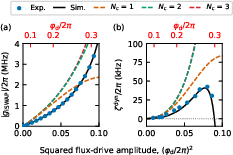
Figure 7: Comparison of experimental and simulated iSWAP rate and dynamical ZZ4 as a function of flux-drive amplitude.
Experimental System and Readout Infrastructure
The measurement and control architecture employs high-fidelity room-temperature electronics (ZH Instruments SHFQC+, HDAWG) and attenuation/thermalization at all cryostat stages, with high SNR single-shot readout employing a near-quantum-limited IMPA followed by HEMT amplification. State discrimination leverages k-means clustering in the IQ plane to account for leakage and spurious state assignments, and assignment fidelities for both data qubits and coupler modes exceed ZZ5.
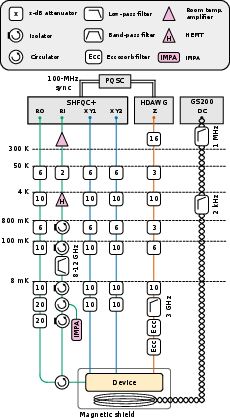
Figure 8: Room-temperature control electronics and cryogenic wiring for all lines relevant to data qubits and coupler flux/crosstalk.
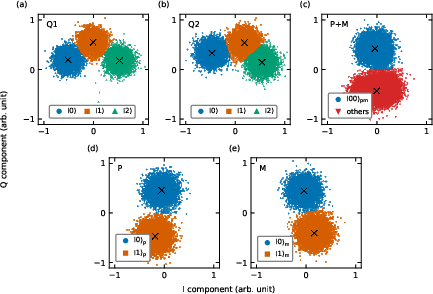
Figure 9: Q1, Q2 single-shot readout IQ distributions and cluster centers, showing assignment clusters with leakage discrimination.
Implications and Outlook
This demonstration establishes second-harmonic parametric iSWAP gates at the CSDTC zero-flux sweet spot as a viable route for high-fidelity, low-overhead two-qubit gates in architectures based on fixed-frequency transmons. The results show that both coherent and leakage errors can be suppressed to negligible levels, with remaining infidelity dominated by incoherent relaxation and dephasing processes—ultimately set by the qubit's intrinsic ZZ6 and ZZ7. The drastically reduced hybridization with lossy coupler modes and softer flux excursions compared to baseband-activated CZ gates mark substantial practical advantages.
The formalism for full-Hamiltonian, multi-mode simulation aligns closely with experimental data across both static and dynamic observables, endorsing the applicability of these techniques for predictive gate optimization in next-generation superconducting quantum computers. Adjustments in drive waveform, pulse shaping, and multi-tone protocols could offer further reductions in dynamical ZZ8 and high-amplitude dephasing. Expanding these methods to multi-qubit coupler networks, leveraging ac sweet spots, or integrating multi-tone cancellation of sideband-induced ZZ9 represents promising directions for theoretical and device-level advances.
Conclusion
The experimental realization and systematic analysis of a parametrically driven iSWAP gate using a capacitively shunted double-transmon coupler at the zero-flux sweet spot provides compelling evidence for the practicality of high-coherence, low-complexity, and high-fidelity entangling operations in fixed-frequency circuit QED architectures. The suppression of coherent errors, minimal calibration overhead, and validation of numerical design frameworks highlight this approach as a strong candidate for scalable, error-corrected superconducting quantum information processors.
(2604.27679)