- The paper presents BAss, a novel BDD-based solver that symbolically encodes and efficiently enumerates major ADF semantics including stable, preferred, and complete interpretations.
- It introduces key algorithmic innovations like greedy conjunction scheduling and dual encoding to mitigate exponential complexity in symbolic reasoning tasks.
- Empirical evaluations show that BAss outperforms traditional SAT, ASP, and earlier BDD-based solvers, effectively handling complex real-world biological networks.
BAss: A Symbolic Solver for Complex Abstract Dialectical Frameworks
Motivation and Background
The paper "BAss: Symbolic Reasoning in Abstract Dialectical Frameworks" (2604.27576) introduces BAss, a new BDD-based solver explicitly designed for the symbolic analysis of Abstract Dialectical Frameworks (ADFs). ADFs generalize Dung's Abstract Argumentation Frameworks (AFs) by representing each argument as a propositional acceptance condition, thus allowing complex logical dependencies beyond pairwise attacks. This added expressivity is critical for direct modeling in domains such as legal reasoning, dialog systems, and computational biology, but also significantly increases computational complexity—particularly for enumeration problems involving admissible, complete, preferred, 2-valued, and stable interpretations.
Recent research demonstrates a formal equivalence between ADFs and Boolean Networks (BNs), allowing translation of acceptance conditions in ADFs to Boolean functions in BNs. This equivalence implies that algorithms and tools developed for one domain are applicable to the other, enhancing the computational toolkit available for reasoning in both fields.
BDD-based Symbolic Representation for ADFs
BAss employs Binary Decision Diagrams (BDDs) as the primary symbolic data structure for representing sets of interpretations and propositional constraints. Each acceptance condition is encoded as a BDD, and the solver leverages multi-variable quantification and dual encodings to model both 2-valued and 3-valued interpretations efficiently. BAss supports the canonical operations required for ADF semantics, including existential quantification—critical for projection and reasoning over high-dimensional solution spaces.
Advanced algorithmic optimizations are adopted:
- Greedy conjunction scheduling: Minimizes intermediate BDD sizes during multi-condition conjunction, preventing exponential blowup.
- Dual encoding: Employs pairs of Boolean variables per argument to succinctly represent the tri-valued domain (true, false, unknown), avoiding reliance on three-valued decision diagrams.
- Direct symbolic transformation: Constructs the dual encoding of acceptance conditions entirely at the propositional/BBD level, sidestepping the exponential complexity of disjunctive normal form (DNF) transformations encountered in previous BN tools.
These strategies collectively enable scalable, symbolic characterization of semantics without enumerative bottlenecks.
Algorithms for Enumerating ADF Semantics
BAss provides symbolic algorithms for all major ADF semantics:
- Admissible and Complete Interpretations: Symbolically characterized by BDDs encoding justifications and fixed points of the characteristic operator; logical formulas are mapped directly to BDDs for efficient bulk reasoning.
- Preferred Interpretations: Symbolic extraction of maximal admissible interpretations using weakening and least-value BDD operations, avoiding costly enumeration over solution sets.
- Stable Models: Symbolic selection of minimal 2-valued models followed by grounding via dual encoding, leveraging structural theorems about minimality (w.r.t. true arguments) for pruning.
Empirical Evaluation
BAss was extensively benchmarked against other state-of-the-art SAT, ASP, and BDD-based solvers across more than 1,200 ADF and BN instances, including large real-world biological models.
Cactus plots quantify runtime performance across admissible, complete, preferred, 2-valued, and stable models.
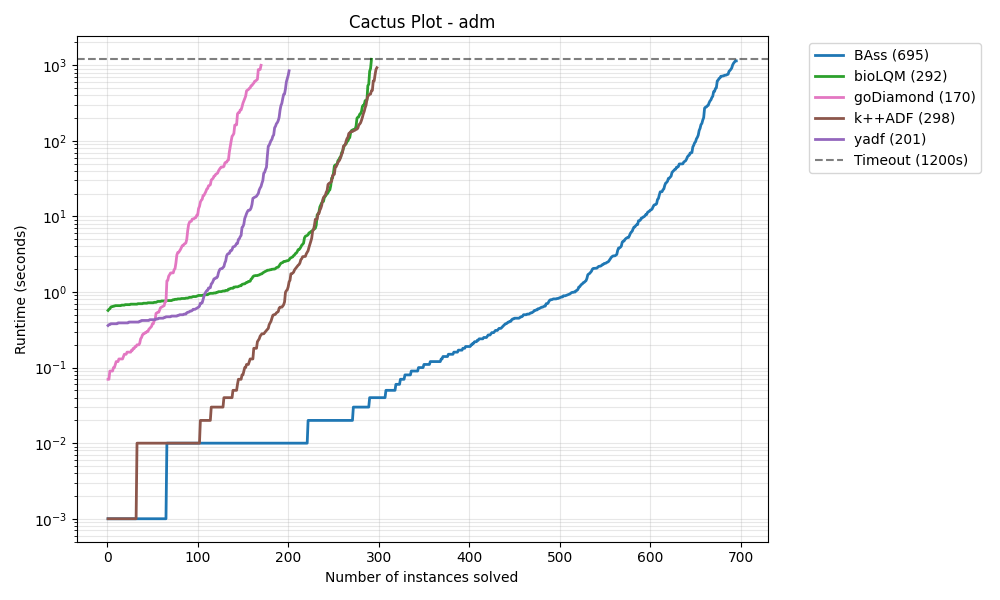
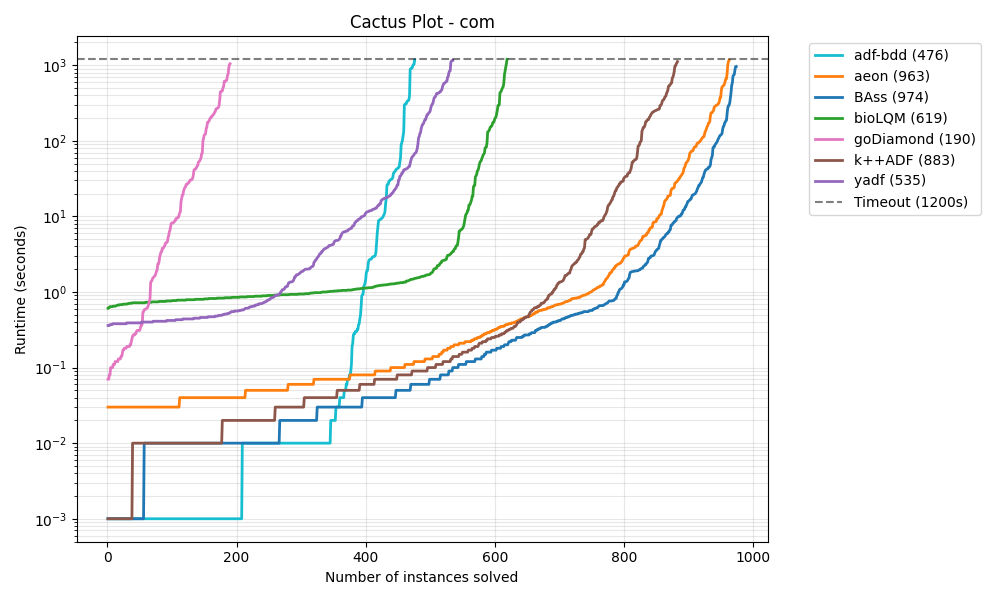
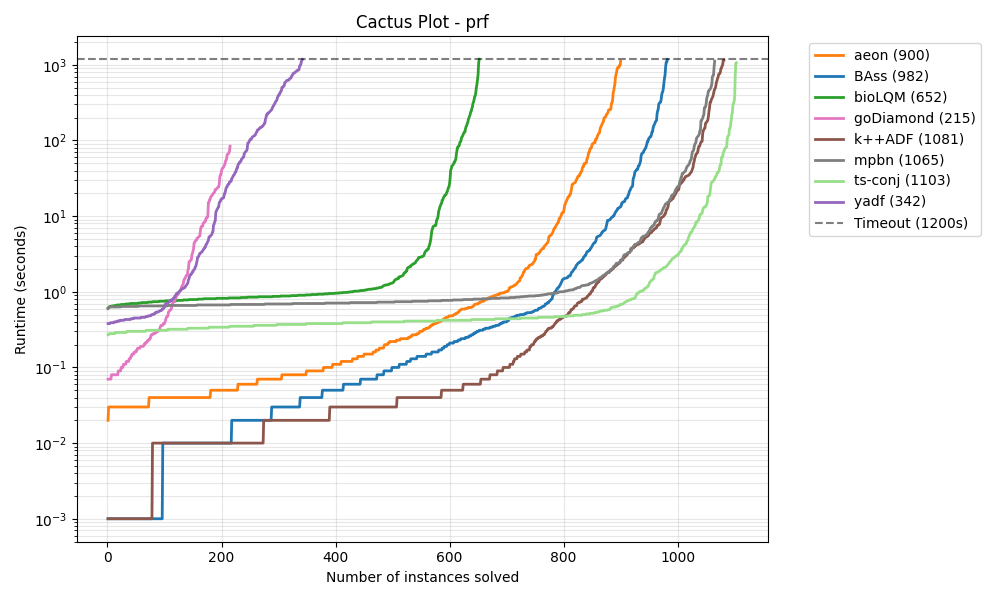
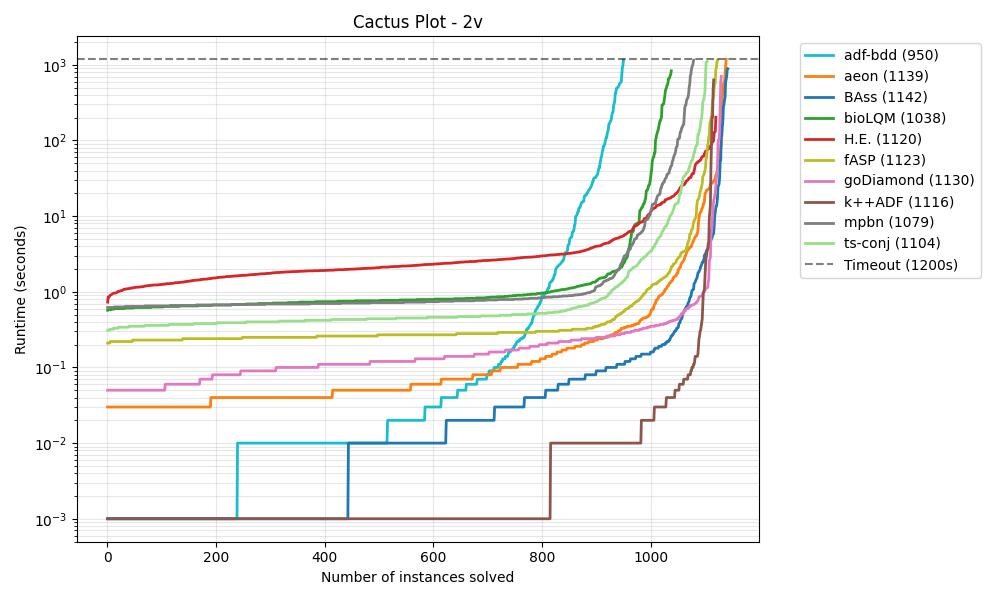
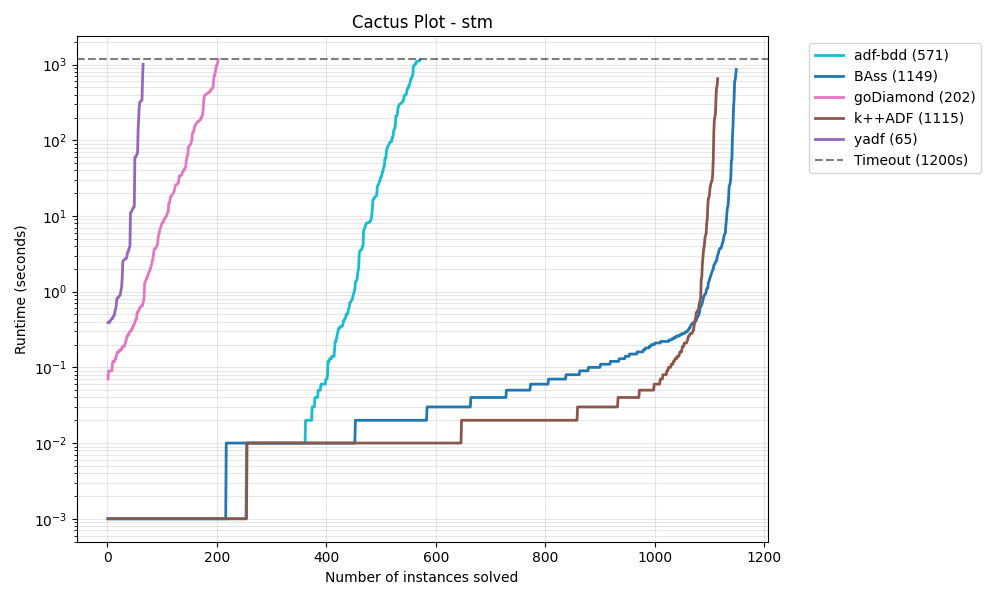
Figure 1: Cactus plots showing the runtime of individual tools across different ADF problem categories.
Experimental results indicate:
- Substantial outperformance of all previous BDD-based solvers (adf-bdd, bioLQM, aeon), especially in scenarios with large solution spaces.
- Competitive results with, and sometimes significant superiority to, leading SAT/ASP-based solvers (e.g., k++adf, goDiamond), particularly for preferred, stable, and exhaustive enumeration problems.
- Unique ability to handle previously unsolved biological networks, enumerating trap and attractor spaces unreachable by prior tools.
Strong numerical highlights include the enumeration of solution spaces with up to 6.7×10¹³ preferred interpretations and 5.4×10²³ complete interpretations in complex BNs, as demonstrated in Table~\ref{tab:biological-results} of the paper.
Practical and Theoretical Implications
Symbolic reasoning with BDDs, as exemplified by BAss, provides a scalable means of analyzing solution spaces in complex ADFs and BNs without enumerative explosion. The ability to uniformly sample from BDD-encoded solution sets instead of solver-biased samples enables unbiased statistical analysis of biological models. This is of particular importance for phenotype discovery and network control in systems biology, where trap space and attractor set enumeration guide interventions and model-based inference.
Further, BAss's approach reveals complementary strengths to SAT/ASP-based tools, suggesting future hybrid strategies combining symbolic and logic-based optimization could further mitigate computational bottlenecks and extend solver capabilities.
Future Directions
Immediate research extensions include:
- Dynamic variable reordering for BDD optimization.
- Symbolic-SAT hybrids to circumvent full enumeration requirements for preferred interpretations.
- Incorporation of BN reduction techniques to pre-process network complexity.
- Support for advanced ADF semantics (naive, stage, semi-stable) via symbolic encoding.
The general methodology of BAss is also directly applicable to argumentation-theoretic analysis in broader AI reasoning systems, formal verification, and real-world knowledge graphs.
Conclusion
BAss establishes a robust, scalable foundation for symbolic enumeration and reasoning in Abstract Dialectical Frameworks, leveraging cross-domain equivalence with Boolean Networks and advanced BDD-based techniques. Its demonstrated empirical strengths in handling large solution spaces and real-world biological benchmarks provide compelling evidence for the practical relevance of symbolic AI reasoning tools in both formal argumentation and computational biology. BAss is available for reproducibility and extension, offering a flexible platform for further advancements in scalable, symbolic knowledge reasoning (2604.27576).