- The paper rigorously derives a linear response formula for invariant measures under small drift perturbations on T^d.
- It introduces an optimal control framework that computes the unique optimal perturbation using Hilbert-space and Fourier-based methods.
- The study validates the approach with numerical implementations on low- and high-dimensional systems, demonstrating efficiency and practical implications.
Optimal Response for SDEs on the Torus with Drift Perturbations
Problem Setting and Theoretical Foundations
This work conducts a rigorous analysis of the optimal linear response for stochastic differential equations (SDEs) defined on the d-dimensional flat torus Td under perturbations to the drift component. The SDEs considered have dynamics
dXtδ,x=(b(Xtδ,x)+δη(Xtδ,x))dt+dWt
with b∈L∞(Td;Rd), a bounded drift, η∈L∞(Td;Rd) as the perturbation direction, and standard additive non-degenerate noise. The paper studies both the stationary measure (invariant density) and the expectation of observables under small drift perturbations by δη, focusing on quantitative, operator-theoretic linear response and the corresponding optimal control problem.
The invariance structure of the associated Markov semigroups and transfer operators, leveraging the compactness and spectral gap due to non-degenerate noise, is central. The main mathematical object is the L2 transfer operator defined by
Lδf(y):=∫Tdpδ(1,x,y)f(x)dx
where pδ(1,x,y) is the time-1 transition kernel for the SDE. The unperturbed operator (δ=0) has a unique normalized invariant density due to positivity, mass-preservation, and spectral gap properties, facilitating well-posedness of perturbation expansions.
Linear Response Theory for Invariant Measures
The first principal result is the rigorous derivation of the linear response formula for both the invariant density and expectations of observables. For an observable Td0 and admissible perturbation Td1, the response
Td2
where Td3 is the invariant density for Td4, is shown to be well-defined and given by
Td5
where the operator Td6 is a continuous linear map from Td7 vector fields to the zero-mean Td8 subspace, representing the first-order impact of the drift perturbation. Existence, continuity, and explicit characterization of this linear response operator are established, and it is proved that the response is continuous in both arguments.
Optimal Linear Response and Explicit Optimization Algorithm
The key advance is the formulation and solution of the optimal response problem: among all admissible perturbations (typically those of unit norm in some Sobolev space Td9), identify dXtδ,x=(b(Xtδ,x)+δη(Xtδ,x))dt+dWt0 maximizing dXtδ,x=(b(Xtδ,x)+δη(Xtδ,x))dt+dWt1. The paper rigorously analyzes the optimization over convex, strictly convex sets in separable Hilbert spaces embedded into dXtδ,x=(b(Xtδ,x)+δη(Xtδ,x))dt+dWt2, proving:
- Existence and uniqueness of dXtδ,x=(b(Xtδ,x)+δη(Xtδ,x))dt+dWt3 for strictly convex, closed, bounded sets dXtδ,x=(b(Xtδ,x)+δη(Xtδ,x))dt+dWt4 containing zero in the relative interior, unless the response is identically zero.
- For the unit ball dXtδ,x=(b(Xtδ,x)+δη(Xtδ,x))dt+dWt5, the unique optimum is the normalized Riesz representative dXtδ,x=(b(Xtδ,x)+δη(Xtδ,x))dt+dWt6 of the response functional:
dXtδ,x=(b(Xtδ,x)+δη(Xtδ,x))dt+dWt7
where dXtδ,x=(b(Xtδ,x)+δη(Xtδ,x))dt+dWt8 is any orthonormal basis for dXtδ,x=(b(Xtδ,x)+δη(Xtδ,x))dt+dWt9.
This structure enables a practical approximation algorithm: compute b∈L∞(Td;Rd)0 for a truncated Fourier or other orthonormal basis, reconstruct b∈L∞(Td;Rd)1, and thus obtain b∈L∞(Td;Rd)2 via its coefficients.
Numerical Implementation and High-Dimensional Examples
The proposed Fourier-based computational method is implemented and validated across several model systems, including low and high-dimensional settings:
Two-Dimensional Kuramoto System
The two-dimensional Kuramoto system, a nonlinear oscillator model on b∈L∞(Td;Rd)3, serves as an illustrative testbed. The method computes the b∈L∞(Td;Rd)4-optimal perturbation by reconstructing the response in a truncated Fourier basis. The vector fields of the drift and optimal perturbation are visualized to illustrate spatial structure.
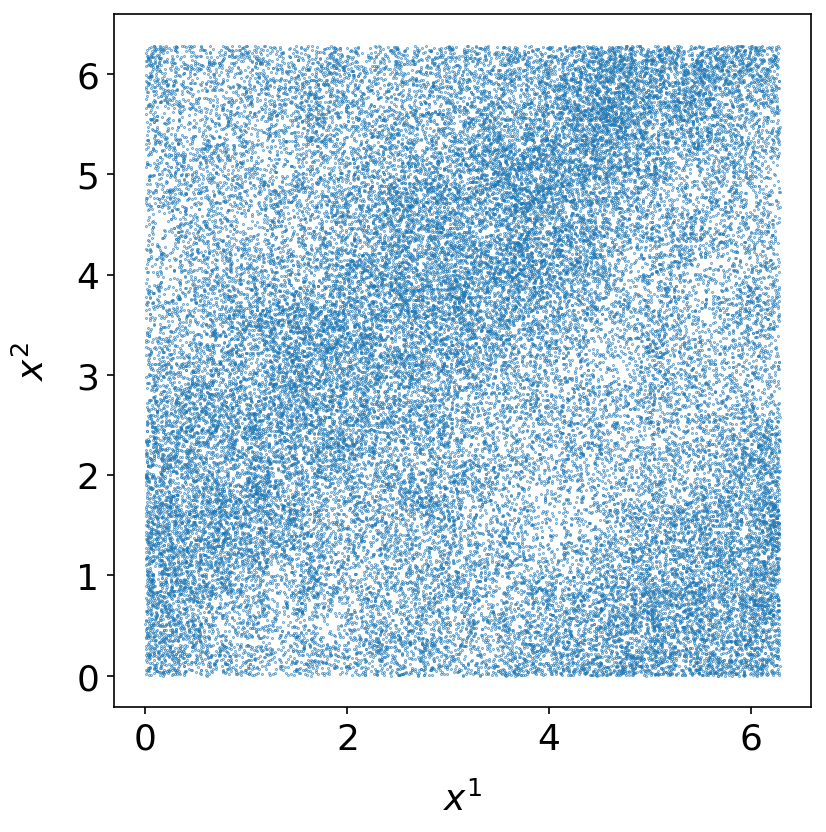
Figure 1: Typical orbit of the two-dimensional Kuramoto system, visualizing phase space coverage.
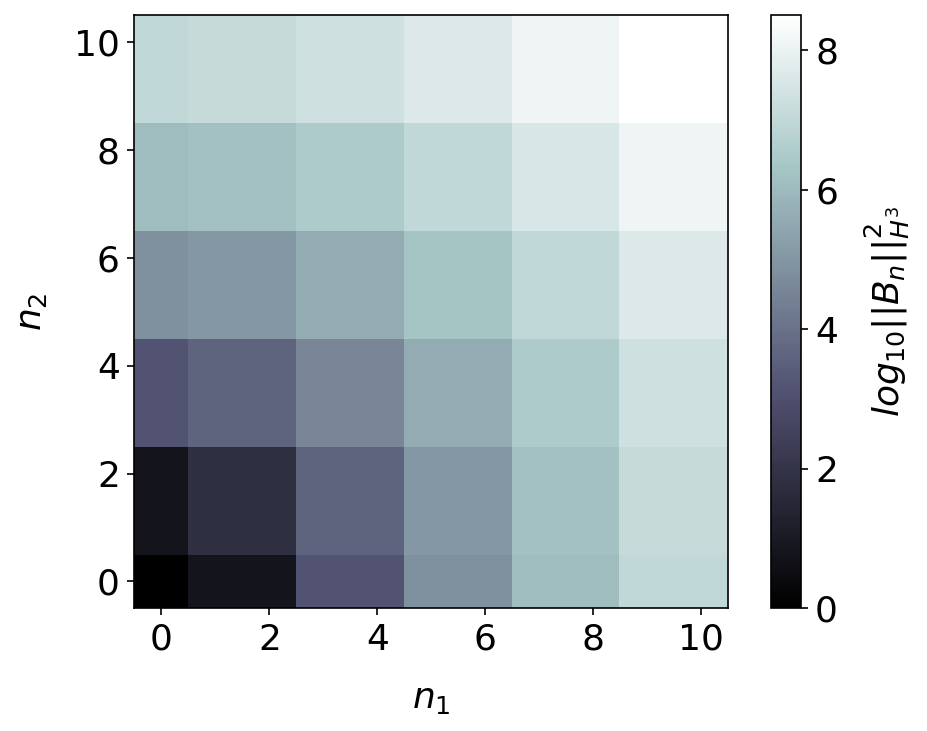
Figure 2: Squared b∈L∞(Td;Rd)5 norms of non-normalized Fourier basis functions b∈L∞(Td;Rd)6 in the Kuramoto example.
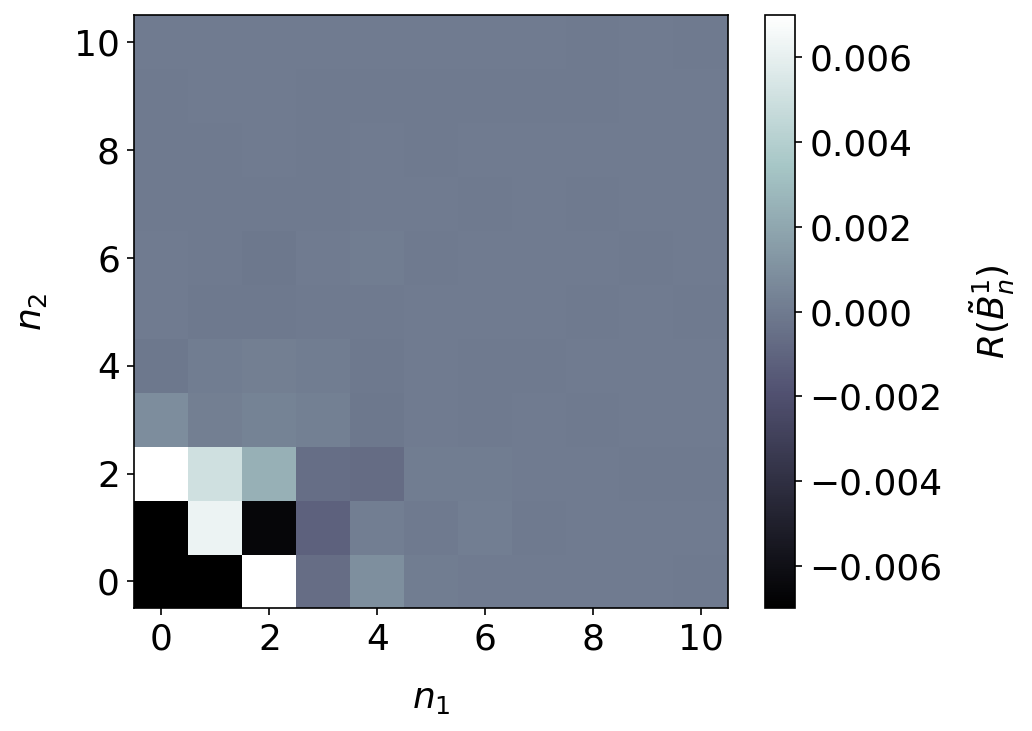
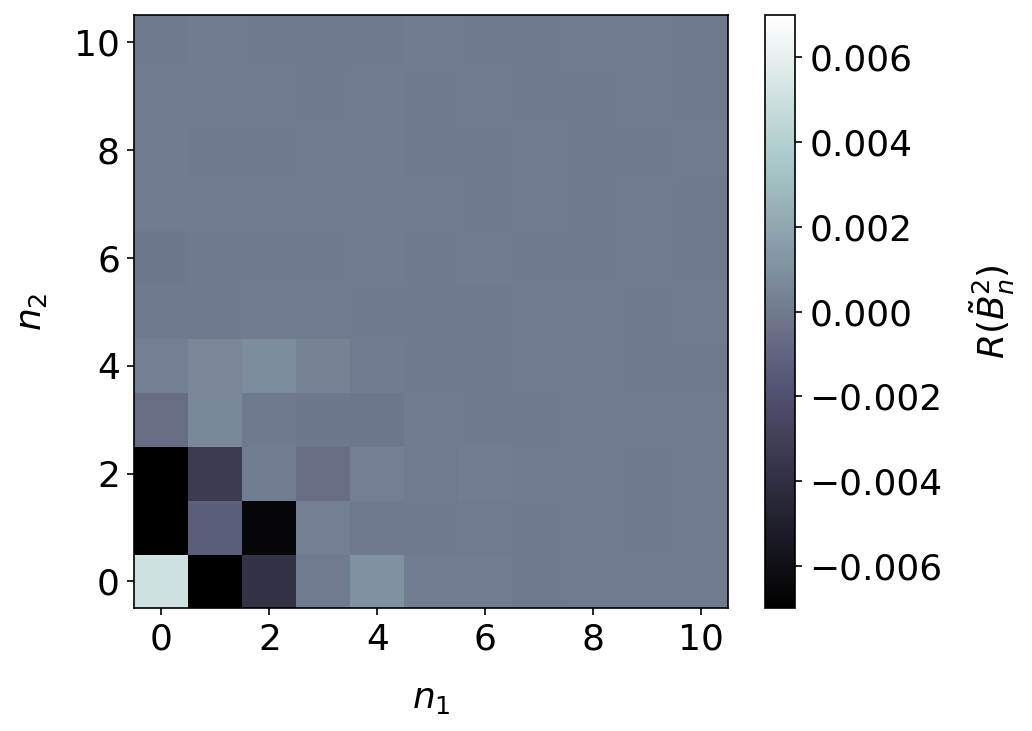
Figure 3: Computed response coefficients b∈L∞(Td;Rd)7 showing how response concentrates on select low-frequency modes.
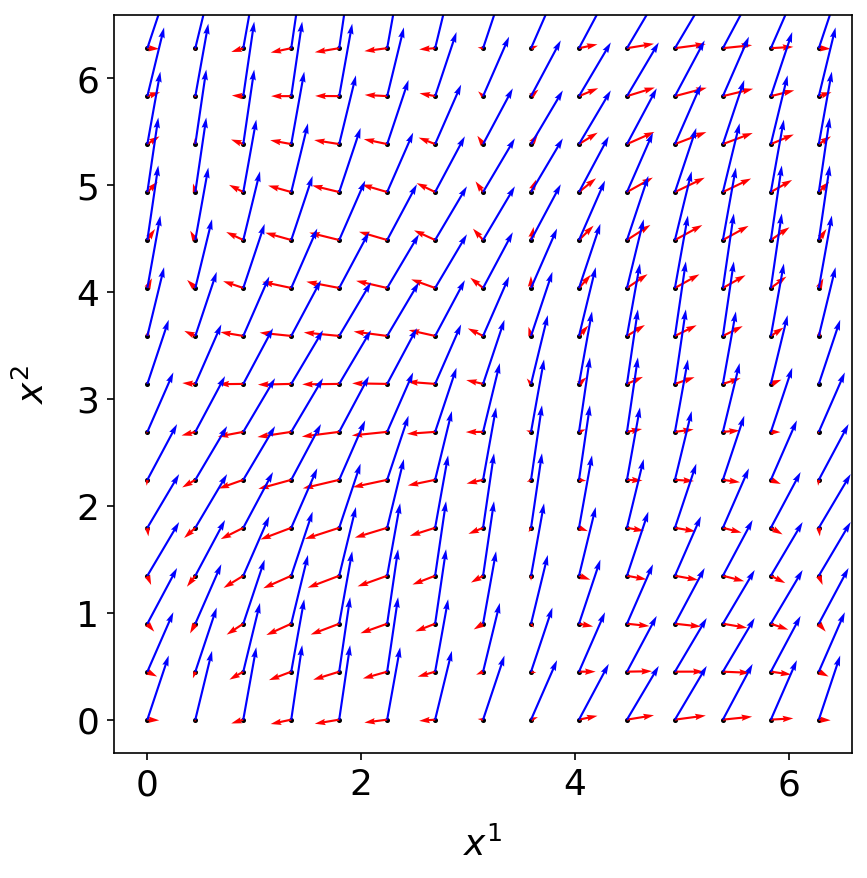
Figure 4: Vector fields of drift b∈L∞(Td;Rd)8 (blue) and optimal perturbation b∈L∞(Td;Rd)9 (red), displaying their spatial structures.
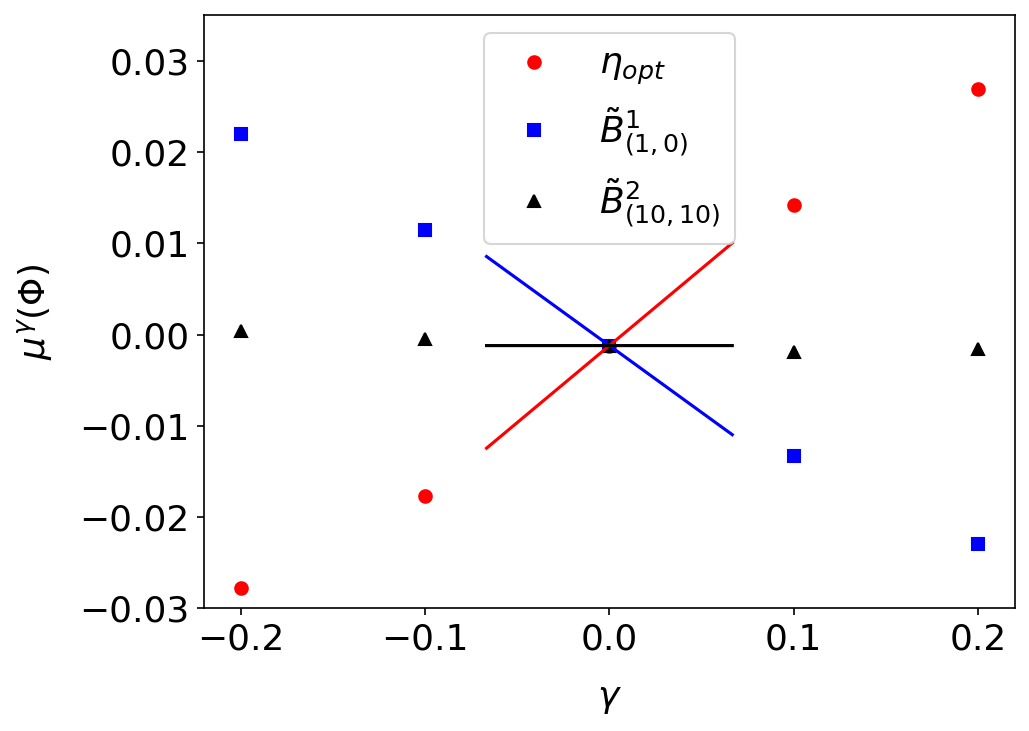
Figure 5: Observed linear responses and actual observable averages η∈L∞(Td;Rd)0 as a function of η∈L∞(Td;Rd)1 for various perturbations; the optimal perturbation yields the largest effect.
High-Dimensional Kuramoto (20 Dimensions)
The approach scales to high dimensions by using a reduced perturbation space: perturbations only depend on one coordinate and affect a subset of components. The exponential decay of the response coefficients with basis index implies the finite-basis truncation error is small, validating the method's efficiency.
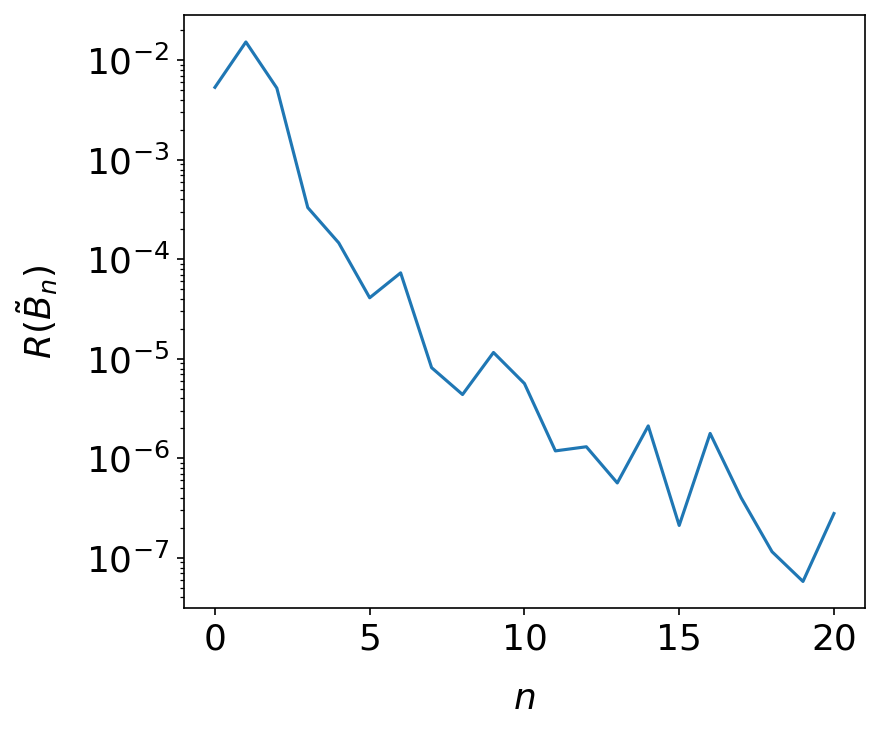
Figure 6: Linear responses η∈L∞(Td;Rd)2 for normalized basis functions in the reduced η∈L∞(Td;Rd)3 space; the decay confirms controlled truncation error.
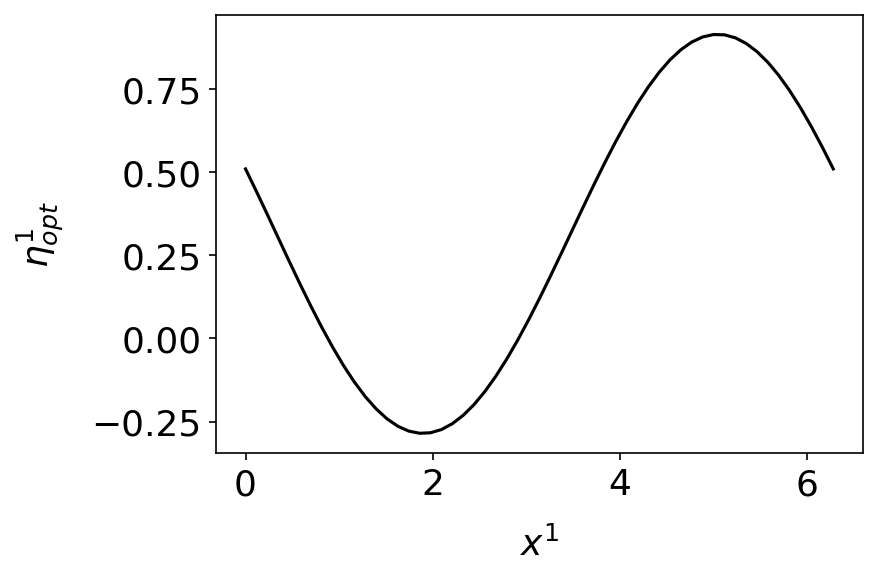
Figure 7: Vector field plots of the drift and the optimal perturbation projected to principal coordinates, showing adaptation in high dimensions.
Figure 8: Comparison of linear responses for different perturbations and resulting observable values under nonlinear perturbations.
Three-Dimensional Lorenz System
A regularized, torus-adapted version of the Lorenz 63 system is analyzed to demonstrate capability in chaotic, nonlinear, multidimensional dynamics. The structure of the optimal perturbation is represented using cross-sectional and 3D arrow plots.
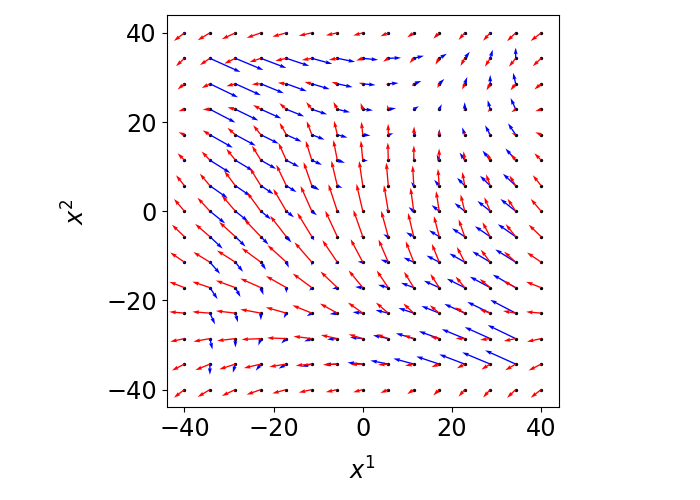
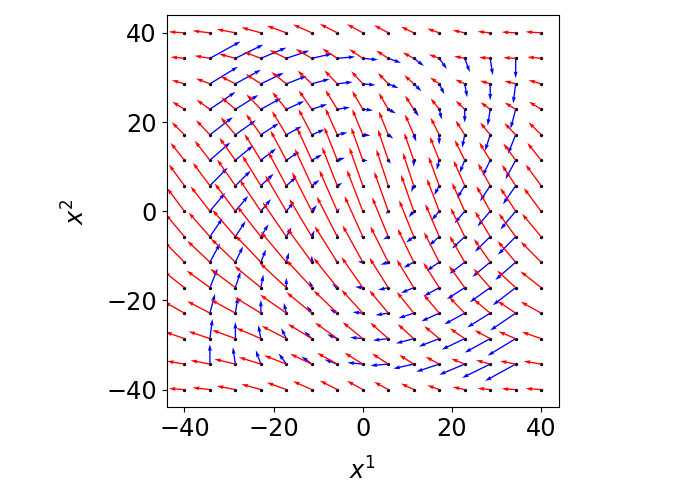
Figure 9: Two-dimensional slices of drift (blue) and optimal perturbation (red) for the Lorenz system at different η∈L∞(Td;Rd)4 levels.
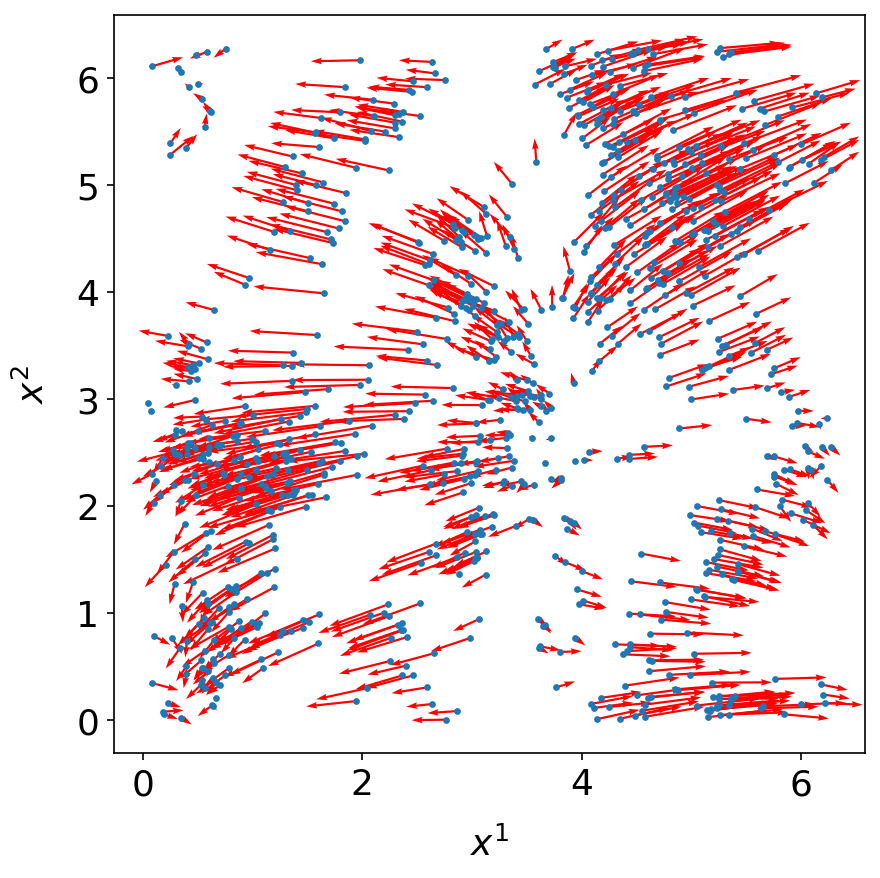
Figure 10: Three-dimensional depiction of optimal perturbation arrows superimposed on a typical system orbit.
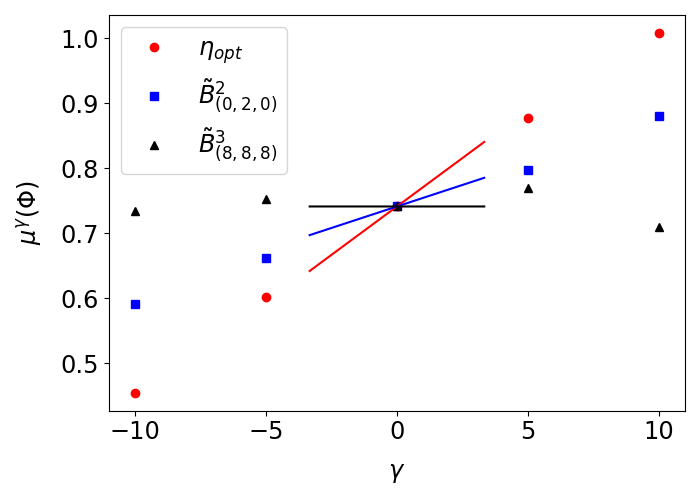
Figure 11: Comparison of linear responses and observable averages, verifying that the optimal perturbation attains the maximal response with accurate linear regime prediction.
Implications, Practical and Theoretical
The primary practical implication is that, for SDEs on η∈L∞(Td;Rd)5 with non-degenerate additive noise and η∈L∞(Td;Rd)6 drift, the optimal response to external interventions in drift can be efficiently and quantitatively computed using spectral techniques. The explicit Hilbert-space operator-theoretic framework facilitates applications to both low- and high-dimensional stochastic systems without relying on direct transfer kernel modification or finite-state approximations.
Theoretically, the work clarifies the structure of the response operator and its dependence on the perturbation space, connecting classical linear response theory, spectral analysis of transfer operators, and convex optimization in infinite-dimensional settings. This realization bridges the gap between control-theoretic and statistical physical approaches to optimal intervention and paves the way for principled design in contexts such as climate response, network dynamics, or large-scale engineered stochastic systems.
Future directions may include extension to multiplicative noise models, systems with degenerate diffusion, SPDEs, or control and optimization of collective observables in interacting particle systems. The operator-analytic techniques developed here adapt naturally to these regimes, providing a scalable pathway for computational optimal control in complex stochastic dynamics.
Conclusion
This comprehensive study develops a mathematically rigorous and computationally implementable framework for the optimal control of linear response in stochastic differential equations on the torus via drift perturbations. By combining transfer operator theory, spectral gap arguments, Hilbert-space optimization, and explicit Fourier methods, the paper delivers both theoretical results and practical algorithms validated by complex multidimensional examples, setting a foundation for a broad array of applications in dynamical systems and stochastic control.
Reference: "Optimal response for stochastic differential equations in η∈L∞(Td;Rd)7 with perturbations on the drift term" (2604.27404)