- The paper presents the first experimental realization of a fully-passive quantum access network using a thermal ASE source and passive splitter to achieve key rates up to 19.48 Mbps per user.
- The experimental setup leverages heterodyne detection and advanced digital signal processing, including GRU-based adaptive phase compensation, to maintain low excess noise and high system stability.
- The study demonstrates compatibility with conventional optical infrastructure, paving the way for scalable and cost-effective quantum-secured networks in practical deployments.
High-Key-Rate Fully-Passive Quantum Access Network with Thermal Source: Experimental Demonstration and Analysis
Introduction
The paper presents the first experimental realization of a high-key-rate, fully-passive quantum access network (QPON) leveraging passive state preparation (PSP) with thermal sources (2604.27327). It extends continuous-variable quantum key distribution with passive state preparation (PSP-CVQKD) from point-to-point (PTP) configurations to a scalable point-to-multi-point (PTMP) access network. The scheme achieves a secure key rate (SKR) of up to 19.48 Mbps per quantum network unit (QNU), exceeding prior QAN results by more than an order of magnitude over comparable distances. The proposed architecture is compatible with conventional classical optical access network infrastructure, facilitating incremental integration of quantum security at the network edge.
PSP-QPON Architecture and Protocol
The architecture features a quantum line terminal (QLT, Alice) that prepares quantum signals passively from a thermal amplified spontaneous emission (ASE) source. Those signals are distributed to multiple QNUs (Bob) via a purely passive splitter network, precluding the need for costly and lossy high-speed active modulators.
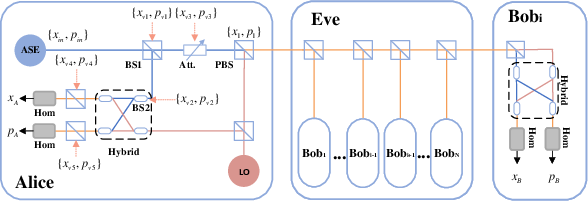
Figure 1: Optical layout of the PSP-QPON using a thermal source. The network comprises the QLT sending passively prepared quantum states through a passive optical splitter to several QNUs, with eavesdropping attacks modeled.
When Alice prepares the quantum signal, she splits the output of the thermal source. One mode is transmitted (after attenuation and polarization multiplexing) to the Bobs, while the other is measured locally via heterodyne detection to estimate the outgoing mode, introducing additive PSP noise as a source of excess noise. Each QNU performs heterodyne detection and uses digital signal processing to recover quadrature data. Reverse reconciliation is employed such that Alice generates a set of secret keys, each independently matched to a Bob, after information reconciliation and privacy amplification.
The network protocol allows multiple users to simultaneously receive unique, independent keys from broadcast quantum states. The security model accounts for both eavesdropper attacks and mutual information among QNUs, ensuring secret keys are statistically decoupled even if Eve controls some network nodes.
Experimental Implementation
The experimental demonstration employs a hybrid 5 km single-mode fiber and 1 m free-space channel (simulating fiber-to-the-home and in-premises wireless/LiFi access) with an average overall attenuation of -10.96 dB per Bob. The configuration uses three cascaded beam splitters to create a 1-to-4 network topology.
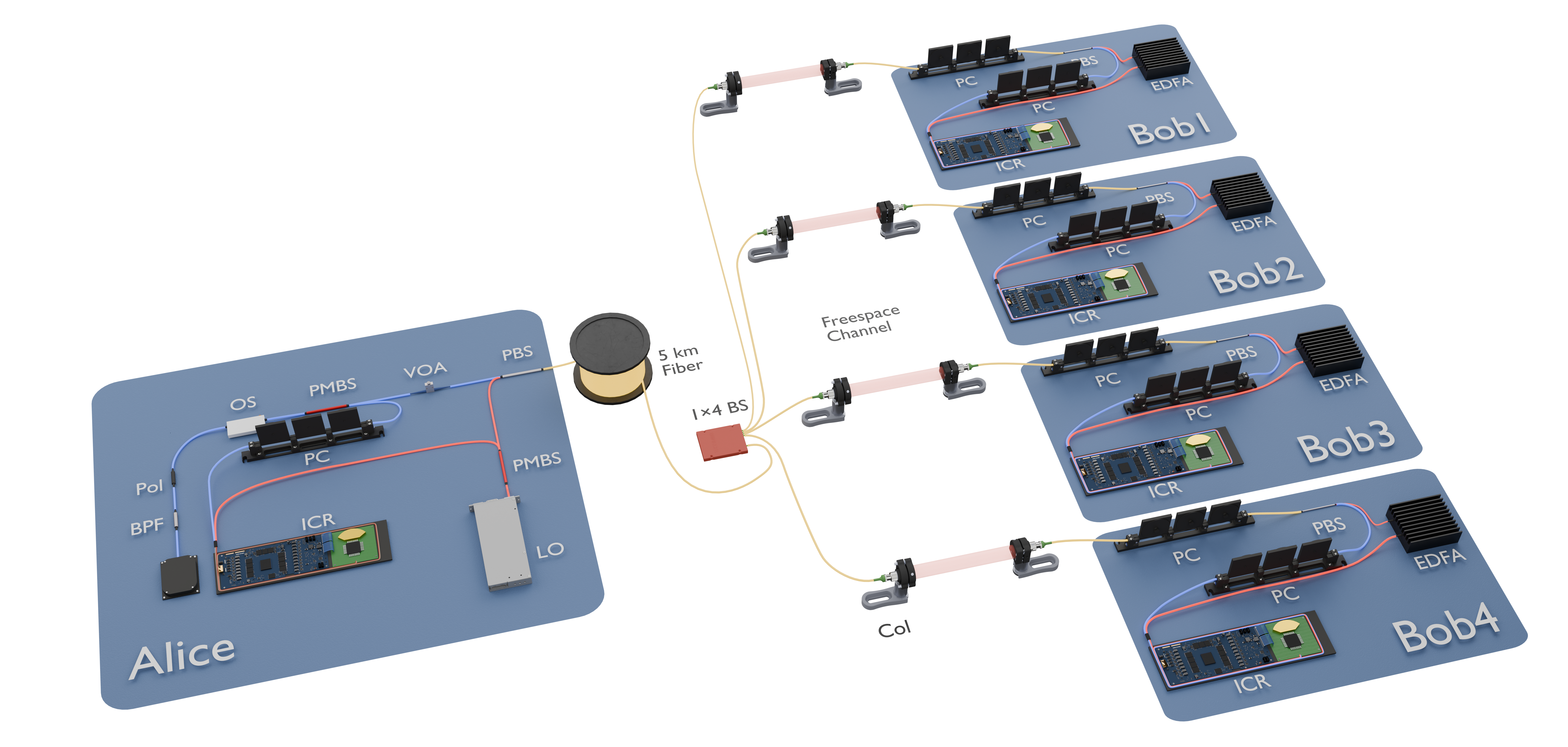
Figure 2: Experimental setup of the PSP-QPON, illustrating optical path components for signal generation, splitting, multiplexing, detection, and synchronization.
Notably, polarization-multiplexed quantum signals and local oscillators are distributed over the same fiber, with high-rejection filtering and real-time shot noise acquisition for accurate normalization. Digital signal processing includes a machine-learning-based phase compensation algorithm (GRU with adaptive attention) to mitigate drift and align frames without classical pilot frames, enhancing both SNR and system stability.
Real-time shot noise is measured by intermittently switching between signal and noise calibration modes at each QNU using an optical switch, thereby suppressing drift- and fluctuation-induced normalization errors over the high bandwidth, high-rate system.
The covariance matrix, transmittance, and mutual information data empirically validate the low cross-correlation among QNUs, with the maximum inter-Bob mutual information measured at 0.0039 bit/pulse—well below the minimum Holevo bound (χBEmin=0.11 bit/pulse) between Eve and any Bob. This permits the basic PTP security reduction for SKR estimation.
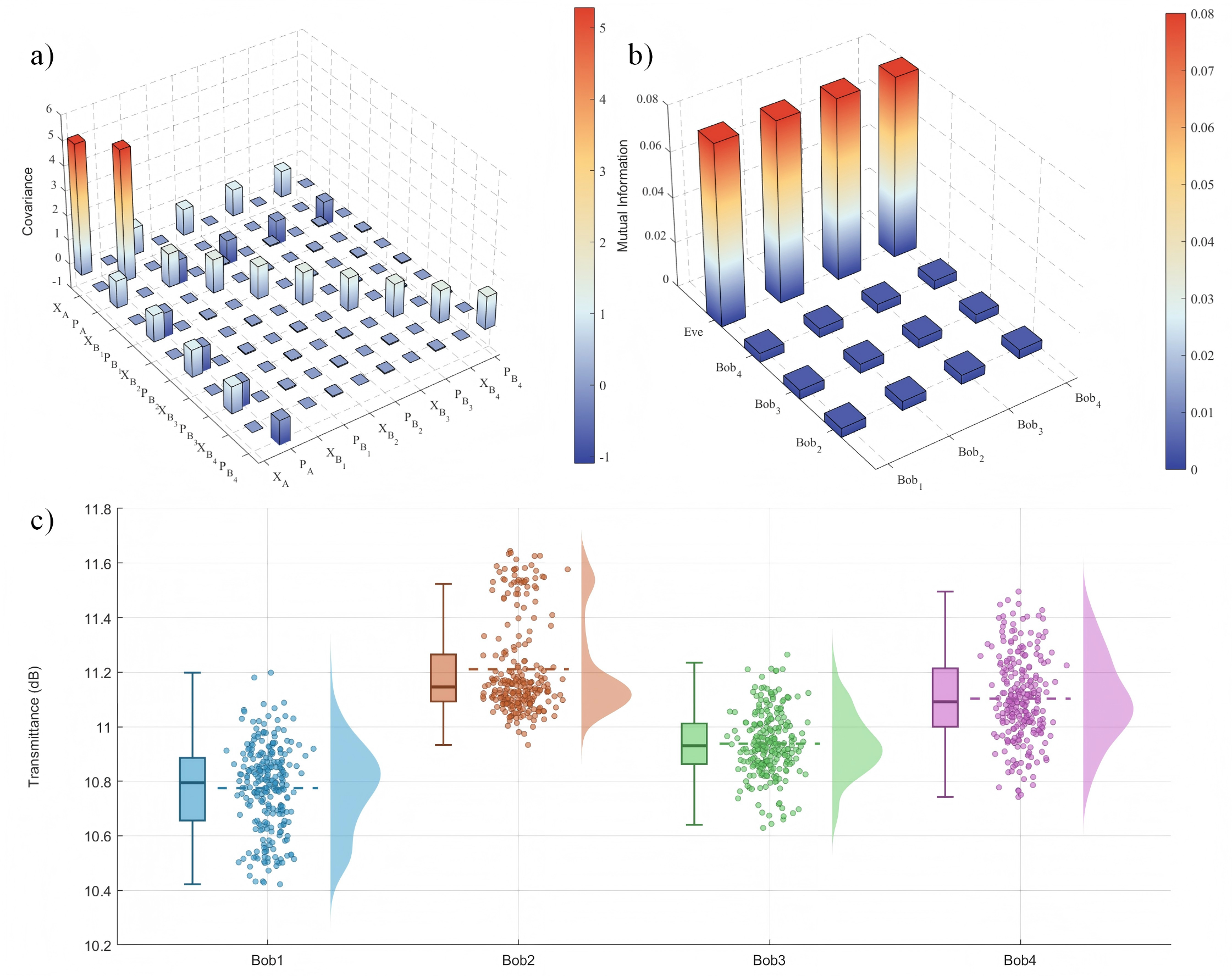
Figure 3: System covariance matrix, mutual information (including inter-user and Eve bounds), and transmittance per user node.
At optimal settings (modulation variance 4.28 SNU, detection efficiency 0.56), average excess noise is maintained below 0.06 SNU in both quadratures across all Bobs. The achieved SKRs are 20.73, 18.56, 20.41, and 17.43 Mbps for the four nodes, with a network average of 19.29 Mbps over the 20 km equivalent fiber channel.
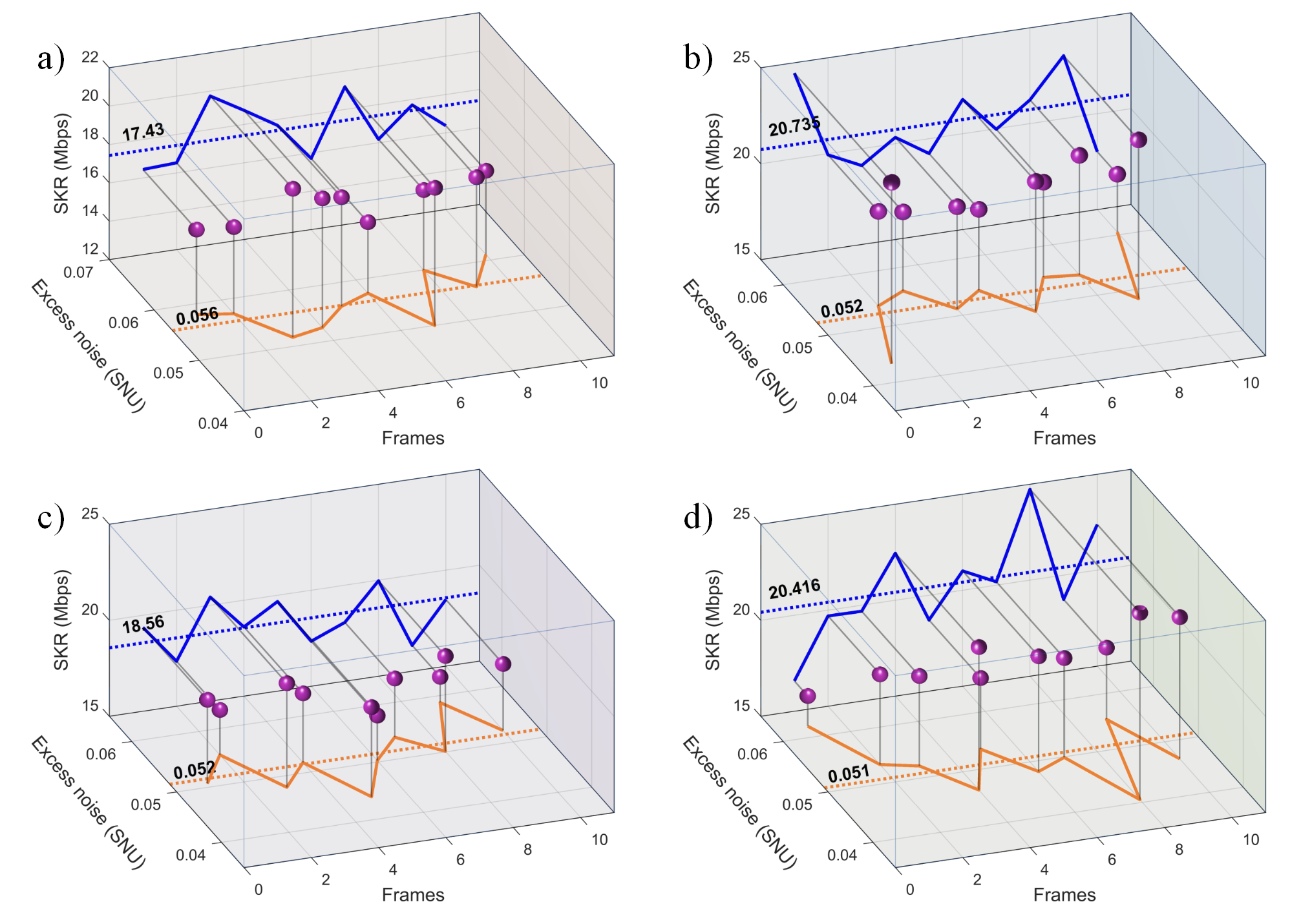
Figure 4: Secure key rate (SKR) and excess noise per QNU, demonstrating strong performance consistency across all nodes.
Comparisons with state-of-the-art CV-QKD access networks show at least an order of magnitude higher key rates at similar or longer distances, e.g., previous bests include 12.05 Mbps (15 km, 8 users) and 1.01 Mbps (21 km, 4 users). The high repetition frequency (4 GHz, bounded by detector bandwidth) and elimination of high-loss, high-noise active components underpin this performance advantage.
Theoretical and Practical Implications
The extension from PSP-CVQKD PTP schemes to a robust PSP-QPON with multiple users addresses a central challenge in quantum-secured optical access networks: balancing scalability, cost, and bit rate without degradation of security or practicality. By proving passive, broadcast quantum state preparation with thermal sources can scale efficiently and maintain high rates, the work positions PSP-QPON as a leading candidate for direct integration into classical passive optical access networks.
The backward compatibility with classical infrastructure, together with low resource footprint (no high-speed modulators, no polarization-maintained fibers), advances the feasibility of QKD for consumer and mobile edge applications. Moreover, the demonstration of advanced DSP routines—real-time shot noise tracking, GRU-based adaptive phase compensation, and digital filter chains—addresses critical engineering bottlenecks for deploying large-scale optical quantum networks.
Nevertheless, the network relies on polarization controllers to compensate for non-polarization-maintained optical paths and local oscillators distributed via fiber (which imposes practical limitations on distance and vulnerability to LO leakage attacks). System performance and security could be further improved with polarization-maintaining ICRs, higher-extinction signal/LO handling, localized LO generation, and optimized time synchronization via GPS-driven acquisition boards.
Conclusion
This work establishes a new benchmark for quantum access networks, achieving high key rates in a fully-passive, scalable, and classical-network-compatible architecture. By advancing both the theoretical model and experimental realization of PSP-QPON, it resolves a major obstacle for the "last mile" of quantum-secured communication. Future research trajectories include integration of local LO schemes, extension to higher user counts, robust polarization control, and broader field deployment, all essential steps for practical, metropolitan-scale quantum security.
Reference:
"High-key-rate Fully-Passive Quantum Access Network with Thermal Source" (2604.27327)

