- The paper introduces a closed-form ED degree expression that quantifies the algebraic complexity reduction in planar-constrained triangulation.
- It leverages both Homotopy Continuation and Gröbner basis techniques to design minimal solvers with superior accuracy and computational efficiency.
- Extensive experiments on synthetic and real datasets demonstrate that planar constraints improve triangulation robustness and reduce errors compared to unconstrained methods.
Triangulation of Points Constrained to a Plane: Algebraic and Algorithmic Insights
Introduction
The paper "Triangulation of Points Constrained to a Plane" (2604.27246) investigates the algebraic and algorithmic aspects of the multi-view triangulation problem under planar constraints. Specifically, it examines the set of image correspondences generated by projecting 3D points confined to a plane across multiple calibrated pinhole cameras and provides a rigorous quantification of the intrinsic algebraic complexity of reconstructing such points. The analysis leverages the geometry of planar-anchored point multiview varieties and presents explicit solvers optimized for the planar constraint scenario. Comprehensive experimentation on both synthetic and real datasets demonstrates significant advantages in accuracy and efficiency compared to unconstrained triangulation.
Algebraic Geometry of Planar Triangulation
The central contribution is the characterization of planar-anchored point multiview varieties, denoted MCΠ, where Π is a plane in P3 (projective 3-space) and C is an arrangement of m calibrated cameras. These varieties encode the structure of all multi-view correspondences that could arise from a 3D point lying on Π, imaged by the cameras.
The authors show that, given the planar constraint, the multiview variety MCΠ is linearly isomorphic to the image of a collection of planar homographies. Algebraically, this reduction means the variety is isomorphic to P2 and always smooth and irreducible. The planar restriction reduces the problem's degrees of freedom, collapsing the search space from the three-dimensional unconstrained case to two—a reduction that also modifies the geometry and complexity of the triangulation problem.
Euclidean Distance Degree and Critical Points
A core theoretical result is a closed-form expression for the Euclidean distance degree (EDdeg) of the planar-anchored point multiview variety. The EDdeg counts the number of complex critical points of the squared Euclidean distance minimization from noisy observations to the variety, which directly measures the apparent algebraic complexity of triangulation via exact algebraic solvers.
The authors prove that for a generic arrangement of m cameras,
EDdeg(MCΠ)=29m2−213m+3,
where Π0 denotes the affine chart of Π1.
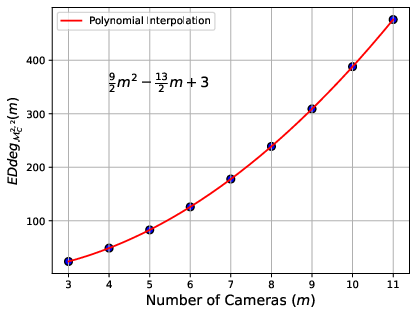
Figure 1: Computed EDdeg values for the affine planar-anchored point multiview variety, obtained using HomotopyContinuation.jl, revealing the quadratic growth in the number of critical points with increasing camera count.
This result is validated numerically using polynomial system solvers, with the algebraic proofs relying on intersection theory, Bertini-type theorems, and the enumeration of nodes and isotropic points within the relevant divisors on the projective plane.
Algorithmic Solvers for Planar-Constrained Triangulation
The authors develop exact minimal solvers for the planar-constrained triangulation task, specializing to the Π2 and Π3 view cases. For each observed image tuple, the problem reduces to finding the minimum of a parametric polynomial system in two variables, whose structure follows from the planar homography relations.
The solvers are implemented via both homotopy continuation (HC) and Grӧbner basis (GB) techniques. The complexity of the solution matches the EDdeg formula, yielding 8 solutions for Π4 and 24 solutions for Π5. The computational efficiency and reliability of the solvers are empirically quantified, showing that the GB solvers are substantially faster, while the HC solvers provide improved numerical stability, especially for the 3-view case.
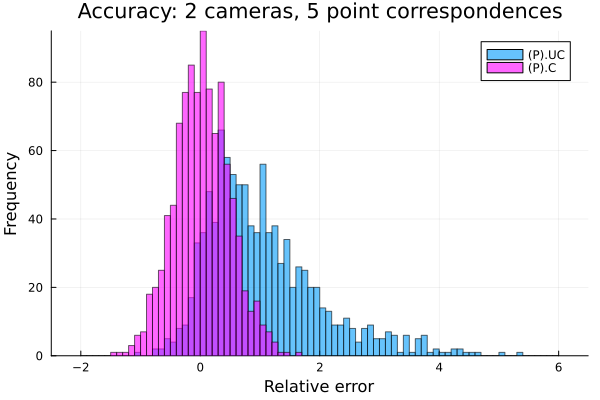
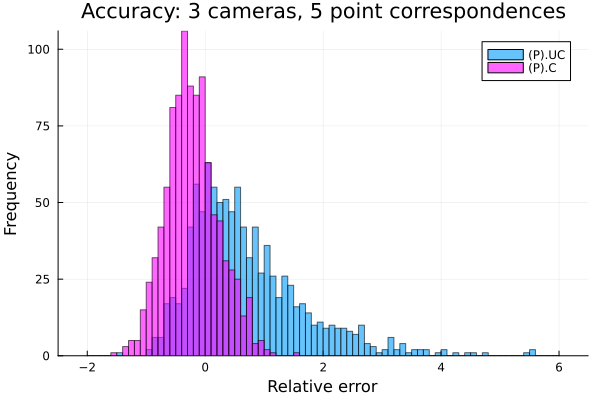
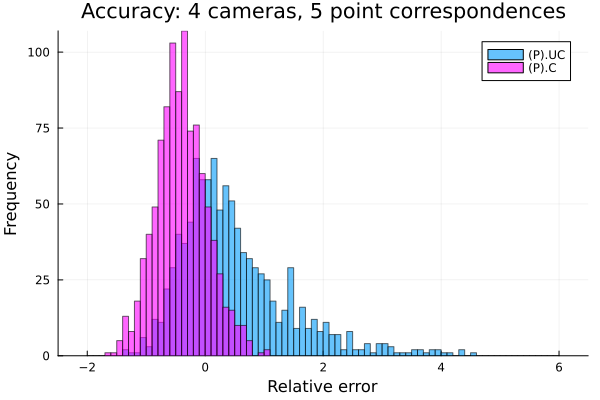
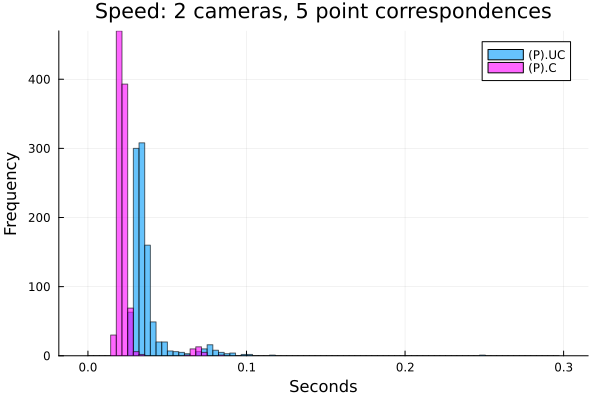
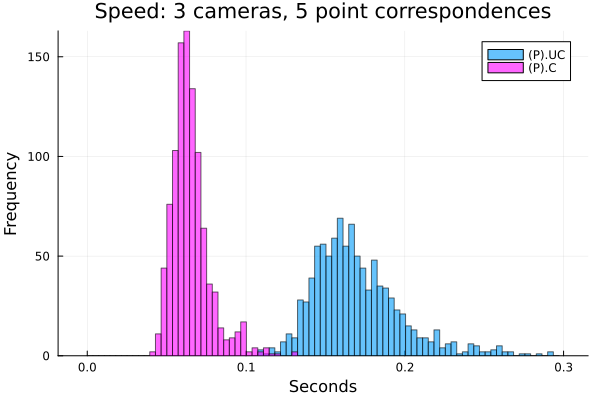
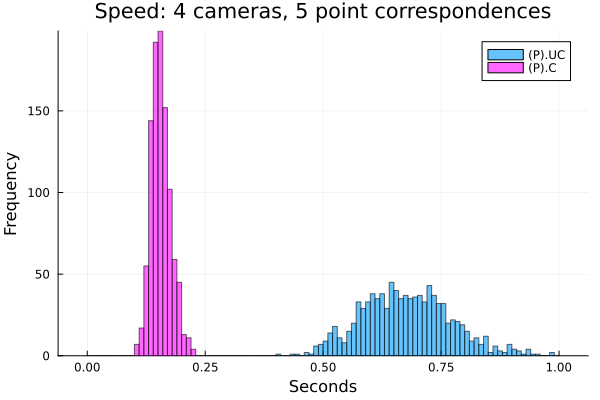
Figure 2: Triangulation errors and runtime distributions over 1000 coplanar cases for Π6 cameras. Planar-constrained methods outperform unconstrained triangulation across all metrics.
Extensive histogram analysis of derivative errors confirms solver stability on randomized synthetic problems. Notably, the planar constraint yields more robust and repeatable convergence compared to unconstrained solvers.
Numerical Experiments on Synthetic and Real Data
Experiments are conducted on randomly generated camera setups, noise-perturbed image correspondences, and ground-truth planar point clouds. Two principal baseline methods are compared:
- (P).UC (Unconstrained): Treats each point generically in Π7, ignoring the planar structure.
- (P).C (Constrained): Jointly triangulates correspondences by projecting onto the planar-anchored variety.
The evaluation metric is the logarithm of the average relative triangulation error, normalized with respect to noise magnitude. The planar-constrained method consistently achieves lower errors and faster runtime profiles. In all regimes, leveraging the planar model improves geometric fidelity and computational tractability.
For real data evaluation, the methods are benchmarked on the CAB sequence from the Lamar dataset, using RGB-D ground-truth. Plane detection is achieved through depth prediction and RANSAC fitting, and triangulated results are compared to the high-accuracy laser scans.
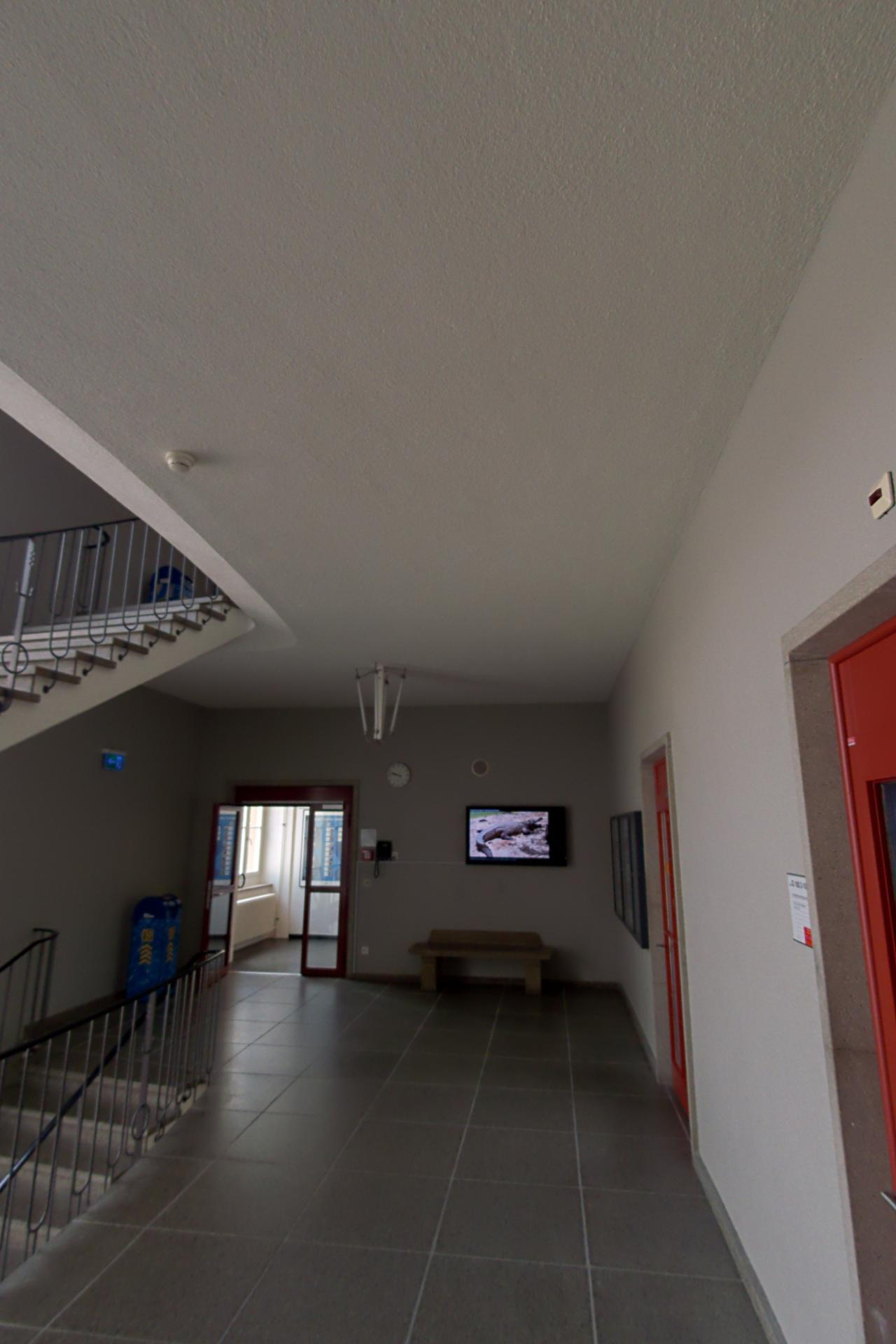
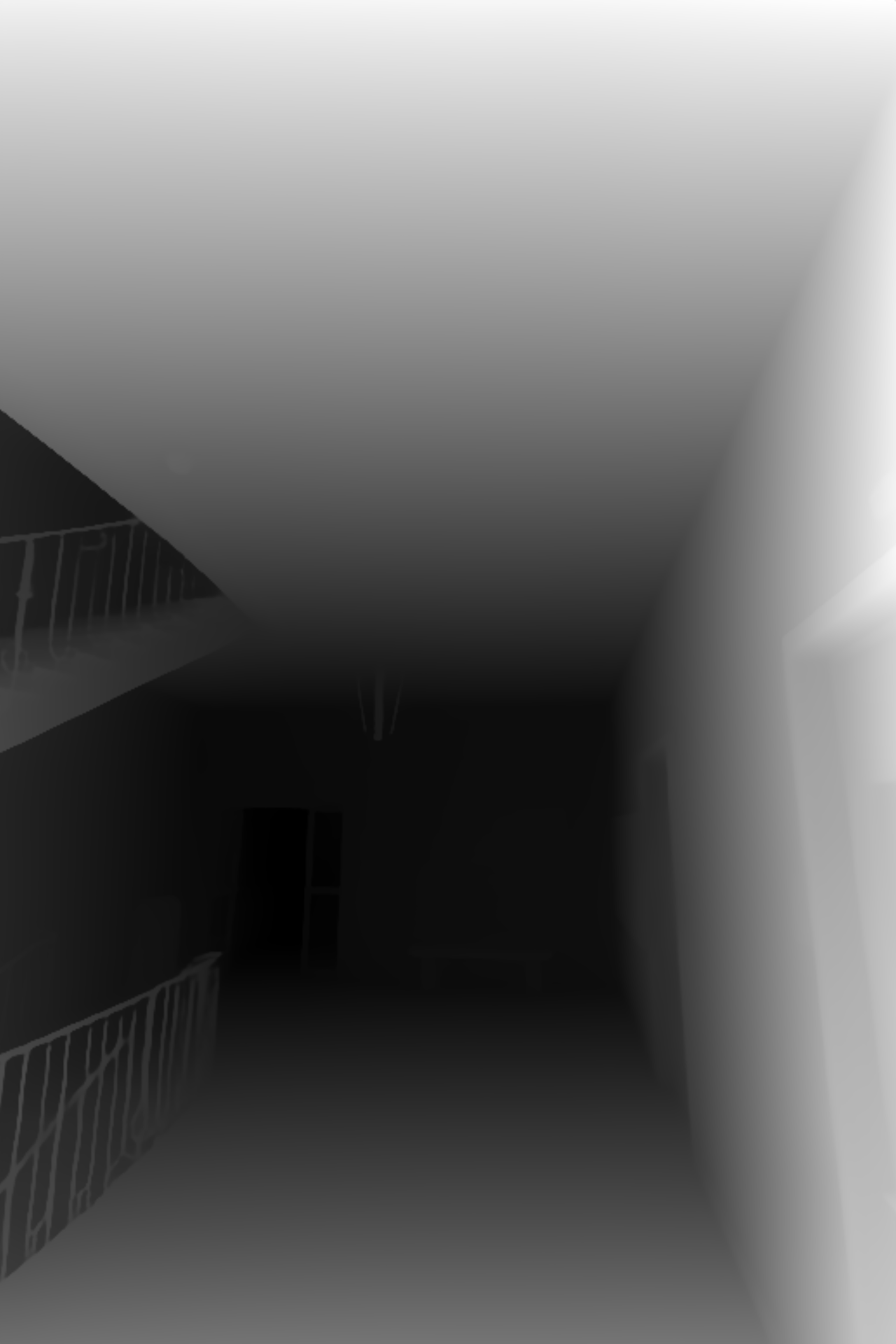
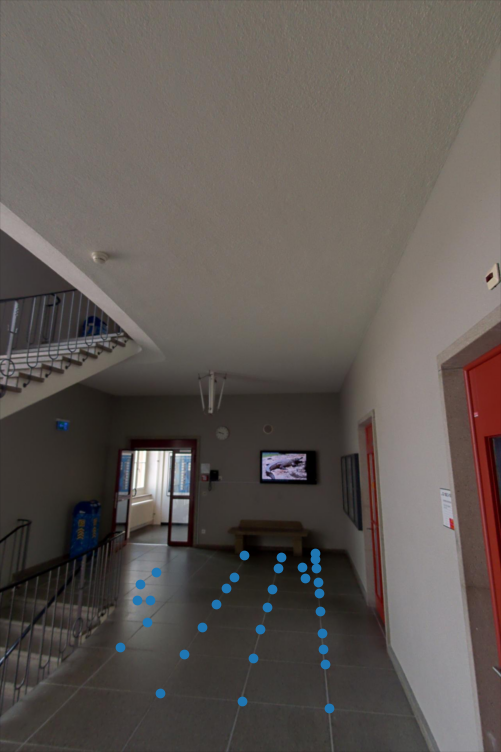
Figure 3: Example image from the Lamar dataset, with corresponding depth prediction and plane segmentation, used in the real data planar triangulation evaluation.
On real-world data, constrained triangulation demonstrates markedly improved accuracy: for Π8 views, the primary peak of triangulation errors for the planar-constrained approach is at approximately 4 cm, compared to 10 cm for the unconstrained baseline. A hybrid method is also presented to address misclassifications, switching to unconstrained solvers when the reprojection error post-planar triangulation is excessive. The constrained methods also exhibit reduced rates of failed reconstructions (signaled by large outlier errors).
Implications and Future Directions
The planar-anchored approach offers several theoretical and practical implications:
- Complexity reduction: The derived EDdeg quantifies how geometric priors (here, planarity) can dramatically simplify triangulation, lowering the ambient degree of the polynomial systems to be solved.
- Robustness and accuracy: Specialized solvers for planar-anchored varieties not only are faster but yield reconstructions that better reflect the physical source of image correspondences in structured environments (e.g., architectural interiors, urban facades).
- Generality: The algebraic framework readily generalizes to other structured varieties (e.g., line-anchored, curve-constrained) and provides a blueprint for integrating geometric priors into minimal solver design.
The findings suggest that modern Structure-from-Motion (SfM) pipelines would benefit from explicit exploitation of planar priors, for both fundamental matrix estimation and for bundle-adjustment initializations. Open directions include extending these results to lines and higher-order features, integration with incremental 3D reconstruction software (such as COLMAP and LIMAP), and approximative solvers for use in real-time or out-of-core scenarios.
Conclusion
This study rigorously characterizes the algebraic and algorithmic foundation of multi-view triangulation for points constrained to a plane. The explicit formula for the EDdeg underscores the complexity savings introduced by structured priors. The designed minimal solvers achieve superior accuracy and efficiency relative to unconstrained algorithms, as substantiated by large-scale experiments on both synthetic and real-world datasets. The theoretical contributions and practical findings motivate broader adoption of geometric constraints in 3D vision pipelines and open promising avenues for further research in algebraic computer vision.