Perturbative Coulomb branches on R3×S1: the global D-term potential
Published 29 Apr 2026 in hep-th and math-ph | (2604.27066v1)
Abstract: We find the perturbative potential on the 3d N!=!2 Coulomb branch arising from a chiral 4d N!=!1 gauge theory on R<sup>3</sup>×S<sup>1, zeta-regularizing the D-term couplings generated by the Kaluza-Klein modes. This fills a significant gap in the literature on circle-compactified SUSY gauge theories. Unlike earlier indirect approaches to the circle reduction of chiral theories, our formula provides a global view of the Coulomb branch, necessary for capturing holonomy saddles and for systematic implementation. The zero locus of the potential identifies perturbative SUSY vacua, and we show how data-analysis techniques (such as RANSAC hyperplane detection) numerically extract the structure of the moduli space when this locus is extended. Our formula yields new results even in abelian theories, and offers a new perspective on several earlier observations in the context of the Cardy limit of the superconformal index. In particular, circle reductions (of interest in the SCFT/VOA correspondence) found earlier from limits of the index can now be reproduced on R<sup>3</sup>×S<sup>1. An appendix shows how our 3d N!=!2 potential is related to a function arising in the Cardy limit of the index analogously to how the 4d N!=!2 prepotential arises in a limit of the Nekrasov partition function.
The paper formulates a closed-form, zeta-regularized D-term potential across the full Coulomb branch for chiral gauge theories.
It employs a rigorous 4d to 3d compactification strategy, accurately integrating the full Kaluza-Klein tower to overcome limitations of earlier methods.
It introduces a robust numerical pipeline using clustering, LPCA denoising, and RANSAC hyperplane detection to systematically analyze SUSY vacuum structures.
Perturbative Coulomb Branches on R3×S1: Global D-term Potential in Chiral N=1 Gauge Theories
The work "Perturbative Coulomb branches on R3×S1: the global D-term potential" (2604.27066) rigorously formulates the perturbative scalar potential on the classical Coulomb branch of circle-compactified four-dimensional N=1 chiral gauge theories. By zeta-regularizing the 1-loop D-term contributions from the full Kaluza-Klein tower, the analysis achieves a globally valid, chamber-independent description that overcomes limitations of earlier reduction or effective-action approaches, especially in the presence of chirality. The results resolve a significant technical gap and permit systematic, numerical, and analytic exploration of supersymmetric vacuum structure in these theories.
Formulation of the Global D-term Potential and Its Structure
The central object is the perturbative scalar potential VD on the moduli space parameterized by holonomy variables xj (gauge holonomies along S1), modulo the Weyl group. Using compactification from 4d to 3d and a precise Wilsonian cutoff, the vacuum structure is organized as a decomposition of the moduli space into "outer" (no light charged states) and "inner" (with light charged states) patches. In the outer patch, integrating out all KK-modes with real mass above the cutoff, the D-term potential is determined by the effective FI parameters and Chern-Simons (CS) couplings, both receiving 1-loop contributions:
with ζ~(4) the dimensionless 4d FI parameter, ρ denoting gauge weights (summed appropriately), and N=10 a periodic Bernoulli polynomial accounting for the zeta-regularized sum over KK modes. The potential is globally defined and explicitly encodes the entire effect of chirality and boundary condition twists.
The zeros of N=11 correspond to perturbative SUSY vacua, and their locus inside the classical Coulomb branch typically comprises unions of hyperplanes and isolated points, reflecting the piecewise-linear structure enforced by anomaly cancellation.
Figure 1: Decomposition of the classical Coulomb branch for a N=12 gauge theory such as SQED (left) and an N=13 gauge theory such as SQCD (right). The moduli space splits into outer and inner patches characterized by different 3d EFTs.
Analysis of Inner Patches and Theoretical Conjectures
The structure within inner patches, where charged states become light, generically falls outside perturbative control. The analysis shows that the naive extension of the outer patch formula across the walls (loci of massless charged fields) leads to unphysical discontinuities—these must be resolved by averaging over adjacent chambers or, more generally, by incorporating the full light spectrum. Accordingly, the authors conjecture that vanishing of N=14 is a necessary but not sufficient condition for a supersymmetric vacuum to exist on an inner patch. This subtlety is reinforced by connections to the Cardy limit of the superconformal index, where similar necessary criteria for saddle point contributions are identified.
The analysis further highlights the importance of Kähler (or "Kähler potential type") corrections that modify the coefficient of the D-term in the inner patches, rendering the precise arithmetic of vacuum structure sensitive to both perturbative and non-perturbative effects, especially in rank-one cases with SQED-like regions or nontrivial infrared dynamics.
Numerical Algorithms for Moduli Space Structure
To effectively study complex vacuum loci (especially at higher rank), the paper introduces a robust numerical pipeline, integrating clustering (DBSCAN), denoising (Local PCA), and hyperplane detection (RANSAC):
Vacuum Dataset Generation: The moduli space (represented as a high-dimensional unit cube) is discretized, and points where N=15 is below a set threshold are recorded as candidate vacua.
Clustering: DBSCAN identifies connected components, separating different branches or disconnected regions of vacua.
LPCA Denoising: Principal component analysis in neighborhood windows projects the data onto dominant flat directions, suppressing numerical noise from discretization.
RANSAC Hyperplane Detection: Iteratively detects and parameterizes the flat directions (hyperplanes, lines, points) characterizing the moduli space structure.
This approach, validated up to rank-three systems, is poised for generalization to higher-rank gauge theories, and provides a crucial tool for nontrivial vacuum geometries.
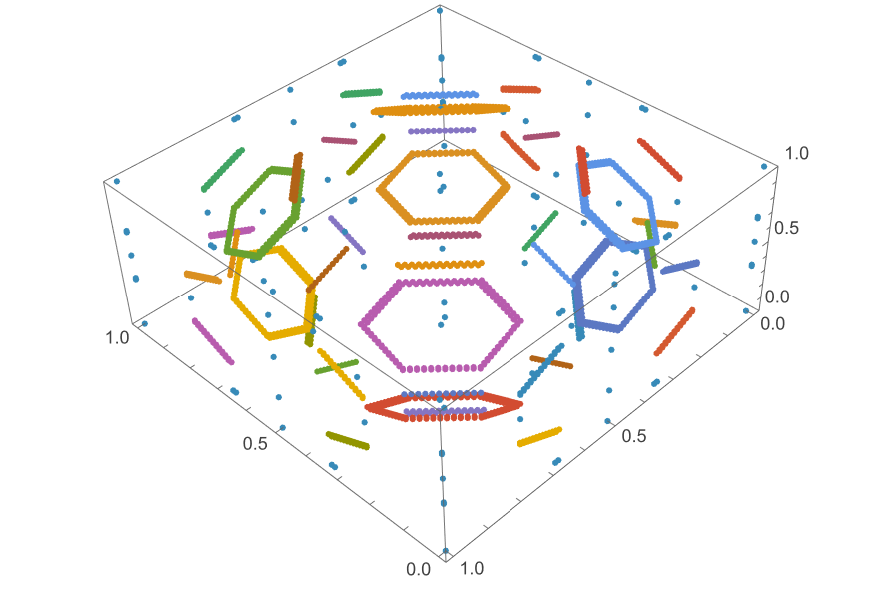
Figure 2: DBSCAN clustering of approximate zeros of N=16 for the N=17 theory. Each cluster corresponds to a distinct connected component of the SUSY vacuum locus, here formed by 1d intervals and 0d points.
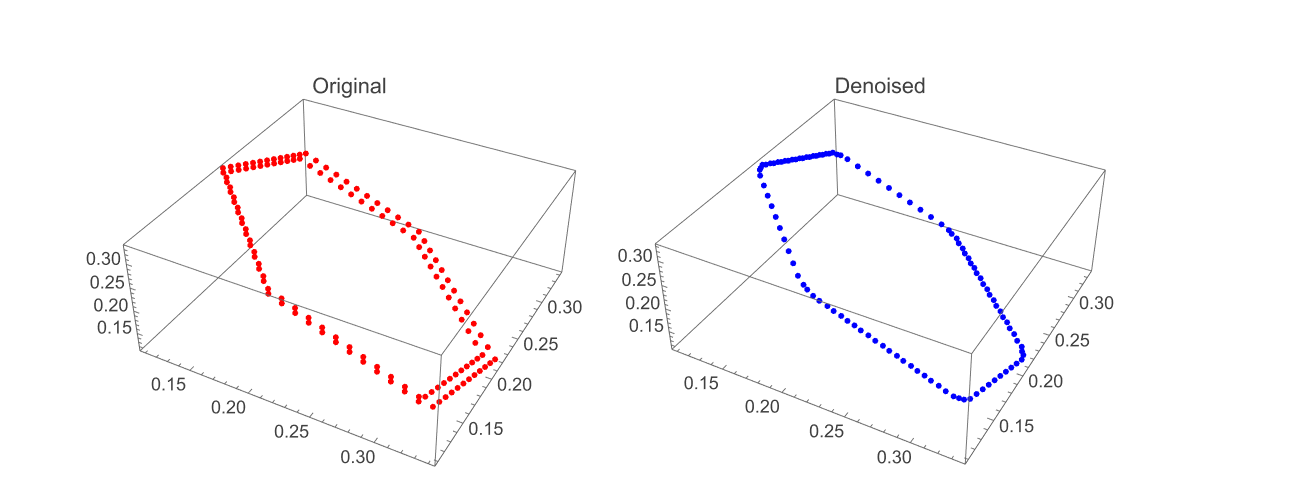
Figure 3: LPCA-denoised cluster in the N=18 example, showing preservation of the geometric features (shape) of the vacuum moduli space after noise reduction.
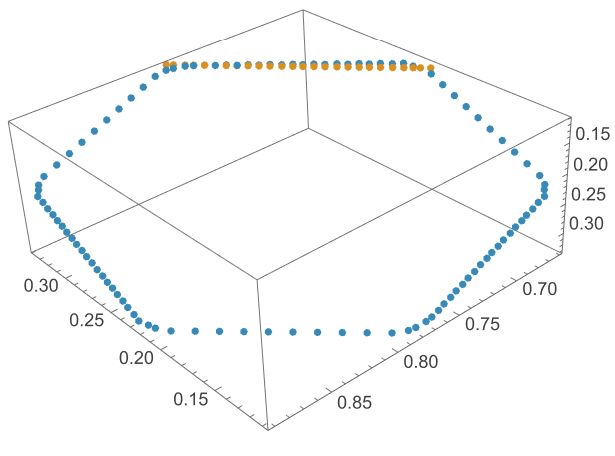
Figure 4: RANSAC-based hyperplane detection overlays a fitted line (orange) confirming the 1d nature of the hexagon cluster in N=19.
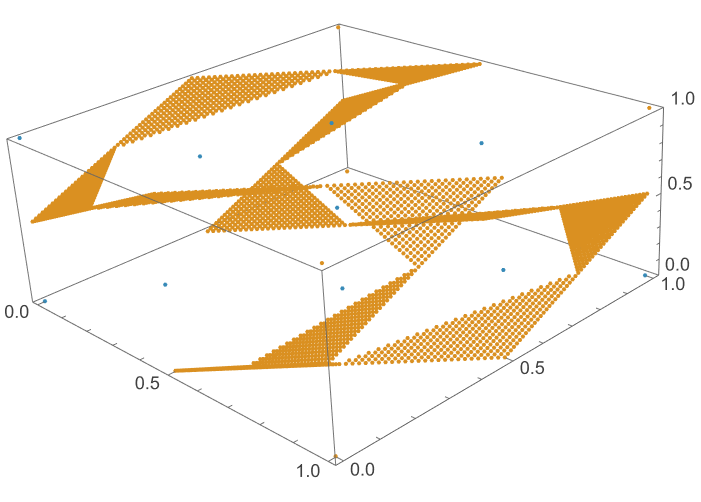
Figure 5: DBSCAN clustering for R3×S10. Here, the vacuum moduli space comprises connected two-dimensional hyperplanes (triangles) and isolated points.
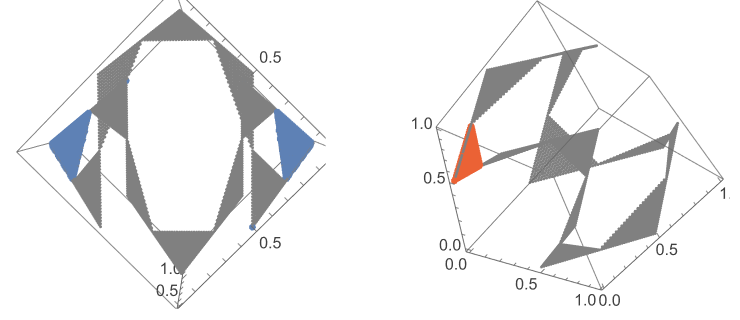
Figure 6: RANSAC-detected planes in the R3×S11 vacua demonstrate the method's capacity to resolve coplanar and non-coplanar hyperplanes in complex moduli spaces.
Implications, Broad Connections, and Future Directions
The explicit global formula for the D-term potential offers a universal and computationally tractable foundation for the study of chiral R3×S12 gauge theories on R3×S13. This enables:
Reinterpretation of SCFT/VOA Correspondence: The framework clarifies the analytic continuation between the Cardy limit of the superconformal index and the genuine dynamics in the compactified geometry, unifying previously distinct approaches.
Symplectic and Algebraic Structure: The moduli space decompositions and the associated vacuum structure are anticipated to play roles in the modern study of symplectic singularities and quantum field theory representation theory.
AI and Data Analysis in Theoretical Physics: The adoption of machine learning and statistical techniques for moduli-space exploration demonstrates new paradigms for bridging analytic and computational investigations in high-energy theory.
The formalism provides the perturbative starting point for more challenging non-perturbative analyses, such as the structure of dressed monopole superpotentials and the resolution of strongly coupled vacua in inner patches. The observation that the current method enables "chamber-independent" circle compactification calculations removes prior obstacles in studying reductions of genuinely chiral 4d gauge theories and their vacuum landscapes.
Conclusion
This work achieves a comprehensive, global, and computationally accessible characterization of the perturbative Coulomb branch potential for 4d R3×S14 chiral gauge theories compactified on R3×S15. The most significant contributions are:
The closed-form, zeta-regularized D-term potential valid across all chambers, making strongly technical advances over patchwork or indirect approaches.
A numerical and algorithmic framework for extracting and analyzing the moduli space of SUSY vacua, deployable to a wide class of gauge theories.
A clarified dictionary between 4d superconformal indices (in the Cardy limit) and the explicit moduli space geometry and vacuum equations.
A conjecture relating the necessary conditions for SUSY vacua in inner patches to both analytic structure and non-perturbative dynamics.
Future developments are expected in non-perturbative generalizations, resolution of Kähler ambiguities, and broader cross-disciplinary applications of numerical tools in quantum field theory.