- The paper establishes global well-posedness for AA chemotaxis models using energy functional methods to derive uniform bounds.
- It demonstrates exponential convergence to homogeneous steady states with rigorously quantified decay estimates under weakly singular sensitivity (0 < k < 1).
- The work validates theoretical results with numerical simulations that capture Turing instabilities and evolving pattern dynamics in 2D domains.
Global Boundedness and Asymptotic Behavior of a Chemotaxis System with Weakly Singular Sensitivity for Alopecia Areata
Introduction and Mathematical Model
This paper delivers a rigorous mathematical analysis of a chemotaxis system tailored to the pathogenesis of Alopecia Areata (AA), a T-cell driven autoimmune disorder affecting hair follicles. The system under investigation models the densities of CD4+ T cells (u), CD8+ T cells (v), and interferon-gamma (IFN-γ, w), incorporating weakly singular sensitivity in the chemotactic response with respect to w: {ut=Δu−χ1∇⋅(wku∇w)+w−μ1u2, vt=Δv−χ2∇⋅(wkv∇w)+w+ruv−μ2v2, wt=Δw+u+v−w,
on a smooth bounded domain Ω⊂R2, with homogeneous Neumann boundary conditions. Here, χi>0 are chemotactic sensitivities, u0 encode quadratic damping, u1 models cross-species proliferation, and u2 quantifies the degree of sensitivity singularity.
The principal theoretical novelty is allowing for weakly singular (u3) chemotactic sensitivity, in contrast to the classical strong singular (u4) or regular (u5) settings. Such weak singularities are motivated by more realistic biochemical signal processing, avoiding technical blow-up challenges while retaining the analytical subtlety of near-zero signal regimes.
Main Analytical Results
The work establishes that, for arbitrarily large regular initial data, all solution components remain globally well-posed and uniformly bounded for all time. The proof utilizes an energy functional approach: u6
allowing the authors to control u7 and u8 without imposing a strictly positive lower bound on u9—a critical obstacle for weak singularities. Through a refined series of a-priori estimates, +0-bounds for all +1 are subsequently constructed for +2, +3, and +4. The approach is an extension of the strategy from the scalar, single-species weakly singular Keller-Segel system [le2025absence] to the coupled CD4+5/CD8+6/IFN-+7 AA context, facing additional difficulties due to the nonlinear coupling term +8.
Formally: +9
for all v0, with v1 independent of time.
Asymptotic Convergence to Steady State
Beyond boundedness, the analysis demonstrates exponential convergence to the spatially homogeneous steady state
v2
where v3, under the critical regime v4 and v5. A Lyapunov functional of entropy type is constructed to facilitate dissipation estimates: v6
with
v7
where v8 is the squared v9-distance to steady state. This yields
γ0
for some γ1.
The structure of the proof handles the complicated cross-diffusive nonlinearity, controlling all higher-order derivatives by bootstrapping γ2 and γ3 bounds, yielding uniform parabolic regularity and ultimately Hölder and Sobolev bounds for all variables.
Numerical Simulation and Spatio-Temporal Dynamics
To corroborate the theoretical predictions, a finite-difference and finite-volume numerical framework is implemented on a two-dimensional domain, with explicit Euler time-stepping and positivity-preserving cutoffs. The system is initialized near the steady state with small random perturbations, and the evolution of γ4 is visualized at selected times.
The simulations elucidate the dissipative dynamics: transient spatio-temporal patterning (Turing-like instability), subsequent peak coalescence, smoothing towards quasi-uniformity, and eventual sharp convergence towards the homogeneous steady state.
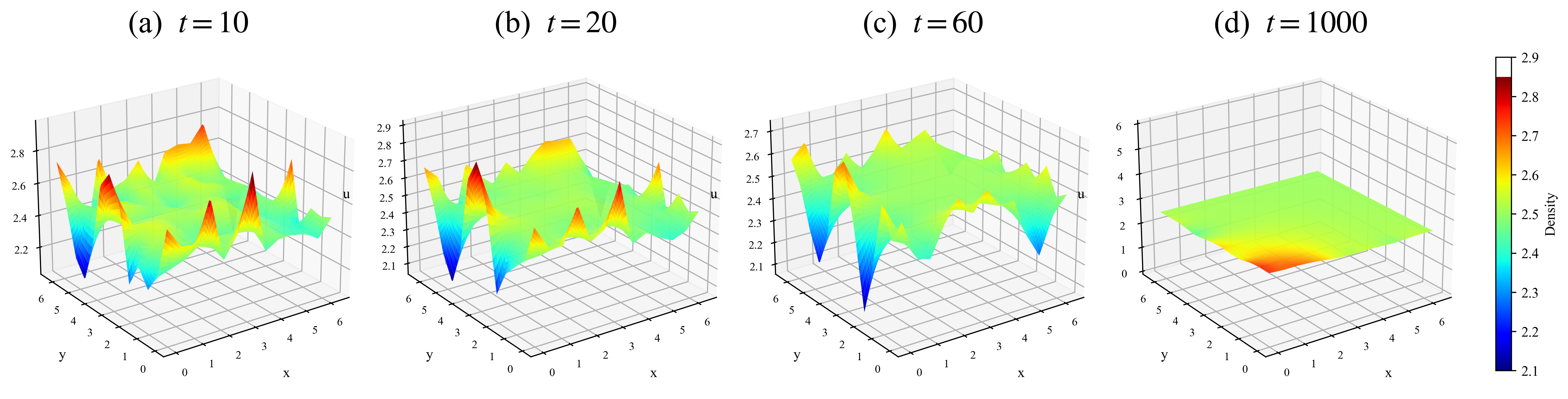
Figure 1: Spatio-temporal evolution and Turing instability of γ5 for the chemotaxis system with weakly singular sensitivity (γ6), illustrating early pattern formation and gradual return to equilibrium.
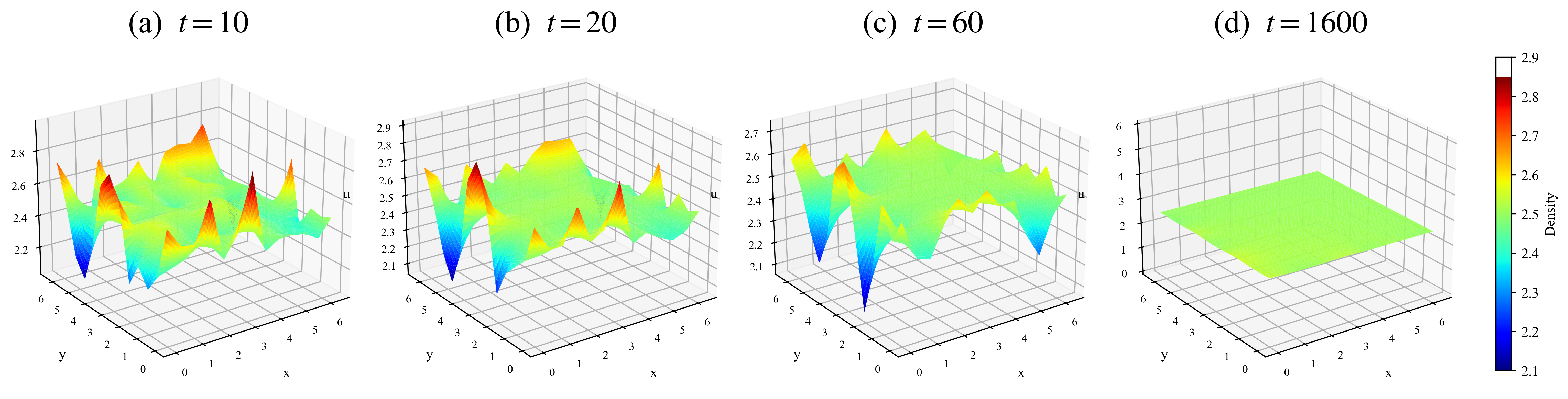
Figure 2: Continued evolution with γ7, showing the decay and smoothing of spatial heterogeneities over time.
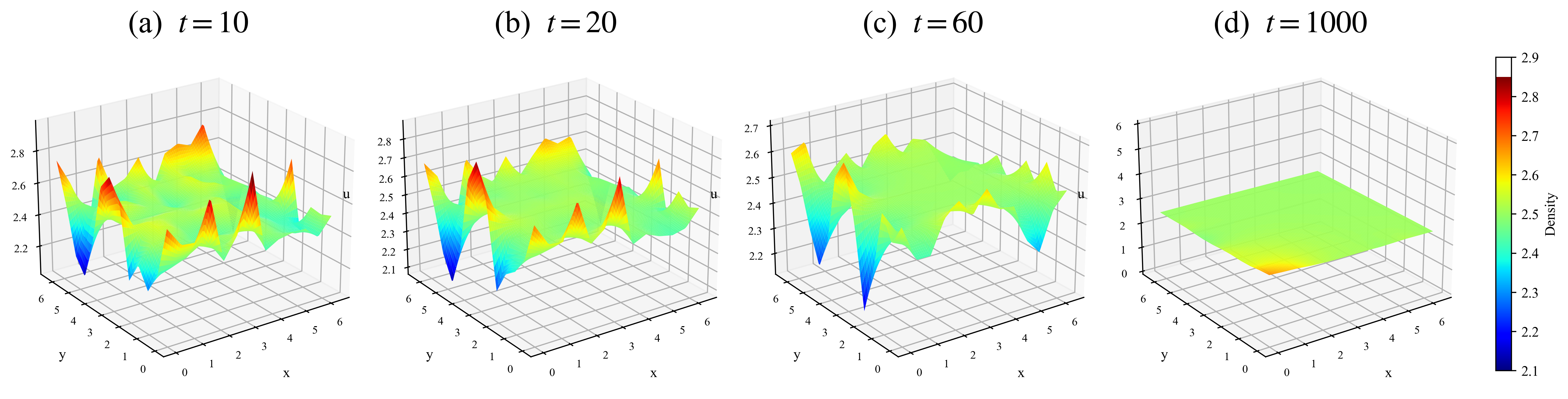
Figure 3: Spatio-temporal evolution for the case γ8, corresponding to the standard singular sensitivity case; pattern formation is more pronounced, and convergence is slower.
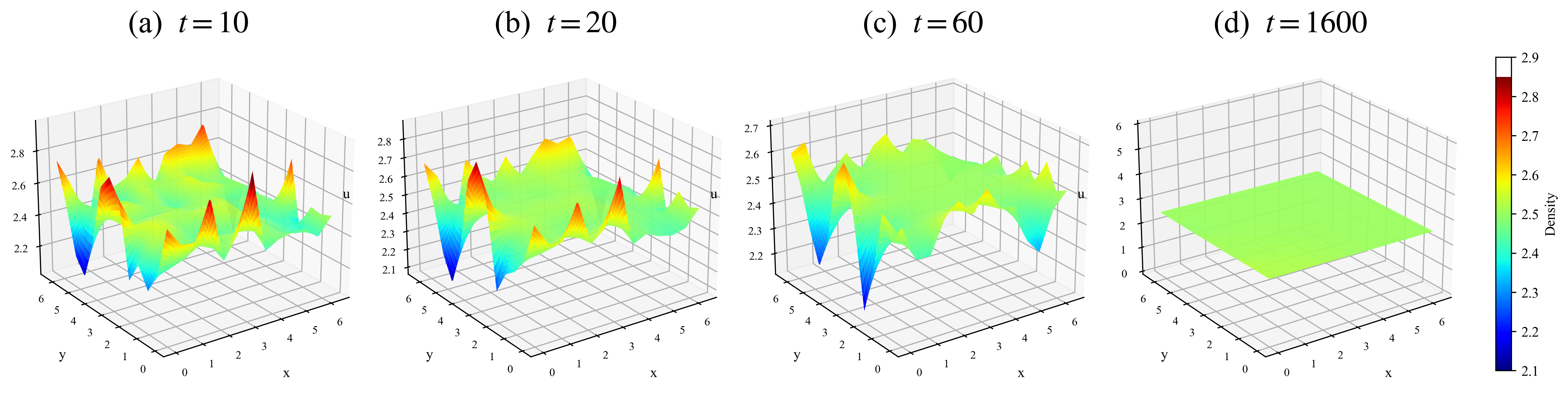
Figure 4: Long-time behavior for γ9, emphasizing persistent heterogeneity and slower stabilization compared to w0.
The computational experiments confirm that weakly singular sensitivity slows the asymptotic convergence—requiring longer times to reach the homogeneous steady state compared to the fully singular (w1) or regular case.
Theoretical and Practical Implications
On the theoretical side, the paper resolves a previously open case for AA models: global well-posedness and exponential stabilization for two-species, one-signal systems with weakly singular chemotactic sensitivity. The results extend and refine existing theory on Keller-Segel-type systems and apply directly to higher-structure AA models relevant in biomedical contexts. The methods—particularly the construction and manipulation of tailored energy functionals—are potent for a broad range of multicomponent reaction-diffusion-chemotaxis systems with singular or near-singular structure.
Practically, these findings imply that chemotactic aggregation induced by weakly singular IFN-w2 sensitivity cannot produce pathological blow-up or pattern persistence in 2D tissue domains, provided appropriate dissipative mechanisms (logistic-type damping, sufficiently large w3) are in effect. For AA, this supports the mathematical well-posedness of spatio-temporal models incorporating more neurobiologically plausible signaling kinetics.
Future Directions
Potential extensions include analysis in higher spatial dimensions (w4), fully parabolic cross-diffusion with additional nonlinearities, generalization to signal-dependent diffusion, or inclusion of more biologically faithful coupled signaling and immune dynamics. The perturbation and functional methods employed here could be adapted to infer threshold bounds for singularity exponents w5 and to analyze metastable pattern formation for small but nonzero w6.
Conclusion
This work establishes global boundedness and exponential convergence for the AA chemotaxis system with weakly singular chemotactic response. The results fill an essential gap in the PDE theory of such coupling-structured autoimmune disease models, providing rigorous analytical guarantees as well as computational evidence for the predicted long-time dynamics.
(2604.26905)