- The paper introduces a Gaussian asymmetry measure derived from quantum relative entropy within the Gaussian manifold.
- It provides analytic results on quasiparticle dynamics, with a linear decay and saturation of asymmetry post-quench.
- The work offers operational diagnostics and resource-theoretic insights, illuminating symmetry restoration in quantum systems.
A Gaussian Asymmetry Measure: Operational Definition, Dynamics, and Implications
Introduction and Conceptual Framework
The quantification of symmetry breaking in quantum many-body systems is critical for understanding thermalization, transport, and entanglement dynamics, especially in out-of-equilibrium situations. Standard approaches utilize entanglement asymmetry (EA)—typically defined as the relative entropy between a local reduced density matrix and its symmetrization over charge sectors. While this is a general and robust measure, in free-fermionic systems it introduces non-Gaussianity, thus disconnecting the asymmetry quantifier from the manifold traversed by the system's dynamics. The present work introduces a novel "Gaussian asymmetry" ΔS(G), persistently defined within the Gaussian manifold, and demonstrates its strong analytical tractability and physical relevance (2604.26878).
Definition and Properties of Gaussian Asymmetry
The Gaussian asymmetry is the quantum relative entropy between a Gaussian reduced density matrix ρA and its Gaussian-symmetrized version ρA(s), where the latter is constructed by removing the pairing (off-diagonal, anomalous) sector, thereby rendering the subsystem formally symmetric under the appropriate U(1) charge. Concretely,
ΔSA(G)=S(ρA∣∣ρA(s))=S(ρA(s))−S(ρA).
All quantities are Gaussian and can be efficiently computed via the subsystem correlation matrix. This measure fulfills key criteria:
- ΔSA(G)≥0, and vanishes if and only if ρA is invariant under the symmetry.
- It is operationally meaningful—it reduces to the minimal relative entropy between ρ and all symmetric Gaussian states, aligning with the structure of quantum resource theory for Gaussian channels.
- Unlike standard EA, ΔSA(G) is generally extensive in the subsystem size, properly capturing the distance from the symmetric Gaussian manifold, as opposed to the entropic distance to fully symmetrized (generically non-Gaussian) states.
Analytic Solution and Quasiparticle Dynamics
The analytic structure of ΔSA(G) allows for explicit, asymptotically exact dynamical results using the quasiparticle picture—a powerful framework in free systems for entanglement spreading following a quantum quench. For initial coherent Gaussian states with pair structure,
ρA0
where ρA1 is the subsystem length, ρA2 the group velocity, and ρA3 a single-mode entropy functional. Notably, the time dependence manifests as a linear decrease of asymmetry until ρA4, followed by saturation—a direct reflection of the ballistic propagation of entanglement and local relaxation mechanisms.
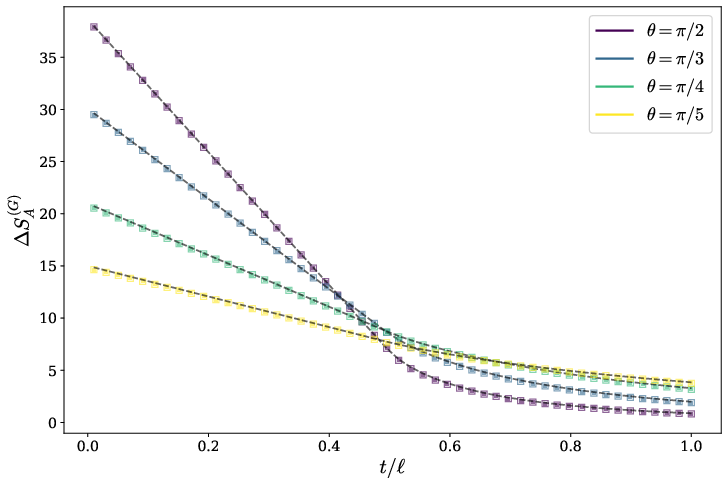
Figure 1: Gaussian asymmetry in a quench from a tilted ferromagnetic state with various tilt angles, showing ballistic linear decrease and subsequent saturation—signature of the quasiparticle picture and quantum Mpemba effect.
For generic initial states (e.g., tilted Néel), the asymmetry does not necessarily decay to zero, reflecting the absence of symmetry restoration—a feature also encoded directly and quantitatively by non-vanishing long-time values in the analytic formula for ρA5.
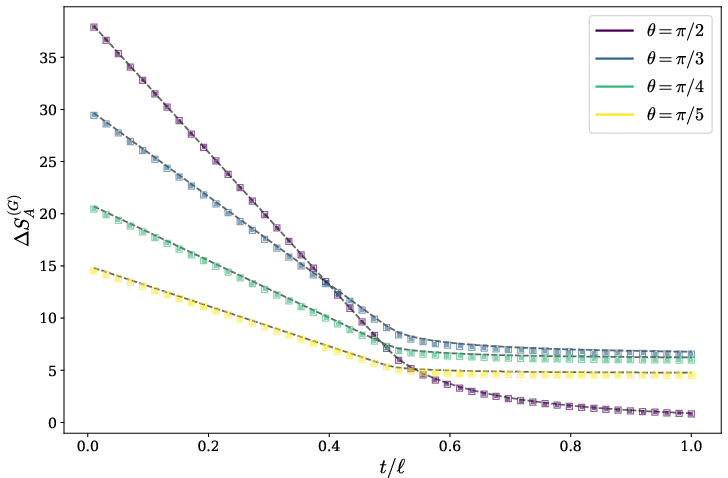
Figure 2: Gaussian asymmetry in a quench from a tilted Néel state evidencing lack of symmetry restoration, with long-time plateau behavior.
Mpemba Effect and Dynamical Symmetry Restoration
The Gaussian asymmetry retains the sensitivity of the entanglement asymmetry to dynamical features such as the quantum Mpemba effect, in which initially less symmetric (greater asymmetry) states can, paradoxically, equilibrate to symmetry faster than less asymmetric ones—a phenomenon captured analytically through the detailed structure of the occupation (mode populations) and velocities in Eq. (3.13) of the paper. The framework shows that the effect is governed by the balance of purity in fast versus slow quasiparticle modes; when slow modes are purer, states with higher initial breaking can restore symmetry more rapidly.
Relation to Non-Gaussianity and Resource Theoretic Interpretation
Given any Gaussian state, the standard EA involves a symmetrization that outputs a non-Gaussian object. By contrast, the Gaussian asymmetry remains fully within the analytically tractable Gaussian sector. The paper establishes the decomposition:
ρA6
with ρA7 denoting the non-Gaussianity of ρA8 (measured by relative entropy to its Gaussianization). Consequently, ρA9 quantifies not just symmetry-breaking, but also the extent that symmetrization drives the state away from Gaussianity—an effect that is generally extensive, highlighting a profound disconnect between the dynamical (Gaussian) manifold and the symmetric sector addressed by full twirling.
Typicality and Statistical Structure
Averaging over random Gaussian states reveals a typical extensive scaling for ρA(s)0, with smooth dependence as a function of subsystem fraction ρA(s)1, and without the sharp Page-curve-like transitions observed in Haar-random (non-Gaussian) states. This signals the essential role played by the entanglement structure in the Gaussian ensemble, fundamentally distinct from the full Hilbert space statistics.
Operational Diagnostics: FCS-Based Asymmetry and Charge Fluctuations
The approach naturally suggests experimentally accessible probes. The difference in cumulants or even the full counting statistics (FCS) of the local charge between the original Gaussian state and its symmetrized partner serves as a practical diagnostic. Analytical expressions are available for the variance, higher cumulants, and the generating function, all reflecting symmetry restoration or its absence in real time.
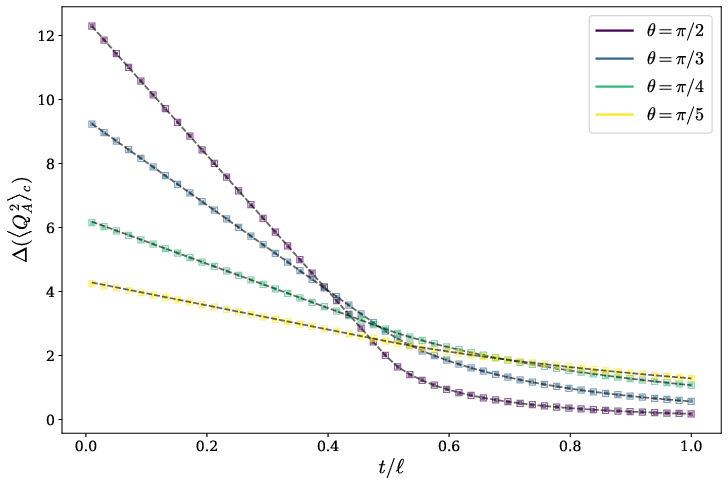
Figure 3: Dynamics of the charge variance difference after a quench, providing a direct experimental diagnostic of symmetry restoration processes, and displaying features analogous to the Gaussian asymmetry.
Extensions and Theoretical Implications
The operational and analytic utility of ρA(s)2 opens several natural directions:
- Dissipative and Monitored Dynamics: The measure is inherently suited to settings with linear dissipation or continuous measurement, where dynamics remain Gaussian but may restore symmetry non-trivially.
- Interacting Integrable and Non-Integrable Systems: The work suggests possible extensions by analogy to the "integrable" manifold, though canonical symmetrization (as in the Gaussian case) might not always be available.
- Resource-Theoretic Perspective: ρA(s)3 is a monotone under symmetric Gaussian CPTP maps, making it an appropriate quantifier of symmetry-breaking resources in experimental or protocol-driven operations.
Conclusion
This work establishes a mathematically robust, physically meaningful, and computationally tractable measure of quantum asymmetry that is intrinsic to the Gaussian manifold. It preserves the diagnostic acuity of conventional asymmetry measures while facilitating analytic treatment of non-equilibrium phenomena, such as the quantum Mpemba effect and lack of symmetry restoration, in experimentally relevant settings. The measure’s extensivity and connection to non-Gaussianity underscore fundamental aspects of quantum symmetry dynamics, and further establish the Gaussian manifold as a privileged sector for both analytic calculations and quantum information processing protocols (2604.26878).

