- The paper proposes SPA-SDF, a pose-conditioned implicit representation that overcomes the rigid prior to detect anomalies in articulated 3D geometries.
- It introduces the ArtiAD benchmark with over 15K annotated point clouds to evaluate performance across seen and unseen pose configurations.
- Empirical results demonstrate that SPA-SDF outperforms rigid-based methods, achieving AUROC scores above 0.87 and ensuring robust defect localization.
Articulated 3D Anomaly Detection Beyond the Rigid Prior: ArtiAD and SPA-SDF
Motivation and Problem Setting
Anomaly detection from 3D geometry is central to high-assurance applications such as industrial inspection, where structural defects must be reliably discerned from valid object variations. Existing methodologies underpin their algorithms with a rigid prior—the assumption that all normal objects within a category are pose-invariant and reducible to a unique canonical representation via rigid registration. However, this paradigm fundamentally collapses when posed with articulated objects whose legitimate geometry is functionally pose-dependent due to underlying kinematics (e.g., hinges, prismatic joints). Discrete and continuous articulation induces geometric variations orthogonal to the presence of defects, breaking the equivalence between pose and canonicalization. This results in two ubiquitous errors: (1) misidentification of articulation-induced geometry as anomaly (false positives) and (2) the suppression or masking of true defects when conflated with pose-dependent changes (false negatives).
Despite advances in articulated shape reconstruction and anomaly localization, the intersection has thus far gone unaddressed due to a lack of benchmarks supporting pose-annotated, dense and localized defect supervision in the articulated regime. The paper "Breaking the Rigid Prior: Towards Articulated 3D Anomaly Detection" (2604.26868) systematically dissects this limitation and provides both a large-scale simulation-based dataset (ArtiAD) and a novel pose-conditioned implicit learning approach (SPA-SDF) to address anomaly detection in articulated settings.
The ArtiAD Benchmark: Dense, Articulated, Supervised
ArtiAD is engineered to comprehensively quantify anomaly detection performance on articulated objects with continuous pose variation. It spans 15,229 point clouds across 39 distinct object categories, each sampled over dense, physically valid articulation manifolds and augmented with six geometric anomaly types (dents, bulges, fractures, bends, distortions, missing material). Each sample is jointly annotated with its joint-angle configuration and point-wise anomaly mask, providing explicit factorization between kinematic deformation and structural defect.
Fundamental to the utility of ArtiAD is its division into Seen and Unseen splits. Training occurs only on the Seen articulation manifold—pose configurations encountered during training. The Unseen split provides evaluation over articulations outside the training domain, directly testing interpolation/extrapolation capabilities and avoiding spurious memorization of template shapes. This protocol surfaces the generalization properties of pose-conditioned models as compared to rigid, pose-normalized alternatives.
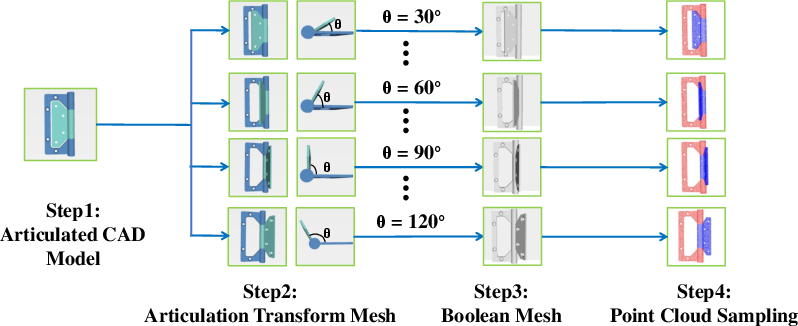
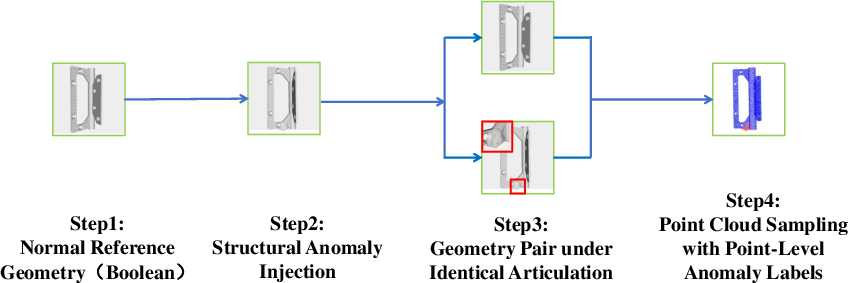
Figure 1: Normal sample generation pipeline, showing synthetic articulated object instantiation with dense, continuous joint variation.
ArtiAD's data generation is graphically structured into two parallel pipelines: one producing pose-conditioned normal geometry and another injecting localized anomalies post-articulation, ensuring pose and defect factors are strictly disentangled.
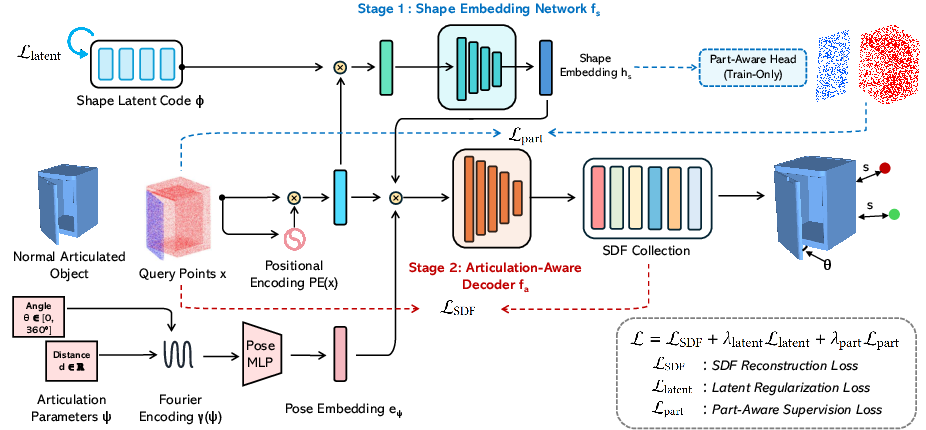
Figure 2: Overview of the SPA-SDF framework for pose-aware 3D anomaly detection. Geometry is modeled as a function of spatial coordinate, shape prior, and pose encoding, supporting joint inference of articulation state and anomaly localization.
SPA-SDF: Pose-Conditioned Implicit Manifolds
To transcend the rigid prior, the paper introduces Shape--Pose-Aware Signed Distance Field (SPA-SDF): a factorized, pose-conditioned implicit representation for normal geometry. Explicitly, SPA-SDF models the manifold of valid shapes as a function f(x;ϕ,ψ), where x is a spatial query, ϕ is a latent code capturing articulation-independent structure, and ψ is the current articulation (e.g., joint angle or displacement).
SPA-SDF leverages multi-frequency Fourier feature mapping to encode articulation states, preserving high-frequency geometric variation across the entire motion manifold. Key architectural attributes include: a two-stage network (shape embedding, articulation-aware decoder), part-level auxiliary supervision, and disentangled optimization objectives targeting SDF reconstruction, latent regularization, and part label consistency.
At test time, SPA-SDF solves for the best-fitting pose ψ (unknown at inference, estimated via grid or gradient-based search to minimize SDF energy) before scoring anomalies as large residuals with respect to the reconstructed surface. This enables one-shot estimation of both the pose and explicit pointwise defects, robust across interpolation and extrapolation regimes.
Empirical Evaluation
Extensive benchmarks on ArtiAD reveal that SPA-SDF demonstrates substantial improvements over all categories of rigid-based baselines, both reconstruction- and feature-matching-based. Specifically, SPA-SDF achieves mean object-level AUROC of 0.884 (Seen) and 0.874 (Unseen), while next-best baselines (e.g., M3DM) stagnate at 0.87. Memory-based and explicit registration-based methods (Reg3D-AD, PatchCore, PO3AD, PASDF) are decisively limited, with object-level AUROCs rarely exceeding 0.76, and in some cases falling to random or sub-random performance.
Ablations underscore the necessity of pose conditioning: removing pose conditioning collapses performance to the rigid prior regime, and multi-frequency Fourier encoding is required for generalization to unseen joint configurations. Auxiliary part supervision further boosts unseen anomaly localization, supporting the manifold's disentangled structural smoothness.
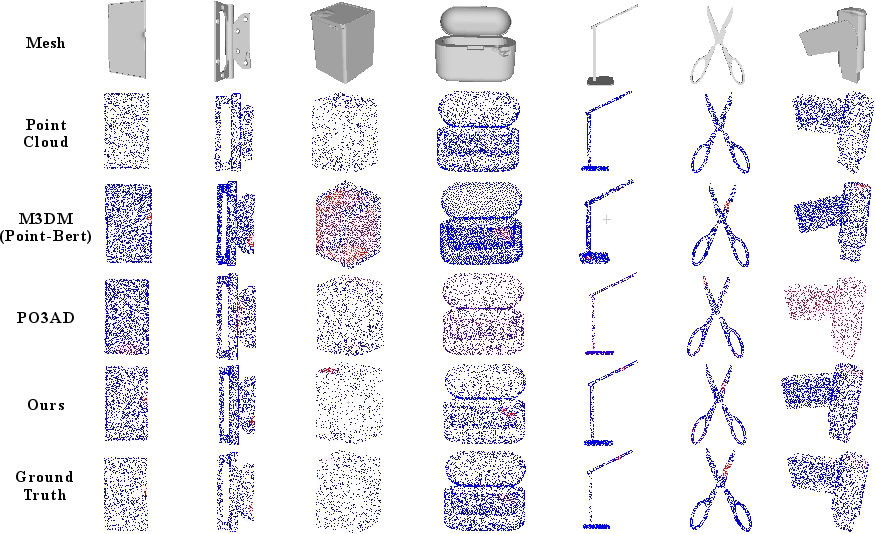
Figure 3: Qualitative comparison of anomaly localization performance on articulated objects. SPA-SDF produces highly precise, pose-invariant defect maps, minimizing false positives in highly deformed regions.
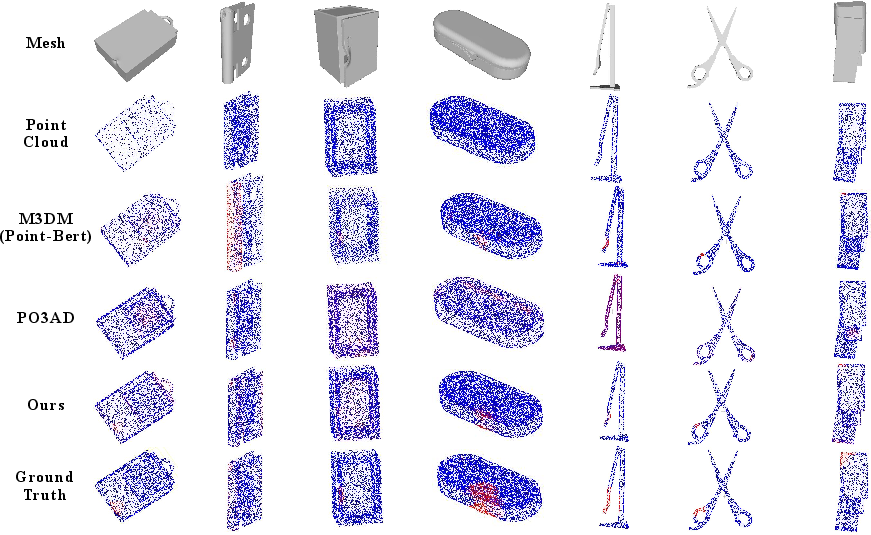
Figure 4: Visualization of SPA-SDF ablations, demonstrating that explicit pose modeling (A4, full model) is required for removal of pose-induced false positives and reliable defect detection across the articulation manifold.
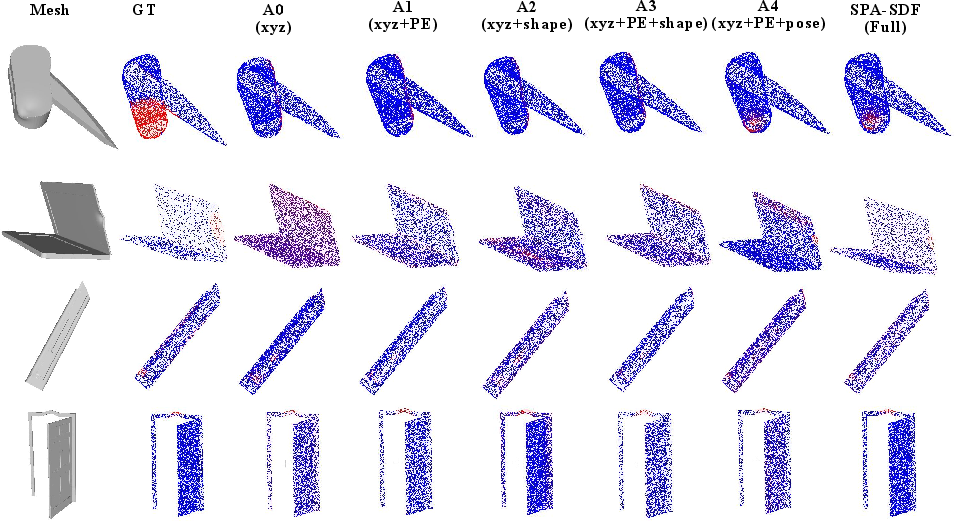
Figure 5: SPA-SDF outperforms M3DM and PO3AD for highly articulated pose variations, showing more accurate and spatially coherent anomaly segmentation.
Theoretical and Practical Implications
This work establishes that the rigid prior is not merely an engineering limitation but a structural impediment in articulated anomaly detection. The findings dictate that explicit pose-dependent modeling is mandatory for any method to be robust in real inspection scenarios where articulation is intrinsic (e.g., manufacturing quality control of assemblies with joints and sliders). SPA-SDF's factorized manifold paves the way for continuous, interpolation-and-extrapolation robust detection, with direct application in industrial robotics, safety validation, and interactive manipulation.
Practically, SPA-SDF's approach is limited to single-DoF (degree of freedom) scenarios and presupposes knowledge of joint topology. Extension to arbitrary kinematic chains, real sensor data, and joint estimation without category knowledge are immediate, high-impact research directions.
Conclusions
This paper provides the first systematic treatment of articulated 3D anomaly detection by introducing both a dedicated benchmark and a pose-conditioned implicit learning baseline. Empirical evidence and architectural disambiguation confirm that the rigid prior is incompatible with articulated settings, and that pose-conditioned, implicit models such as SPA-SDF are able to localize anomalies with high fidelity both within and outside the training manifold. This paradigm signals a necessary evolution for 3D anomaly detection, with broad implications for geometry-grounded ML in real-world, structure-rich environments.