- The paper introduces a logistic function-based alternative to Hill functions, resolving issues like non-smoothness and parameter entanglement in GRN models.
- It demonstrates that both linear additive and weighted logistic models preserve key dynamical behaviors while significantly reducing global and Jacobian Lipschitz constants.
- The analysis covers equilibrium, local stability, and delay-induced Hopf bifurcation, offering improved numerical reliability and parameter identifiability.
Overview and Motivation
Gene regulatory networks (GRNs) are predominantly modeled using Hill functions, due to their ability to capture sigmoidal responses typical of biological regulatory processes. However, Hill functions exhibit multiple pathologies when deployed in mathematical and computational models: loss of C∞ smoothness for non-integer Hill coefficients, divergence or complexification near the origin, zero baseline output, irreversible trapping in the off-state, and complicating parameter identifiability due to entangled threshold and steepness. This paper introduces and comprehensively analyzes a logistic function-based alternative for modeling delay-coupled GRNs, focusing on the reformulation of a two-gene mutual-activation and self-repression network. Two reformulations are considered: a linear-additive model with logistic self-repression, and a fully sigmoidal "weighted logistic" model for both activation and repression. Theoretical analyses include equilibrium structure, local stability, Hopf bifurcation, and, critically, rigorous computation of global and Jacobian Lipschitz constants.
The logistic activation (f+) and repression (f−) functions are utilized to capture sigmoidal activation and NOT-type repression respectively. The two key reformulations are:
- Linear Additive Logistic: Retains linear activation (e.g., gA+gABB) but replaces Hill-type self-repression by a decreasing logistic function.
- Weighted Logistic: Applies an increasing logistic function to the activation term (bounded) and a decreasing logistic function for self-repression.
Closed-form parameter correspondence is established to guarantee local equivalence with original Hill-based models. Matching the slope at half-maximum input yields λ=n/θ, ensuring that the logistic and Hill functions present near-identical input-output characteristics in the critical regime. For the weighted logistic variant, further parameter identities are derived (κ1=4gA, θB=gA, λ1=ln3/gA), ensuring both basal expression and activation slope match to the original model.
Numerical Comparison: Dynamics and Steady States
A direct numerical comparison of the two logistic reformulations demonstrates near-identical dynamical behavior in the delay-free case. The logistic approach preserves both the initial transient response and equilibrium structure of the original model. The bounded nature of the weighted logistic activation leads to a consistent, interpretable shift in equilibrium concentrations—~16% lower steady state than the linear additive case—caused by saturation of activation at high concentrations, a feature more consistent with biological constraints.
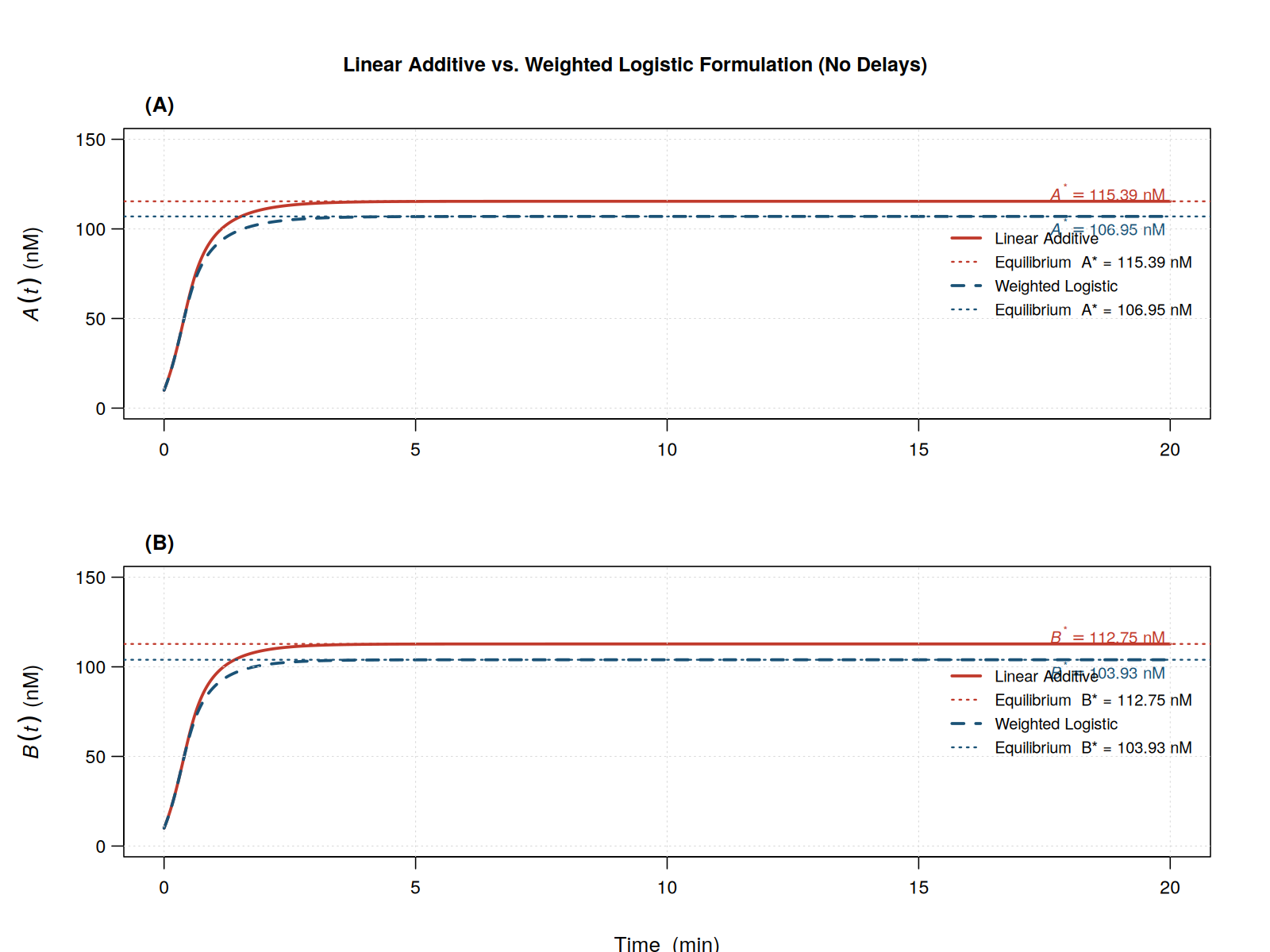
Figure 2: Comparison of the linear additive (solid lines) and weighted logistic (dashed lines) reformulations for proteins A (top, red) and B (bottom, blue) under delay-free dynamics, highlighting similar trajectories and the effect of activation saturation in the weighted logistic model.
At the computed steady states, the weighted logistic model exhibits equilibrium concentrations of (144.46,139.99)~nM for (A,B), while the linear additive model yields f+0~nM, with bounded activation accounting for the reduction. The logistic reformulation's basal regime is a direct structural consequence of the function, eliminating the need for ad hoc additive constants required by Hill functions.
Local Stability and Hopf Bifurcation Under Delays
For both reformulations, local asymptotic stability is proved in the absence of delay, with the Jacobian trace and determinant satisfying strict negativity and positivity, respectively, across all biologically relevant parameter regimes. The delayed system exhibits delay-induced Hopf bifurcation, with critical delays numerically determined from transcendental characteristic equations: f+1 min for linear additive and f+2 min for the weighted logistic reformulation. The increased critical delay in the weighted logistic system is attributed to reduced feedback strength at lower equilibrium concentrations, with both values residing within the plausible range for transcription-translation lags in prokaryotic and eukaryotic systems.
Lipschitz Analysis and Numerical Implications
The paper delivers explicit bounds for both global Lipschitz constant f+3 and Jacobian Lipschitz constant f+4. Replacing the linear additive activation with the weighted logistic form reduces f+5 from f+6 to f+7 (a 70% decrease) and f+8 from f+9 to f−0 (a 65% decrease). This directly improves the robustness, numerical conditioning, and step-size tolerance for ODE/DDE integrators, as standard explicit methods are inversely sensitive to these constants.
The logistic reformulation inherently guarantees f−1 smoothness, real-valuedness across the entire concentration axis (thus, no invalid complexification), and strictly positive outputs at zero input. In contrast, Hill functions with non-integer exponents yield diverging second derivatives as f−2, so their f−3 is formally infinite near the origin, which is avoided in the logistic formalism. The implication is a dramatic gain in analytical tractability and simulation reliability.
Biological and Modeling Consequences
The logistic framework aligns with biological evidence for nonzero basal gene expression, tunable independently of activation threshold or steepness, contrary to the inherent limitations of classical Hill models. The explicit construction for parameter identification based on observable kinetics offers robust pathways for mapping experimental data to model parameters. The flexibility in sigmoid placement and shape ensures adaptability to a wide range of synthetic and natural regulatory circuits, with direct implications for systems biology, synthetic biology, and control theory.
Moreover, by facilitating uniform and bounded derivatives throughout state space, this approach opens the possibility for advanced control theory methodologies, including feedback linearization and state observer synthesis, which are compromised in ill-conditioned or non-smooth systems.
Implications for Future Developments and AI
The analytic tractability and implementation rigor afforded by this reformulation suggest its utility in large-scale, automated analyses of GRNs, a central challenge for AI-guided systems biology. The boundedness, interpretability, and efficient identifiability of logistic parameters can streamline the optimization loop in machine-learning-driven modeling pipelines. Furthermore, the compatibility with gradient-based learning (enabled by global smoothness) is essential for coupling mechanistic models to AI-based parameter estimation and systems identification workflows.
Conclusion
The general logistic reformulation of delay-coupled gene regulatory networks achieves a significant advance in both mathematical rigor and computational reliability compared to traditional Hill function-based models. By addressing structural pathologies of Hill functions and providing a clear parameterization pipeline, the logistic approach ensures greater analytic stability, more accurate representation of biological nonlinearities (including nonzero basal rates and bounded activation), and superior performance in numerical simulations. The formal reduction in Lipschitz constants underscores practical improvements for simulation and control. Future directions include direct simulation of extreme dynamic behaviors, extension to more complex multicellular and stochastic settings, and integration with contemporary AI-driven systems biology frameworks for improved inference, prediction, and design of gene circuits.
(2604.26810)