- The paper achieves optical squeezing below shot noise by coupling two ground-state cooled oscillators with a high-finesse cavity.
- It utilizes balanced heterodyne detection and tomographic homodyne mapping to reveal non-Lorentzian spectral features driven by strong optomechanical coupling.
- Results indicate a 2% noise reduction, with prospects for enhanced squeezing through improved detection efficiency and advanced cavity configurations.
Context and Motivation
Levitated optomechanics has become a strategic platform for exploring quantum dynamics at the mesoscopic scale, combining high sensitivity with versatile manipulation of mechanical degrees of freedom. While separate achievements in ground-state cooling and ponderomotive squeezing have advanced the field, the intersection of these regimes — manifesting simultaneous quantum features in both mechanical and optical subsystems — remains insufficiently explored. This paper investigates optical squeezing below shot noise, mediated by optomechanical interaction with two center-of-mass modes of a silica nanosphere, both cooled well below unitary occupation, thus establishing direct evidence for quantum-coherent light-matter coupling in the strong hybridization regime.
Experimental Approach
The experimental realization utilizes an optical tweezer to trap a silica nanoparticle at the center of a high-finesse optical cavity, with the tweezer focus engineered as a slightly elliptical beam in the transverse plane at a 45-degree orientation relative to the cavity axis.
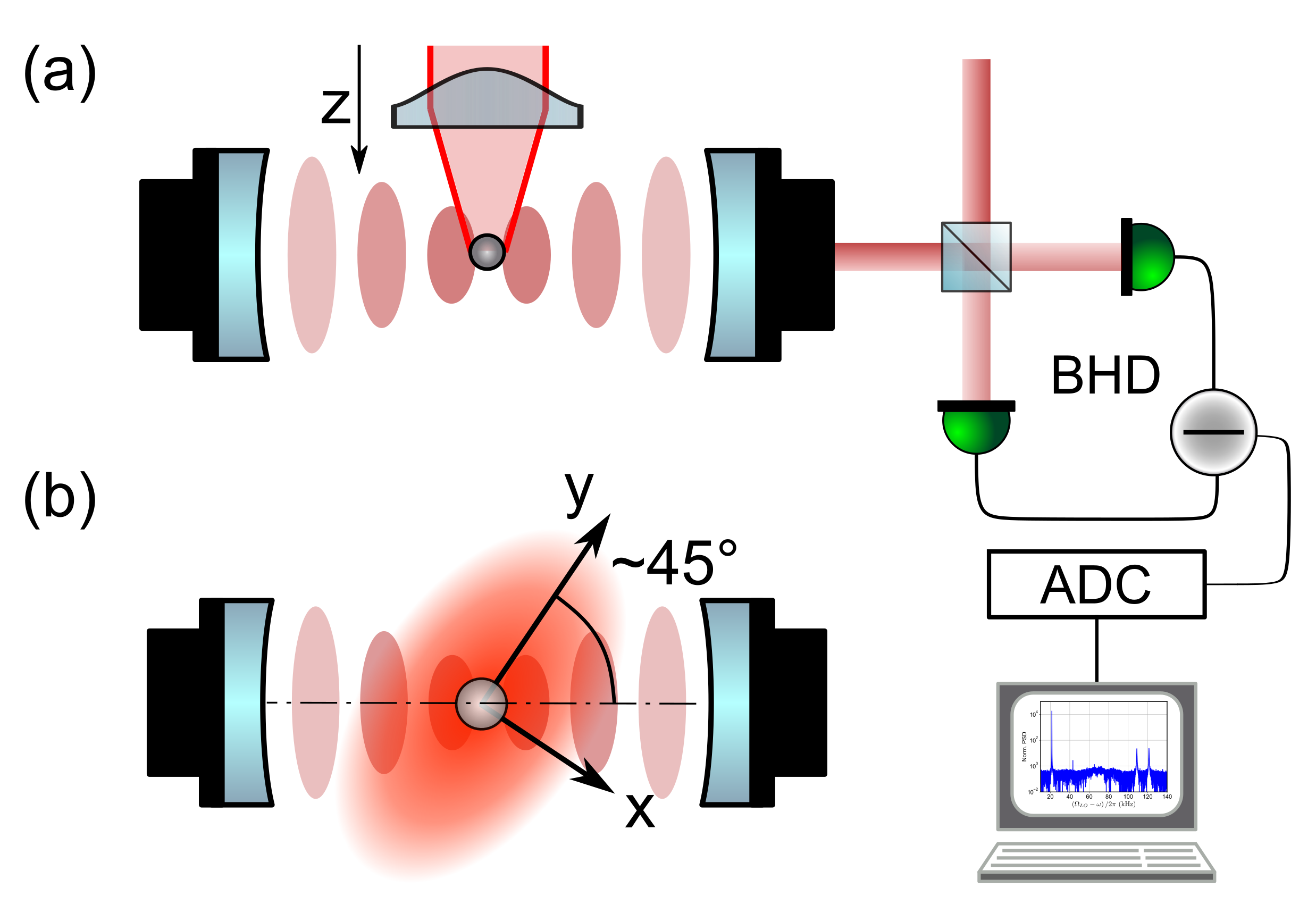
Figure 1: Pictorial representation of the experimental setup, including tweezer confinement, cavity positioning, and balanced heterodyne detection.
Across the transverse directions, the optical cavity is operated in the resolved sideband regime (κ≪Ωi), achieving ground-state cooling for both x and y oscillatory motion with mean occupation numbers nx=0.55 and ny=0.74. The output field is analyzed via balanced heterodyne detection, reconstructing quadrature fluctuations in post-processing to resolve the full covariance matrix VQP of the optical field.
Spectral Covariance Analysis
Balanced heterodyne spectroscopy combined with digital phase referencing enables full reconstruction of spectral correlations among all field quadratures. The measured power spectral densities (PSD), spanning both diagonal and off-diagonal elements, exhibit significant non-Lorentzian features attributed to optomechanical strong coupling and hybridization between optical and mechanical modes. Notably, discrepancies are observed in the off-diagonal PSDs, indicative of residual phase noise. Modeling this noise with a Gaussian distributed phase variance, σθ2, and fitting it exclusively as a free parameter, yields substantial improvement in model-experiment agreement with σθ2=0.062rad2.
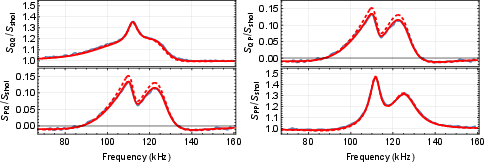
Figure 2: Spectral covariance matrix reconstructed via phase-sensitive analysis; experimental and theoretical PSD elements compared with and without phase noise.
Mapping of Sub-Shot-Noise Regions
A tomographic homodyne analysis provides a two-dimensional mapping of the optical quadrature spectrum as a function of detection phase and frequency. This protocol reveals distinct regions of sub-shot-noise fluctuations around 80 kHz and 150 kHz, separated by approximately π/2 in phase, which are corroborated by the theoretical model incorporating phase noise.
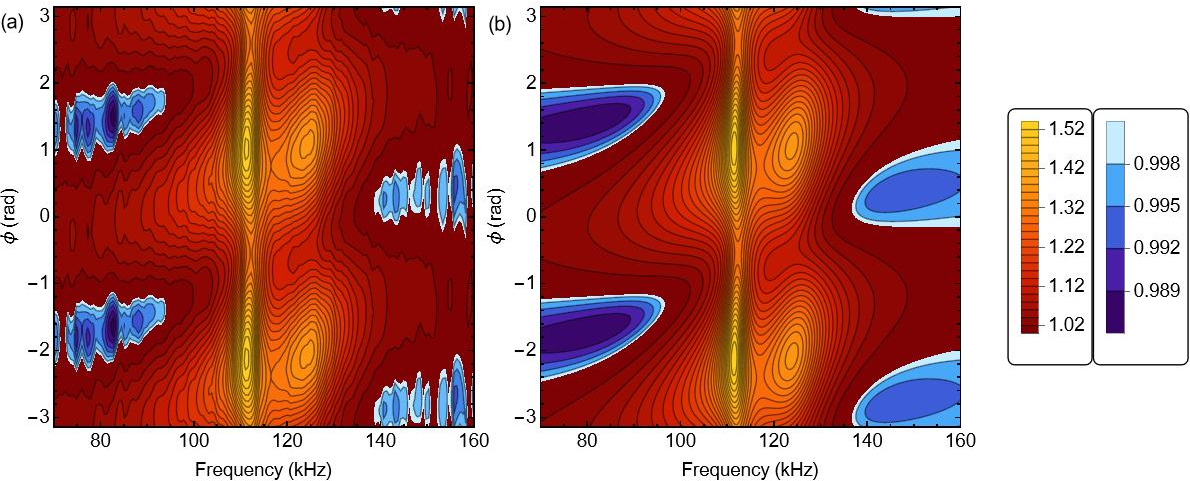
Figure 3: 2D map showing regions of optical squeezing, both in experimental reconstructions and model predictions, highlighting blue sub-vacuum domains.
Optimal Squeezing and Quantitative Results
By optimizing the detection phase at every frequency, the optimal squeezing spectrum S~Qopt(ω) is extracted. Experimental results reveal consistent squeezing in the 70–95 kHz band with minimum measured variance at 0.98 (2% below vacuum level). Model predictions with phase noise show negligible deviation in squeezed regions, while other frequencies exhibit increased noise contributions.
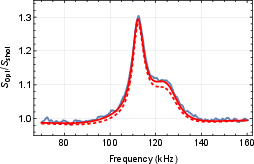
Figure 4: Optimal quadrature spectrum, demonstrating squeezing below shot noise; phase noise inclusion only impacts non-squeezed spectral domains.
Implications and Prospects
The demonstration of squeezing mediated by two mechanical oscillators both simultaneously cooled to their quantum ground states constitutes a substantive advance in cavity optomechanics. The observed degree of squeezing is limited by heating rates (primarily from residual gas collisions), overall detection efficiency, and cavity configuration. Back-tracing the available squeezing at unit detection efficiency would double the observed noise reduction, and further enhancement could be realized through single-ended cavity architectures and improved optical collection. Quantum non-demolition measurements and variational readout schemes may significantly amplify observable squeezing without incurring penalties from heterodyne detection inefficiencies.
Practically, this platform is poised for multimode quantum protocols including stationary entanglement, quantum state transfer, and quantum-enhanced sensing. The robust control over mechanical and optical quantum states demonstrated here illustrates the capacity for complex quantum resource generation, entanglement among mechanical subsystems, and quantum memory realization.
Conclusion
This study validates the capacity for optical squeezing below shot noise mediated by multiple mechanical oscillators both in their quantum ground state, with strong coupling and hybridization shaping the spectral properties of the optical field. The findings bridge quantum optics and quantum mechanical control, positioning levitated optomechanics as a highly relevant system for fundamental explorations of quantum mechanics at intermediate mass scales, and providing fertile ground for quantum communication, metrology, and entanglement protocols in future AI-driven quantum technologies.

