A New Location Estimator for Mixed LOS & NLOS scenarios
Published 29 Apr 2026 in eess.SP | (2604.26759v1)
Abstract: Time-of-arrival (TOA)-based localization in mixed line-of-sight (LOS) and non-line-of-sight (NLOS) environments is challenging because conventional Euclidean range models do not capture diffraction-dominated propagation. We show that the diffraction path-length model smoothly transitions between LOS and diffraction-dominated NLOS conditions, eliminating the need for explicit path classification. Although this model provides a unified geometric description of mixed LOS/NLOS propagation, the resulting 3D maximum-likelihood problem is nonconvex, and a direct Gauss--Newton estimator based on this model can converge to suboptimal local minima. This motivates the development of a class of structure-exploiting estimators. For known target height, the model induces a virtual-anchor representation of the reduced 2D problem, enabling estimators that exhibit a clear complexity--performance tradeoff: surrogate formulations provide structure and computational efficiency, while a semidefinite-relaxation formulation more faithfully preserves the original likelihood at higher cost. Building on this same structure, we develop 3D sample--polish--select estimators that reduce the global search to one dimension, solve the associated fixed-height 2D subproblems, and then apply local nonlinear refinement in 3D. The proposed estimators achieve near-Cramér--Rao lower bound (CRLB) performance with substantially lower complexity than multistart Gauss--Newton, while also being far more robust to initialization than a direct single-start Gauss--Newton estimator.
The paper introduces a unified diffraction-aware path model that eliminates the need for explicit LOS/NLOS discrimination in TOA localization.
It employs virtual-anchor embedding and efficient 2D/3D estimators that decouple the localization problem, achieving near-CRLB performance.
The proposed framework reduces computational complexity and seeding requirements, making it practical for real-time, large-scale deployments.
A Unified Diffraction Path Model for Robust TOA Localization in Mixed LOS/NLOS Scenarios
Introduction and Motivation
Time-of-arrival (TOA) localization in wireless networks is fundamentally impeded in mixed line-of-sight (LOS) and non-line-of-sight (NLOS) conditions due to propagation path uncertainty and model mismatch. In NLOS scenarios, TOA measurements are influenced by mechanisms such as reflection, transmission, scattering, and, more importantly, diffraction, causing severe deviations from the ideal Euclidean range model and leading to localization outliers. While early literature focused on NLOS path identification and removal, subsequent work exploited statistical models for NLOS bias mitigation. However, these approaches rely on explicit path classification or detailed prior information, which is difficult to obtain in practical deployments.
This paper—"A New Location Estimator for Mixed LOS & NLOS scenarios" (2604.26759)—introduces a structural framework for TOA-based localization based on a unified geometrical diffraction-aware path length model. This model seamlessly transitions between LOS and diffraction-dominated NLOS regimes and does not require explicit path labeling. The work presents both theoretical advances (notably, the virtual-anchor embedding) and practical estimation pipelines for robust 2D and 3D position estimation, achieving near-Cramér–Rao lower bound (CRLB) accuracy with significantly reduced computational complexity and improved robustness to initialization compared to standard multi-start iterative estimators.
Unified Diffraction Path Model and Virtual-Anchor Embedding
The core of the proposed framework is the adoption of a unified LOS/NLOS path-length model that geometrically subsumes both direct LOS propagation and edge diffraction, with a smooth transition as a function of the anchor-target configuration:
The model for the k-th anchor at position Ak=[xk,yk,zk]T and target at X=[x,y,z]T is
pk(X)=(xk−x)2+(yk2+(zk−z)2+y)2
which collapses to the LOS Euclidean distance when the anchor and target are coplanar.
This formulation eliminates the need for explicit LOS/NLOS discrimination (as required by statistical NLOS bias frameworks) and provides an analytically tractable structure for both inference and algorithmic acceleration.
Leveraging the path model’s separability, the localization task is decoupled into:
2D localization with respect to horizontal coordinates at a fixed height z,
An efficient 1D search over plausible target heights.
A mathematical consequence is the virtual-anchor representation: for each anchor, the measurement model is isometric to a Euclidean ranging model in a "virtual plane" induced by the known height, yielding
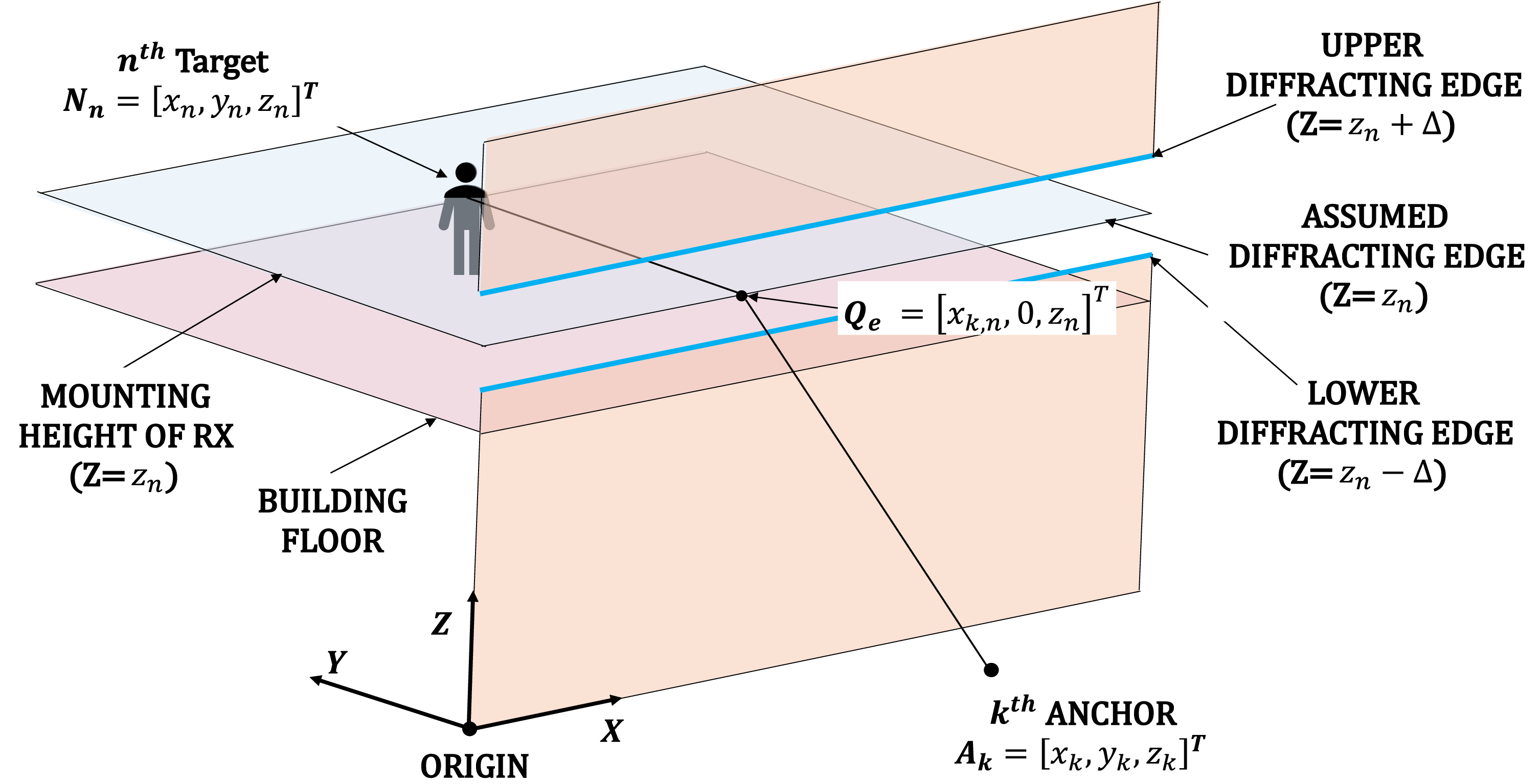
Figure 1: In the O2I scenario, K anchors transmit orthogonal signals; the n‑th target receives segregated paths, including the distinctive diffraction path producing the observed TOA.
2D Localization: Structure-Exploiting Estimators
For known height, the target location reduces to X2D=[x,y]T, and each anchor induces a 2D "virtual" anchor through a transformation. The unified path model allows the reduction of the nonconvex ML estimation into several tractable surrogate or relaxed problems:
Squared-Range Least Squares (SR-LS) via GTRS: The 2D problem is formulated as a Generalized Trust Region Subproblem (GTRS), leveraging lifted variables and quadratic equality constraints. The solution is globally optimal for the SR-LS surrogate, computed efficiently via a root-finding procedure on the KKT dual parameter.
Unconstrained Squared-Ranges (USR): If the quadratic constraint in GTRS is relaxed, the problem reduces to a weighted linear least squares (WLLS). The computational advantage is substantial, but it sacrifices constraint consistency.
Semidefinite Relaxation (SDR): The exact ML objective is embedded in a lifted positive semidefinite matrix variable, relaxing the nonconvex rank-1 constraint to obtain a convex SDP. This method is more statistically faithful but has higher computational overhead due to matrix variable scaling with O(K2).
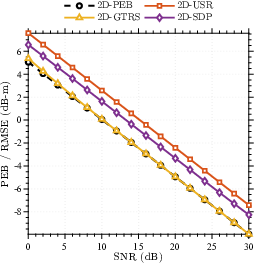
Monte Carlo results clarify the complexity-accuracy tradeoffs. Notably, the GTRS-based estimator asymptotically attains the CRLB at moderate SNR, outperforming the USR and SDR variants.
Figure 2: 2D-RMSE versus SNR comparison: GTRS rapidly attains the CRLB, SDR is close but suboptimal, and USR lags due to its relaxation-induced approximation error.
Profiled 3D Estimation: Sample–Polish–Select
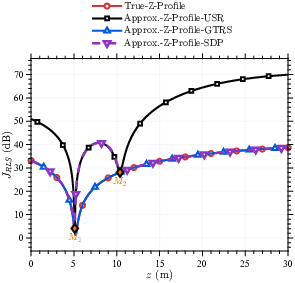
The 3D localization problem, being nonconvex due to the nested square-root dependence of the path model, is reformulated as a 1D profiling task over z:
For each candidate Ak=[xk,yk,zk]T0, the horizontal location is estimated via the 2D solver, yielding a "profiled" cost as a function of Ak=[xk,yk,zk]T1 (“Ak=[xk,yk,zk]T2-profile”).
A grid search (sample) is used over possible Ak=[xk,yk,zk]T3 samples, using the 2D subproblem solution for each sample.
Each Ak=[xk,yk,zk]T4 initializer is polished by a few Gauss-Newton (GN) iterations directly on the original R-LS ML cost.
The solution with the best ML residual is selected as the final estimate.
This approach mitigates the sensitivity to initialization inherent to iterative solvers and avoids the curse-of-dimensionality present in multi-start strategies that seed the full 3D search space.
The Ak=[xk,yk,zk]T5-profile analysis and the experiments reveal that faithfulness of the 2D inner solver primarily impacts seeding quality. Post-polish, both the GTRS and USR-based pipelines achieve near-CRLB accuracy, though GTRS is slightly more robust with fewer seeds.
Figure 3: The ML objective (“Ak=[xk,yk,zk]T6-profile”) versus target height. GTRS-based 2D solutions closely track the global minimum, whereas USR and SDR deviate—yet all yield effective seeds for final 3D GN polish.
3D Algorithmic Benchmarking and Results
Numerical evaluation compares:
The proposed sample–polish–select schemes (3D-GTRS, 3D-USR)
Multi-start 3D Gauss–Newton (3D-MS-GN) over a grid in Ak=[xk,yk,zk]T7
The D-NLS baseline (single-start specialized GN)
The CRLB bound
Key findings are:
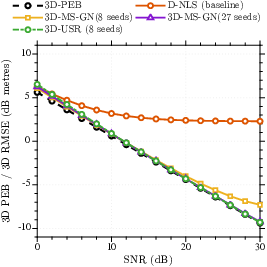
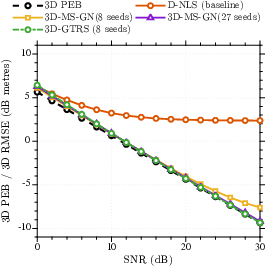
3D-GTRS and 3D-USR achieve near-CRLB accuracy using only Ak=[xk,yk,zk]T8 seeds in the height dimension, with minimal additional 3D refinement steps.
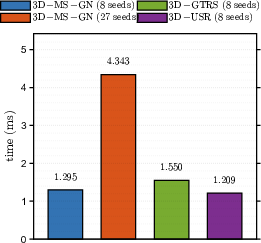
Multi-start 3D-GN requires Ak=[xk,yk,zk]T9 seeds for comparable performance but at %%%%20pk(X)=(xk−x)2+(yk2+(zk−z)2+y)221%%%% computational cost.
D-NLS is highly susceptible to local minima and fails to approach CRLB.
Figure 4: 3D-RMSE versus SNR: 3D-USR and 3D-GTRS attain the CRLB with 8 seeds; 3D-MS-GN requires 27 seeds for similar performance, D-NLS is suboptimal.
Furthermore, timing analysis underscores that the 1D seeding enabled by the diffraction model and virtual-anchor reduction yields a marked practical reduction in compute time for comparable estimator performance.
Figure 5: Timing comparison for 3D estimators: 3D-USR and 3D-GTRS are computationally efficient compared to 3D-MS-GN with high seed count; 2D surrogates require negligible computational resources compared to SDP.
Theoretical and Practical Implications
This work provides the following advances:
Theoretical: It demonstrates that robust and efficient 3D localization is attainable in generic TOA settings without explicit path-type labeling by modeling underlying physical propagation (e.g., diffraction).
Practical: The virtual-anchor and profiled estimator structure allows deployment in large-scale, real-time localization systems—particularly in public safety scenarios—without the need for anchor–target floor plan annotation or visibility maps.
Notably, the framework generalizes seamlessly to ultra-wideband (UWB) localization contexts with resolvable multi-paths and to mmWave systems, where diffraction dominates O2I propagation.
Future Directions
Future work may extend to:
Data-driven hybridization with multipath fingerprinting,
Adaptive seeding strategies using uncertainty quantification,
Distributed anchor cooperation and online anchor deployment optimization for improved coverage and robustness,
Generalization to settings with jointly unknown environment geometries and simultaneous mapping.
Conclusion
A unified diffraction path-based localization estimator is introduced for mixed LOS/NLOS environments. The synthesis of virtual-anchor embedding and structure-exploiting 2D/3D algorithms yields robust, near-CRLB accuracy at substantially reduced computational complexity, obviating the need for explicit path-type classification and expensive 3D seeding strategies. This framework provides both deep theoretical insight and practical means to unlock high-accuracy, scalable localization in physically obstructed, cluttered settings.